Complaint Waived File For Divorce In California
Description





Get your form ready online
Our built-in tools help you complete, sign, share, and store your documents in one place.
Make edits, fill in missing information, and update formatting in US Legal Forms—just like you would in MS Word.
Download a copy, print it, send it by email, or mail it via USPS—whatever works best for your next step.
Sign and collect signatures with our SignNow integration. Send to multiple recipients, set reminders, and more. Go Premium to unlock E-Sign.
If this form requires notarization, complete it online through a secure video call—no need to meet a notary in person or wait for an appointment.
We protect your documents and personal data by following strict security and privacy standards.
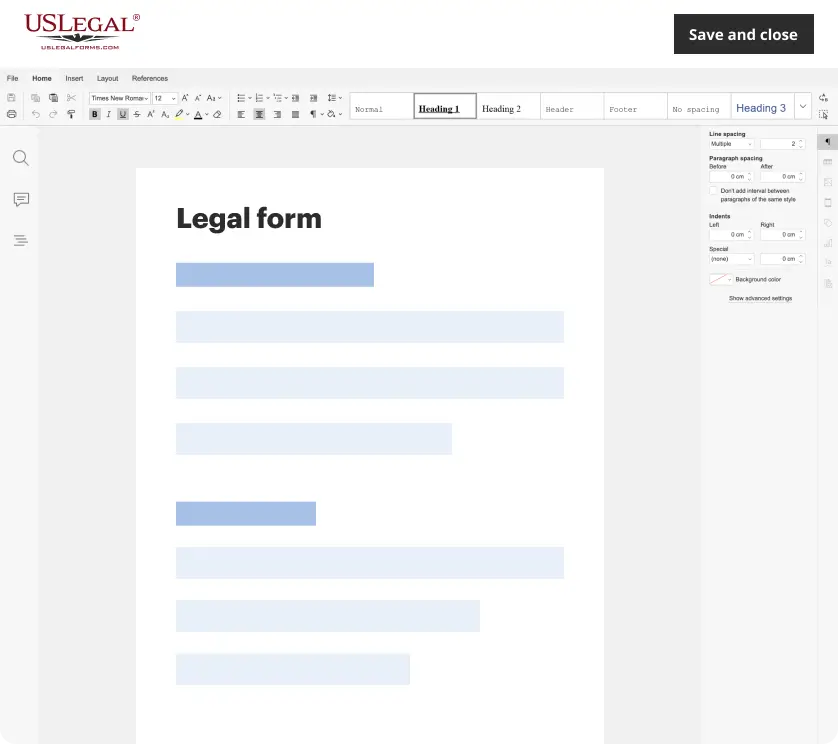
Make edits, fill in missing information, and update formatting in US Legal Forms—just like you would in MS Word.
Download a copy, print it, send it by email, or mail it via USPS—whatever works best for your next step.
Sign and collect signatures with our SignNow integration. Send to multiple recipients, set reminders, and more. Go Premium to unlock E-Sign.
If this form requires notarization, complete it online through a secure video call—no need to meet a notary in person or wait for an appointment.
We protect your documents and personal data by following strict security and privacy standards.
Looking for another form?

Form popularity
FAQ
Stay calm. Talk to your spouse. Try to understand what made your spouse come to this decision. Talk about how you will pace yourselves as you move toward divorce. Consider nesting for a period of time if you have children. Discuss a non-adversarial process. Accept and let go.
If one spouse fails or refuses to sign, the other will lose all legal protections under the law. Ignoring divorce documents won't prevent the divorce from happening; it will, however, prevent you from having any say in important issues like child custody, alimony, and property distribution.
Under California's no-fault divorce laws, neither spouse has an absolute right to deny the other's request for divorce. Contesting specific divorce terms may be possible, but the dissolution itself cannot be refused. The court will grant the divorce decree after the mandatory waiting period expires.
In California, only one spouse needs to request the divorce to start the process, meaning your refusal to sign or participate won't prevent it. However, it may complicate the proceedings, leading to a default judgment, where the court can grant the divorce without your input.
If you don't file a response within 30 days of getting the Petition form, your spouse or domestic partner can ask for a default. If there's a default, the court won't let you file a response and can decide the case without you. If it's been more than 30 days, check with the court to see if your spouse got a default.
In general, it takes at least six months to get a divorce in California, even if it is uncontested, due to a required 6-month waiting period. Nationwide, contested divorces take at least several months to over a year to get finalized.
Under California's no-fault divorce laws, neither spouse has an absolute right to deny the other's request for divorce. Contesting specific divorce terms may be possible, but the dissolution itself cannot be refused. The court will grant the divorce decree after the mandatory waiting period expires.
In California, you get a divorce by starting a court case. No one has to prove someone did something wrong to cause the divorce (this is called no fault divorce). You can get a divorce even if the other person doesn't want one. You can divorce to end a marriage or domestic partnership.
California has no specific limit on how long a spouse may drag out your divorce, but the court has some mechanisms in place to deal with uncooperative spouses. This typically involves issuing court orders to ensure divorce cases progress in a timely manner.
Having an experienced California divorce lawyer on your side will not only speed up your divorce but also take a bit of stress out of the process. While a divorce can take time, there are ways to speed up the process. An uncontested divorce is the quickest end to a marriage partnership in the state of California.
