Tx Correction Deed Online Without A Lawyer
Description

Get your form ready online
Our built-in tools help you complete, sign, share, and store your documents in one place.
Make edits, fill in missing information, and update formatting in US Legal Forms—just like you would in MS Word.
Download a copy, print it, send it by email, or mail it via USPS—whatever works best for your next step.
Sign and collect signatures with our SignNow integration. Send to multiple recipients, set reminders, and more. Go Premium to unlock E-Sign.
If this form requires notarization, complete it online through a secure video call—no need to meet a notary in person or wait for an appointment.
We protect your documents and personal data by following strict security and privacy standards.

Make edits, fill in missing information, and update formatting in US Legal Forms—just like you would in MS Word.

Download a copy, print it, send it by email, or mail it via USPS—whatever works best for your next step.

Sign and collect signatures with our SignNow integration. Send to multiple recipients, set reminders, and more. Go Premium to unlock E-Sign.

If this form requires notarization, complete it online through a secure video call—no need to meet a notary in person or wait for an appointment.

We protect your documents and personal data by following strict security and privacy standards.
Looking for another form?



How to fill out Texas Correction Warranty Deed?
Regardless of whether it is for corporate reasons or personal matters, everyone must handle legal issues at some point in their lives.
Completing legal paperwork demands meticulous attention, starting with choosing the appropriate form template. For instance, if you choose an incorrect version of the Tx Correction Deed Online Without A Lawyer, it will be rejected upon submission.
With an extensive catalog from US Legal Forms available, you do not need to waste time searching for the correct template online. Utilize the library’s straightforward navigation to find the suitable template for any circumstance.
- Obtain the template you require by utilizing the search field or browsing the catalog.
- Review the form’s details to verify it aligns with your circumstances, state, and area.
- Select the form’s preview to examine it.
- If it is not the correct form, return to the search function to find the Tx Correction Deed Online Without A Lawyer template you require.
- Acquire the file if it satisfies your requirements.
- If you already possess a US Legal Forms account, click Log in to access previously stored documents in My documents.
- In case you do not yet have an account, you can obtain the form by clicking Buy now.
- Select the appropriate pricing option.
- Fill out the profile registration form.
- Choose your payment method: a credit card or PayPal account can be used.
- Select the desired file format and download the Tx Correction Deed Online Without A Lawyer.
- Once downloaded, you can complete the form using editing software or print it out and fill it in manually.
Form popularity
FAQ
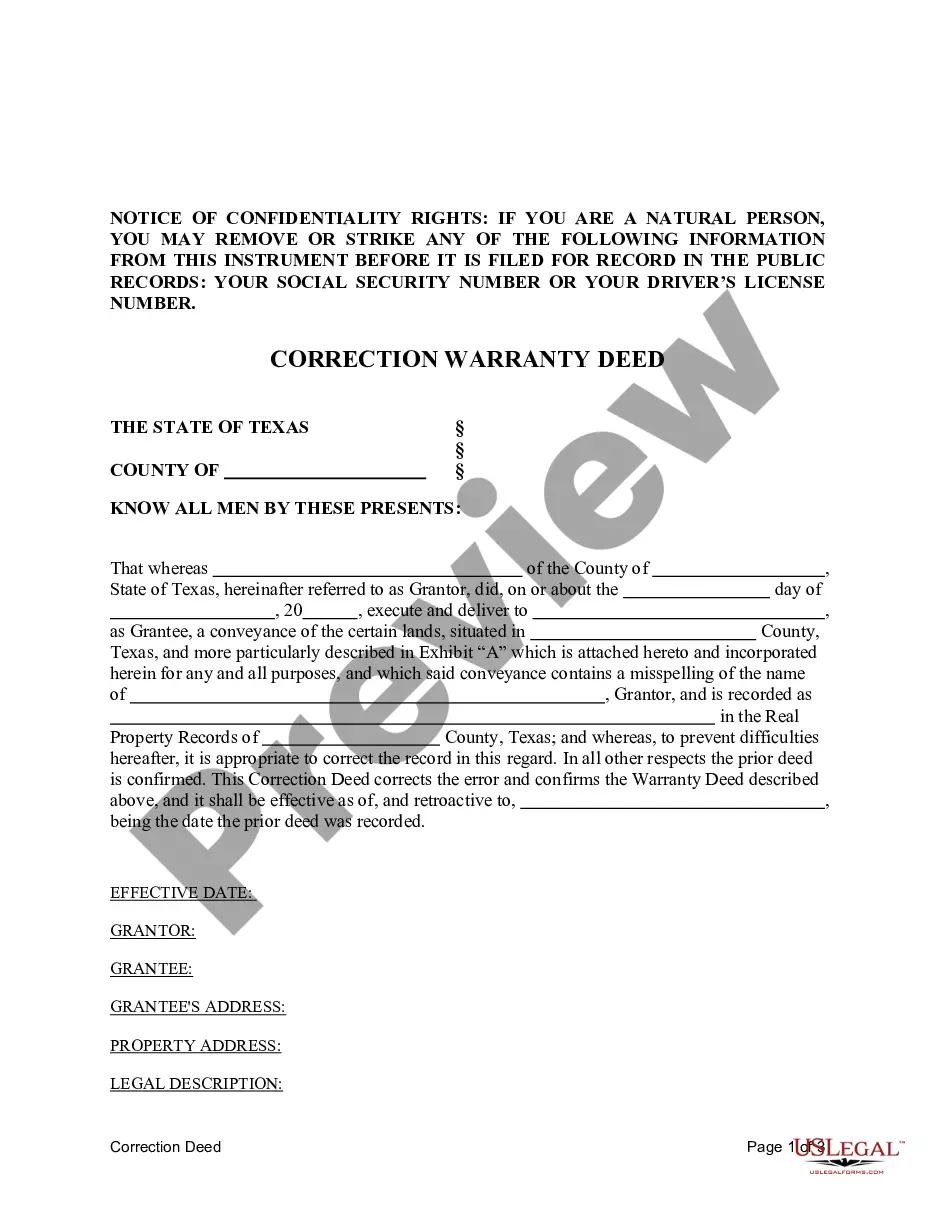
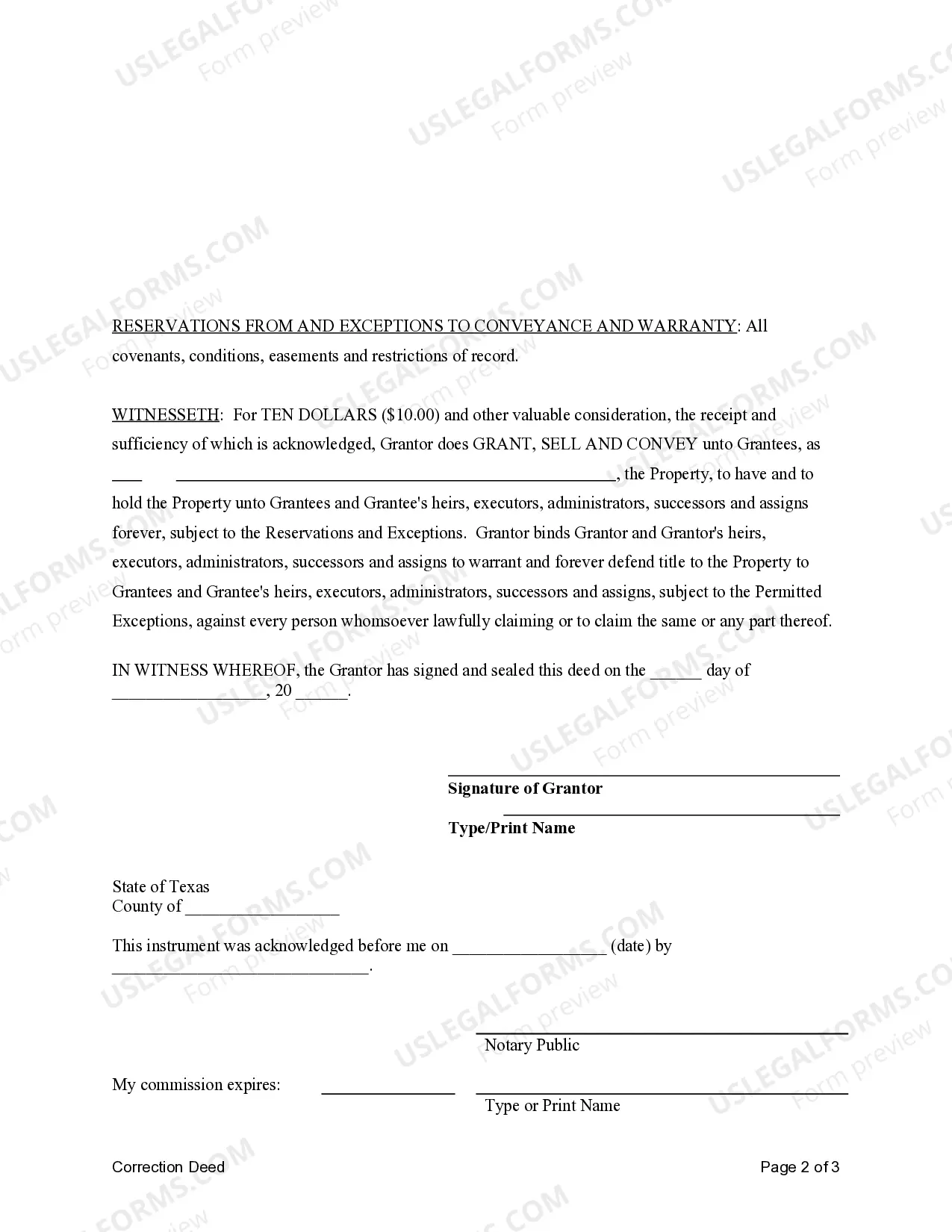
A correction deed, also known as a confirmatory or corrective deed, is a legal document used to fix errors on a property title that is recorded. Property owners can use this special type of deed to amend common errors such as misspellings, incomplete names, and other missing information.
Generally, all parties who signed the prior deed must sign the correction deed in the presence of a notary, who will acknowledge its execution. Then record it in the country court records system to make it valid.
Scrivener's Affidavits are sworn statements by the person who drafted a deed. Unlike a Corrective Deed, a Scrivener's Affidavit doesn't correct anything. Instead, it simply adds information to the property records to help clarify something about the prior deed.
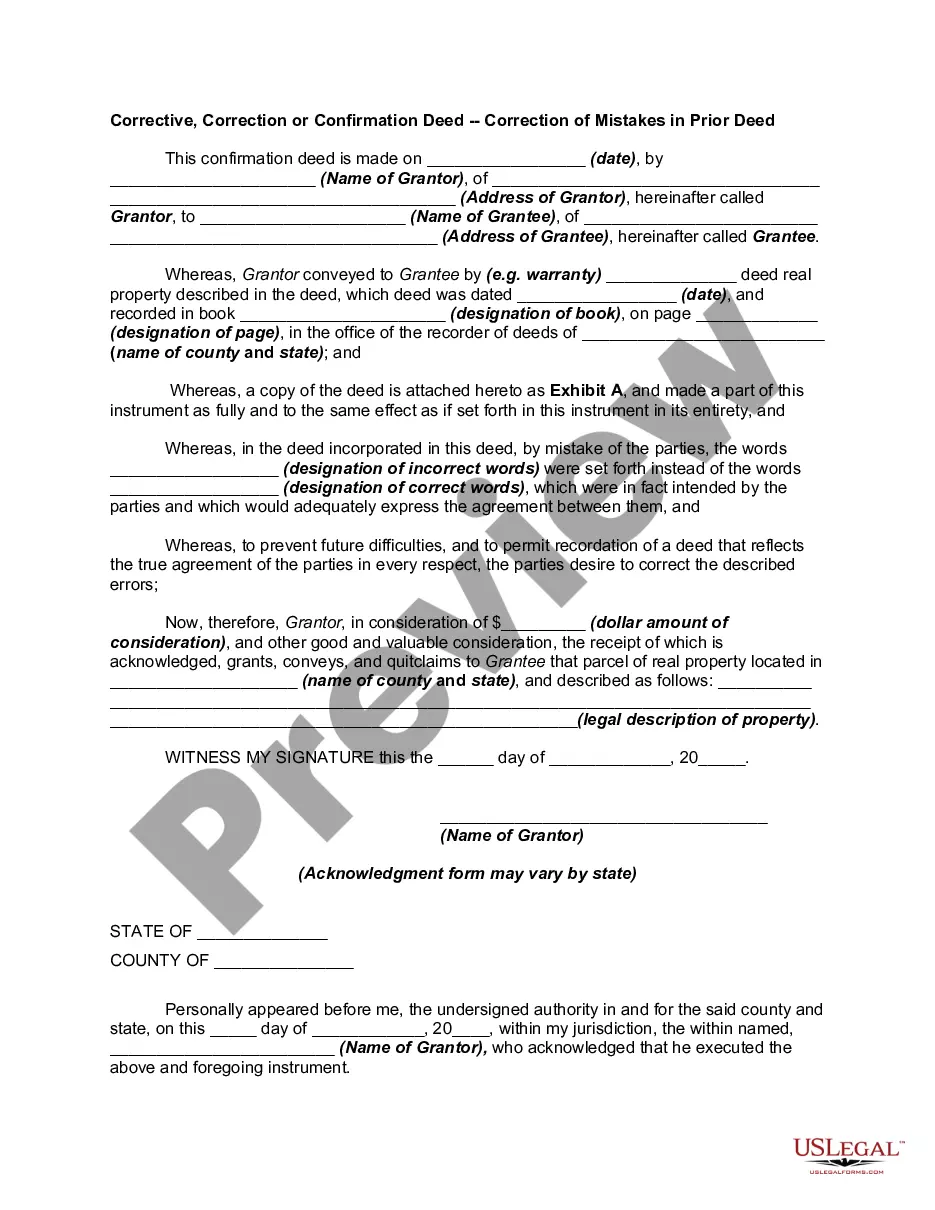
You might also hear the terms corrective or confirmatory deed used interchangeably. You can use this special type of deed to make amendments to common, minimal errors such as misspellings, typos, missing information, and incomplete names.
It is important to remember that although Section 5.028 only requires a correction deed making nonmaterial changes to be executed by a person who has personal knowledge of facts relevant to the correction, Section 5.029 requires correction deeds making material changes to be executed by all parties to the original ...