Texas Intestate Succession With Foreigners
Description

Get your form ready online
Our built-in tools help you complete, sign, share, and store your documents in one place.
Make edits, fill in missing information, and update formatting in US Legal Forms—just like you would in MS Word.
Download a copy, print it, send it by email, or mail it via USPS—whatever works best for your next step.
Sign and collect signatures with our SignNow integration. Send to multiple recipients, set reminders, and more. Go Premium to unlock E-Sign.
If this form requires notarization, complete it online through a secure video call—no need to meet a notary in person or wait for an appointment.
We protect your documents and personal data by following strict security and privacy standards.

Make edits, fill in missing information, and update formatting in US Legal Forms—just like you would in MS Word.

Download a copy, print it, send it by email, or mail it via USPS—whatever works best for your next step.

Sign and collect signatures with our SignNow integration. Send to multiple recipients, set reminders, and more. Go Premium to unlock E-Sign.

If this form requires notarization, complete it online through a secure video call—no need to meet a notary in person or wait for an appointment.

We protect your documents and personal data by following strict security and privacy standards.
Looking for another form?


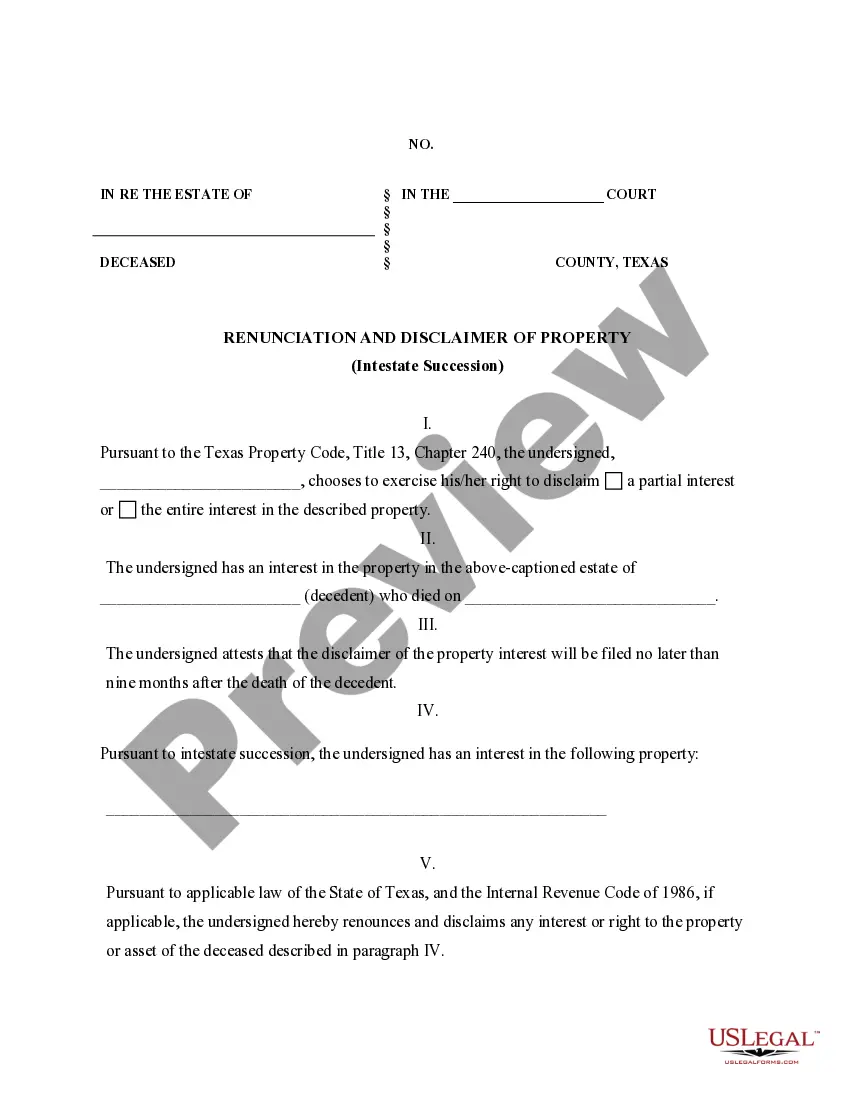
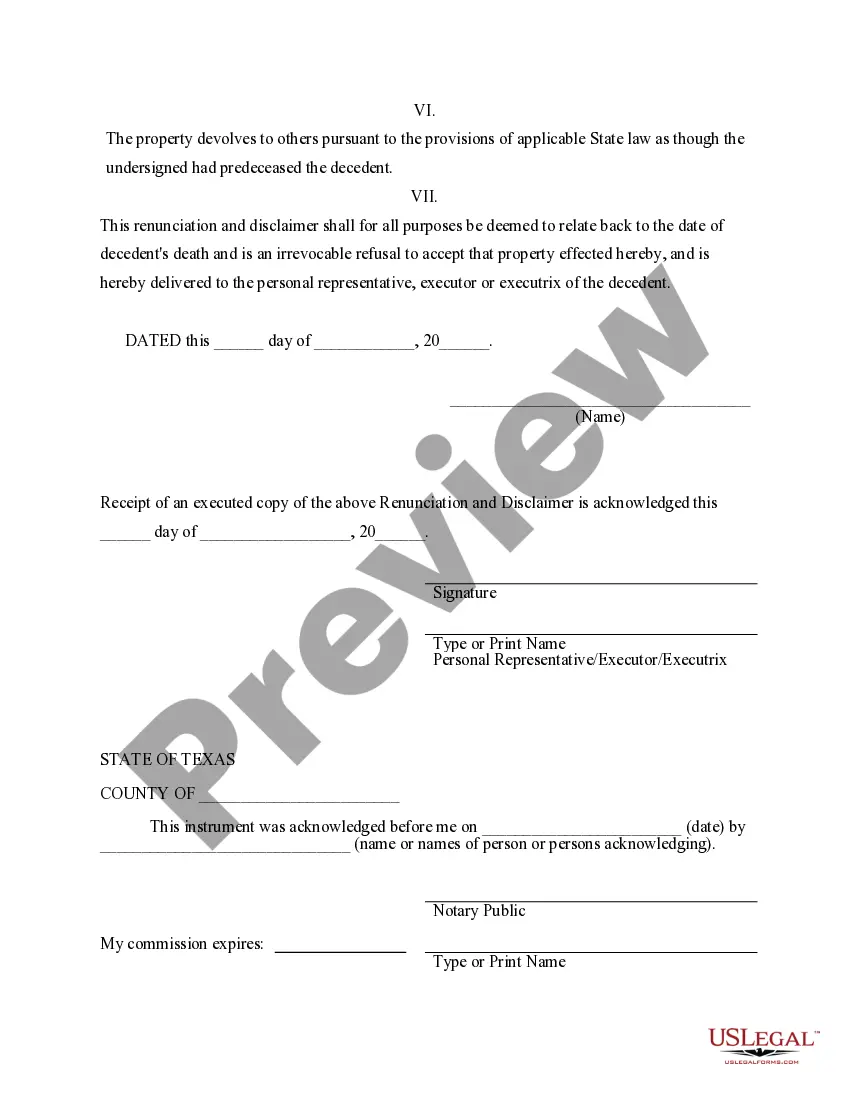
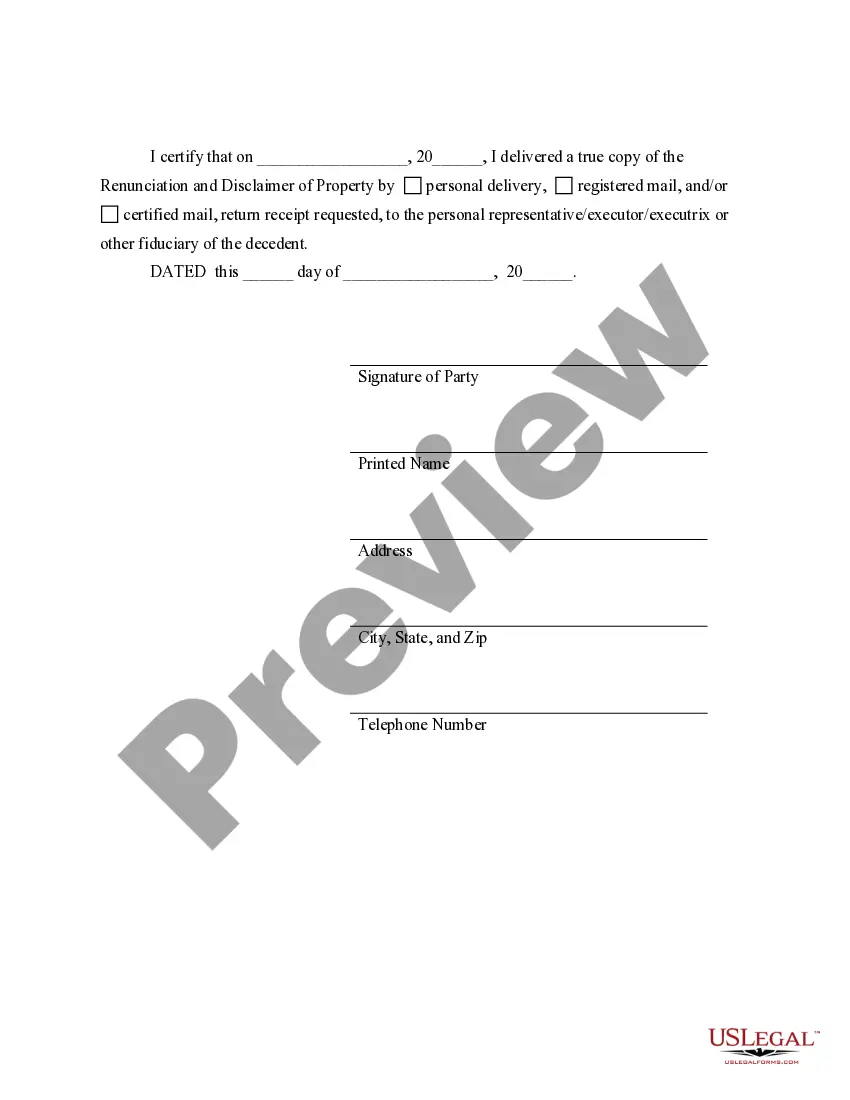
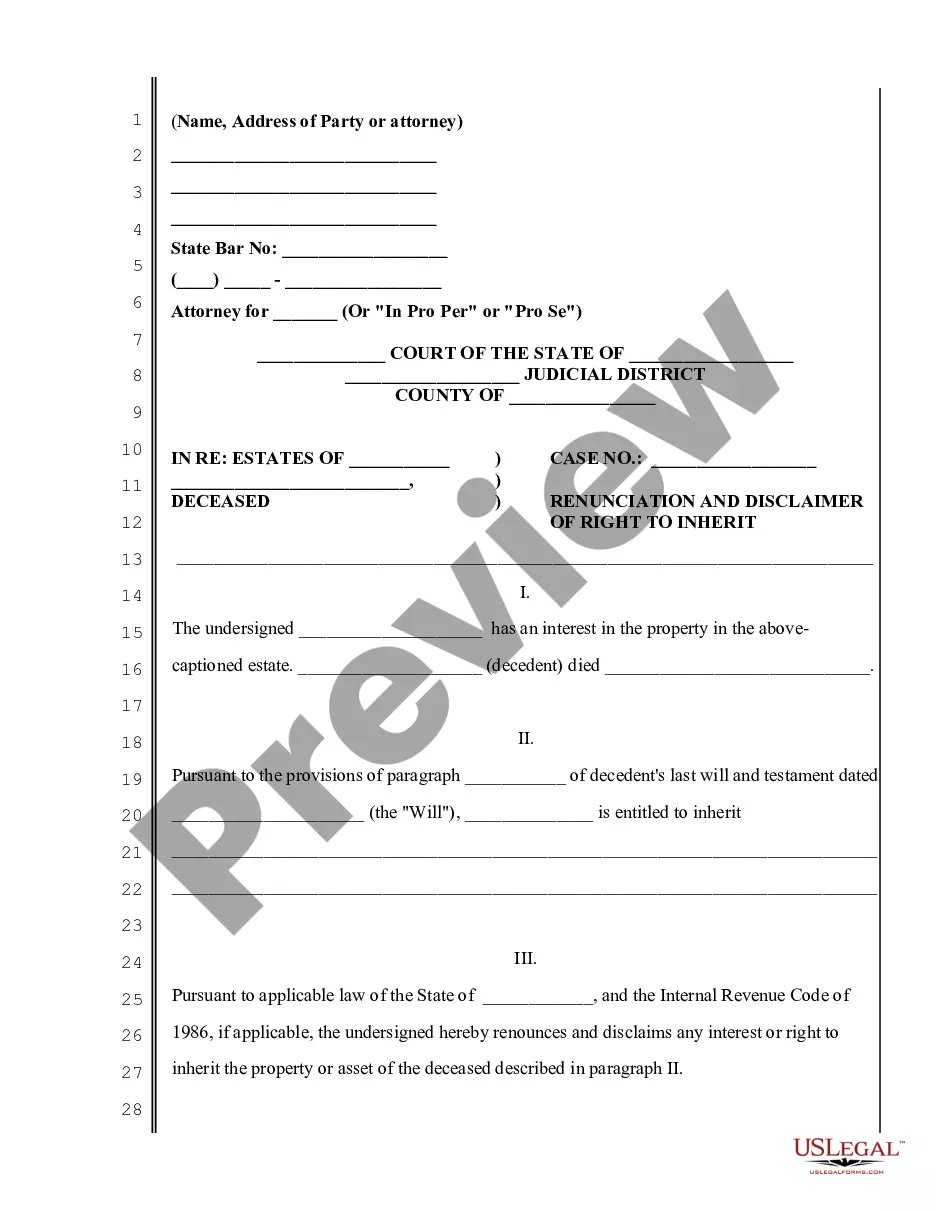
How to fill out Texas Renunciation And Disclaimer Of Property Received By Intestate Succession?
- If you are a returning user, log into your account. Confirm your subscription is active, or renew it based on your payment plan.
- For new users, start by inspecting the Preview mode and the form description. Make sure you select the correct form that meets your legal needs and adheres to local jurisdiction requirements.
- Utilize the Search tab to locate additional templates if necessary. If you find any discrepancies, ensure you have the appropriate form before proceeding.
- Purchase the document by clicking the Buy Now button. Choose a subscription plan that fits your needs, and register an account for full access to the library.
- Complete your payment by entering your credit card information or using your PayPal account to finalize the subscription.
- Download the form to your device. You can find your purchased document anytime in the My Forms section of your profile.
By following these steps, you'll have access to US Legal Forms' extensive library of over 85,000 legal documents, making it easier to handle Texas intestate succession with foreigners.
Take control of your legal documentation today and ensure your forms are precise and compliant. Visit US Legal Forms to get started!
Form popularity
FAQ
Per stirpes and per capita are two distinct methods of distributing an estate. Per stirpes distributes assets based on family branches, ensuring each branch receives an equal share. Conversely, Texas uses a per capita method, where each heir gets an equal portion, regardless of family ties. Understanding these terms is key for foreign heirs navigating Texas intestate succession with foreigners to ensure fair and equitable distribution.
The recent inheritance law in Texas focuses on simplifying the probate process and clarifying rights for heirs. It aims to streamline the distribution of assets for intestate estates, especially when dealing with claims from foreign heirs. Being aware of this law can provide peace of mind for those involved in Texas intestate succession with foreigners. For further assistance, consider using platforms like USLegalForms to navigate these new regulations.
States like California, Florida, and New York utilize the per stirpes method for distributing estates. In this approach, heirs inherit their deceased parent’s share, ensuring family branches remain intact. This is in contrast to Texas, which employs a per capita method. Understanding these differences is important when engaging with Texas intestate succession with foreigners, as it affects how estates are divided across state lines.
Yes, Texas recognizes foreign probate, allowing for the administration of estates probated outside the U.S. This recognition can be particularly beneficial for foreigners involved in Texas intestate succession. If a foreigner holds assets in Texas, understanding how foreign probate works can simplify the settling of estates. Resources like USLegalForms can assist in navigating these processes effectively.
Texas follows a per capita distribution method without representation for intestate succession. This means that each legal heir receives an equal share of the estate, regardless of their family branch. It is vital to comprehend this method, especially when dealing with multiple heirs, including foreigners, to prevent confusion during the distribution process. Knowledge of these rules aids in efficiently managing Texas intestate succession with foreigners.
In Texas, the legal next of kin includes the deceased person's spouse, children, parents, siblings, and other close relatives. If a person dies without a will, Texas intestate succession laws determine how their estate is divided. It is essential to establish the next of kin, especially in cases involving foreigners, to ensure proper handling of the estate. Understanding this legal framework is crucial for those navigating Texas intestate succession with foreigners.
Typically, an affidavit of heirship is prepared by a family member or a close friend of the deceased who is familiar with the family's dynamics. In some cases, legal professionals may assist in drafting the document to ensure compliance with Texas laws surrounding intestate succession with foreigners. Utilizing platforms like UsLegalForms can help simplify this process, providing ready-to-use templates and guidance for legal accuracy.
The affiant in an affidavit of heirship in Texas is the person providing the information about the deceased and the heirs. This individual should have personal knowledge of the family's circumstances and relationships. Their testimony is vital in establishing the heirs under Texas intestate succession with foreigners, making it essential that the affiant is reliable.
Completing an affidavit of heirship requires clear documentation of the deceased's family tree and the heirs. You will list heirs in order of their entitlement under Texas intestate succession with foreigners. It is important to gather accurate information to help prevent disputes and ensure a smooth transfer of assets.
To fill out an affidavit of inheritance, start by collecting essential information about the estate and the rightful heirs. You must provide the names and details of all individuals who inherit under Texas intestate succession with foreigners. Ensure you sign the document in front of a notary to validate the affidavit, as this step is crucial for legal recognition.