Pay Employee Law With Holiday
Description
Get your form ready online
Our built-in tools help you complete, sign, share, and store your documents in one place.
Make edits, fill in missing information, and update formatting in US Legal Forms—just like you would in MS Word.
Download a copy, print it, send it by email, or mail it via USPS—whatever works best for your next step.
Sign and collect signatures with our SignNow integration. Send to multiple recipients, set reminders, and more. Go Premium to unlock E-Sign.
If this form requires notarization, complete it online through a secure video call—no need to meet a notary in person or wait for an appointment.
We protect your documents and personal data by following strict security and privacy standards.

Make edits, fill in missing information, and update formatting in US Legal Forms—just like you would in MS Word.

Download a copy, print it, send it by email, or mail it via USPS—whatever works best for your next step.

Sign and collect signatures with our SignNow integration. Send to multiple recipients, set reminders, and more. Go Premium to unlock E-Sign.

If this form requires notarization, complete it online through a secure video call—no need to meet a notary in person or wait for an appointment.

We protect your documents and personal data by following strict security and privacy standards.
Looking for another form?


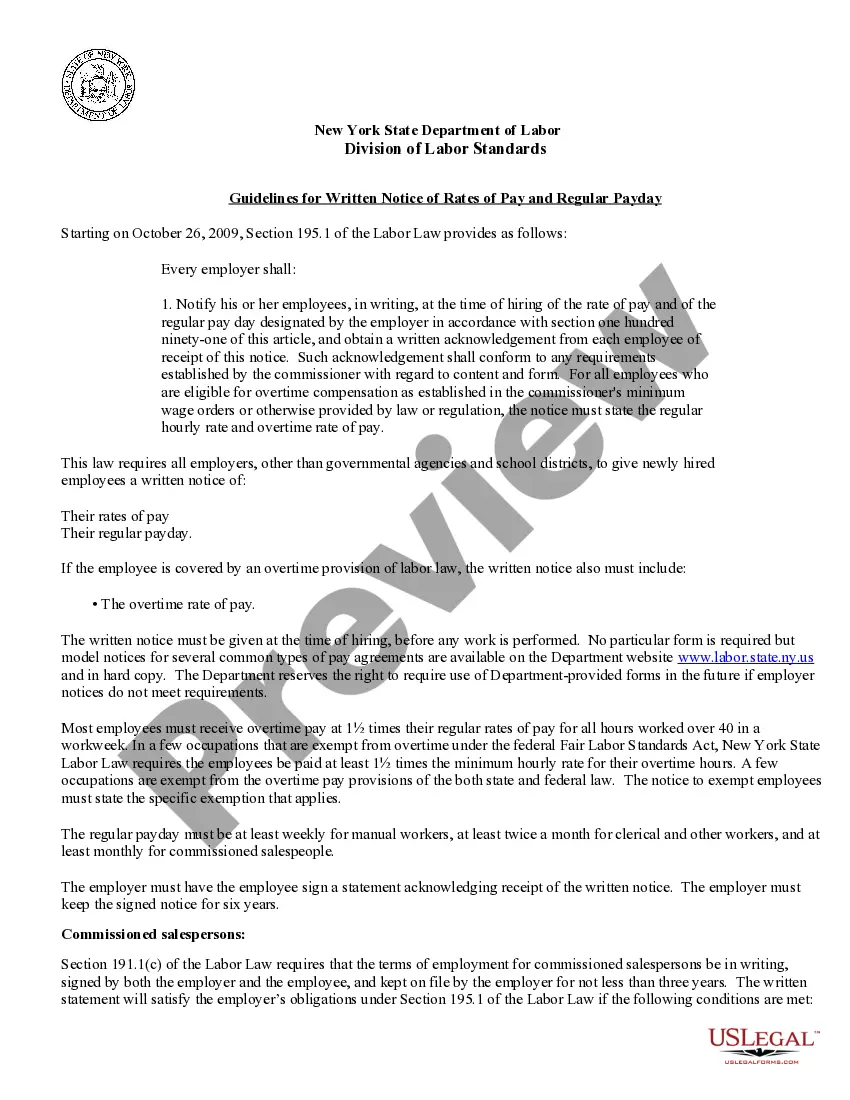
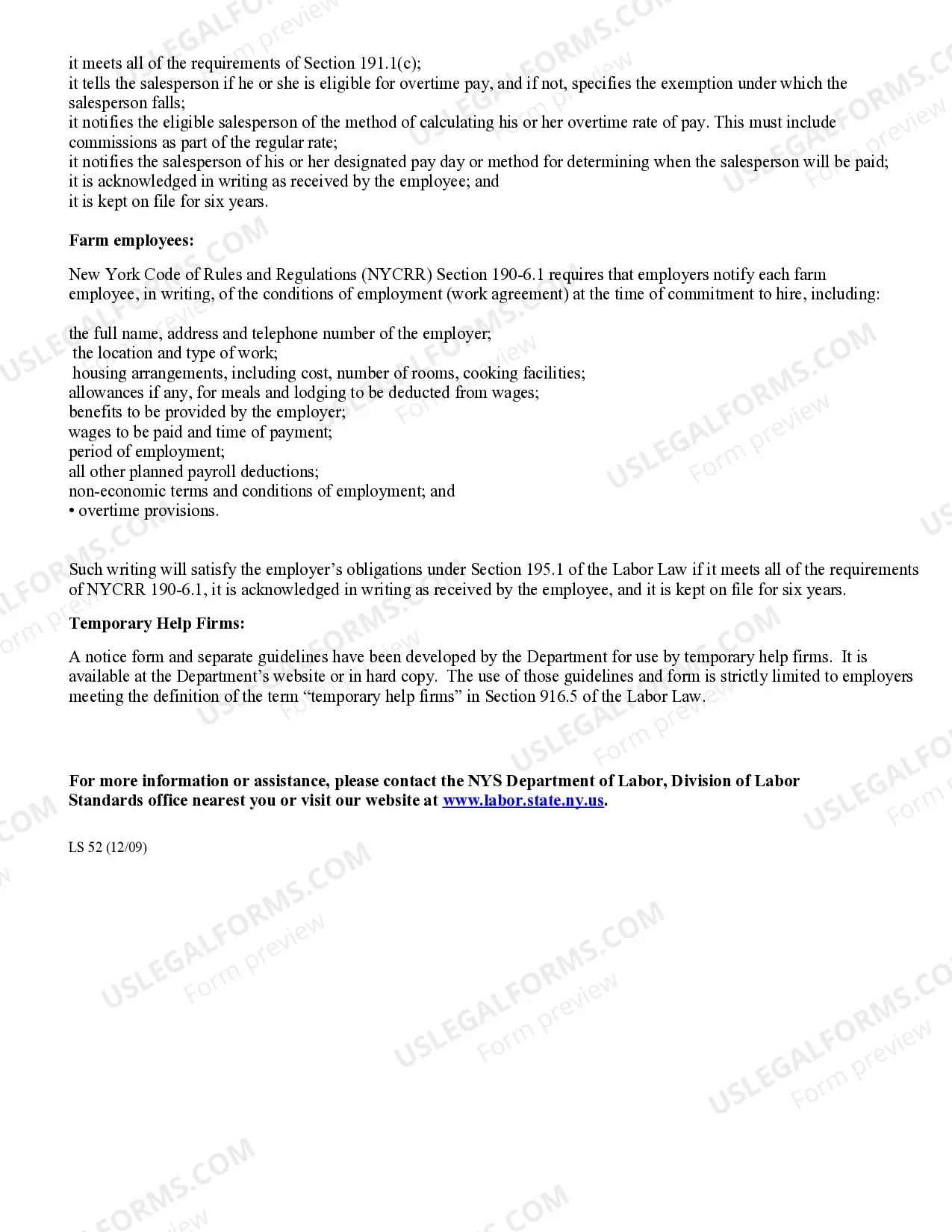
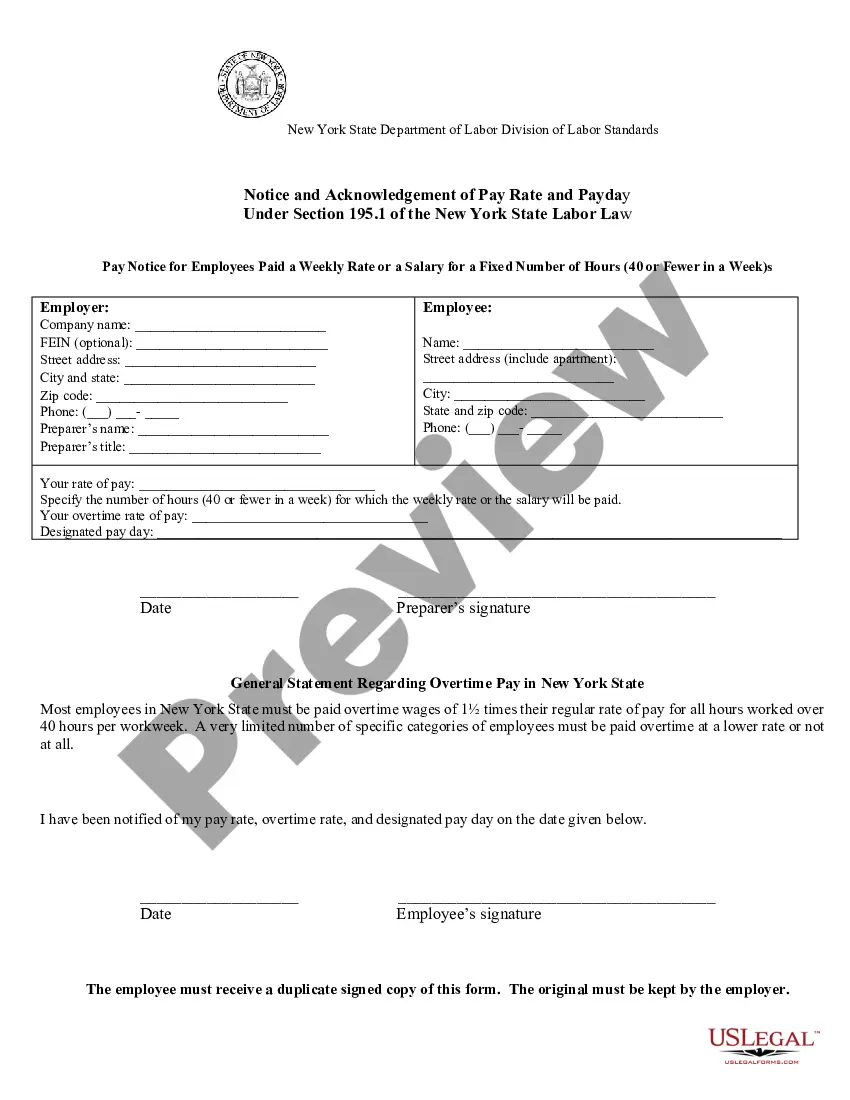
How to fill out New York Guidelines For Written Notice Of Rates Of Pay And Regular Payday?
It’s clear that you cannot instantly become a legal authority, nor can you quickly determine how to draft the Pay Employee Law With Holiday without possessing a specific skill set.
Assembling legal documents is a lengthy endeavor that necessitates particular knowledge and expertise. So why not entrust the development of the Pay Employee Law With Holiday to the experts.
With US Legal Forms, one of the most comprehensive legal document repositories, you can discover anything from judicial papers to formats for internal corporate correspondence. We understand the significance of compliance and adherence to federal and state regulations. That’s why, on our platform, all templates are region-specific and current.
You can access your documents from the My documents section at any time. If you’re a current customer, you can simply Log In, and find and download the template from the same section.
Regardless of the intent of your documents—whether financial, legal, or personal—our website is equipped to assist you. Explore US Legal Forms now!
- Locate the document you need by utilizing the search bar at the upper part of the page.
- Preview it (if this option is provided) and review the accompanying description to determine if the Pay Employee Law With Holiday is what you are seeking.
- Restart your search if you require a different format.
- Sign up for a complimentary account and choose a subscription plan to purchase the form.
- Select Buy now. Once the payment is completed, you can access the Pay Employee Law With Holiday, fill it out, print it, and send or deliver it to the necessary individuals or organizations.
Form popularity
FAQ
Regular holiday pay rules typically require employees to receive their standard rate for holidays, per the pay employee law with holiday standards. Employers may also choose to provide additional pay for employees working on holidays. Policies can differ significantly by employer, so it's essential to review your company's holiday policy. Utilizing platforms like UsLegalForms can simplify your understanding of these rules and help ensure compliance.
Holiday pay is not universally mandated across all states, but certain states have laws that require it under the pay employee law with holiday parameters. For example, some states may require overtime pay in conjunction with holiday work. It's crucial to check both federal and state regulations, as well as company policies, to understand your rights regarding holiday pay in your state.
To be eligible for holiday pay, you generally need to be an employee with a consistent work schedule under the pay employee law with holiday criteria. Eligibility often depends on working a certain number of hours before the holiday without taking unpaid leave. Furthermore, employers may have specific policies regarding part-time employees. Thus, reviewing your employer's handbook can clarify your eligibility.
Holiday pay for federal employees is governed by the pay employee law with holiday guidelines. Employees receive holiday pay if they are in a pay status on the holiday or the day before. The pay amounts to their regular salary for that day. Therefore, understanding these rules can ensure that you receive your due pay during holidays.
When employees work on a holiday, compensation often depends on the company policy regarding holiday pay. Some employers provide additional pay, while others offer time off in lieu. Understanding the pay employee law with holiday is vital for both employers and employees to ensure correct compensation practices and adherence to legal standards.
Laws around holiday pay can vary significantly depending on state legislation and individual employer policies. Federal law does not require holiday pay, but many states have specific regulations. It’s crucial to review local laws to ensure compliance and understand how pay employee law with holiday applies to your business.
To calculate holiday pay for an employee, start by determining the average daily earnings over a specific period. Pay employee law with holiday may specify that this calculation should include regular pay and may also consider any overtime. Employers should also factor in both full-time and part-time employee schedules to ensure fair compensation.
Federal rules regarding holiday pay do not mandate that employers must pay employees extra for working on holidays. Pay employee law with holiday varies by state, and employers often have policies in place for holiday pay. It's essential for employers to communicate their policy clearly to all employees, so everyone understands their rights and any eligibility for holiday pay.