Transfer Deed On Death Form With Mortgage
Description

Get your form ready online
Our built-in tools help you complete, sign, share, and store your documents in one place.
Make edits, fill in missing information, and update formatting in US Legal Forms—just like you would in MS Word.
Download a copy, print it, send it by email, or mail it via USPS—whatever works best for your next step.
Sign and collect signatures with our SignNow integration. Send to multiple recipients, set reminders, and more. Go Premium to unlock E-Sign.
If this form requires notarization, complete it online through a secure video call—no need to meet a notary in person or wait for an appointment.
We protect your documents and personal data by following strict security and privacy standards.

Make edits, fill in missing information, and update formatting in US Legal Forms—just like you would in MS Word.

Download a copy, print it, send it by email, or mail it via USPS—whatever works best for your next step.

Sign and collect signatures with our SignNow integration. Send to multiple recipients, set reminders, and more. Go Premium to unlock E-Sign.

If this form requires notarization, complete it online through a secure video call—no need to meet a notary in person or wait for an appointment.

We protect your documents and personal data by following strict security and privacy standards.
Looking for another form?
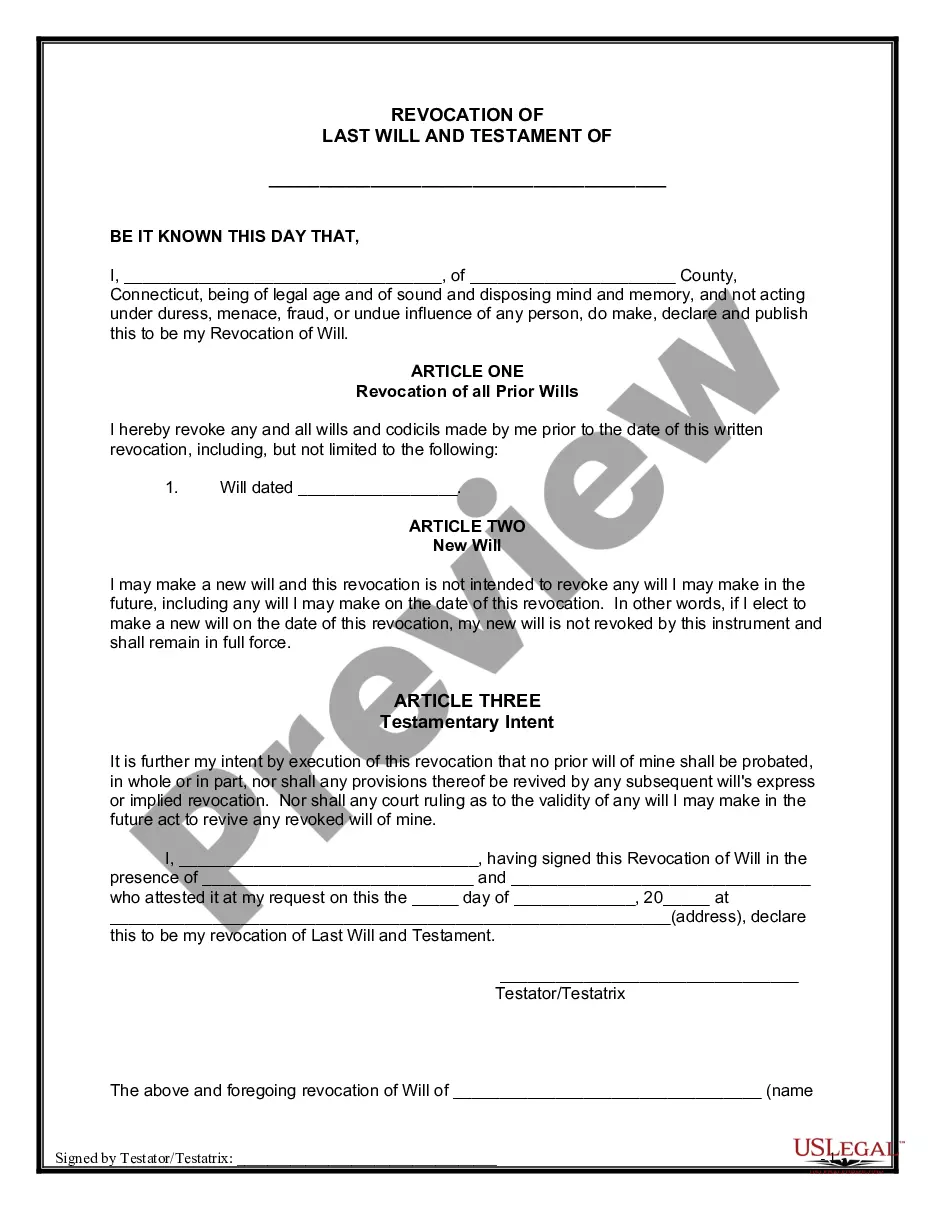



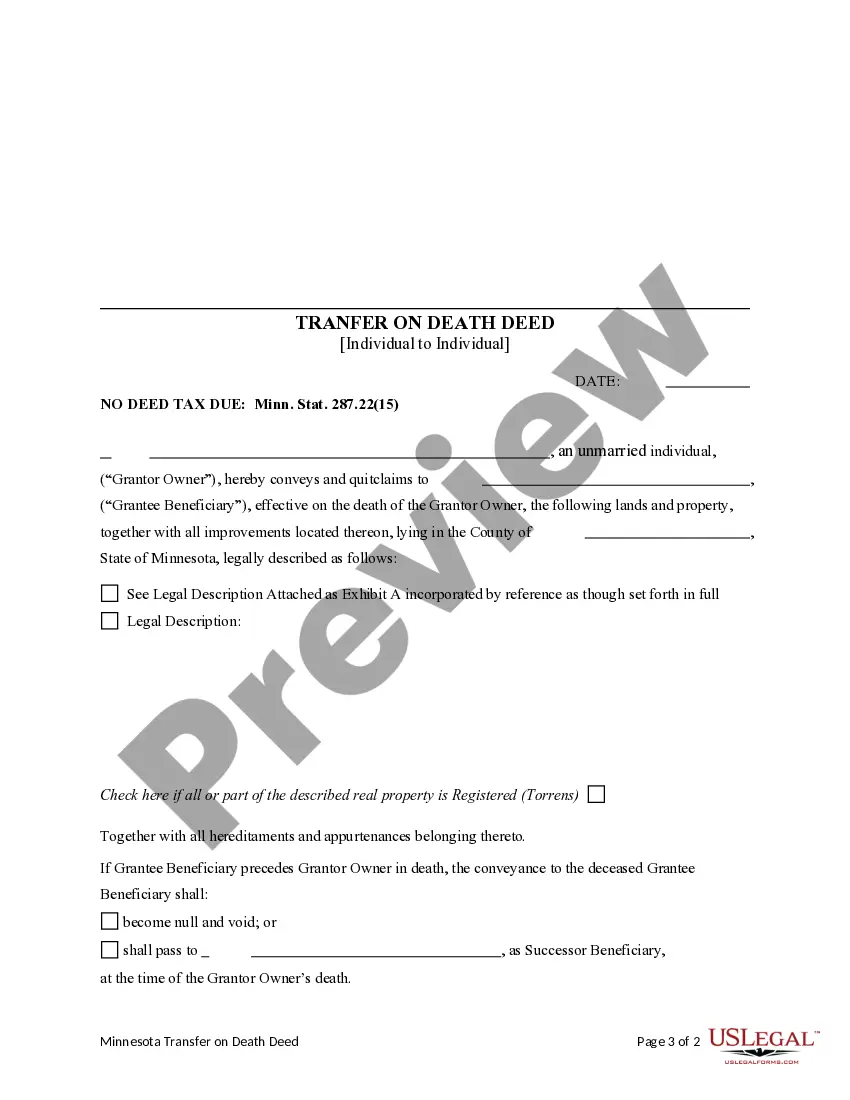
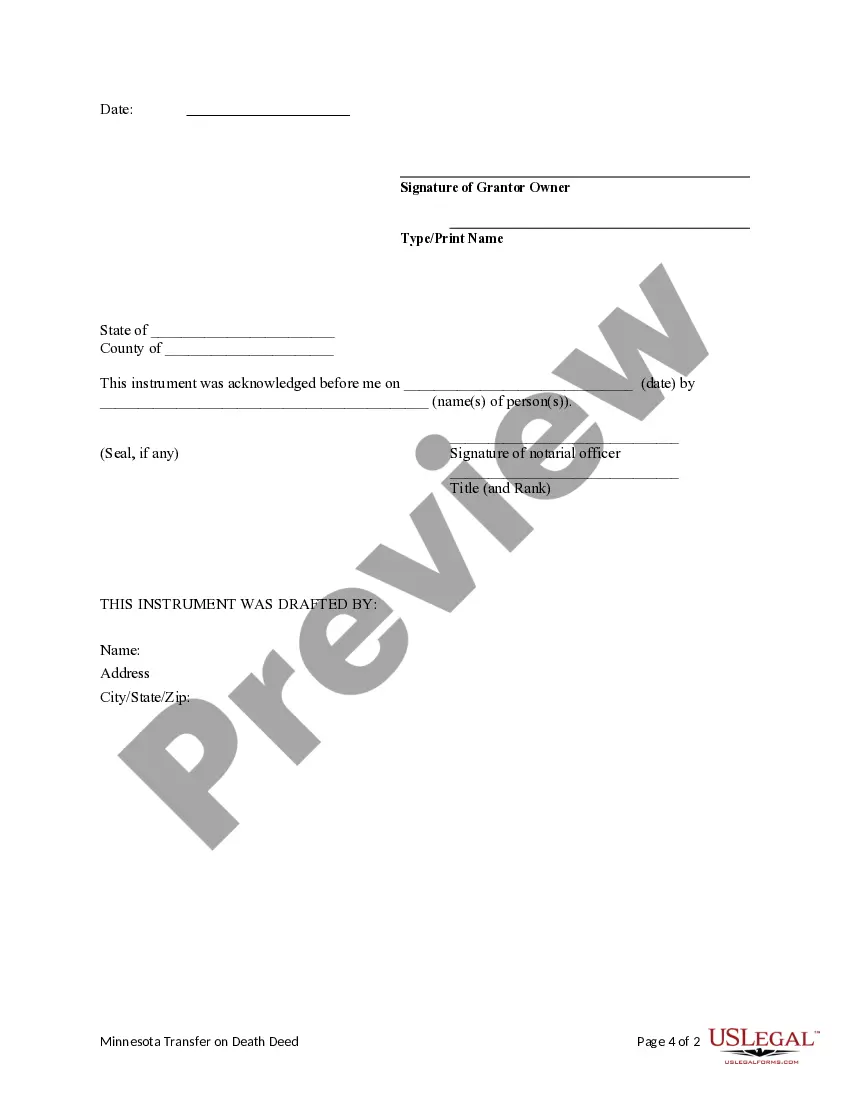
How to fill out Minnesota Transfer On Death Deed - Individual To Individual?
Managing legal paperwork can be daunting, even for experienced professionals.
When you are looking for a Transfer Deed On Death Form With Mortgage and don’t have the opportunity to invest time searching for the accurate and current version, the process can be challenging.
US Legal Forms addresses any requirements you may have, ranging from personal to business documentation, all in one location.
Utilize advanced tools to complete and manage your Transfer Deed On Death Form With Mortgage.
Here are the steps to follow after accessing the form you desire: Verify that this is the correct document by previewing it and reviewing its details. Ensure that the template is accepted in your state or county. Click Buy Now once you are ready. Choose a monthly subscription plan. Find the format you need, and Download, complete, eSign, print, and submit your document. Take advantage of the US Legal Forms online library, backed by 25 years of experience and reliability. Simplify your routine document management into a straightforward and user-friendly process today.
- Access a resource library of articles, guides, and tools pertinent to your situation and requirements.
- Save time and energy searching for the documents you need, and use US Legal Forms’ sophisticated search and Preview feature to find and download the Transfer Deed On Death Form With Mortgage.
- If you have a subscription, Log In to your US Legal Forms account, search for the form, and download it.
- Check your My documents tab to view the documents you have saved previously and manage your folders as you wish.
- If it's your first experience with US Legal Forms, create a free account to gain unlimited access to all features of the library.
- A comprehensive online form repository can be a significant advantage for anyone who wishes to navigate these issues effectively.
- US Legal Forms is a leading provider in digital legal forms, offering over 85,000 state-specific legal documents available to you at any moment.
- With US Legal Forms, you can access legal and organizational forms tailored to your state or county.
Form popularity
FAQ
File the deed at the county clerk's office. File deed in the county clerk's office where the property is located. The clerk will charge a fee. Typical filing fees are $24 to $26 for the first page and $4 for each page thereafter.
In New Jersey, real estate can be transferred via a TOD deed, otherwise known as a beneficiary deed. This deed permits a property owner to designate a beneficiary who will automatically inherit the property upon the owner's death, avoiding probate.
Good to know: To be valid and enforceable, the transfer must be in writing and signed by the owner. The document should be filed with the County Clerk for the County in which the property is located. For example, you cannot simply say that your grandfather said he wanted you to have the property.
What Is the Difference Between TOD and Beneficiary? A transfer on death is an instrument that transfers ownership of specific accounts and assets to someone. A beneficiary is someone that is named to receive something of value.
File the deed at the county clerk's office. File deed in the county clerk's office where the property is located. The clerk will charge a fee. Typical filing fees are $24 to $26 for the first page and $4 for each page thereafter.