Planning Will Attorney For Health Care
Description

Get your form ready online
Our built-in tools help you complete, sign, share, and store your documents in one place.
Make edits, fill in missing information, and update formatting in US Legal Forms—just like you would in MS Word.
Download a copy, print it, send it by email, or mail it via USPS—whatever works best for your next step.
Sign and collect signatures with our SignNow integration. Send to multiple recipients, set reminders, and more. Go Premium to unlock E-Sign.
If this form requires notarization, complete it online through a secure video call—no need to meet a notary in person or wait for an appointment.
We protect your documents and personal data by following strict security and privacy standards.

Make edits, fill in missing information, and update formatting in US Legal Forms—just like you would in MS Word.

Download a copy, print it, send it by email, or mail it via USPS—whatever works best for your next step.

Sign and collect signatures with our SignNow integration. Send to multiple recipients, set reminders, and more. Go Premium to unlock E-Sign.

If this form requires notarization, complete it online through a secure video call—no need to meet a notary in person or wait for an appointment.

We protect your documents and personal data by following strict security and privacy standards.
Looking for another form?
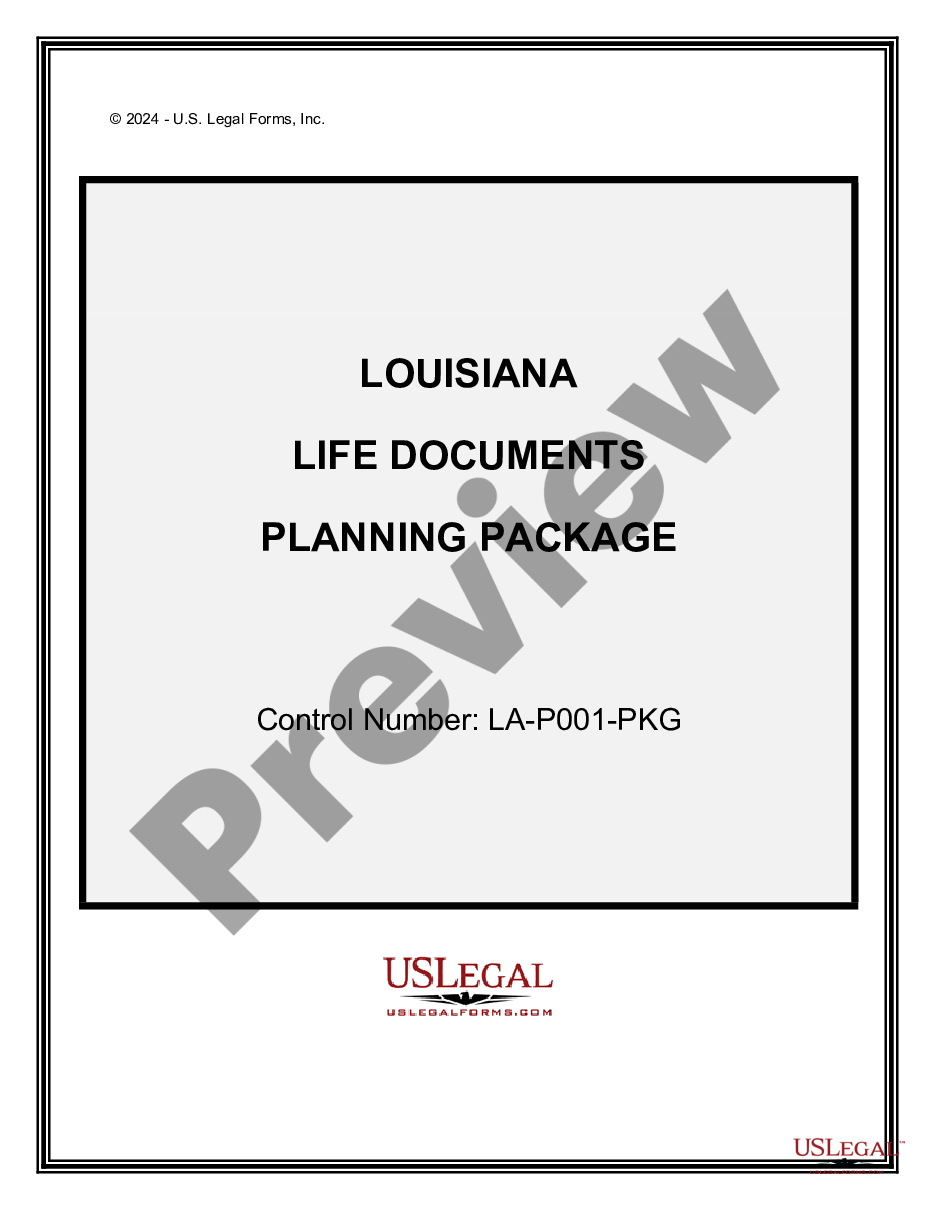
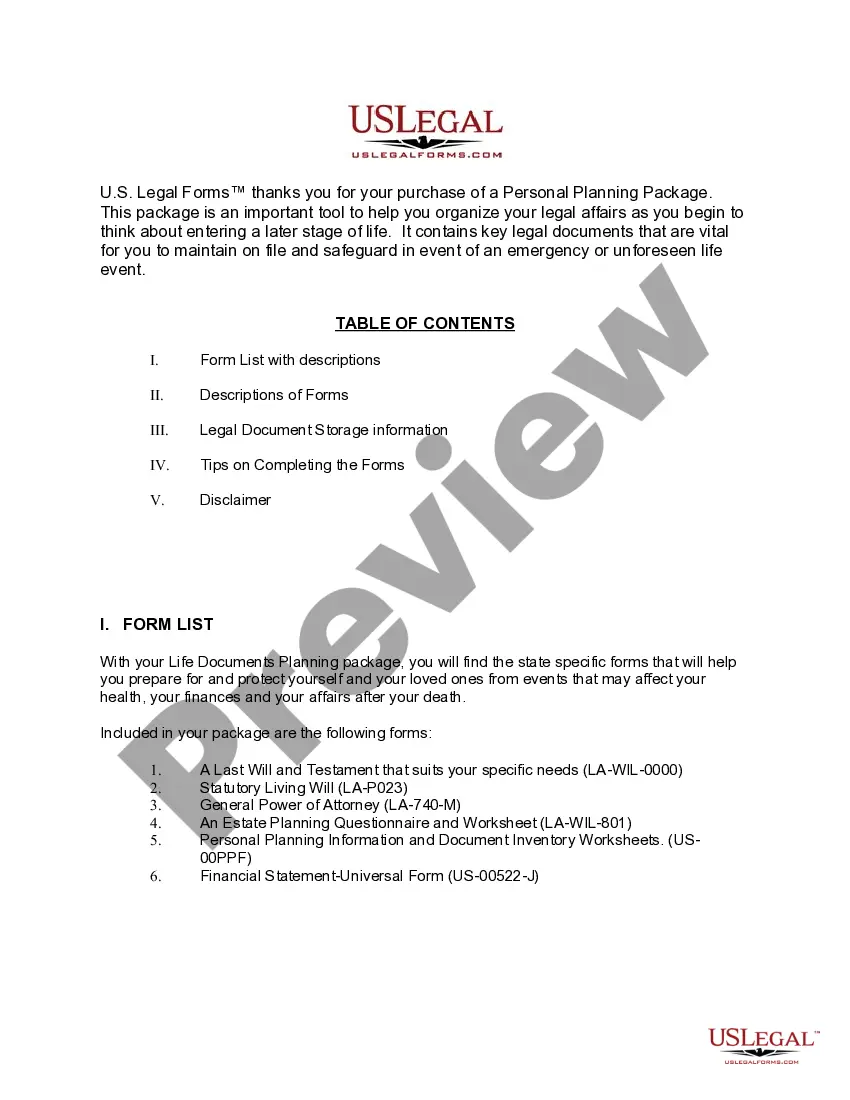
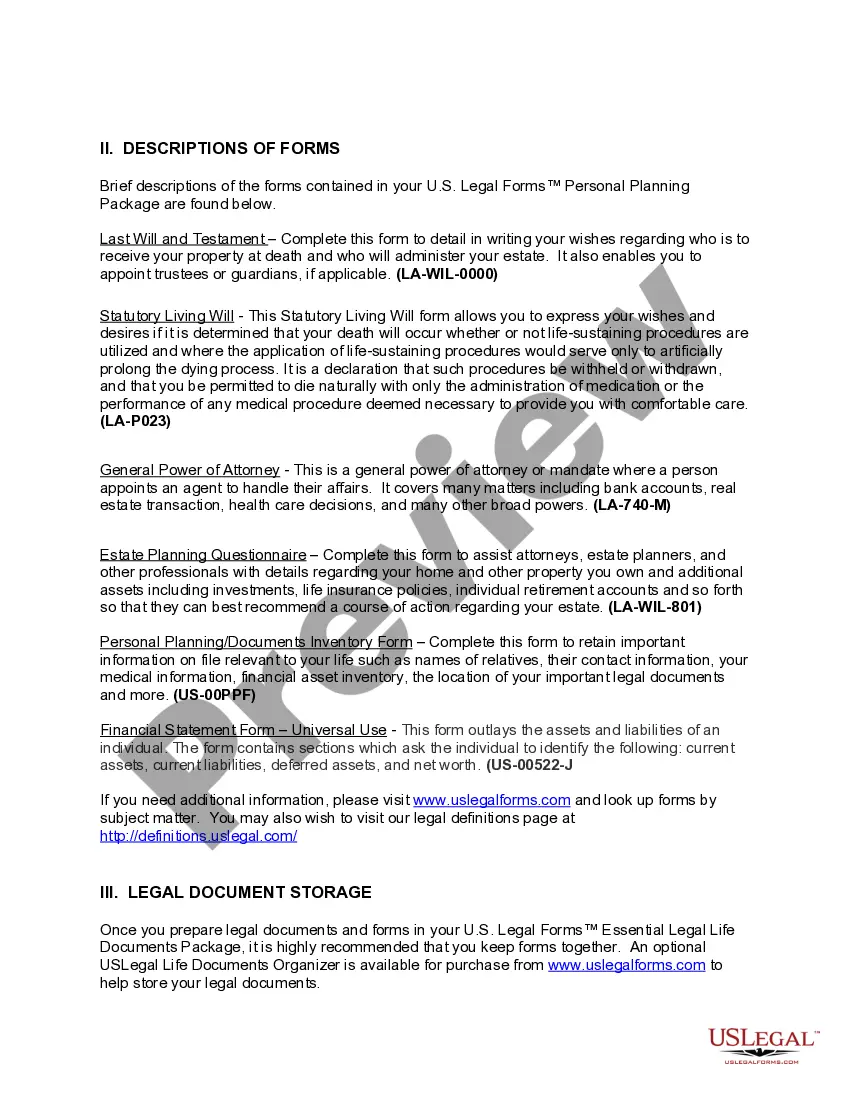
How to fill out Louisiana Life Documents Planning Package, Including Will, Power Of Attorney And Living Will?
- If you're already a user, access your account and download the desired form by selecting the Download button. Ensure your subscription is active to proceed.
- For new users, start by reviewing the Preview mode and form descriptions to ensure you select the correct template per your local jurisdiction.
- If you find any discrepancies, use the Search tab to locate an appropriate form that meets your specific needs.
- Once you have found the correct form, click on the Buy Now button and choose your preferred subscription plan, registering an account to access the resources.
- Complete your purchase by entering your payment information through credit card or PayPal.
- Download the completed form and save it on your device, allowing you to access it anytime under the My Forms section of your profile.
By using US Legal Forms, you benefit from a vast library boasting over 85,000 editable legal templates, ensuring your documents are both comprehensive and legally sound.
Take control of your health care planning today! Start using US Legal Forms to empower your legal documentation process.
Form popularity
FAQ
In certain situations, a hospital may challenge or not fully recognize a power of attorney, especially if they doubt the agent's authority. Hospitals follow strict policies to ensure patients' rights and safety. Consulting a planning will attorney for health care can provide insights into how to prevent these issues.
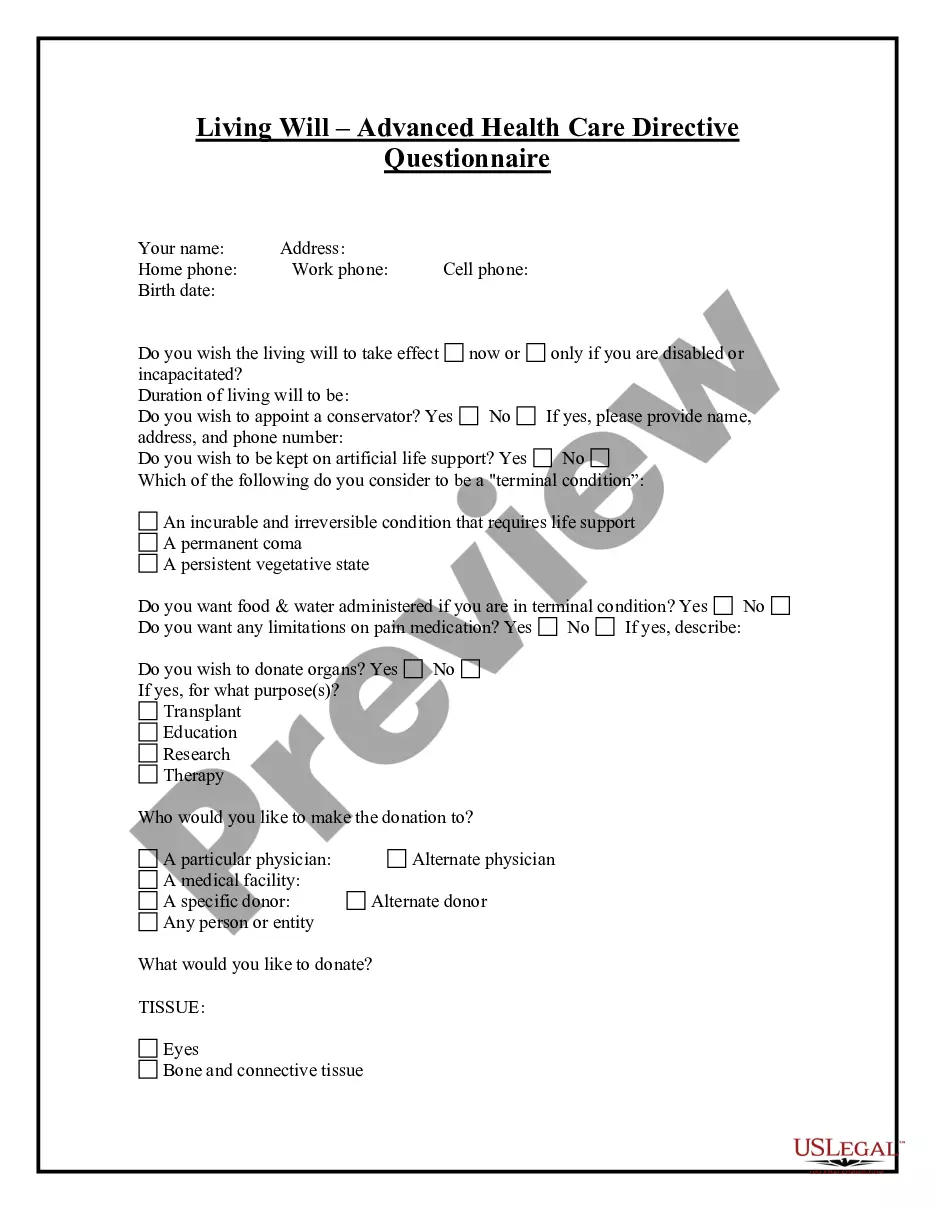
While a health care power of attorney grants someone the authority to make medical decisions, a living will outlines your wishes regarding treatment. Having both documents enhances clarity in your health care decisions. A planning will attorney for health care can help ensure these documents align with your desires.
A medical power of attorney often does not cover financial decisions or non-medical matters. Its authority typically ends if the principal regains capacity, and it may not address every possible health issue. Consulting a planning will attorney for health care can help clarify these limitations.
One major downfall of a power of attorney is the potential for misuse. An agent may not act in your best interests, especially if they lack a clear understanding of your preferences. Understanding the risks is essential when considering using a planning will attorney for health care.
Planning a will attorney for health care doesn’t give power over every decision. A legal power of attorney cannot make choices about personal care, vote in elections, or execute your will after your death. These decisions require separate legal directives or documents.
An example of a living will in healthcare might state that you do not wish to receive any life-prolonging treatments if you are diagnosed with a terminal illness. This enables doctors and loved ones to make informed choices based on your preferences. Another example could include your desire for pain management only, without aggressive interventions. Engaging a planning will attorney for health care can help ensure your living will accurately reflects your wishes.
In nursing, a living will refers to a document that outlines a patient's healthcare preferences during serious medical situations. It guides nurses and medical staff in making decisions that align with the patient's wishes. Living wills serve as essential communication tools, particularly when patients cannot express themselves. Using planning will attorney for health care services can help you create a precise document that provides clear guidance.
The best way to write a living will is to clearly state your medical wishes regarding life-sustaining treatments. Start by thinking carefully about your values and preferences related to critical health situations. Use straightforward language and avoid complex terms. You may also consider working with a planning will attorney for health care to ensure that all necessary legal requirements are met.
A living will is a legal document that specifies your healthcare preferences in case you cannot communicate them yourself. For example, you might express a wish to receive comfort care, but not aggressive treatments if you are in a terminal condition. This allows your family and healthcare providers to honor your wishes. Consulting a planning will attorney for health care can help you craft a comprehensive living will.
To fill out a healthcare power of attorney, you should first choose a trustworthy person to make medical decisions on your behalf. Next, obtain the correct forms, which are often available through legal websites or your local government. Then, clearly outline your healthcare preferences within the document. Lastly, sign the document in front of a witness or notary to ensure it is legally binding.