Transfer On Death Deed For Indiana
Description

Get your form ready online
Our built-in tools help you complete, sign, share, and store your documents in one place.
Make edits, fill in missing information, and update formatting in US Legal Forms—just like you would in MS Word.
Download a copy, print it, send it by email, or mail it via USPS—whatever works best for your next step.
Sign and collect signatures with our SignNow integration. Send to multiple recipients, set reminders, and more. Go Premium to unlock E-Sign.
If this form requires notarization, complete it online through a secure video call—no need to meet a notary in person or wait for an appointment.
We protect your documents and personal data by following strict security and privacy standards.

Make edits, fill in missing information, and update formatting in US Legal Forms—just like you would in MS Word.

Download a copy, print it, send it by email, or mail it via USPS—whatever works best for your next step.

Sign and collect signatures with our SignNow integration. Send to multiple recipients, set reminders, and more. Go Premium to unlock E-Sign.

If this form requires notarization, complete it online through a secure video call—no need to meet a notary in person or wait for an appointment.

We protect your documents and personal data by following strict security and privacy standards.
Looking for another form?



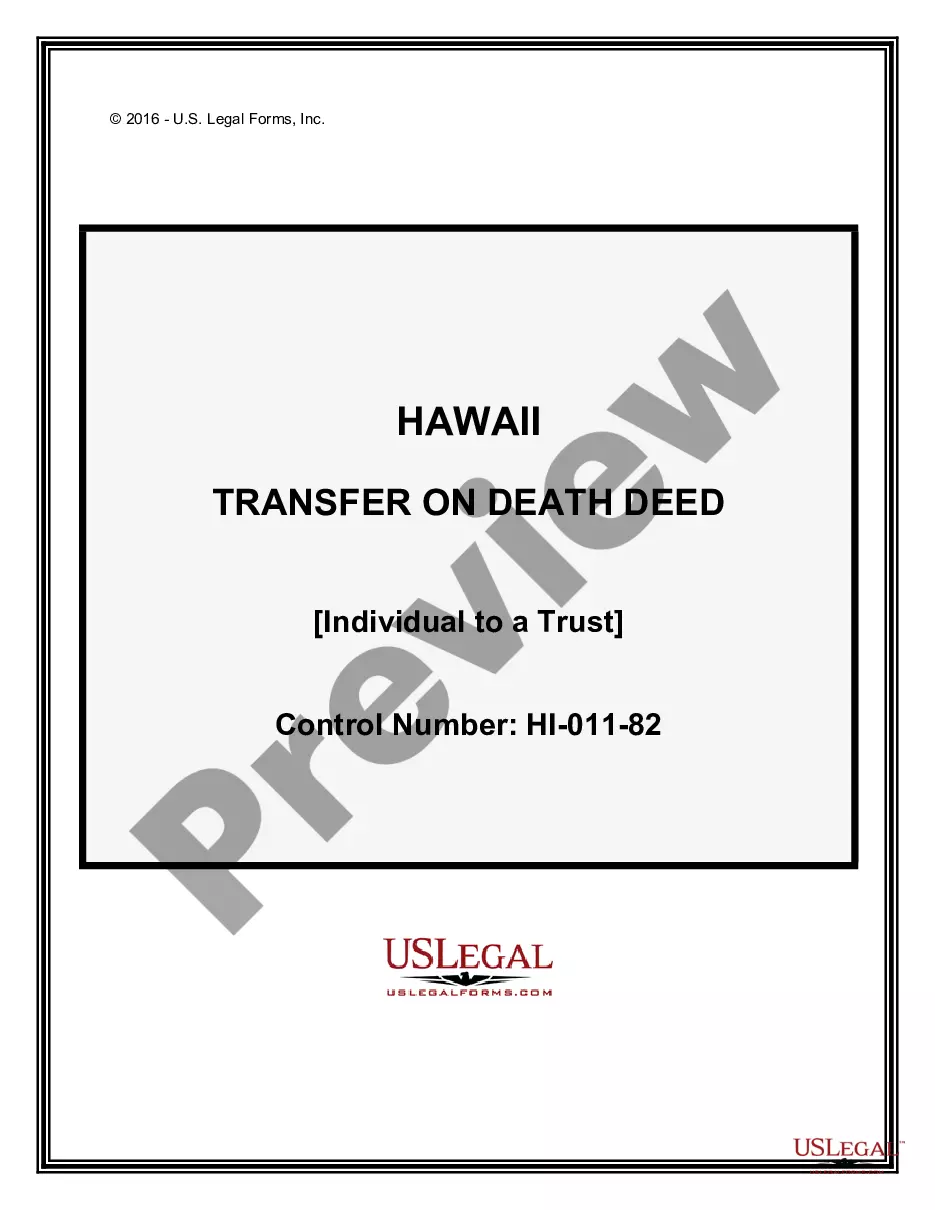
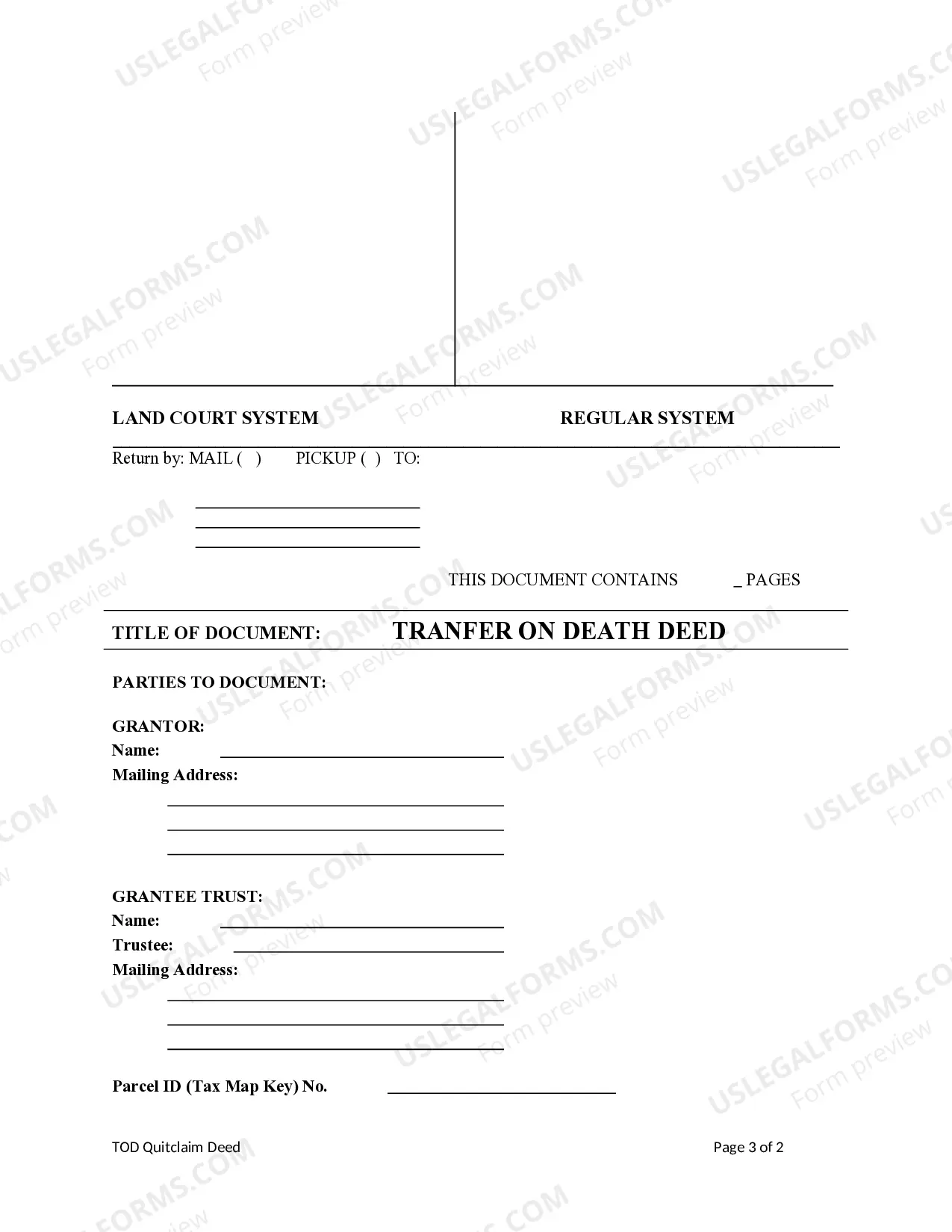
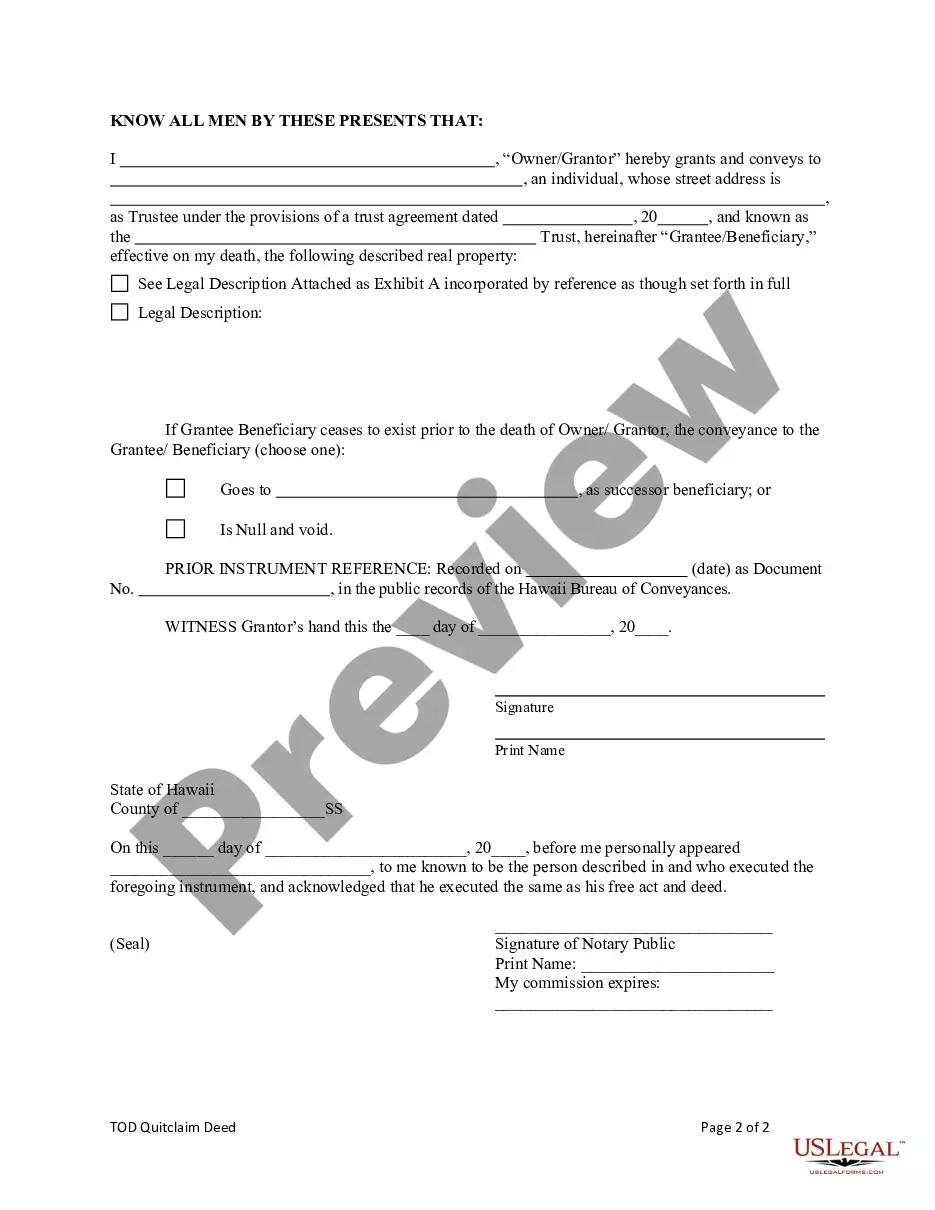
How to fill out Hawaii Transfer On Death Quitclaim Deed From Individual To A Trust?
- If you're a returning user, log in to your account and download the Transfer on Death Deed template by selecting the Download button. Ensure your subscription is active; if not, renew your plan as needed.
- For first-time users, start by reviewing the Preview mode and form description to confirm that the template aligns with your requirements and Indiana state laws.
- Use the Search tab to find additional templates if your initial choice doesn't meet your needs. Ensure your selected form is appropriate for Indiana.
- Proceed by clicking the Buy Now button, choose your desired subscription plan, and create an account for access to all resources.
- Complete your purchase by entering your credit card information or using PayPal.
- Finally, download your completed form and save it on your device. You can access it anytime from the My Forms section of your profile.
By using US Legal Forms, you can take advantage of a vast collection of over 85,000 legal forms that are easy to fill out and edit.
Our service helps you ensure that your documents are precise and legally sound, with access to premium experts available to assist you. Start your journey in securing your assets today!
Form popularity
FAQ
A transfer on death deed does not inherently avoid capital gains tax in Indiana. When your beneficiary sells the inherited property, they may be subject to capital gains tax based on the property's value at the time of sale. However, they could benefit from a step-up in basis, which reflects the property’s value at your time of death. Navigating tax implications can be complex, so consulting with a professional can be very helpful.
Yes, a transfer on death deed for Indiana allows your assets to bypass probate proceedings. This means your beneficiaries can receive property directly after your passing without the delays or costs associated with probate. However, it’s important to ensure that the deed is correctly executed to enjoy this benefit. Engaging with a qualified platform like US Legal Forms can help you navigate this process smoothly.
A significant disadvantage of a transfer on death deed lies in its inability to account for debts the owner may owe at the time of death. This could lead to beneficiaries inheriting property burdened with liens or other liabilities. Additionally, if the property owner grows estranged from a beneficiary, the deed could unintentionally favor someone undesired. Careful planning is essential to mitigate these risks.
While a transfer on death deed for Indiana offers significant advantages, it also has drawbacks. One major concern is that it does not cover jointly held property or assets held in a trust. Furthermore, if the beneficiary predeceases the property owner, the deed may become problematic without clear alternate instructions. Users should consider these factors when deciding whether a TOD is the right choice.
Transfer on death accounts can present issues, particularly if the beneficiary designation is unclear or invalid. If the account holder forgets to update the beneficiary information after significant life changes, this could lead to complications. Additionally, disputes among potential heirs may arise, especially if not everyone is aware of the TOD account. It's wise to carefully monitor and manage these accounts.
In Indiana, you do not necessarily need an attorney to prepare a transfer on death deed. However, hiring an attorney can help ensure that the deed meets all legal requirements and aligns with your intentions. Utilizing a professional can prevent future legal challenges and provide peace of mind. Ultimately, seeking expert guidance can simplify the process.
Yes, a transfer on death (TOD) account effectively bypasses probate in Indiana. When you set up a TOD account, the assets in that account automatically transfer to your designated beneficiaries upon your death. This means that your loved ones can receive their inheritance quickly and without the costs and delays associated with probate, making it a useful tool for estate planning.
To create a valid transfer on death deed for Indiana, you must be the legal owner of the property and must execute the deed in writing. The deed should clearly name the beneficiaries and must be signed, dated, and recorded with the county recorder's office. Ensuring proper execution is crucial, as it guarantees that your property transfers smoothly upon your death without going through probate.
Beneficiaries can avoid probate in Indiana by utilizing tools like joint ownership, payable-on-death (POD) accounts, and transfer on death deeds. A transfer on death deed for Indiana specifically allows property owners to designate beneficiaries, ensuring a smooth transition of property without probate. Consider working with platforms like US Legal Forms, which can guide you through the process and provide the necessary documentation.
In Indiana, certain assets can bypass probate, easing the transfer process for beneficiaries. Common assets that are exempt include property held jointly with rights of survivorship, life insurance proceeds, and retirement accounts with designated beneficiaries. Additionally, if you use a transfer on death deed for Indiana, your real estate can be passed on outside of probate, streamlining the inheritance process.