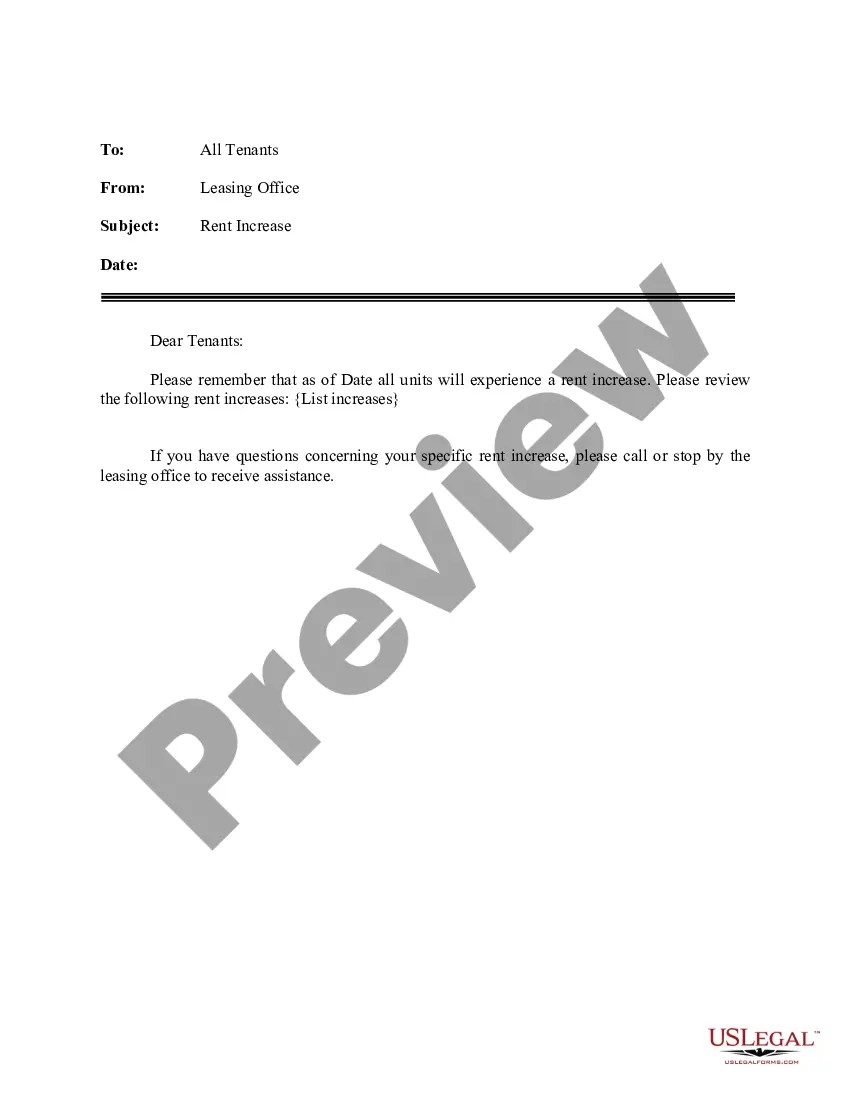
Reasons For Rent Increase Letter
Description



Get your form ready online
Our built-in tools help you complete, sign, share, and store your documents in one place.
Make edits, fill in missing information, and update formatting in US Legal Forms—just like you would in MS Word.
Download a copy, print it, send it by email, or mail it via USPS—whatever works best for your next step.
Sign and collect signatures with our SignNow integration. Send to multiple recipients, set reminders, and more. Go Premium to unlock E-Sign.
If this form requires notarization, complete it online through a secure video call—no need to meet a notary in person or wait for an appointment.
We protect your documents and personal data by following strict security and privacy standards.

Make edits, fill in missing information, and update formatting in US Legal Forms—just like you would in MS Word.

Download a copy, print it, send it by email, or mail it via USPS—whatever works best for your next step.

Sign and collect signatures with our SignNow integration. Send to multiple recipients, set reminders, and more. Go Premium to unlock E-Sign.

If this form requires notarization, complete it online through a secure video call—no need to meet a notary in person or wait for an appointment.

We protect your documents and personal data by following strict security and privacy standards.
Looking for another form?


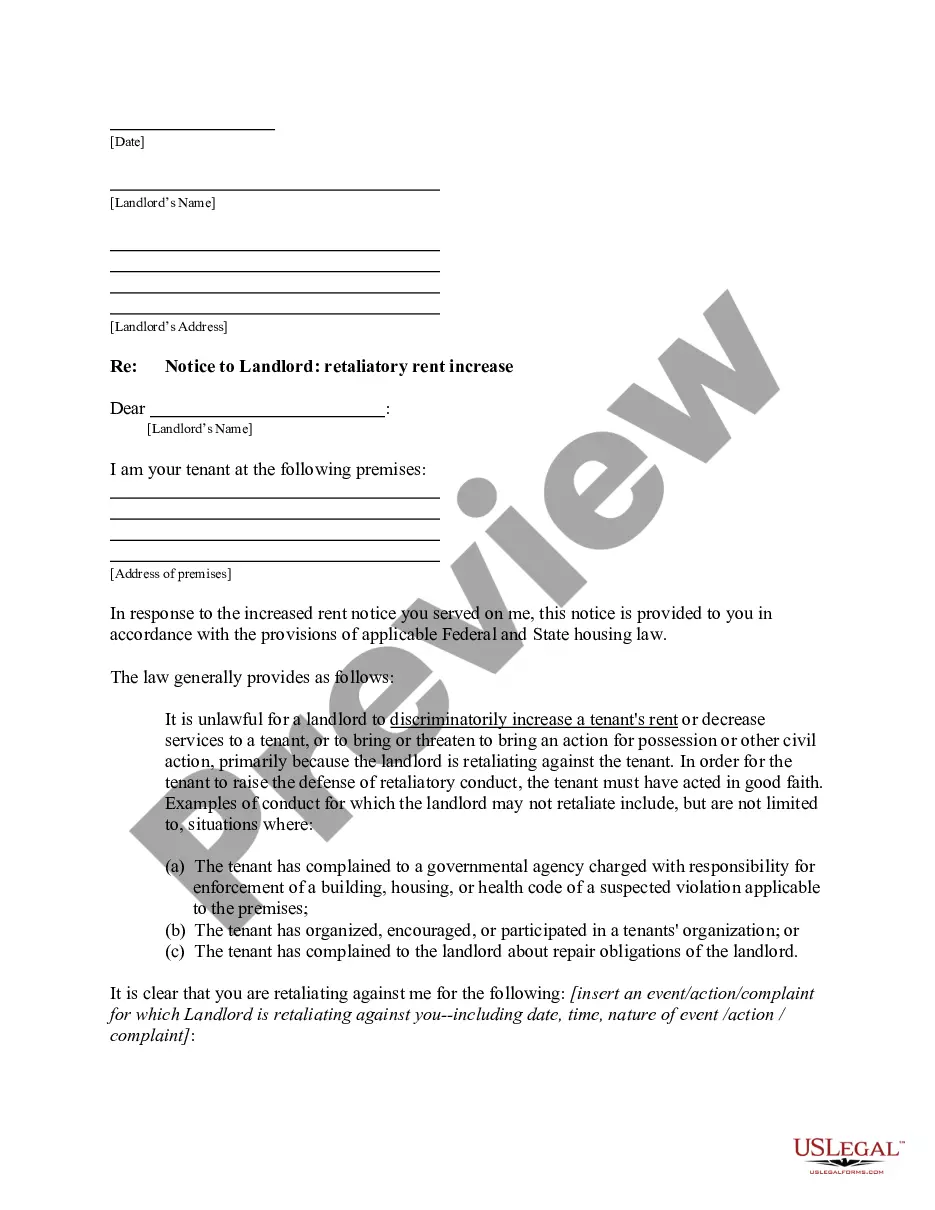
How to fill out California Letter From Tenant To Landlord Containing Notice To Landlord To Withdraw Retaliatory Rent Increase?
Whether for professional reasons or personal issues, everyone must handle legal circumstances at some juncture in their lives.
Filling out legal documents necessitates meticulous care, starting from selecting the correct form template.
Choose your payment method: either a credit card or PayPal account. Select the file format you desire and download the Reasons For Rent Increase Letter. Once saved, you can fill out the form using editing software or print it and complete it manually. With a vast US Legal Forms collection available, you will never need to waste time searching for the correct example across the web. Utilize the library’s straightforward navigation to locate the suitable form for any circumstance.
- For instance, if you choose an incorrect version of a Reasons For Rent Increase Letter, it will be rejected when you submit it.
- Consequently, it is crucial to secure a reliable source of legal paperwork like US Legal Forms.
- If you need a Reasons For Rent Increase Letter template, adhere to these straightforward steps.
- Obtain the example you require by utilizing the search box or catalog navigation.
- Review the form’s details to ensure it aligns with your circumstances, state, and county.
- Click on the form’s preview to inspect it.
- If it is not the correct document, return to the search option to find the Reasons For Rent Increase Letter example you need.
- Download the document when it satisfies your criteria.
- If you already possess a US Legal Forms account, click Log in to reach previously saved documents in My documents.
- If you do not yet have an account, you can obtain the form by clicking Buy now.
- Select the appropriate pricing choice.
- Complete the account registration form.
Form popularity
FAQ
Probate administration only applies to probate assets. Probate assets are those assets that the decedent owned in his or her sole name at death, or that were owned by the decedent and one or more co-owners and lacked a provision for automatic succession of ownership at death.
Bank accounts with no named beneficiaries will need to pass through Florida probate as per the will's instructions by the personal representative. Probate can be expensive and complicated, leaving it open to disputes and family upsets.
What Assets Avoid Probate in Florida? Revocable Trusts. ... Designated Beneficiaries. ... Transfer on Death Accounts. ... Joint Retirement Accounts. ... Tenancy By Entireties. ... Florida Homestead. ... Furniture and Appliances. ... Vehicles.
ALTHOUGH YOU ARE NOT REQUIRED TO HAVE AN ATTORNEY FOR CERTAIN PROBATE PROCEEDINGS, ONLY AN ATTORNEY CAN GIVE LEGAL ADVICE. IF YOU CHOOSE TO PROCEED WITHOUT AN ATTORNEY, AT ANY TIME IN YOUR CASE YOU MAY OPT TO HIRE ONE.
If property, bank accounts, insurance policies, annuities, 401K plans, and all assets have beneficiaries or joint owners, probate is unnecessary. However, without a will or trust all assets must pass through probate court if no beneficiary or joint owner is named.
The most common assets that go through this process are bank accounts, real estate, vehicles, and personal property. In order to determine if a specific financial account is subject to probate, the financial institution should be contacted.
Formal administration in Florida Submit the will. First, you'll submit the will to the deceased's local court. ... File for probate. ... Receive authorization from the court. ... Contact beneficiaries. ... Inventory assets. ... Pay debts. ... Request approval to distribute assets. ... Close the estate.
Most probate documents are public records, however, inventories and accountings filed in estates are confidential and may be viewed only by the personal representative, the personal representative's attorney or an "interested party," as defined in the Florida probate laws.