Az Occupancy Formula
Description

Get your form ready online
Our built-in tools help you complete, sign, share, and store your documents in one place.
Make edits, fill in missing information, and update formatting in US Legal Forms—just like you would in MS Word.
Download a copy, print it, send it by email, or mail it via USPS—whatever works best for your next step.
Sign and collect signatures with our SignNow integration. Send to multiple recipients, set reminders, and more. Go Premium to unlock E-Sign.
If this form requires notarization, complete it online through a secure video call—no need to meet a notary in person or wait for an appointment.
We protect your documents and personal data by following strict security and privacy standards.

Make edits, fill in missing information, and update formatting in US Legal Forms—just like you would in MS Word.

Download a copy, print it, send it by email, or mail it via USPS—whatever works best for your next step.

Sign and collect signatures with our SignNow integration. Send to multiple recipients, set reminders, and more. Go Premium to unlock E-Sign.

If this form requires notarization, complete it online through a secure video call—no need to meet a notary in person or wait for an appointment.

We protect your documents and personal data by following strict security and privacy standards.
Looking for another form?

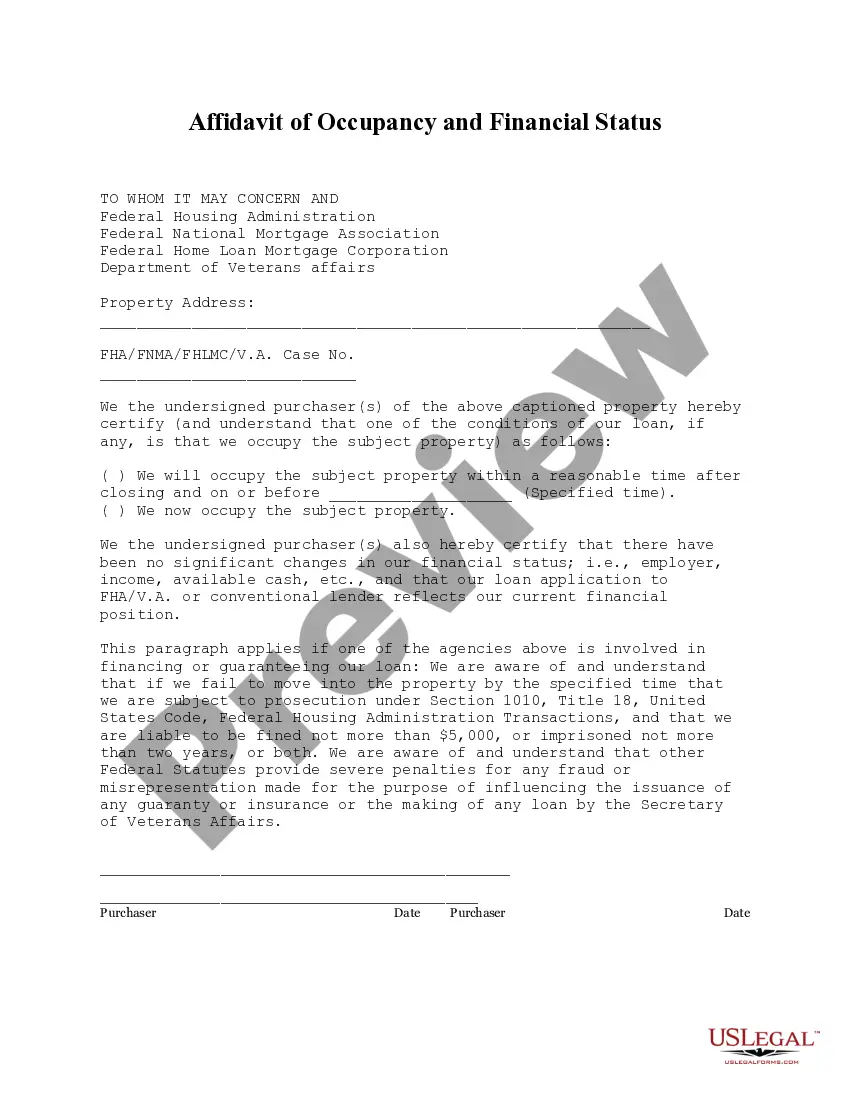
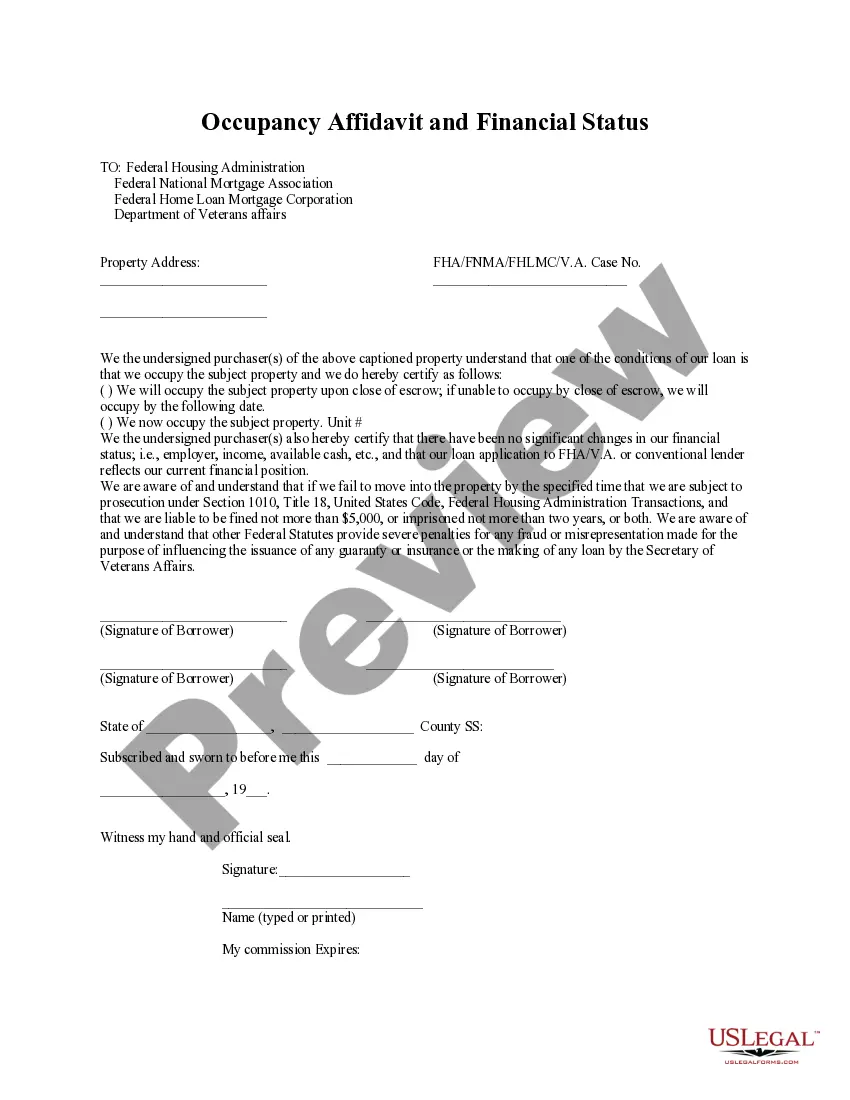
How to fill out Arizona Affidavit Of Occupancy And Financial Status?
Regardless of whether for commercial reasons or personal issues, everyone must handle legal matters at some stage in their lives. Completing legal documents requires meticulous care, starting from choosing the appropriate form template. For example, if you select an incorrect version of the Az Occupancy Formula, it will be declined once submitted. Thus, it is vital to obtain a reliable source of legal documents like US Legal Forms.
If you need to obtain an Az Occupancy Formula template, follow these straightforward steps.
With an extensive catalog from US Legal Forms available, you do not need to waste time searching for the suitable template online. Use the library’s user-friendly navigation to locate the correct form for any circumstance.
- Obtain the template you require by utilizing the search bar or catalog navigation.
- Review the form’s details to ensure it aligns with your case, state, and area.
- Click on the form’s preview to examine it.
- If it is the incorrect document, return to the search function to find the Az Occupancy Formula sample you need.
- Acquire the template if it satisfies your criteria.
- If you possess a US Legal Forms account, click Log in to access previously stored templates in My documents.
- If you do not have an account yet, you can download the form by clicking Buy now.
- Select the appropriate pricing option.
- Fill out the account registration form.
- Choose your payment method: use a credit card or PayPal account.
- Select the document format you desire and download the Az Occupancy Formula.
- Once downloaded, you can complete the form with the aid of editing software or print it and finish it manually.
Form popularity
FAQ
Occupancy rate is the percentage of occupied rooms in your property at a given time. It is one of the most high-level indicators of success and is calculated by dividing the total number of rooms occupied, by the total number of rooms available, times 100, creating a percentage such as 75% occupancy.
If you are providing temporary seating then this may be limited by the maximum numbers your escape routes can accommodate. e.g. Bar area of 100m2 ÷ 0.5 (floor space factor)= 200 persons and 50 seats around the side of the room Total occupancy = 250 people.
The ?occupant load factor? is a number that describes how many square feet per person (ft2/person) should be provided when determining the preliminary occupant load. For example, in an assembly occupancy, the two most commonly used occupant load factors are 7 ft2/person (net) and 15 ft2/person (net).
To calculate the occupant load of a room or space, you take the area and divide by an occupant load factor. The IBC lists these factors in a table, and the factor for educational classrooms is 20 square feet per person.
The occupancy load is calculated by dividing the area of a room by its prescribed unit of area per person. Units of area per person for specific buildings can be found in the chart at the end of this article. For instance, the chart dictates that dormitories require 50 square feet of floor area for every room occupant.