Alabama Involuntary Commitment Forms With Mental Health Services
Description
Get your form ready online
Our built-in tools help you complete, sign, share, and store your documents in one place.
Make edits, fill in missing information, and update formatting in US Legal Forms—just like you would in MS Word.
Download a copy, print it, send it by email, or mail it via USPS—whatever works best for your next step.
Sign and collect signatures with our SignNow integration. Send to multiple recipients, set reminders, and more. Go Premium to unlock E-Sign.
If this form requires notarization, complete it online through a secure video call—no need to meet a notary in person or wait for an appointment.
We protect your documents and personal data by following strict security and privacy standards.

Make edits, fill in missing information, and update formatting in US Legal Forms—just like you would in MS Word.

Download a copy, print it, send it by email, or mail it via USPS—whatever works best for your next step.

Sign and collect signatures with our SignNow integration. Send to multiple recipients, set reminders, and more. Go Premium to unlock E-Sign.

If this form requires notarization, complete it online through a secure video call—no need to meet a notary in person or wait for an appointment.

We protect your documents and personal data by following strict security and privacy standards.
Looking for another form?

How to fill out Alabama Petition For Mental Health Commitment?
It’s clear that you can’t become a legal authority instantly, nor can you swiftly learn how to draft Alabama Involuntary Commitment Forms With Mental Health Services without possessing a specialized skill set.
Assembling legal documents is a lengthy process that necessitates a certain level of education and expertise.
So why not entrust the preparation of the Alabama Involuntary Commitment Forms With Mental Health Services to the professionals.
Preview it (if this option is available) and review the accompanying description to see if Alabama Involuntary Commitment Forms With Mental Health Services is what you’re looking for.
Create a free account, select a subscription plan to purchase the template, click Buy now. Once the payment is processed, you can access the Alabama Involuntary Commitment Forms With Mental Health Services, fill it out, print it, and send or mail it to the appropriate parties or organizations.
- With US Legal Forms, one of the largest legal document repositories, you can find everything from court documents to templates for internal business communication.
- We understand how important compliance with federal and state regulations is.
- That’s why, on our platform, all documents are location-specific and current.
- Here’s how to begin using our platform and obtain the document you require in just a few minutes.
- Find the form you need using the search bar at the top of the page.
Form popularity
FAQ
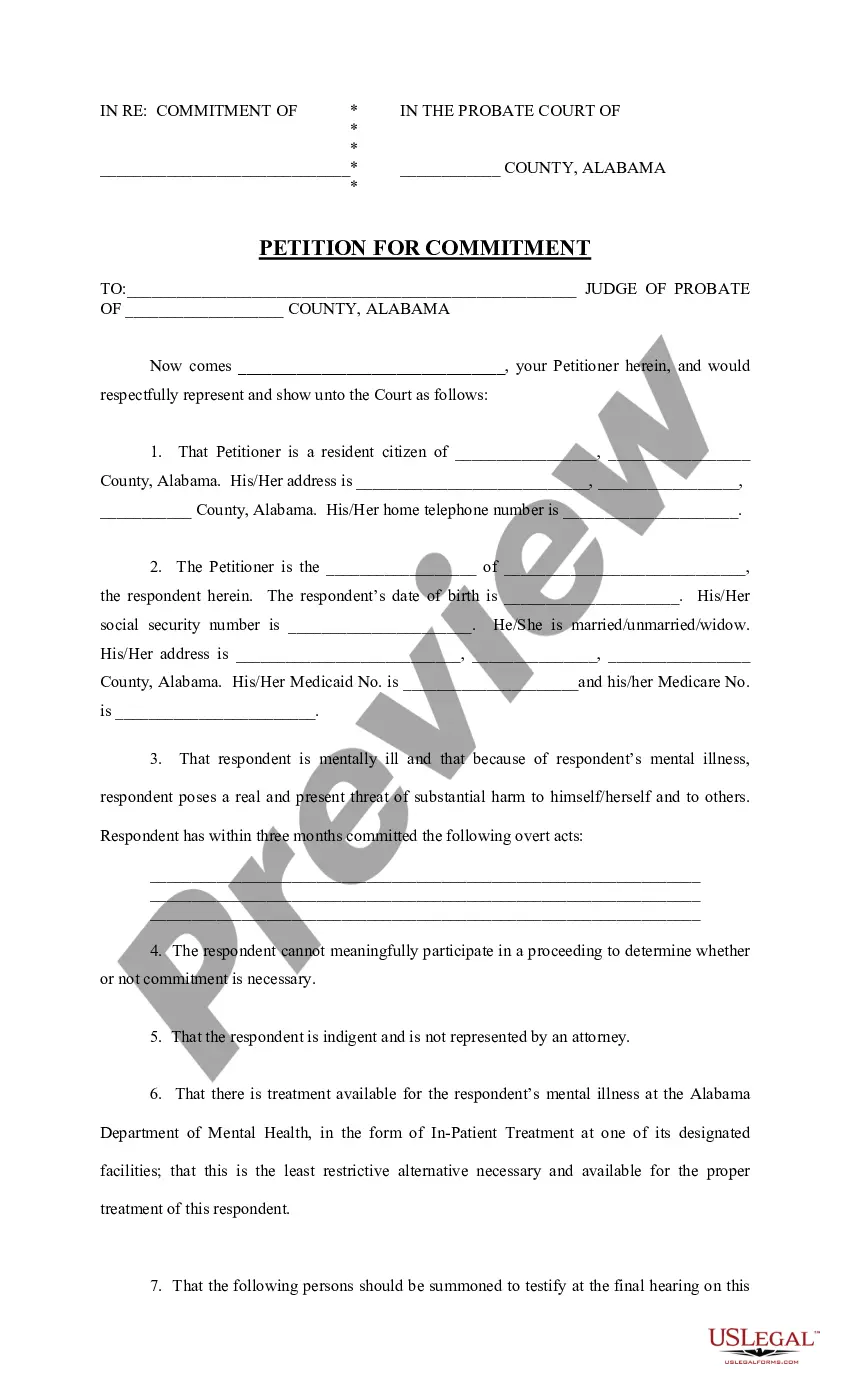
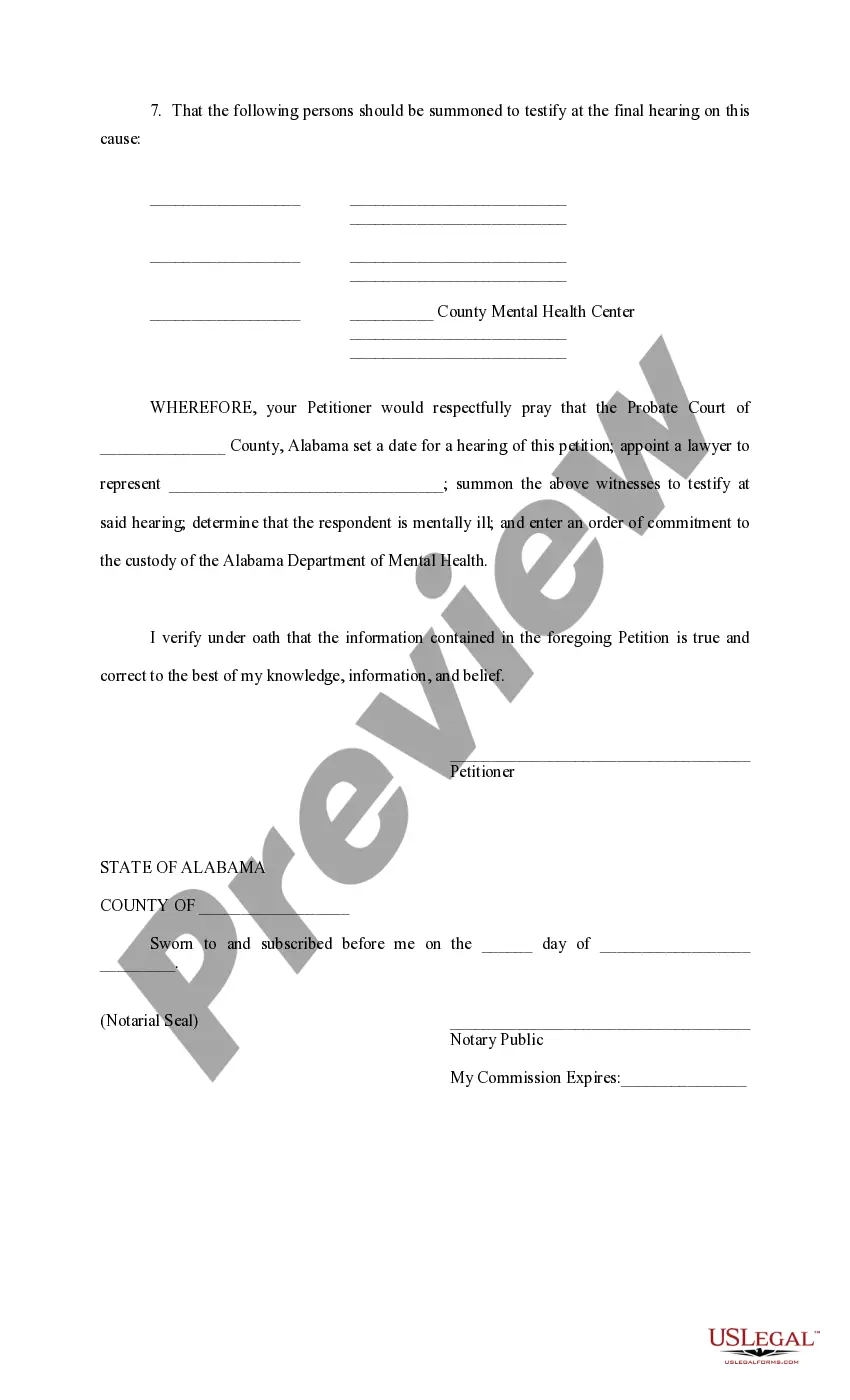
Any person may seek to have another person committed by filing a petition with the Probate Court. WHAT MUST THE PETITION CONTAIN? Names and addresses of the other people with knowledge of the defendant's illness or who observed the person's overt acts and who may be called as his witnesses.
The court or jury shall determine that the respondent is in need of care and treatment only if the court or jury finds by clear and convincing evidence that the person has a mental illness and, as a result of such mental illness, is a danger to others or to himself or herself or is gravely disabled.
5150 is the number of the section of the Welfare and Institutions Code, which allows an adult who is experiencing a mental health crisis to be involuntarily detained for a 72- hour psychiatric hospitalization when evaluated to be a danger to others, or to himself or herself, or gravely disabled.
Section 22-52-1.2 - Filing and contents of petition seeking involuntary commitment of another (a) Any person may file a petition seeking the involuntary commitment of another person. The petition shall be filed in the probate court of the county in which the respondent is located.
To get a court-ordered commitment, there must be some evidence to show that the person poses an imminent threat to him/herself or others. Evidence that suggests need for involuntary commitment include a threat of suicide, overt threats against another individual, or actions that might put people in danger.