Alabama Involuntary Commitment Forms With Consent
Description
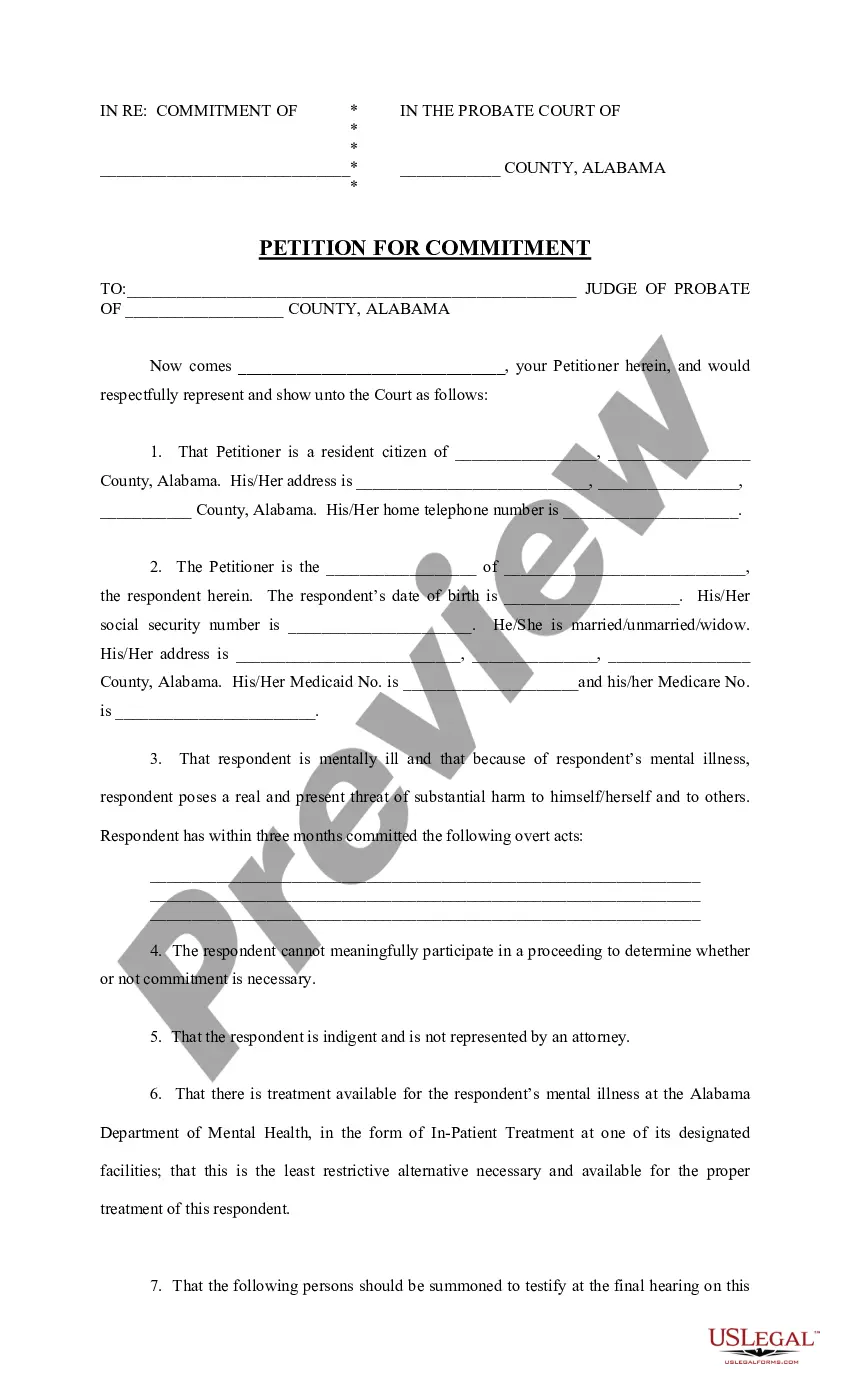
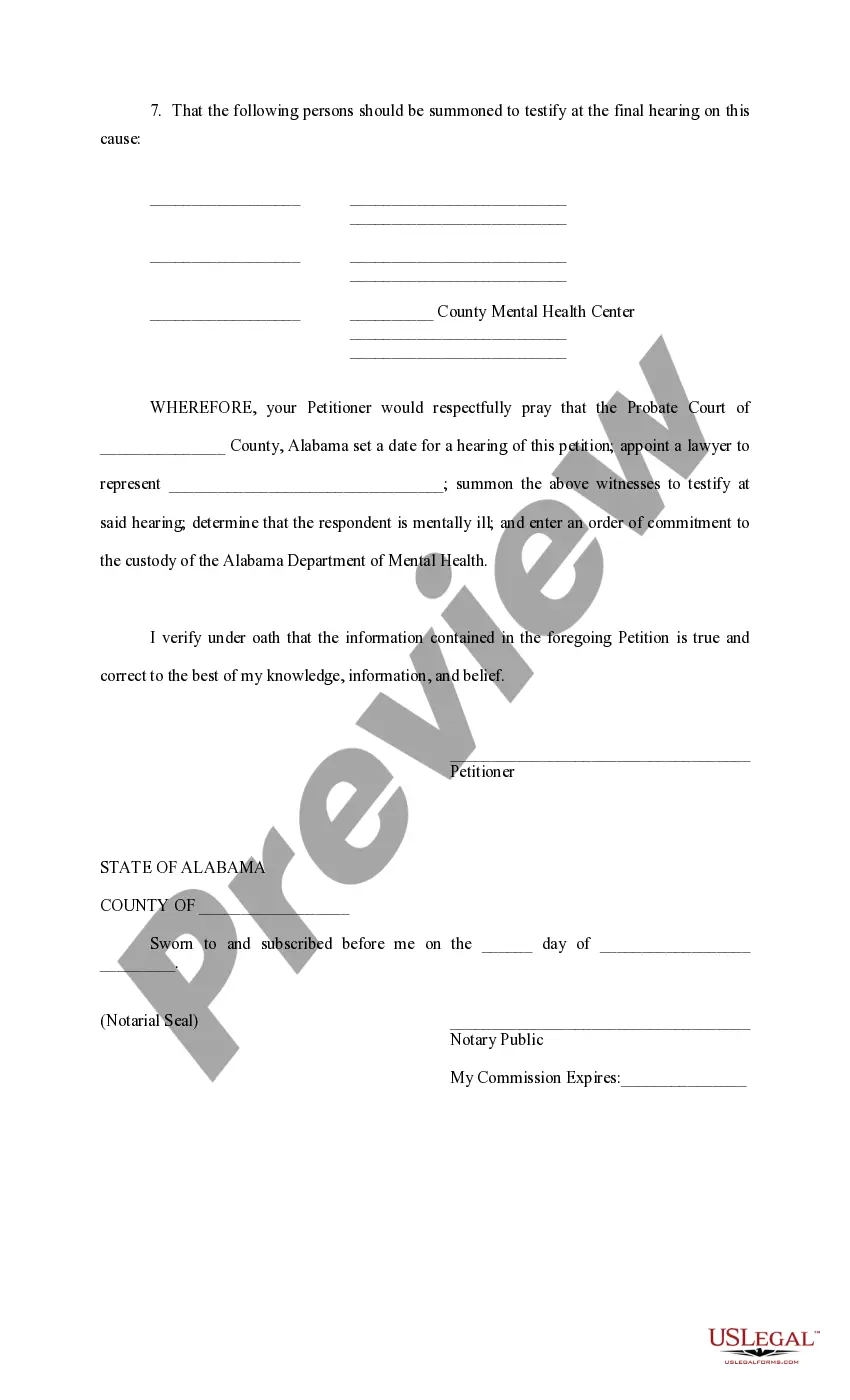
Get your form ready online
Our built-in tools help you complete, sign, share, and store your documents in one place.
Make edits, fill in missing information, and update formatting in US Legal Forms—just like you would in MS Word.
Download a copy, print it, send it by email, or mail it via USPS—whatever works best for your next step.
Sign and collect signatures with our SignNow integration. Send to multiple recipients, set reminders, and more. Go Premium to unlock E-Sign.
If this form requires notarization, complete it online through a secure video call—no need to meet a notary in person or wait for an appointment.
We protect your documents and personal data by following strict security and privacy standards.

Make edits, fill in missing information, and update formatting in US Legal Forms—just like you would in MS Word.

Download a copy, print it, send it by email, or mail it via USPS—whatever works best for your next step.

Sign and collect signatures with our SignNow integration. Send to multiple recipients, set reminders, and more. Go Premium to unlock E-Sign.

If this form requires notarization, complete it online through a secure video call—no need to meet a notary in person or wait for an appointment.

We protect your documents and personal data by following strict security and privacy standards.
Looking for another form?




How to fill out Alabama Petition For Mental Health Commitment?
Legal paperwork handling can be daunting, even for experienced professionals.
When you are looking for Alabama Involuntary Commitment Forms With Consent and lack the time to find the correct and current version, the process can be overwhelming.
US Legal Forms meets all your needs, from personal to business documentation, in a single location.
Utilize advanced tools to complete and manage your Alabama Involuntary Commitment Forms With Consent.
Here are the actions to take after obtaining the form you require: Verify it is the correct document by previewing it and reviewing its description. Ensure that the template is valid in your state or county. Click Buy Now when you are prepared. Choose a monthly subscription plan. Locate the format you need, and Download, complete, eSign, print, and send your document. Enjoy the US Legal Forms online library, supported by 25 years of expertise and reliability. Improve your everyday document management in a straightforward and user-friendly manner today.
- Access a wealth of articles, guides, and resources related to your situation and needs.
- Save time and effort searching for the necessary documents, and employ US Legal Forms’ sophisticated search and Review feature to locate and download Alabama Involuntary Commitment Forms With Consent.
- If you have a subscription, Log In to your US Legal Forms account, search for the document, and download it.
- Visit the My documents tab to view the documents you have previously saved and to organize your folders as desired.
- If it's your first experience with US Legal Forms, create a free account to gain unlimited access to all the advantages of the library.
- A comprehensive online form repository could revolutionize the way anyone addresses these matters.
- US Legal Forms stands as a leader in the online legal form sector, providing over 85,000 state-specific legal documents available to you at any time.
- With US Legal Forms, you can access legal and organizational forms that are specific to your state or county.
Form popularity
FAQ
5150 is the number of the section of the Welfare and Institutions Code, which allows an adult who is experiencing a mental health crisis to be involuntarily detained for a 72- hour psychiatric hospitalization when evaluated to be a danger to others, or to himself or herself, or gravely disabled.
The petitioner is usually a family member, but any person may file a petition seeking the commitment of another, provided that all the elements are met. Once the petition is filed and probable cause is determined, the patient may be involuntarily confined in a designated mental health facility.
Any person may seek to have another person committed by filing a petition with the Probate Court. WHAT MUST THE PETITION CONTAIN? Names and addresses of the other people with knowledge of the defendant's illness or who observed the person's overt acts and who may be called as his witnesses.
To get a court-ordered commitment, there must be some evidence to show that the person poses an imminent threat to him/herself or others. Evidence that suggests need for involuntary commitment include a threat of suicide, overt threats against another individual, or actions that might put people in danger.
House Bill 70 also expands the definition of ?real and present danger? for involuntary commitments to include the risk that the individual may ?cause, allow, or inflict serious bodily harm upon himself, herself, or another individual,? and ?be unable to satisfy his or her need for nourishment, medical care, shelter, or ...