Alabama Involuntary Commitment Forms For Juveniles
Description
Get your form ready online
Our built-in tools help you complete, sign, share, and store your documents in one place.
Make edits, fill in missing information, and update formatting in US Legal Forms—just like you would in MS Word.
Download a copy, print it, send it by email, or mail it via USPS—whatever works best for your next step.
Sign and collect signatures with our SignNow integration. Send to multiple recipients, set reminders, and more. Go Premium to unlock E-Sign.
If this form requires notarization, complete it online through a secure video call—no need to meet a notary in person or wait for an appointment.
We protect your documents and personal data by following strict security and privacy standards.

Make edits, fill in missing information, and update formatting in US Legal Forms—just like you would in MS Word.

Download a copy, print it, send it by email, or mail it via USPS—whatever works best for your next step.

Sign and collect signatures with our SignNow integration. Send to multiple recipients, set reminders, and more. Go Premium to unlock E-Sign.

If this form requires notarization, complete it online through a secure video call—no need to meet a notary in person or wait for an appointment.

We protect your documents and personal data by following strict security and privacy standards.
Looking for another form?

How to fill out Alabama Petition For Mental Health Commitment?
It’s clear that you cannot become a legal authority instantly, nor can you quickly understand how to prepare Alabama Involuntary Commitment Forms For Juveniles without possessing a specific set of expertise.
Drafting legal documents is a lengthy task that demands a particular level of education and expertise. So why not entrust the crafting of the Alabama Involuntary Commitment Forms For Juveniles to the professionals.
With US Legal Forms, one of the most extensive legal document repositories, you can locate anything from court filings to templates for internal communication.
You can regain access to your documents from the My documents section at any time. If you are a current client, you can simply Log In, and locate and download the template from the same section.
Regardless of the purpose of your documents—whether they are financial, legal, or personal—our platform has everything you need. Experience US Legal Forms today!
- Identify the form you require by utilizing the search bar at the top of the page.
- View it (if this option is available) and review the accompanying description to determine if Alabama Involuntary Commitment Forms For Juveniles is what you need.
- Restart your search if you require a different template.
- Sign up for a complimentary account and select a subscription plan to purchase the template.
- Click Buy now. Once the payment is processed, you can obtain the Alabama Involuntary Commitment Forms For Juveniles, complete it, print it, and deliver it by mail or send it to the appropriate individuals or organizations.
Form popularity
FAQ
A procedure whereby a person is involuntarily placed in the custody of the State Department of Mental Health for treatment. A person cannot be committed due to a drug or alcohol problem. The law specifically states that such problems do not constitute a mental illness for purposes of this act.
Section 22-52-1.2 - Filing and contents of petition seeking involuntary commitment of another (a) Any person may file a petition seeking the involuntary commitment of another person. The petition shall be filed in the probate court of the county in which the respondent is located.
To get a court-ordered commitment, there must be some evidence to show that the person poses an imminent threat to him/herself or others. Evidence that suggests need for involuntary commitment include a threat of suicide, overt threats against another individual, or actions that might put people in danger.
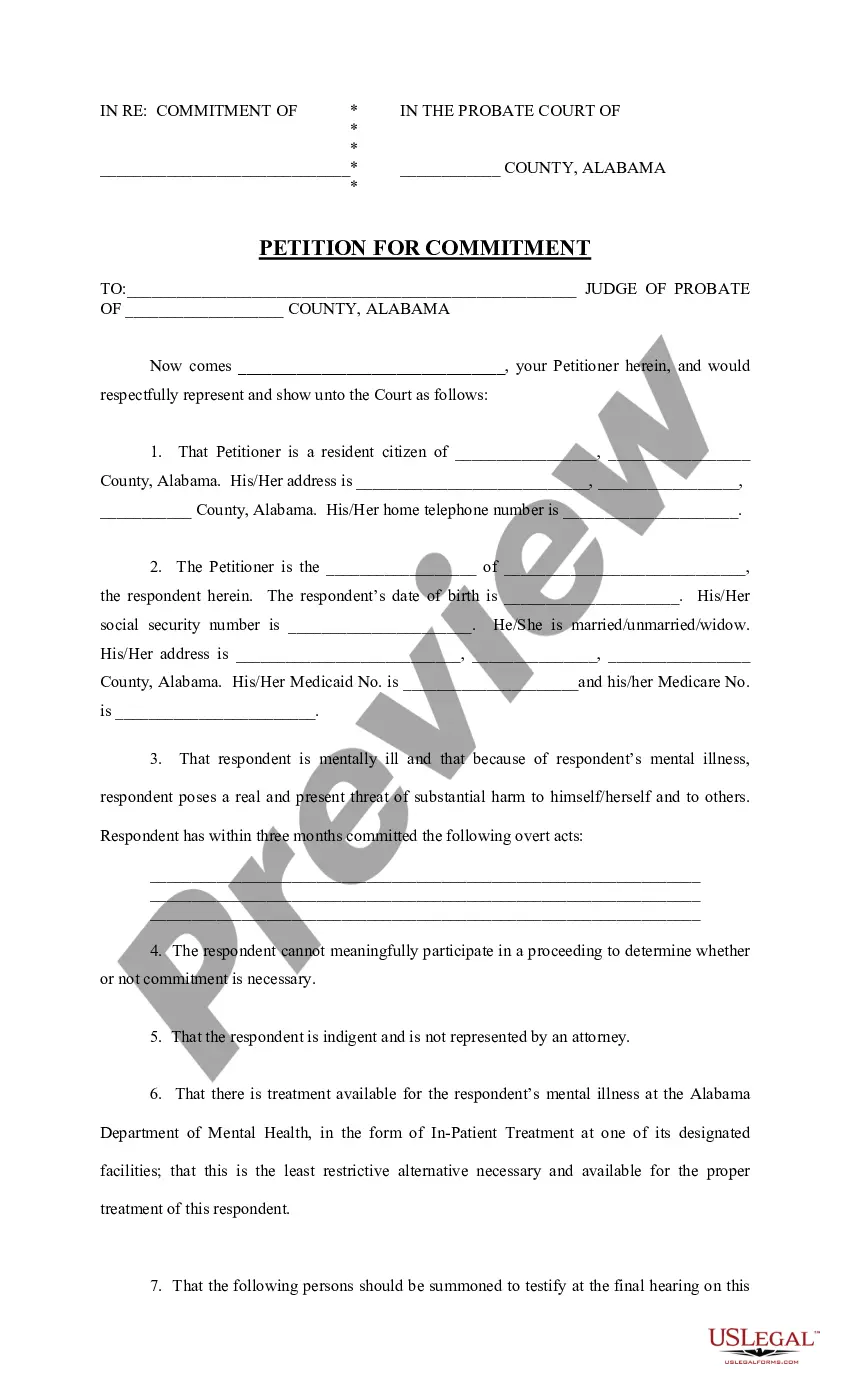
Any person may seek to have another person committed by filing a petition with the Probate Court. WHAT MUST THE PETITION CONTAIN? Names and addresses of the other people with knowledge of the defendant's illness or who observed the person's overt acts and who may be called as his witnesses.
House Bill 70 also expands the definition of ?real and present danger? for involuntary commitments to include the risk that the individual may ?cause, allow, or inflict serious bodily harm upon himself, herself, or another individual,? and ?be unable to satisfy his or her need for nourishment, medical care, shelter, or ...