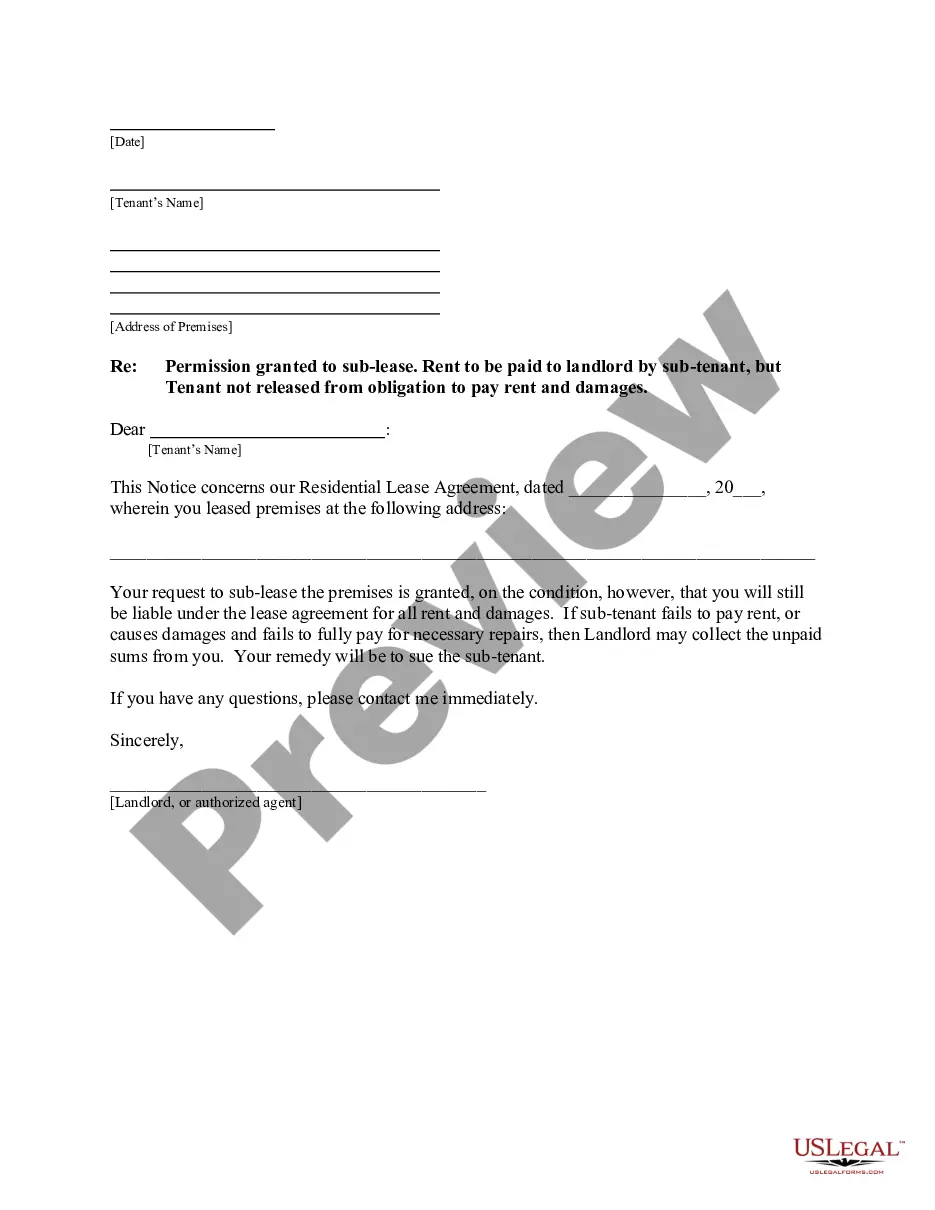
Delaware Letter from Landlord to Tenant that Sublease granted - Rent Paid by Subtenant, but Tenant Still Liable for Rent and Damages
Overview of this form
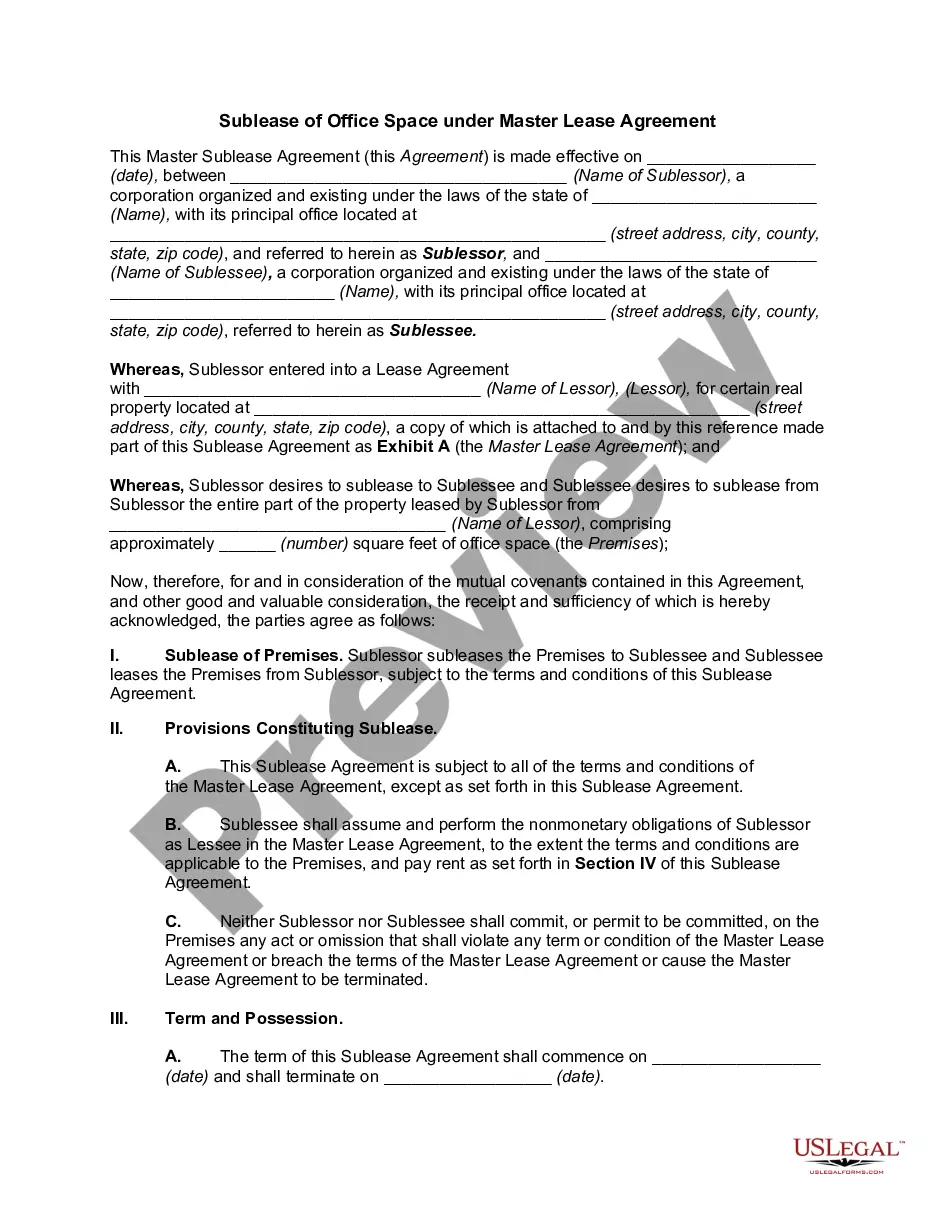
This form is a letter from the landlord to the tenant, confirming that a sublease has been granted. It clarifies that while the subtenant will pay the rent, the tenant remains responsible for rent and any damages. This letter serves as a legal acknowledgment of the sublease arrangement and emphasizes the tenant's liability, distinguishing it from other landlord-tenant communications.
Form components explained
- Confirmation of sublease approval.
- Statement of tenant's ongoing responsibility for rent and damages.
- Details regarding payment by the subtenant.
- Contact information for further inquiries.
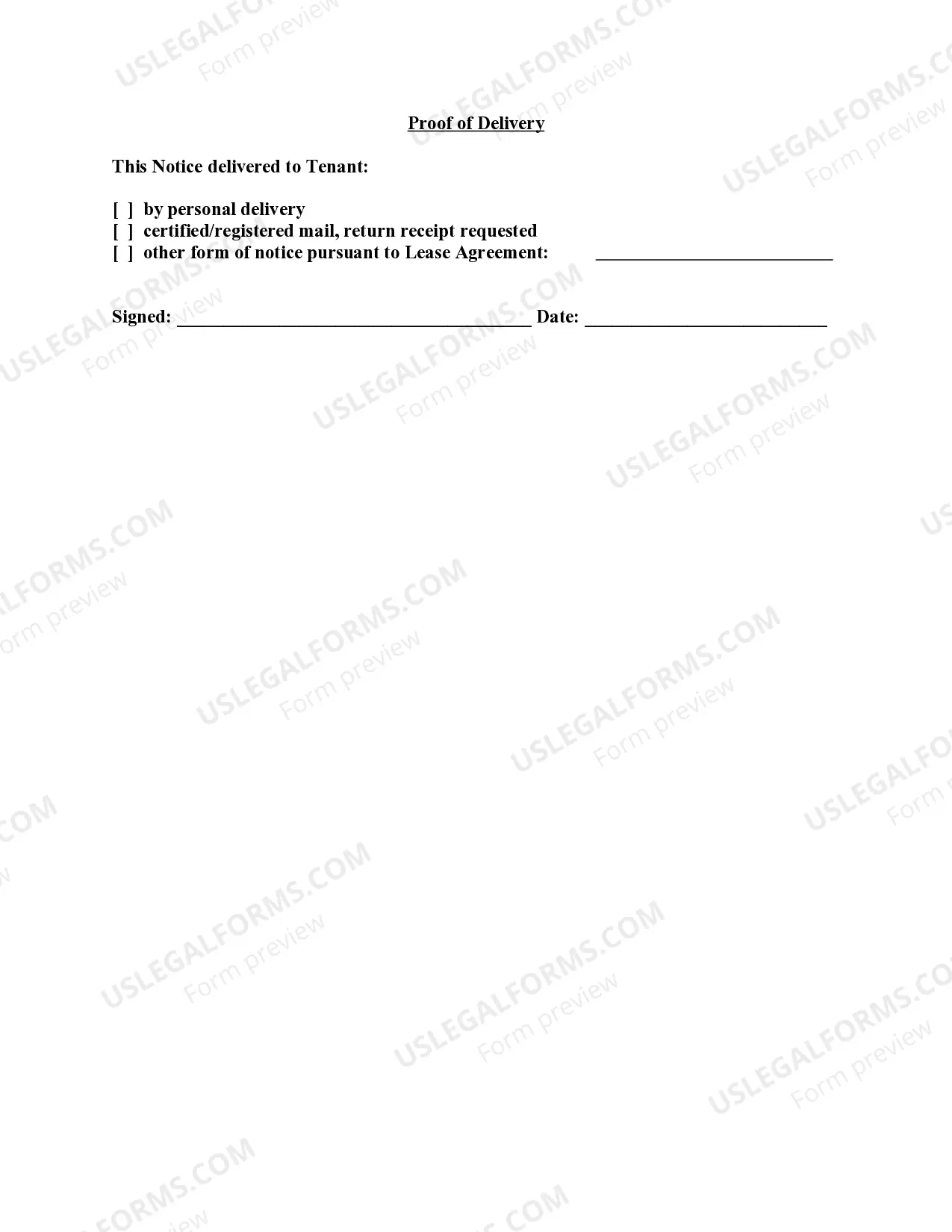
- Proof of delivery methods.

Situations where this form applies
This form is used when a tenant has received approval from their landlord to sublease their rental unit. It is essential in situations where the tenant wants to ensure that their rights and responsibilities are clearly stated, especially regarding financial liability in case the subtenant defaults on rent or causes damages to the property.
Intended users of this form
- Landlords looking to formally notify tenants of sublease approval.
- Tenants who have arranged a sublease and need to understand their ongoing liabilities.
- Subtenants who require clarification on their financial responsibilities.
Steps to complete this form
- Identify the parties involved: landlord, tenant, and subtenant.
- Provide the property address and details of the sublease.
- Include relevant dates of the sublease agreement.
- Sign the letter, including your title (Landlord or authorized agent).
- Choose a proof of delivery method: personal delivery or certified/registered mail.
Does this document require notarization?
Notarization is not commonly needed for this form. However, certain documents or local rules may make it necessary. Our notarization service, powered by Notarize, allows you to finalize it securely online anytime, day or night.
Get your form ready online
Our built-in tools help you complete, sign, share, and store your documents in one place.
Make edits, fill in missing information, and update formatting in US Legal Forms—just like you would in MS Word.
Download a copy, print it, send it by email, or mail it via USPS—whatever works best for your next step.
Sign and collect signatures with our SignNow integration. Send to multiple recipients, set reminders, and more. Go Premium to unlock E-Sign.
If this form requires notarization, complete it online through a secure video call—no need to meet a notary in person or wait for an appointment.
We protect your documents and personal data by following strict security and privacy standards.

Make edits, fill in missing information, and update formatting in US Legal Forms—just like you would in MS Word.

Download a copy, print it, send it by email, or mail it via USPS—whatever works best for your next step.

Sign and collect signatures with our SignNow integration. Send to multiple recipients, set reminders, and more. Go Premium to unlock E-Sign.

If this form requires notarization, complete it online through a secure video call—no need to meet a notary in person or wait for an appointment.

We protect your documents and personal data by following strict security and privacy standards.
Mistakes to watch out for
- Failing to specify ongoing tenant liability, which can lead to misunderstandings.
- Not retaining proof of delivery, which is essential for legal documentation.
- Omitting essential details of the subtenant agreement.
Why complete this form online
- Convenient access allows for quick modifications and printing.
- Legal validity, ensuring all necessary clauses are included.
- Time-saving e-filing options facilitate easier processing.
Summary of main points
- The letter formalizes the sublease agreement while keeping the original tenant liable.
- Clear communication about tenant responsibilities is crucial.
- Using this form protects the landlord's interests and clarifies expectations for the tenant.
Looking for another form?
Form popularity
FAQ
A sublet occurs when a tenant rents out their leased property to another individual, known as the subtenant. For example, a tenant moving to another city for a job might enter into a sublease agreement, allowing a friend to occupy the apartment temporarily. In this situation, the original tenant must ensure they still comply with the lease terms, maintaining their responsibility for the property. This is vital because the original lease remains in effect, and the landlord will still hold the tenant responsible for rent and damages.
If you're seeking damages for emotional distress caused by a landlord's discrimination, or punitive damages for especially blatant and intentional discrimination, a lawsuit may well be your best bet. Understand what's involved in suing your landlord. You may file a lawsuit in either federal or state court.
Know your state's landlord/tenant laws. Read and respond to the court summons. Try to work out a settlement. Consider legal counsel. Show up for court. Look sharp and provide evidence.
A sublease is a legally binding contract made between a tenant and a new tenant (also known as a subtenant or a sublessee).Usually, the first tenant must get consent from the landlord before he/she is allowed to sublease the premises.
A subtenant is not a cotenant and does not have a direct relationship with your landlord. As their landlord, you can (and should) require them to pay rent directly to you and evict them if they fail to follow through. This differs from a cotenant, who can be evicted only by your landlord.
Only landlords are allowed to evict their tenants. A master tenant is considered a landlord in relation to his or her subtenant, meaning that a master tenant is able to evict a subtenant.Similarly, roommates who are co-tenants cannot evict their fellow co-tenants.
If a tenant is subletting without consent, it's likely they will have broken terms in their tenancy agreement. This breach of contract means that the landlord can take action to evict them from their home. Possession proceedings can be started quickly, but it's important to follow the correct legal process.
If the headlease is forfeited because the tenant has breached its terms, the underlease will end automatically.As an alternative, a tenant may be able to agree with the landlord that if the headlease is forfeited and the underlease falls away, the landlord will grant a new lease to the undertenant.
If your landlord breaches the warranty of habitability or the warranty of quiet enjoyment, you may be able to sue her to recover monetary damages.In some states, such as California and Arizona, you may be able to seek emotional distress damages if the landlord's actions were particularly egregious.
If a court finds you guilty of the first offence of unlawful subletting, you can be fined in the magistrates' court.At the magistrates' court, you can get up to six months in prison or a fine, or both. At the Crown Court the maximum penalty is imprisonment for two years or a fine, or both.