Connecticut Notice of Lease for Recording
About this form
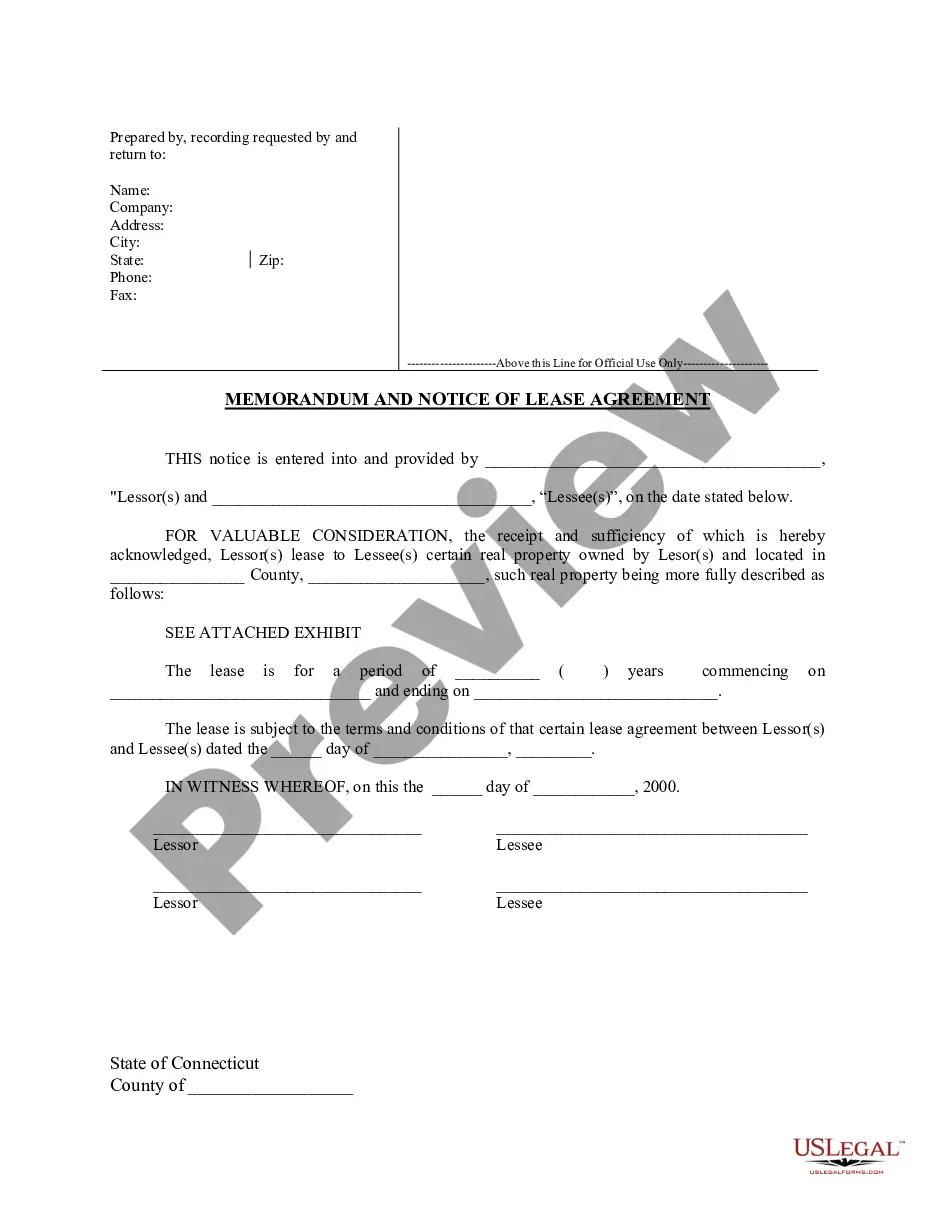
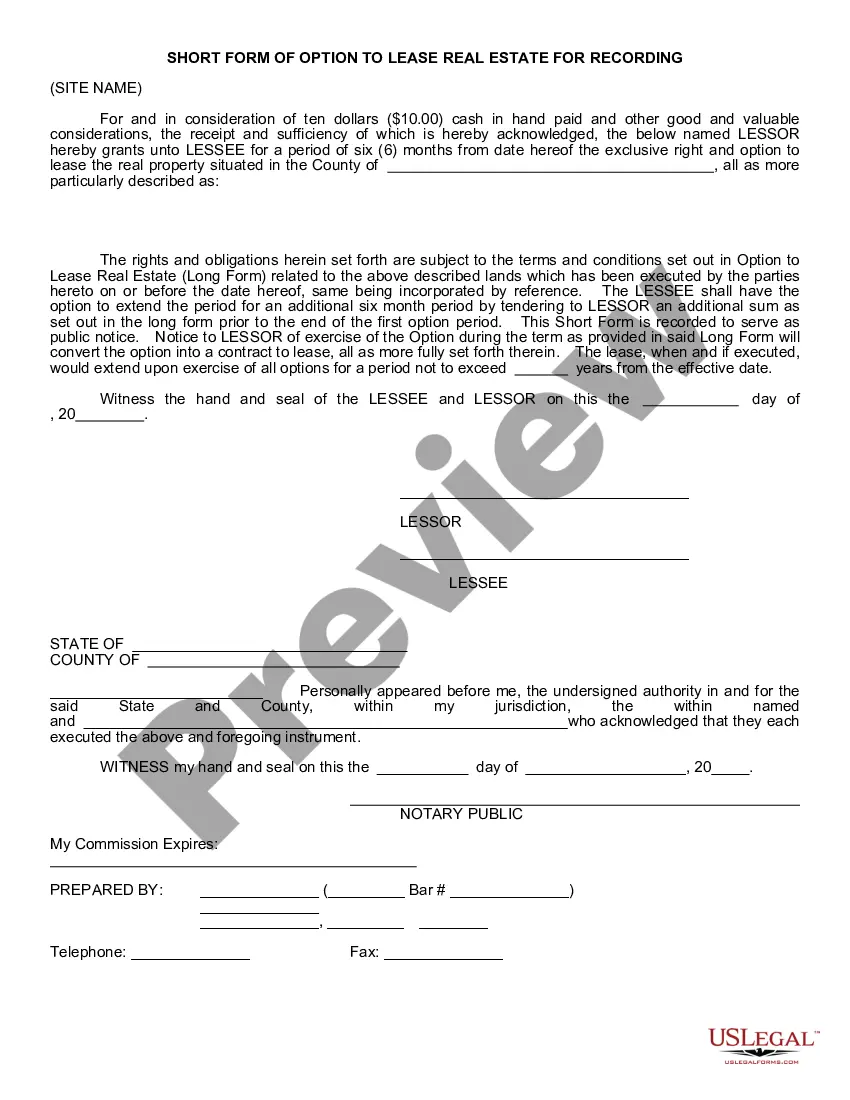
The Notice of Lease for Recording is a legal document used to officially record the existence of a lease agreement for a specific parcel of real estate. Unlike recording the entire lease agreement, this memorandum serves as a simplified approach to provide public notice of the lease, ensuring that interested parties are aware of the leasing arrangements in place.
Key components of this form
- Prepared by and contact information of the Lessor and Lessee
- Details of the leased property including county and description
- Lease term duration and commencement and expiration dates
- Referencing the original lease agreement date
- Signatures of the Lessor and Lessee
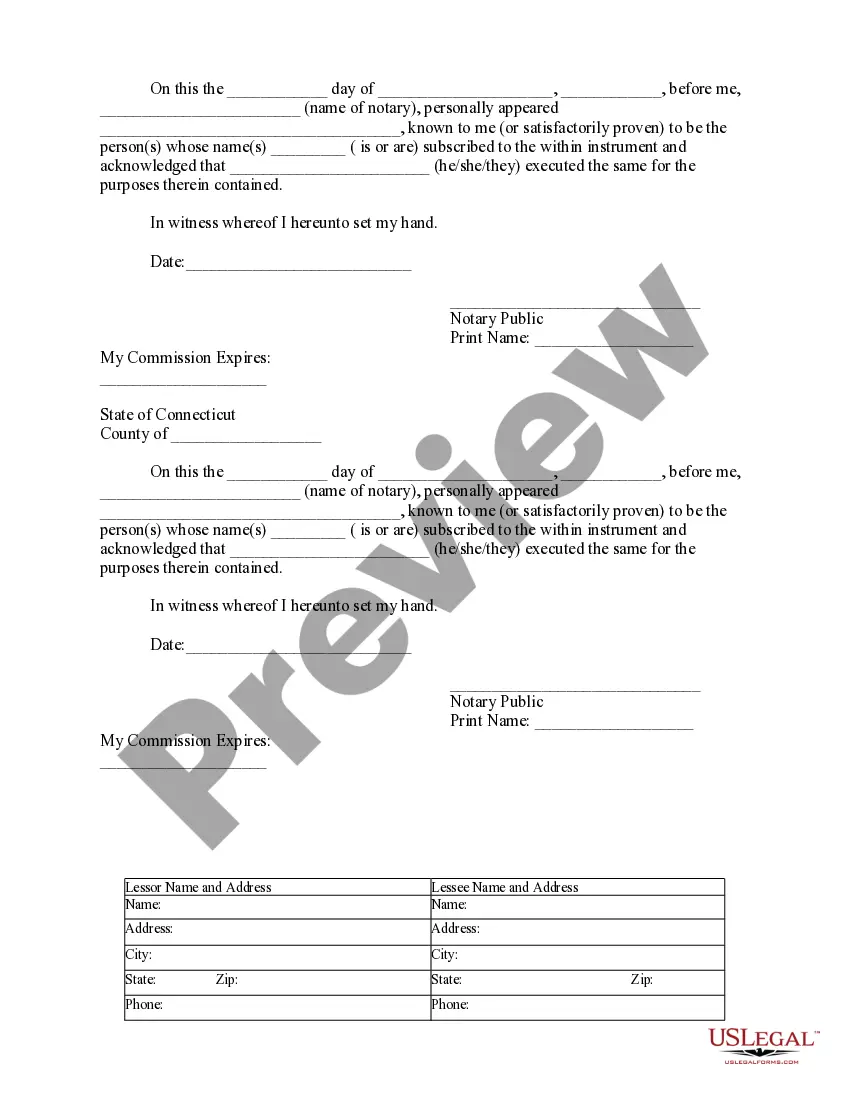
- Notary acknowledgment sections for verification

When this form is needed
This form should be used when a property owner (Lessor) wishes to record a lease agreement without submitting the entire document. It is particularly useful in circumstances where the lease is lengthy or contains sensitive information that the parties prefer not to disclose publicly while still providing legal notice of the lease's existence.
Who this form is for
This form is intended for:
- Property owners or Lessors leasing out their real estate
- Tenants or Lessees entering into lease agreements
- Real estate attorneys assisting clients with lease agreements
- Individuals or businesses looking to protect their lease interest publicly
Steps to complete this form
- Identify the parties involved: Provide the names of Lessor(s) and Lessee(s).
- Specify the property: Include detailed information about the property being leased.
- Enter the lease term: State the duration of the lease, including start and end dates.
- Reference the original lease: Specify the date of the lease agreement to which this notice pertains.
- Collect signatures: Both Lessor and Lessee must sign the form in the designated areas.
- Obtain notarization: Ensure a notary public witnesses the signatures to validate the document.
Is notarization required?
This form must be notarized to be legally valid. US Legal Forms provides secure online notarization powered by Notarize, allowing you to complete the process through a verified video call.
Get your form ready online
Our built-in tools help you complete, sign, share, and store your documents in one place.
Make edits, fill in missing information, and update formatting in US Legal Forms—just like you would in MS Word.
Download a copy, print it, send it by email, or mail it via USPS—whatever works best for your next step.
Sign and collect signatures with our SignNow integration. Send to multiple recipients, set reminders, and more. Go Premium to unlock E-Sign.
If this form requires notarization, complete it online through a secure video call—no need to meet a notary in person or wait for an appointment.
We protect your documents and personal data by following strict security and privacy standards.

Make edits, fill in missing information, and update formatting in US Legal Forms—just like you would in MS Word.

Download a copy, print it, send it by email, or mail it via USPS—whatever works best for your next step.

Sign and collect signatures with our SignNow integration. Send to multiple recipients, set reminders, and more. Go Premium to unlock E-Sign.

If this form requires notarization, complete it online through a secure video call—no need to meet a notary in person or wait for an appointment.

We protect your documents and personal data by following strict security and privacy standards.
Mistakes to watch out for
- Failing to provide complete names and contact information for all parties.
- Omitting key details about the leased property.
- Incorrectly stating the lease term dates.
- Not having the document notarized, when required.
- Forgetting to reference the original lease agreement accurately.
Benefits of completing this form online
- Convenience of downloading and completing the form at your own pace.
- Editability allows users to customize the form as needed.
- Access to forms prepared by licensed attorneys ensures reliability and compliance.
- Ability to store copies digitally for record-keeping purposes.
Looking for another form?

Form popularity
FAQ
The new tenant law in Connecticut includes various protections for renters, focusing on maintaining safe and healthy living conditions. It mandates timely repairs and prohibits landlords from retaliating against tenants who exercise their rights. Understanding these laws is crucial, and utilizing a Connecticut Notice of Lease for Recording can help tenants secure their rights and interests in any rental agreement.
Yes, a handwritten lease agreement can be legally binding as long as it meets the state's legal requirements. It's important that the document clearly outlines the terms, is signed by both parties, and is in writing. However, consider using a Connecticut Notice of Lease for Recording to formally document it and prevent misunderstandings later on.
No, leases do not need to be notarized to be legally binding in Connecticut. What matters is that the lease is properly executed, which means it must be signed by both the landlord and tenant. That said, using a Connecticut Notice of Lease for Recording can prove beneficial, offering public record documentation that may help resolve potential future disputes.
Yes, a lease is valid in Connecticut even if it is not notarized. The critical factors are that the lease must be in writing and signed by both parties. However, notarizing a lease agreement adds an extra level of protection and can prevent disputes over its authenticity in the future. Utilizing a Connecticut Notice of Lease for Recording can further legitimize your lease by providing public documentation.
In Connecticut, a will must be signed by the testator and witnessed by at least two individuals who are not beneficiaries. While notarization is not a requirement for a will to be valid, having it notarized can strengthen its authenticity. Therefore, while you don’t need a notarized will, doing so can enhance its credibility in court, especially when disputes arise.
To record a lease agreement in Connecticut, you must first ensure it meets all legal requirements. Typically, this involves completing a Connecticut Notice of Lease for Recording, which you can file with the town or city where the property is located. Once you have the notice signed and dated by all parties, you can submit it to the appropriate local office for recording, thereby making your lease publicly accessible.
When a lease is recorded, it means that the document is officially filed with the local land records office. This process ensures that the terms of the lease become part of the public record, which helps protect the rights of both landlords and tenants. By utilizing a Connecticut Notice of Lease for Recording, you can solidify your agreement and prevent future disputes. Ultimately, this measure enhances transparency and can facilitate smoother transactions within real estate.
You might want to record a lease to solidify your legal rights and responsibilities. By filing the Connecticut Notice of Lease for Recording, you create an official record that can be referenced in case of disputes or litigation. This recording also shows future purchasers or tenants the existing lease terms, helping maintain clarity and transparency.
When a lease is recorded, it signifies that the lease has been filed with the land records office, giving it legal standing within public records. This action, particularly when using the Connecticut Notice of Lease for Recording, enhances the enforceability of the lease terms. It also provides a clear timeframe and details that can protect both tenants and landlords.
To record a lease, first complete the Connecticut Notice of Lease for Recording. This form should be filed with your local land records office. After submission, the lease will be part of the public record, providing a clear, legal reference for both parties involved in the lease.