Connecticut Residential Lease Renewal Agreement
Understanding this form
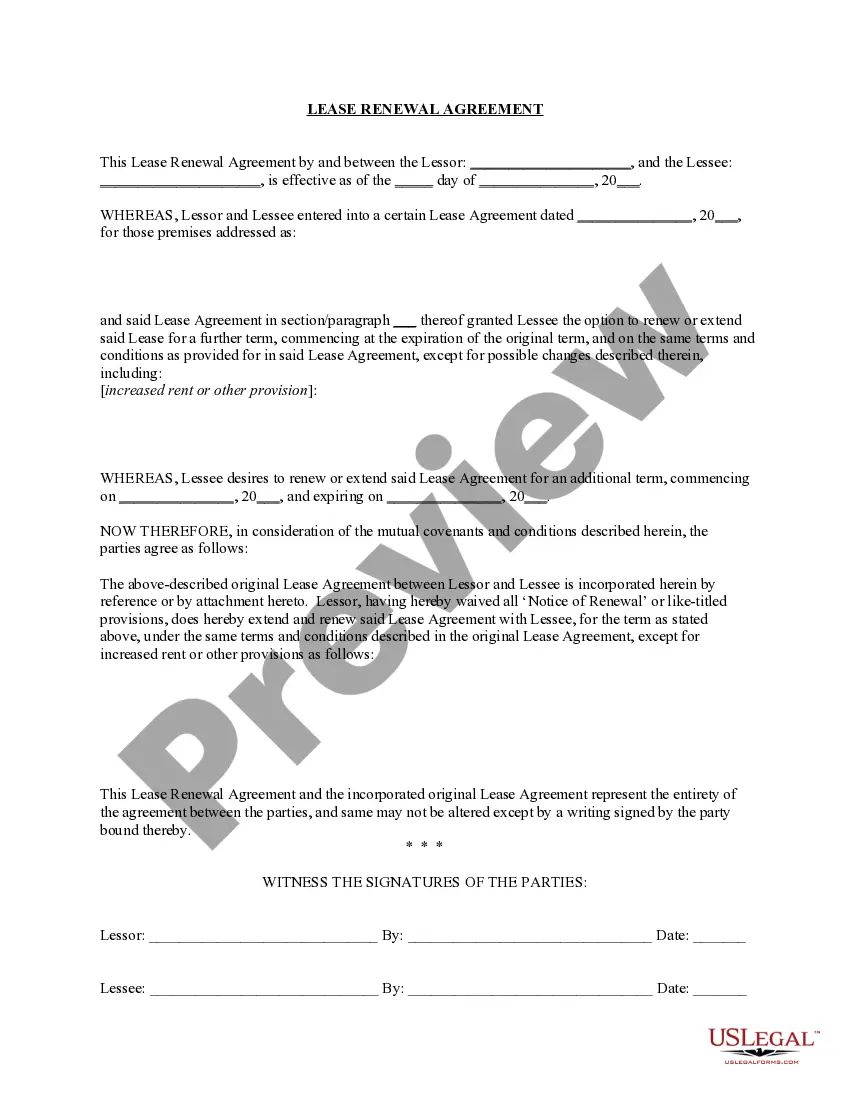
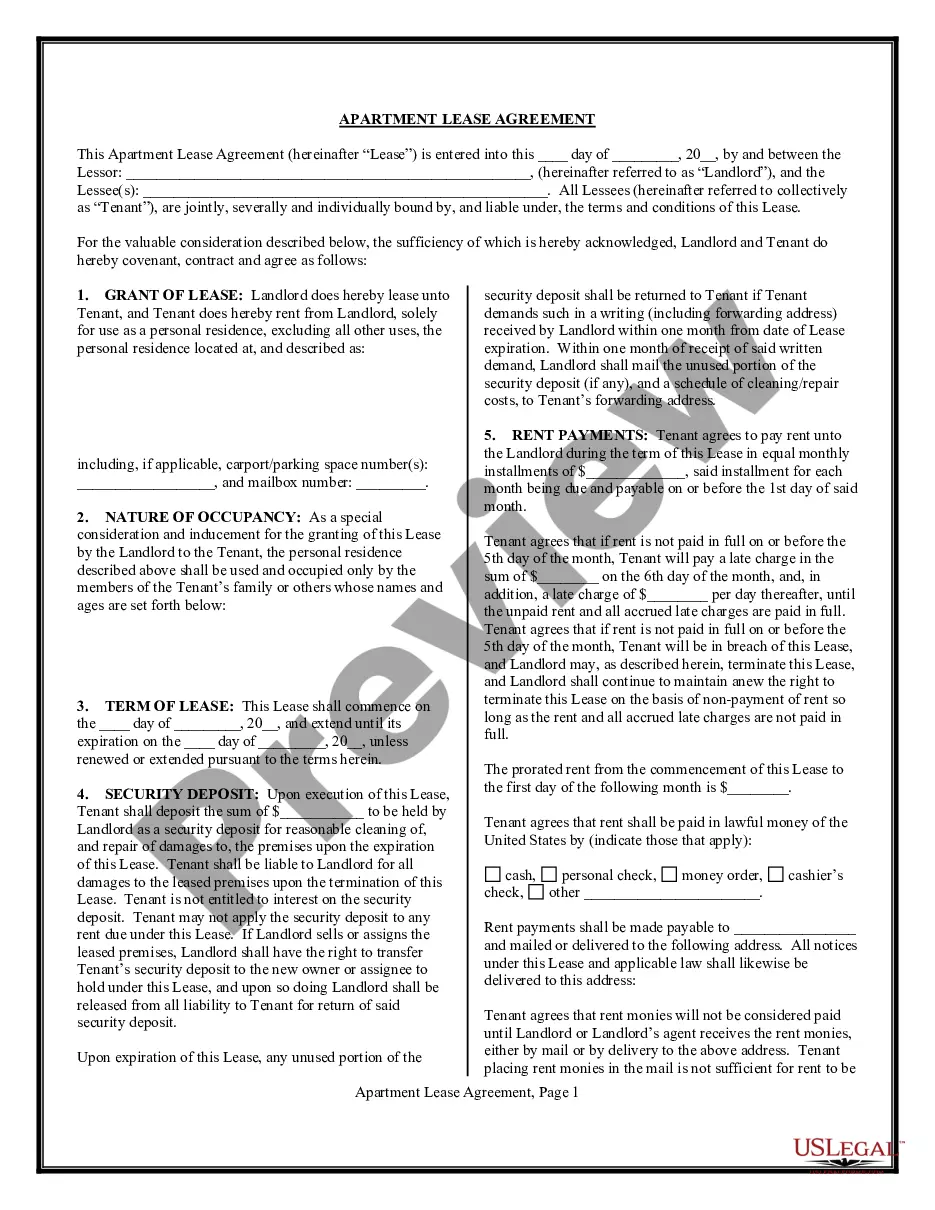
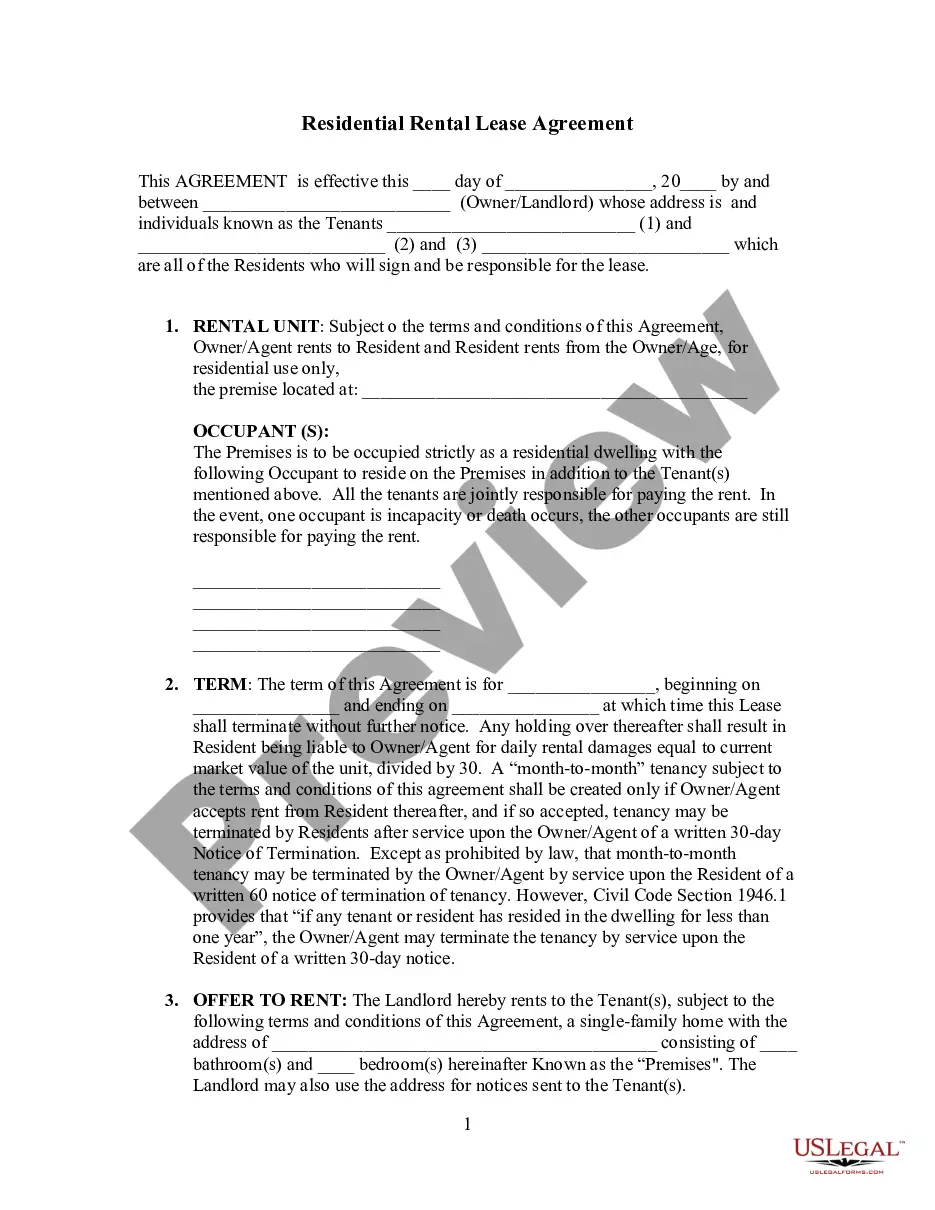
A Residential Lease Renewal Agreement is a legal document that formalizes the renewal of an existing residential lease between a landlord (lessor) and tenant (lessee). This agreement usually allows for an extension of the lease term, possibly with modifications to the original terms. Unlike a new lease agreement, this form is specifically designed to continue an existing rental arrangement while complying with state statutory law.
What’s included in this form
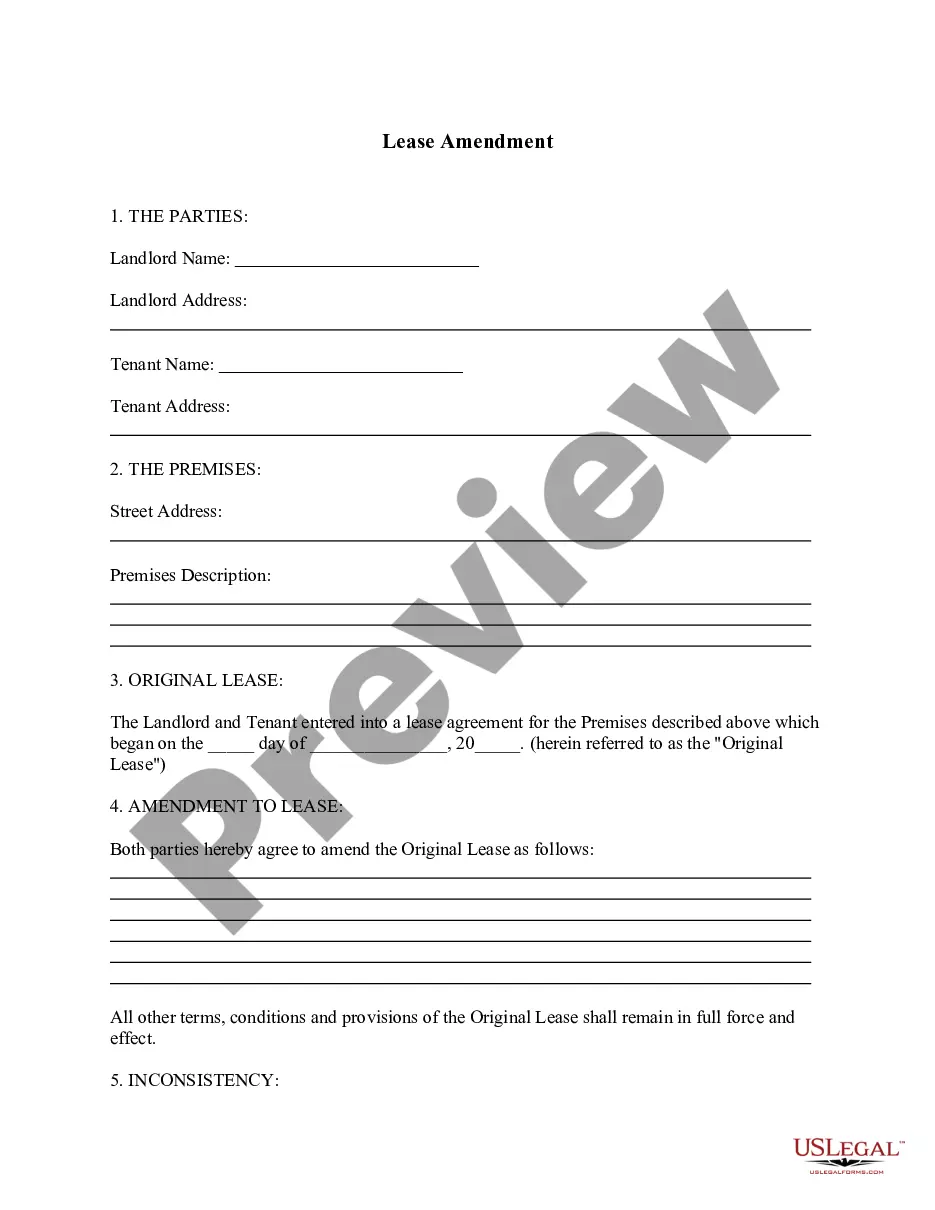
- Parties involved: Identifies the lessor and lessee.
- Effective date: Specifies when the renewal takes effect.
- Original lease details: References the original lease agreement's date.
- Property address: Clearly states the leased property's location.
- Signatures: Requires signatures and dates from both parties to validate the agreement.
Common use cases
This form should be used when a tenant and landlord wish to extend an existing residential lease agreement. It is particularly useful for situations where both parties are satisfied with the current lease terms but want to formalize the continuation for another term, which may involve minor updates or adjustments if necessary.
Who can use this document
- Landlords seeking to renew a lease with their tenants.
- Tenants who wish to continue their residence under the same terms as the original lease.
- Property managers handling lease renewals on behalf of property owners.
Instructions for completing this form
- Identify the parties: Fill in the names of the lessor and lessee.
- Enter the effective date: Specify the date when the renewal begins.
- Reference the original lease: Provide the date of the original lease agreement.
- Specify the property: Write the full address of the rental property.
- Obtain signatures: Have both parties sign and date the document to finalize the renewal.
Is notarization required?
Notarization is generally not required for this form. However, certain states or situations might demand it. You can complete notarization online through US Legal Forms, powered by Notarize, using a verified video call available anytime.
Get your form ready online
Our built-in tools help you complete, sign, share, and store your documents in one place.
Make edits, fill in missing information, and update formatting in US Legal Forms—just like you would in MS Word.
Download a copy, print it, send it by email, or mail it via USPS—whatever works best for your next step.
Sign and collect signatures with our SignNow integration. Send to multiple recipients, set reminders, and more. Go Premium to unlock E-Sign.
If this form requires notarization, complete it online through a secure video call—no need to meet a notary in person or wait for an appointment.
We protect your documents and personal data by following strict security and privacy standards.

Make edits, fill in missing information, and update formatting in US Legal Forms—just like you would in MS Word.

Download a copy, print it, send it by email, or mail it via USPS—whatever works best for your next step.

Sign and collect signatures with our SignNow integration. Send to multiple recipients, set reminders, and more. Go Premium to unlock E-Sign.

If this form requires notarization, complete it online through a secure video call—no need to meet a notary in person or wait for an appointment.

We protect your documents and personal data by following strict security and privacy standards.
Common mistakes
- Failing to include the effective date of the renewal.
- Not referencing the original lease agreement correctly.
- Missing signatures or dates, which could invalidate the agreement.
- Using outdated or incorrect property addresses.
Benefits of completing this form online
- Convenience of completing the form from anywhere at any time.
- Editability allows for quick updates before finalization.
- Access to forms drafted by licensed attorneys, ensuring legal reliability.
- Easy download for printing and sharing with the involved parties.
Looking for another form?
Form popularity
FAQ
In Connecticut, a tenant may stay after the lease expires as a holdover tenant, but this status can vary based on the landlord's decision. Generally, if the landlord agrees, a tenant can remain until the landlord provides a notice to vacate. However, once the lease term ends, it is essential to clarify the situation in relation to your Connecticut Residential Lease Renewal Agreement to avoid any potential disputes.
The renewal clause in a lease agreement outlines the process and conditions for extending the lease term. It typically includes details about the notice period required and any adjustments to rent. Understanding the renewal clause helps ensure that both parties comply with the terms of the Connecticut Residential Lease Renewal Agreement, promoting a smooth transition.
A lease renewal clause details the conditions under which a lease may be renewed. An example could state, 'The tenant may renew this lease for one additional year at the current rent, provided that the landlord receives notice of intent to renew 30 days before the lease concludes.' This clause is vital as it governs the terms of your Connecticut Residential Lease Renewal Agreement.
A lease automatic renewal clause specifies that the lease will automatically extend for a set period unless either party provides notice to terminate. For example, the agreement could read, 'This lease will automatically renew for an additional 12 months unless the tenant gives written notice 30 days before the end of the current lease term.' Understanding this clause is crucial when reviewing your Connecticut Residential Lease Renewal Agreement.
An option to renew clause allows a tenant to extend their lease for an additional period at a predetermined rate. For instance, the clause might state, 'The tenant has the option to renew the lease for another year at a rate of $1,500 per month, provided that the landlord receives written notice 60 days prior to the lease's expiration.' This clause can significantly enhance your Connecticut Residential Lease Renewal Agreement by providing flexibility.
When communicating with your landlord about renewing your lease, it is helpful to express your desire to continue renting the property. Clearly state your appreciation for the home and your satisfaction with the current arrangement. Mention any requested changes or updates to the lease terms, if necessary, ensuring you approach the conversation positively. This dialogue sets a solid foundation for your Connecticut Residential Lease Renewal Agreement.
To renew your residential lease, start by reviewing your current lease agreement for any specific renewal terms. Next, communicate with your landlord about your intention to renew the lease, ideally well before the expiration date. After reaching an agreement, ensure you receive a new lease document that outlines any updated terms. This process is critical to formalizing your Connecticut Residential Lease Renewal Agreement.
In Connecticut, a landlord can indeed refuse to renew a lease, but they must adhere to state regulations regarding notice and fair practices. If a tenant has fulfilled their lease obligations, the reasons for non-renewal should be legitimate and not discriminatory. Knowledge of the Connecticut Residential Lease Renewal Agreement is crucial for both landlords and tenants to ensure fairness. For personalized assistance, exploring options through US Legal Forms can provide vital legal insights.
Yes, a landlord can choose not to renew a lease, but they must follow specific legal processes. Typically, in Connecticut, landlords must notify tenants of their intention not to renew by a certain date, as stated in the lease agreement. Understanding the Connecticut Residential Lease Renewal Agreement can clarify your rights and obligations as a tenant. Seeking guidance from US Legal Forms can assist you in mitigating any issues related to lease renewal.
Yes, you can contest a non-renewal of your lease under certain circumstances. If you believe the non-renewal violates state laws or your lease agreement, you may have grounds to challenge it. The Connecticut Residential Lease Renewal Agreement protects tenant rights, and consulting with an expert can help you navigate your options. Using platforms like US Legal Forms can provide you with the necessary legal resources.