Connecticut Demand for Discharge - Individual
What is this form?
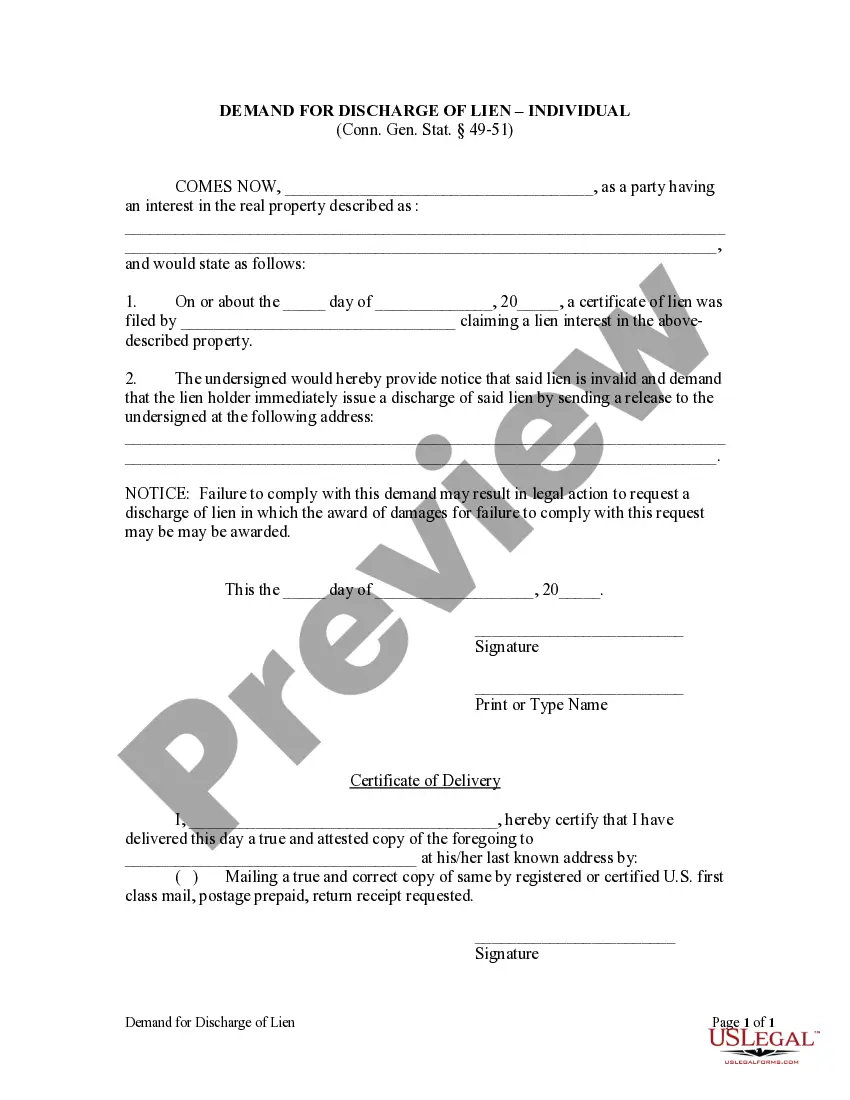
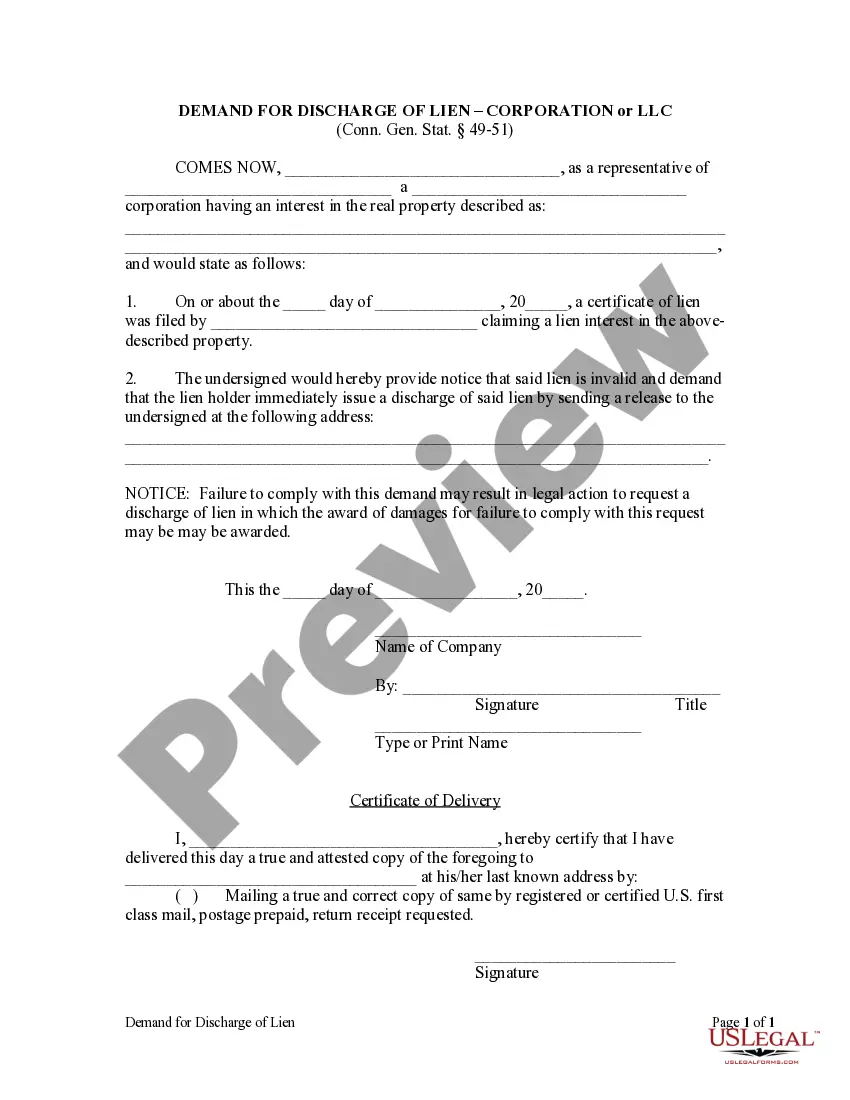
The Demand for Discharge - Individual form is a legal document used to request the removal of an invalid lien on a real property. This form allows an individual with a legitimate interest in the property to notify the lien holder that the lien is no longer valid and to seek a formal release. Unlike similar forms that might simply ask for a lien to be contested, this specific demand emphasizes the invalidity of the lien, providing a clear pathway for individuals to protect their property rights.
Key parts of this document
- Identification of the party making the demand
- Details of the real property associated with the lien
- Information regarding the certificate of lien, including the date filed and lien holder's name
- Statement declaring the lien's invalidity
- Request for immediate discharge of the lien
- Notification of potential legal actions if the request is ignored
When to use this document
This form should be used when an individual has a vested interest in a property and believes that a lien against the property is invalid. Situations may include discovering that a lien was filed in error, a miscommunication about debts, or the completion of a financial obligation that was previously secured by the lien. Using this form can prompt a timely response from the lien holder to resolve the issue before further legal actions are necessary.
Intended users of this form
- Individuals or parties who own or have a financial interest in real estate.
- Property owners seeking to clear invalid liens from their property titles.
- Anyone needing to formally notify a lien holder of the invalidity of their lien.
- Individuals preparing for potential legal actions if a lien holder fails to respond appropriately.
Instructions for completing this form
- Identify the party making the demand by filling in their name.
- Clearly specify the property in question, providing full details of the real estate concern.
- Enter the date when the lien was filed and the name of the lien holder.
- State the reason why the lien is invalid, asserting your claim.
- Provide your delivery address for the lien release and sign the form appropriately.
- Complete the certification of delivery, including sending the form via registered or certified mail.
Notarization requirements for this form
This form must be notarized to be legally valid. US Legal Forms provides secure online notarization powered by Notarize, allowing you to complete the process through a verified video call.
Get your form ready online
Our built-in tools help you complete, sign, share, and store your documents in one place.
Make edits, fill in missing information, and update formatting in US Legal Forms—just like you would in MS Word.
Download a copy, print it, send it by email, or mail it via USPS—whatever works best for your next step.
Sign and collect signatures with our SignNow integration. Send to multiple recipients, set reminders, and more. Go Premium to unlock E-Sign.
If this form requires notarization, complete it online through a secure video call—no need to meet a notary in person or wait for an appointment.
We protect your documents and personal data by following strict security and privacy standards.

Make edits, fill in missing information, and update formatting in US Legal Forms—just like you would in MS Word.

Download a copy, print it, send it by email, or mail it via USPS—whatever works best for your next step.

Sign and collect signatures with our SignNow integration. Send to multiple recipients, set reminders, and more. Go Premium to unlock E-Sign.

If this form requires notarization, complete it online through a secure video call—no need to meet a notary in person or wait for an appointment.

We protect your documents and personal data by following strict security and privacy standards.
Mistakes to watch out for
- Failing to provide complete property details, which could delay processing.
- Not addressing the form to the correct lien holder or using an outdated address.
- Skipping the certification of delivery, which is essential for legal documentation.
- Not keeping a copy of the sent demand for personal records.
Why complete this form online
- Conveniently downloadable for immediate use.
- Easy to customize according to individual circumstances.
- Drafted by licensed attorneys for reliability and legal compliance.
- Available to access anytime, eliminating the need for in-person consultations.
Looking for another form?

Form popularity
FAQ
The EPA defines stormwater as water that originates from precipitation events, including rain and snowmelt. This definition encompasses all forms of runoff and highlights the need for proper management to protect water resources. Understanding the regulations surrounding stormwater is essential for compliance in Connecticut. You can leverage US Legal Forms to stay informed and ensure adherence to the Connecticut Demand for Discharge - Individual regulations.
Most states, including Connecticut, can manage their own stormwater permitting systems under EPA guidelines. However, certain conditions must be met to ensure that states effectively oversee water quality and public health. Knowing the legal framework can help you navigate these regulations confidently. If you seek more information, consider utilizing platforms like US Legal Forms to understand the Connecticut Demand for Discharge - Individual better.
The general permit for stormwater discharges in Connecticut provides a streamlined approach for managing stormwater runoff from certain activities. This permit outlines specific conditions that must be followed to protect water quality. It's vital for both businesses and homeowners to adhere to these conditions to avoid legal repercussions. Using US Legal Forms can simplify understanding and applying for the Connecticut Demand for Discharge - Individual permit.
Stormwater discharge refers to the release of rainwater or melted snow from surfaces, like roads or rooftops, into water bodies. This discharge can carry pollutants that affect water quality, making regulation important. Understanding how your activities may impact stormwater discharge is essential for compliance with the Connecticut Demand for Discharge - Individual. Resources like US Legal Forms offer guidance to help you manage these responsibilities effectively.
A stormwater general permit is a legal document that allows you to discharge stormwater under specific conditions. In Connecticut, this permit covers various activities related to managing stormwater runoff, ensuring they meet state and federal regulations. Compliance with this permit can significantly reduce legal risks associated with non-compliance. If you need clarity and support in this process, the US Legal Forms platform can provide valuable insights.
Filling out a Connecticut bill of sale is straightforward. Start by including the date of the transaction, names and addresses of both the buyer and seller, and a detailed description of the item being sold. If you're dealing with vehicles, include the VIN and odometer reading. Consider using resources like US Legal Forms to find templates that guide you through the process, ensuring compliance with Connecticut Demand for Discharge - Individual requirements.
A lis pendens generally remains valid for 90 days in Connecticut, mirroring the duration established across many states. Should the underlying action continue, you can seek to extend this notice. Keeping track of your lis pendens status is crucial to protect your interests in any real estate dealings. If you're uncertain about your rights, the Connecticut Demand for Discharge - Individual may offer you additional avenues to address related concerns effectively.
In Connecticut, a judgment lien is good for 20 years. This time frame begins from the date the judgment is rendered, and it can be renewed for an additional 20 years if necessary. Knowing the duration of a judgment lien helps you make informed decisions regarding your financial obligations. If you are facing a judgment lien, the Connecticut Demand for Discharge - Individual can be a pathway to resolving your situation.
Connecticut General Statutes 49-37 pertains to the enforcement and duration of judgment liens on real property. Specifically, it clarifies how long a judgment lien remains effective, which can be crucial when exploring options for discharge or resolution. Understanding this statute is essential for anyone looking to address liens in the context of the Connecticut Demand for Discharge - Individual. Using well-reviewed legal forms can assist you in properly navigating this law.
In Connecticut, a lis pendens is valid for a period of 90 days after being filed. However, it can be extended if the underlying action remains ongoing. It’s important to monitor the status of the lis pendens to ensure it does not impact your property rights longer than necessary. Utilizing resources like USLegalForms can guide you through managing such legal documents effectively.