Arkansas Revocation of Anatomical Gift Donation
Overview of this form
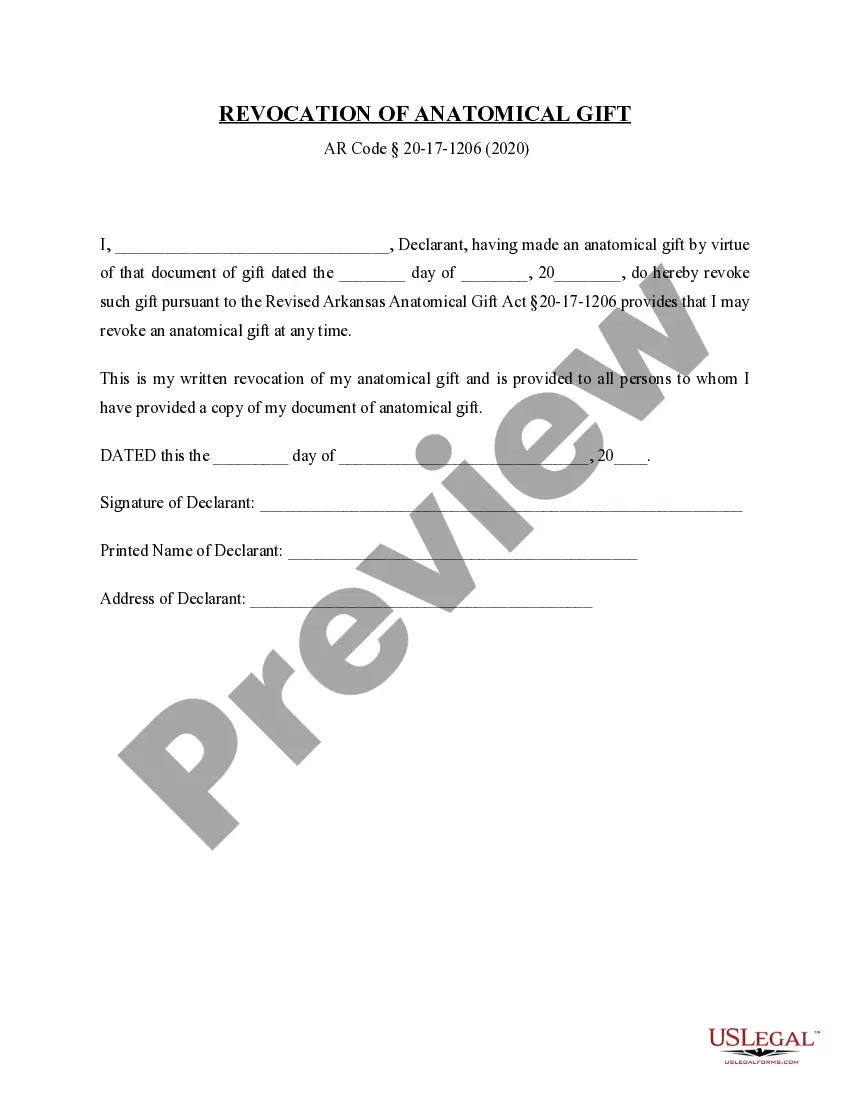
The Revocation of Anatomical Gift Donation form is a legal document that allows an individual to revoke a previously made decision regarding the donation of their organs or body parts upon death. This form specifically revokes the earlier executed Anatomical Gift Donation, providing clarity and formal acknowledgment of the individual's current wishes regarding organ donation.
What’s included in this form
- Declarant's full name: Identification of the person revoking the anatomical gift.
- Date of the previous anatomical gift: Reference to the original document of gift.
- Revocation statement: A declaration that the individual is revoking the anatomical gift.
- Signature of the Declarant: A legal signature to validate the revocation.
- Printed name and address: Personal details for identification and correspondence.
Common use cases
This form is necessary when an individual decides to change their mind about donating their anatomical gifts after having previously consented. Situations may include personal changes, such as health status changes, shifts in personal beliefs, or simply a reconsideration of the decision regarding organ and tissue donation.
Who needs this form
- Individuals who have previously executed an Anatomical Gift Donation.
- Persons who wish to formally revoke their decision to donate body parts and organs at the time of death.
- Anyone in Arkansas who wants to ensure their current wishes regarding organ donation are respected.
How to complete this form
- Fill in your full name as the Declarant.
- Include the date of the original anatomical gift document.
- Clearly state your intention to revoke the anatomical gift.
- Sign the declaration to authenticate your revocation.
- Print your name and provide your address for identification purposes.
Does this form need to be notarized?
This form does not typically require notarization to be legally valid. However, some jurisdictions or document types may still require it. US Legal Forms provides secure online notarization powered by Notarize, available 24/7 for added convenience.
Get your form ready online
Our built-in tools help you complete, sign, share, and store your documents in one place.
Make edits, fill in missing information, and update formatting in US Legal Forms—just like you would in MS Word.
Download a copy, print it, send it by email, or mail it via USPS—whatever works best for your next step.
Sign and collect signatures with our SignNow integration. Send to multiple recipients, set reminders, and more. Go Premium to unlock E-Sign.
If this form requires notarization, complete it online through a secure video call—no need to meet a notary in person or wait for an appointment.
We protect your documents and personal data by following strict security and privacy standards.

Make edits, fill in missing information, and update formatting in US Legal Forms—just like you would in MS Word.

Download a copy, print it, send it by email, or mail it via USPS—whatever works best for your next step.

Sign and collect signatures with our SignNow integration. Send to multiple recipients, set reminders, and more. Go Premium to unlock E-Sign.

If this form requires notarization, complete it online through a secure video call—no need to meet a notary in person or wait for an appointment.

We protect your documents and personal data by following strict security and privacy standards.
Typical mistakes to avoid
- Failing to sign the declaration properly.
- Not providing the date of the previous anatomical gift document.
- Omitting personal details such as the address.
Benefits of completing this form online
- Convenience of accessing and completing the form from home.
- Immediate download and easy editing capabilities.
- Reliability of attorney-drafted content for legal compliance.
Looking for another form?
Form popularity
FAQ
The laws governing organ donation in Arkansas are designed to protect both donors and recipients. Under the Arkansas Revocation of Anatomical Gift Donation framework, individuals can donate their organs with clear consent that can be revoked at any time. Specific regulations ensure that the rights of the donor are respected throughout the donation process. To better understand these laws and navigate the donation journey, consider utilizing the services of US Legal Forms, which provide detailed information and resources.
A revocation clause is a specific provision that outlines how a donor may withdraw their consent for a gift. In the context of Arkansas Revocation of Anatomical Gift Donation, this clause ensures that donors have a clear understanding of their rights. It is crucial to include such a clause in advance directives or donor cards. This clause serves as an essential part of a donor's legal rights and can guide them through the revocation process.
Yes, a gift can be revoked under certain conditions and guidelines. Specifically, with Arkansas Revocation of Anatomical Gift Donation, donors retain the legal right to change their minds about organ donation at any time before the procedure. This flexibility ensures that individuals can act according to their wishes as circumstances in their lives change. It is important that the revocation is documented appropriately to maintain clarity and avoid potential issues.
Gift revocation refers to the ability to withdraw or cancel a gift that was previously given. With Arkansas Revocation of Anatomical Gift Donation, individuals can effectively annul their intent to donate organs or tissues. Understanding the procedure can help donors navigate their rights and responsibilities. Always be aware that revocation must be done according to legal protocols to prevent any confusion in the future.
The revocation of a gift is the formal process of canceling a previously made gift. In the case of Arkansas Revocation of Anatomical Gift Donation, this action means that a donor decides to rescind their consent for organ or tissue donation. It's essential to follow appropriate guidelines to ensure the revocation is legally recognized. This process provides peace of mind for those who may have changed their mind regarding their donation status.
A revocable gift is an anatomical donation that can be withdrawn by the donor before it is executed. In the context of Arkansas Revocation of Anatomical Gift Donation, it allows individuals to change their minds about their decision to donate organs or tissues. This process ensures that a donor's final wishes are respected. The donor retains control over the decision until the point of actual organ donation.
The Uniform Anatomical Gift Act serves to provide a legal framework for organ and tissue donation in the United States. It facilitates the process by which individuals can donate their organs after death and helps others understand their rights and responsibilities related to donations. In particular, it outlines the procedures for the Arkansas Revocation of Anatomical Gift Donation, ensuring that families and medical professionals can make informed decisions. By being aware of these regulations, donors' intentions can be respected effectively.
The most important clause of the Uniform Anatomical Gift Act allows individuals to make decisions about organ and tissue donations while they are living. This empowers people in Arkansas to express their wishes regarding anatomical gifts. It emphasizes the importance of consent, ensuring that only the individual’s choice is respected. Therefore, understanding the regulations surrounding the Arkansas Revocation of Anatomical Gift Donation becomes crucial.
The organ donor deduction in Arkansas is a tax incentive for individuals who register as organ donors. This deduction can reduce taxable income, aiming to encourage more people to participate in organ donation. For comprehensive information related to organ donation and related legal considerations, including the Arkansas Revocation of Anatomical Gift Donation, the US Legal Forms platform provides useful resources to navigate the complexities.
The organ that cannot be donated after death is the brain, as its viability typically ceases when circulation stops. Other organs, such as the heart and kidneys, can still be donated if the right conditions are met. Understanding the Arkansas Revocation of Anatomical Gift Donation helps clarify consent and action regarding organ donation options, especially when considering donation preferences.