Pennsylvania Renunciation And Disclaimer of Property from Will by Testate
What this document covers
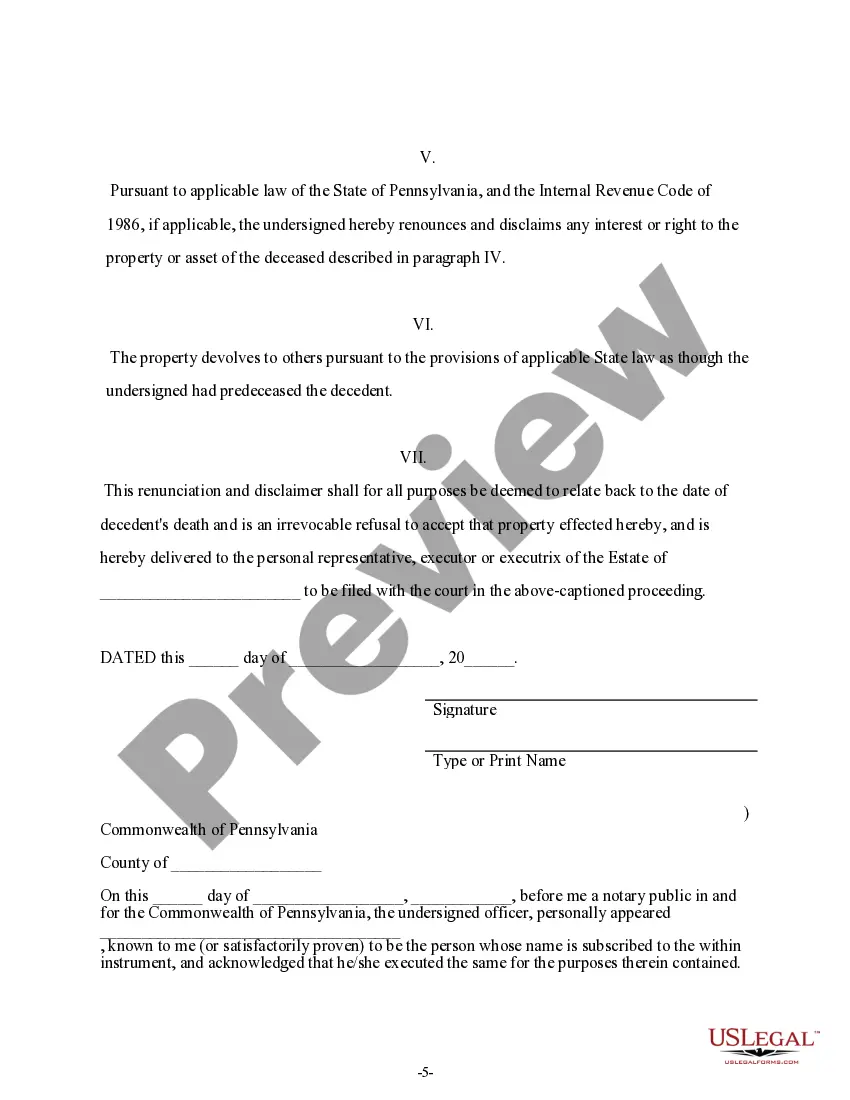
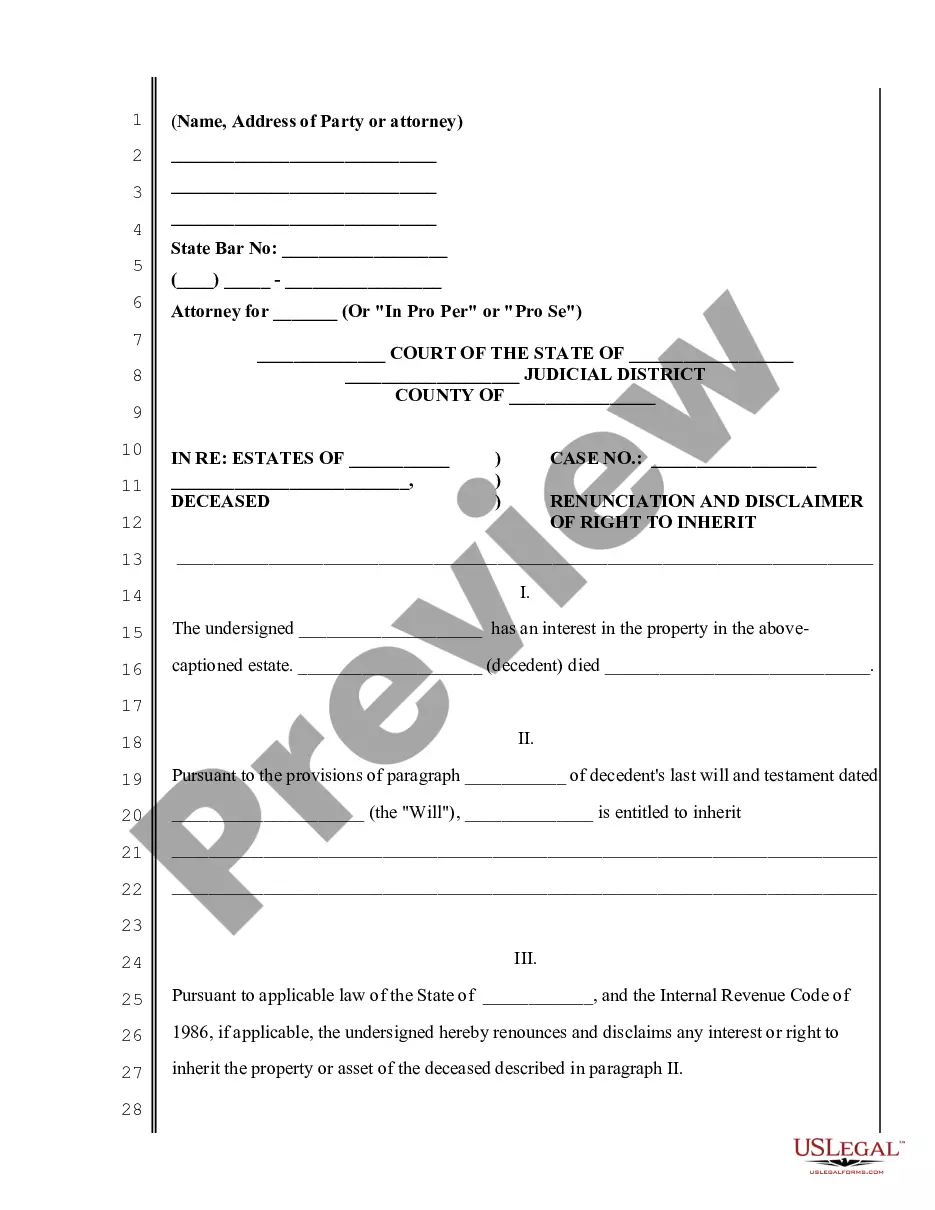
The Renunciation and Disclaimer of Property from Will by Testate form is a legal document that allows a beneficiary to formally decline their interest in property bequeathed to them in a decedentâs last will and testament. This form ensures that the property will pass on to other beneficiaries as if the renouncing beneficiary predeceased the decedent. It is particularly important in Pennsylvania where such disclaimers are governed by specific statutory provisions.
Key components of this form
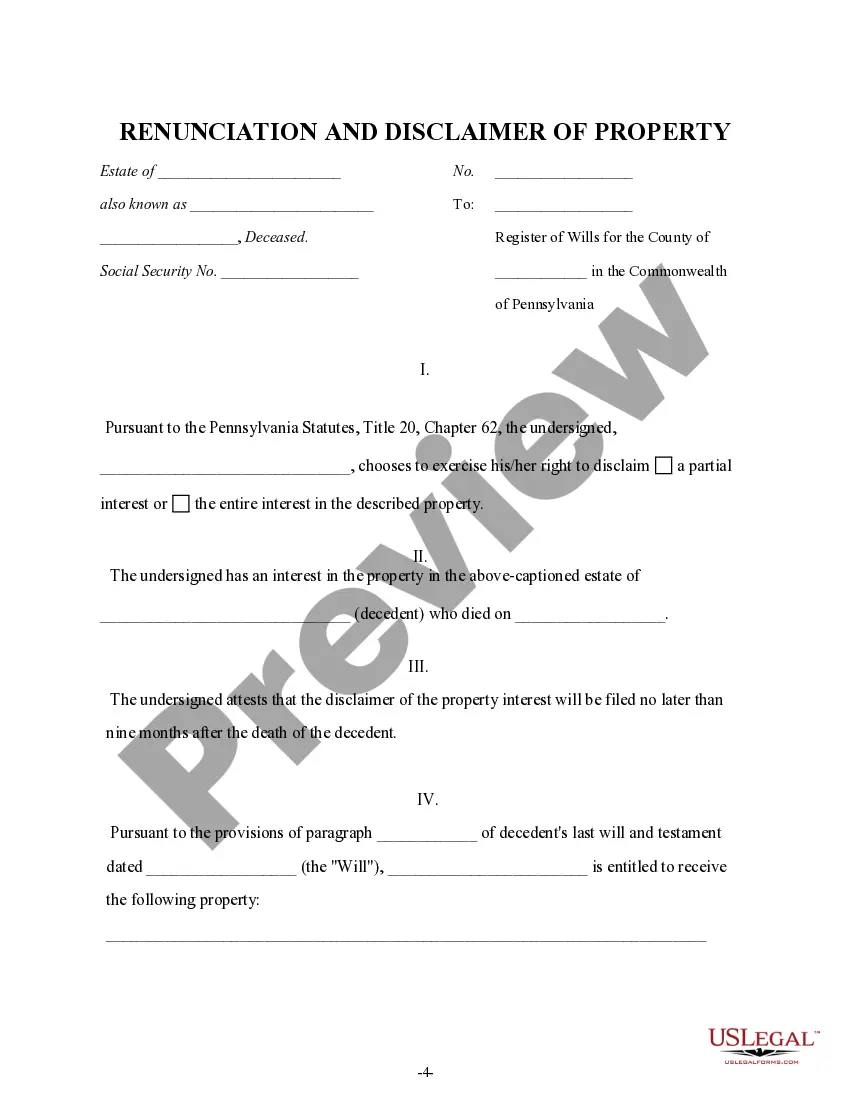
- Identification of the estate and the decedent, including relevant details and identifiers.
- Choice of the beneficiary to disclaim either a partial or entire interest in property.
- Specific details regarding the property being disclaimed under the deceased's will.
- Compliance statement affirming that the disclaimer will be filed within the required timeframe after the decedent's death.
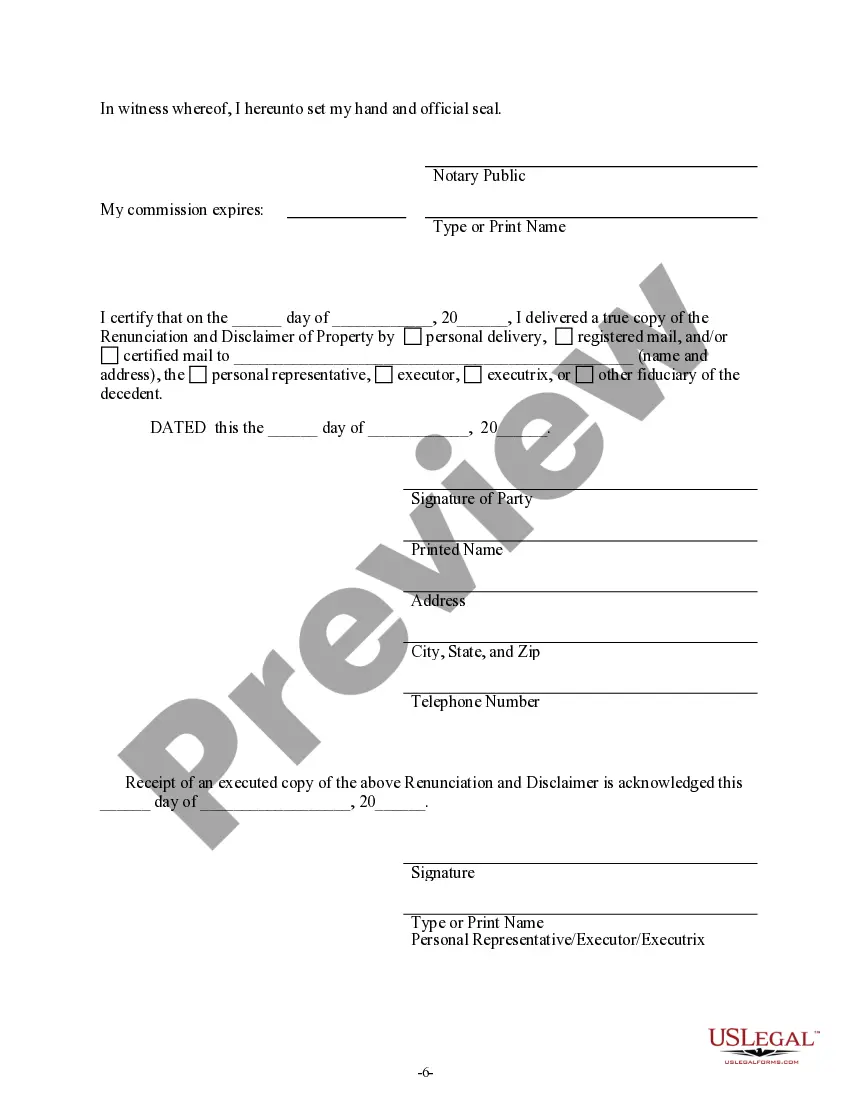
- A notary acknowledgment section to validate the execution of the document.

When to use this form
This form should be used in situations where an individual who is a named beneficiary in a will decides to renounce their rights to the property or assets specified by the decedent. Common scenarios for using this form include situations where the beneficiary wishes to allow the property to pass to contingent beneficiaries or where accepting the inheritance may result in negative tax consequences for the beneficiary.
Who this form is for
- Beneficiaries named in a last will and testament in Pennsylvania.
- Individuals who seek to formally decline their inheritance from a decedentâs estate due to personal, financial, or legal reasons.
- Attorneys assisting clients with estate planning and inheritance matters related to wills.
Instructions for completing this form
- Identify the parties involved, including the decedent and the beneficiary disclaiming their interest.
- Specify the estate number and provide relevant details about the decedent.
- Clearly indicate whether you are disclaiming a partial or entire interest in the specified property.
- Enter the details regarding the properties being disclaimed as outlined in the decedent's will.
- Have the form signed in front of a notary public for validation.
Notarization guidance
Yes, this form must be notarized to be legally valid. Once completed, it needs to be signed in the presence of a notary public. US Legal Forms offers integrated online notarization services, enabling secure video calls to notarize documents without the need for travel.
Get your form ready online
Our built-in tools help you complete, sign, share, and store your documents in one place.
Make edits, fill in missing information, and update formatting in US Legal Forms—just like you would in MS Word.
Download a copy, print it, send it by email, or mail it via USPS—whatever works best for your next step.
Sign and collect signatures with our SignNow integration. Send to multiple recipients, set reminders, and more. Go Premium to unlock E-Sign.
If this form requires notarization, complete it online through a secure video call—no need to meet a notary in person or wait for an appointment.
We protect your documents and personal data by following strict security and privacy standards.

Make edits, fill in missing information, and update formatting in US Legal Forms—just like you would in MS Word.

Download a copy, print it, send it by email, or mail it via USPS—whatever works best for your next step.

Sign and collect signatures with our SignNow integration. Send to multiple recipients, set reminders, and more. Go Premium to unlock E-Sign.

If this form requires notarization, complete it online through a secure video call—no need to meet a notary in person or wait for an appointment.

We protect your documents and personal data by following strict security and privacy standards.
Mistakes to watch out for
- Failing to file the disclaimer within the nine-month period following the decedent's death.
- Not including all necessary identifiers and details about the property being disclaimed.
- Neglecting to have the form notarized, which is crucial for legal validity.
Benefits of using this form online
- Convenience of immediate access and downloadable form options.
- Editability allows users to complete the form according to their specific needs.
- Reliability of having an attorney-drafted document that adheres to state laws.
Looking for another form?
Form popularity
FAQ
A disclaimer is generally any statement intended to specify or delimit the scope of rights and obligations that may be exercised and enforced by parties in a legally recognized relationship.
In law, a disclaimer is a statement denying responsibility intended to prevent civil liability arising for particular acts or omissions. Disclaimers are frequently made to escape the effects of the torts of negligence and of occupiers' liability towards visitors.
1a : a denial or disavowal of legal claim : relinquishment of or formal refusal to accept an interest or estate. b : a writing that embodies a legal disclaimer. 2a : denial, disavowal. b : repudiation.
Disclaim, in a legal sense, refers to the renunciation of an interest in, or an acceptance of, inherited assets, such as property, by way of a legal instrument. A person disclaiming an interest, right, or obligation is known as a disclaimant.
In your disclaimer, cover any and all liabilities for the product or service that you provide. You should warn consumers of any dangers or hazards posed by your product. You should list specific risks while at the same time acknowledging that the list is not exhaustive. For example, you could write, NOTICE OF RISK.
Disclaimer of interest, in the law of inheritance, wills and trusts, is a term that describes an attempt by a person to renounce their legal right to benefit from an inheritance (either under a will or through intestacy) or through a trust. A disclaimer of interest is irrevocable.
While T&C's contain general liability waivers, Disclaimers address specific issues with your product or service. Disclaimers may cover medical or health risks, professional liability and earnings claims. If your website or app creates a risk of user error or misuse, a disclaimer will do more to help you than hurt you.
What is a Deed of Disclaimer? A Deed of Disclaimer is a document that you can execute if you wish to Disclaim an inheritance due via the Rules of Intestacy and you are not applying for probate. A typical example of this is if a spouse of a deceased would prefer the estate passes to the children.