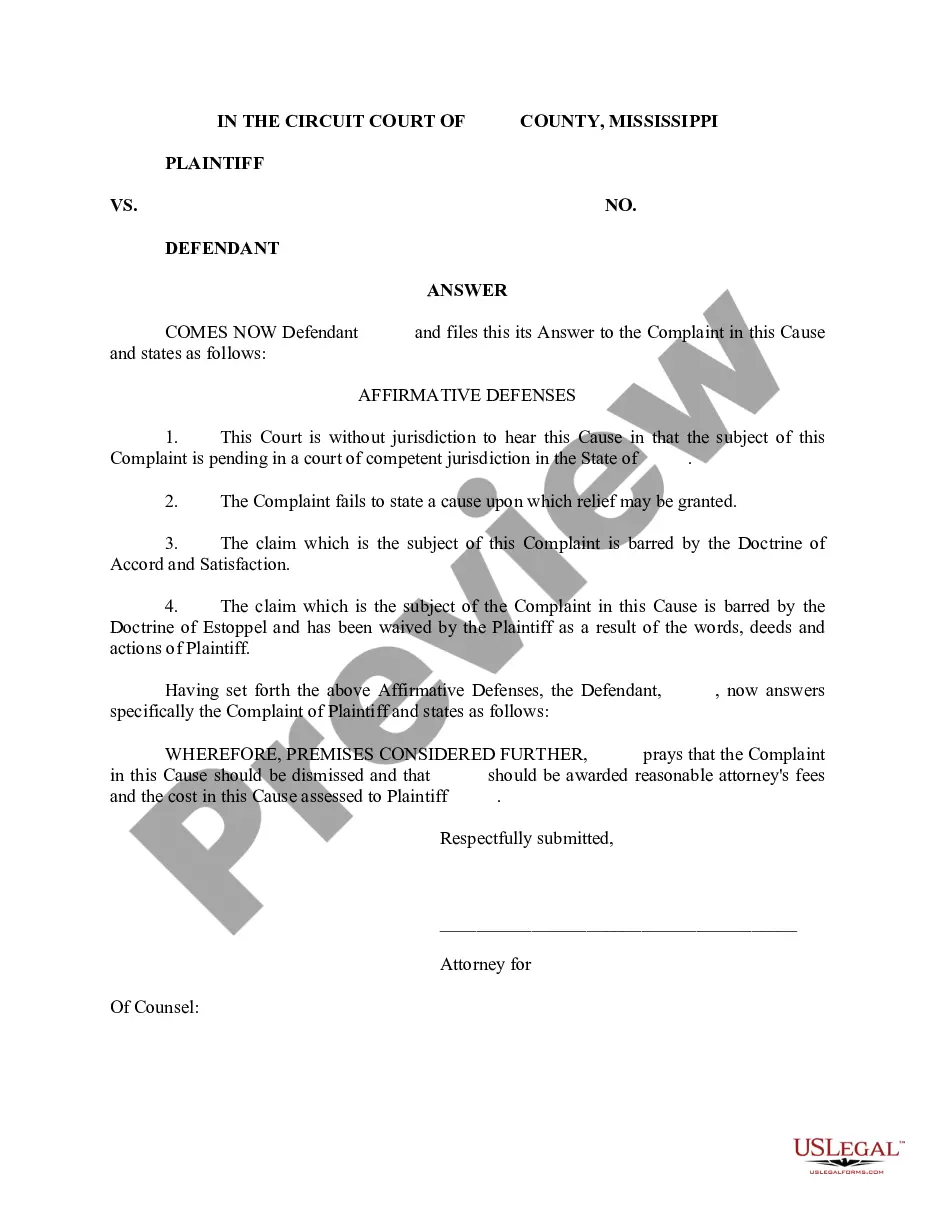
North Dakota Renunciation And Disclaimer of Real Property Interest
What this document covers
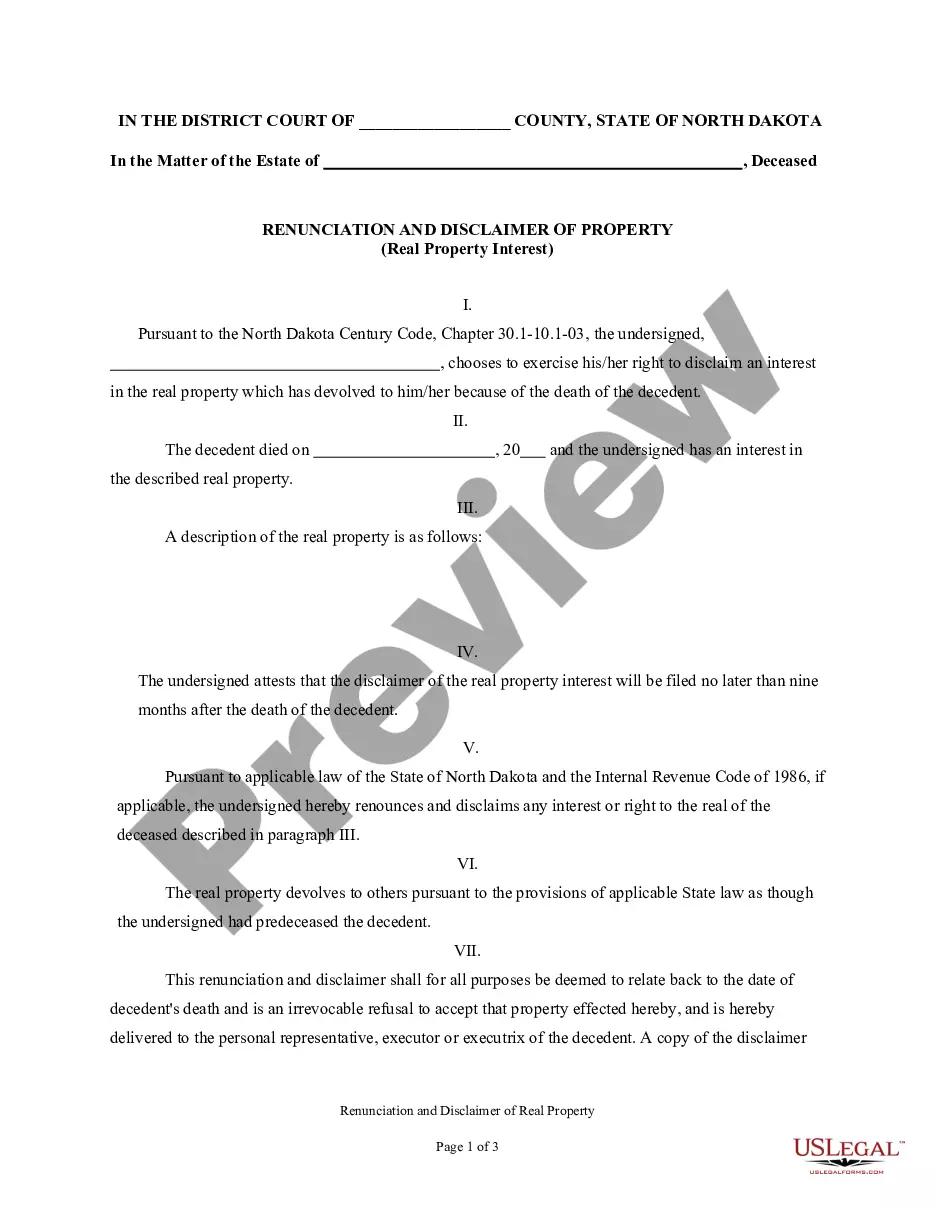
The Renunciation and Disclaimer of Real Property Interest is a legal document that allows a beneficiary, who has inherited real property upon the death of a decedent, to formally refuse their interest in that property. This process is governed by the North Dakota Century Code, and the disclaimer relates back to the decedent's date of death. Unlike other estate planning forms that might imply acceptance of property, this form explicitly denotes an irrevocable refusal to accept any rights or interests in the property.
Key components of this form
- Declaration of renunciation and disclaimer of interest in the property.
- Identification of the real property in question.
- Statement of how the property will devolve to other heirs under state law.
- Confirmation that the disclaimer relates back to the date of the decedent's death.
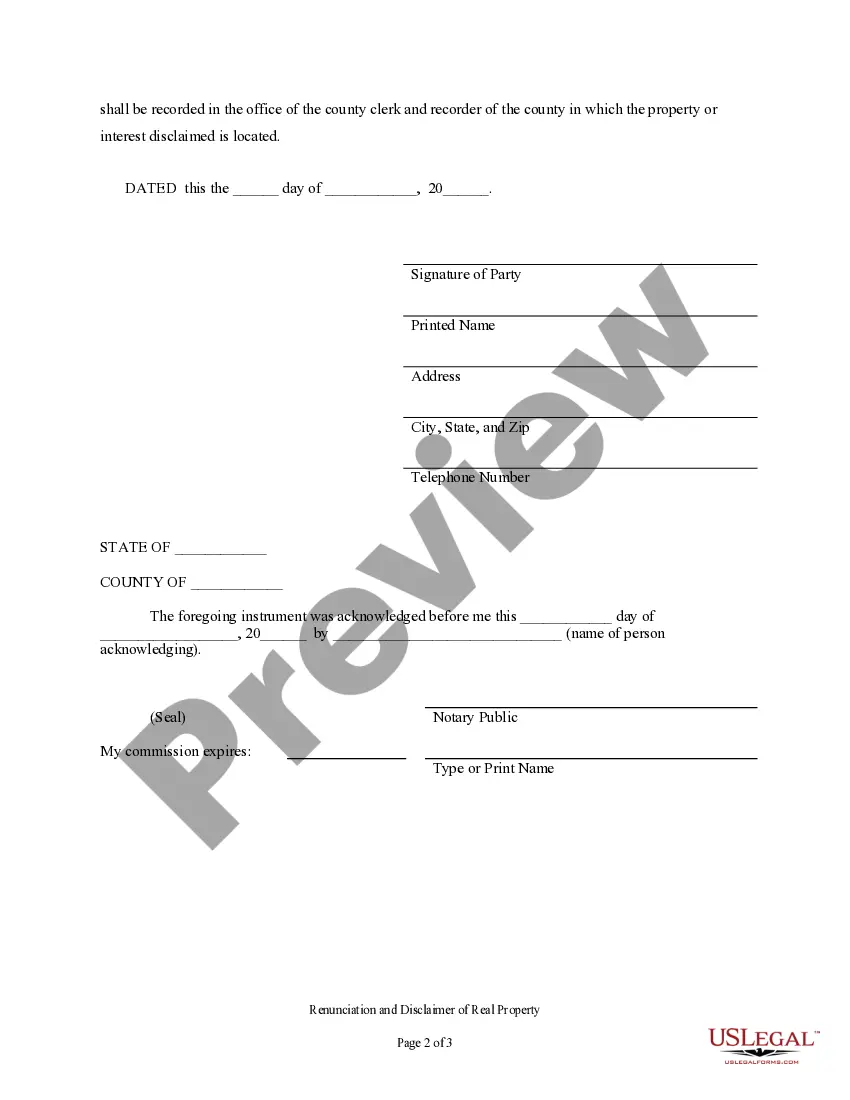
- Signature and acknowledgment section for the individual disclaiming the property interest.

When to use this document
This form is necessary when a beneficiary chooses to refuse their inherited interest in real property following a decedent's death. Common scenarios include situations where the property is undesirable due to financial burdens, ongoing expenses, or personal circumstances. It is essential for individuals wishing to legally document their choice to disclaim any claim over the property and clarify the subsequent inheritance path according to state law.
Who this form is for
- Beneficiaries of a decedent's estate in North Dakota.
- Individuals who have inherited real property and wish to disclaim their interest.
- Executors or personal representatives handling the estate of a decedent.
- Anyone seeking to clarify their intentions regarding real property inheritance.
Instructions for completing this form
- Identify the parties involved, including the decedent and the beneficiary disclaiming the interest.
- Describe the real property being disclaimed, including full legal details.
- Enter the date of the decedent's death for the disclaimer to relate back to.
- Complete the signature section, including the name and acknowledgment of the person disclaiming the property.
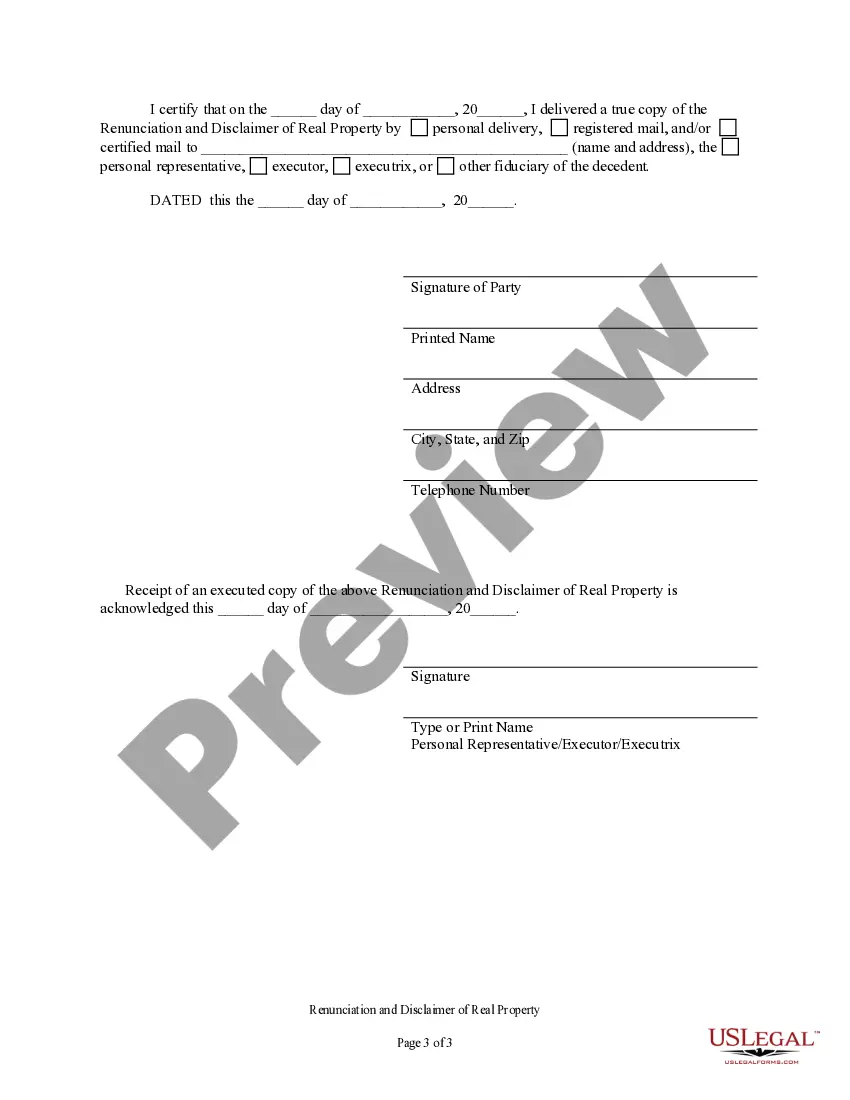
- Submit a copy of the disclaimer to the personal representative or executor of the estate and ensure it is recorded with the county clerk.
Does this document require notarization?
Notarization is required for this form to take effect. Our online notarization service, powered by Notarize, lets you verify and sign documents remotely through an encrypted video session, available 24/7.
Get your form ready online
Our built-in tools help you complete, sign, share, and store your documents in one place.
Make edits, fill in missing information, and update formatting in US Legal Forms—just like you would in MS Word.
Download a copy, print it, send it by email, or mail it via USPS—whatever works best for your next step.
Sign and collect signatures with our SignNow integration. Send to multiple recipients, set reminders, and more. Go Premium to unlock E-Sign.
If this form requires notarization, complete it online through a secure video call—no need to meet a notary in person or wait for an appointment.
We protect your documents and personal data by following strict security and privacy standards.

Make edits, fill in missing information, and update formatting in US Legal Forms—just like you would in MS Word.

Download a copy, print it, send it by email, or mail it via USPS—whatever works best for your next step.

Sign and collect signatures with our SignNow integration. Send to multiple recipients, set reminders, and more. Go Premium to unlock E-Sign.

If this form requires notarization, complete it online through a secure video call—no need to meet a notary in person or wait for an appointment.

We protect your documents and personal data by following strict security and privacy standards.
Typical mistakes to avoid
- Failing to provide complete property details, which can lead to invalid disclaimers.
- Not signing or improperly acknowledging the form, which could negate its legal effect.
- Missing the requirement to file the disclaimer with a county clerk.
- Not understanding the implications of disclaiming property, such as potential tax consequences.
Benefits of using this form online
- Convenience of downloading the form at any time from a reliable source.
- Editability allows for personalization of the form to match individual circumstances.
- Reliability of using a document drafted by licensed attorneys, minimizing legal risks.
Looking for another form?
Form popularity
FAQ
When you relinquish property, you don't get any say in who inherits in your place. If you want to control who gets the inheritance, you must accept it and give it to that person. If you relinquish the property and the deceased didn't name a back-up heir, the court will apply state law to decide who inherits.
Disclaim, in a legal sense, refers to the renunciation of an interest in, or an acceptance of, inherited assets, such as property, by way of a legal instrument. A person disclaiming an interest, right, or obligation is known as a disclaimant.
Put the disclaimer in writing. Deliver the disclaimer to the person in control of the estate usually the executor or trustee. Complete the disclaimer within nine months of the death of the person leaving the property. Do not accept any benefit from the property you're disclaiming.
In your disclaimer, cover any and all liabilities for the product or service that you provide. You should warn consumers of any dangers or hazards posed by your product. You should list specific risks while at the same time acknowledging that the list is not exhaustive. For example, you could write, NOTICE OF RISK.
The disclaimer must be in writing: A signed letter by the person doing the disclaiming, identifying the decedent, describing the asset to be disclaimed, and the extent and amount, percentage or dollar amount, to be disclaimed, must be delivered to the person in control of the estate or asset, such as an executor,
In law, a disclaimer is a statement denying responsibility intended to prevent civil liability arising for particular acts or omissions. Disclaimers are frequently made to escape the effects of the torts of negligence and of occupiers' liability towards visitors.
These documents can include the will, death certificate, transfer of ownership forms and letters from the estate executor or probate court.If you received the inheritance in the form of cash, request a copy of the bank statement that reflects the deposit.
Disclaimer of interest, in the law of inheritance, wills and trusts, is a term that describes an attempt by a person to renounce their legal right to benefit from an inheritance (either under a will or through intestacy) or through a trust. A disclaimer of interest is irrevocable.
What is a Deed of Disclaimer? A Deed of Disclaimer is a document that you can execute if you wish to Disclaim an inheritance due via the Rules of Intestacy and you are not applying for probate. A typical example of this is if a spouse of a deceased would prefer the estate passes to the children.