California Renunciation and Disclaimer of Joint Tenant or Tenancy Interest
About this form
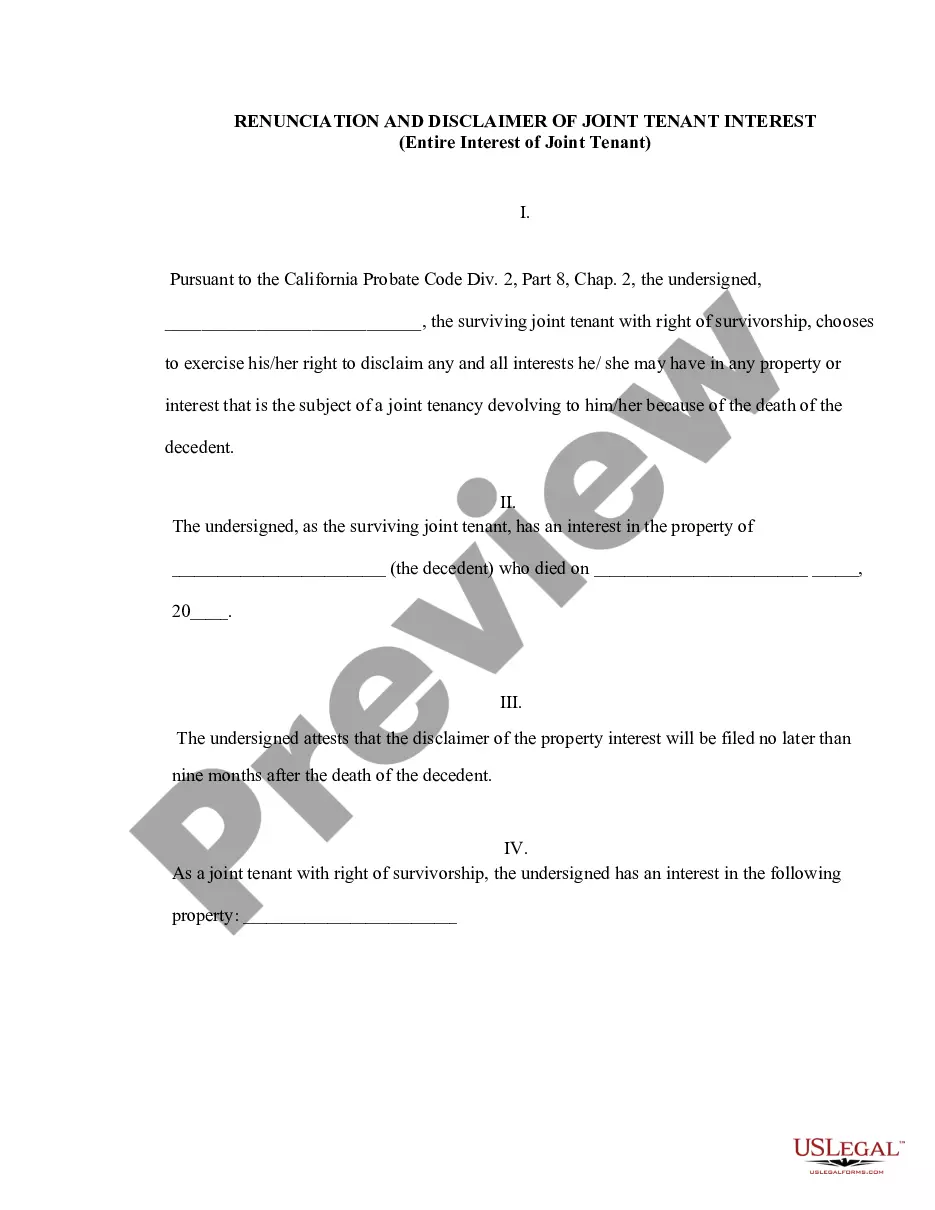
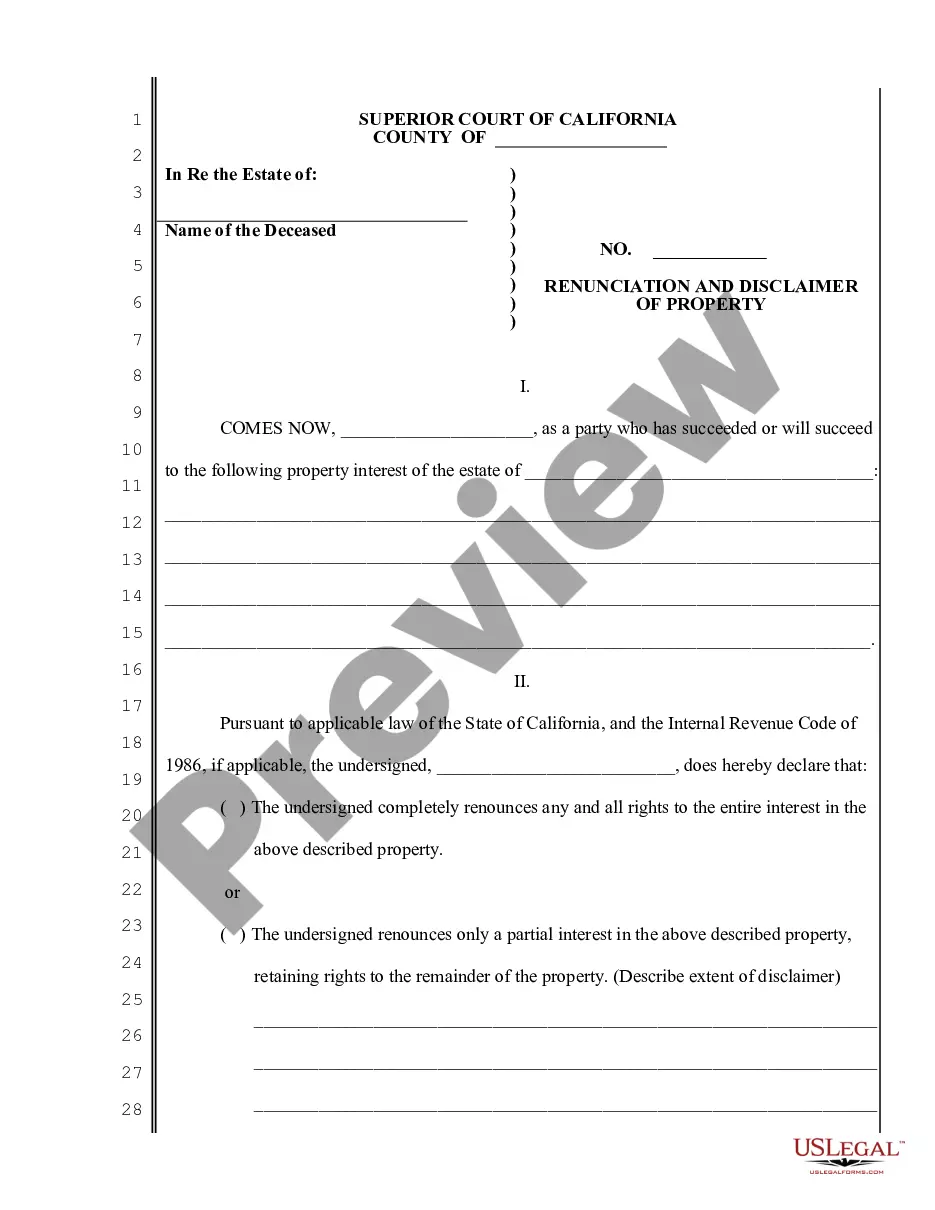
The California Renunciation and Disclaimer of Joint Tenant or Tenancy Interest is a legal document that allows a surviving joint tenant to formally disclaim an interest in property inherited from a deceased co-owner. This form is essential when a joint tenant chooses to relinquish their rights to the property, ensuring that the interest reverts to others as dictated by California law. Unlike other forms of property transfer, this disclaimer is specifically focused on joint tenancy interests and has specific requirements under the California Probate Code.
Form components explained
- Identification of the surviving joint tenant.
- Declaration of the decedent's name and date of death.
- A confirmation that the disclaimer will be filed within nine months of the decedent's death.
- Detailed description of the property being disclaimed.
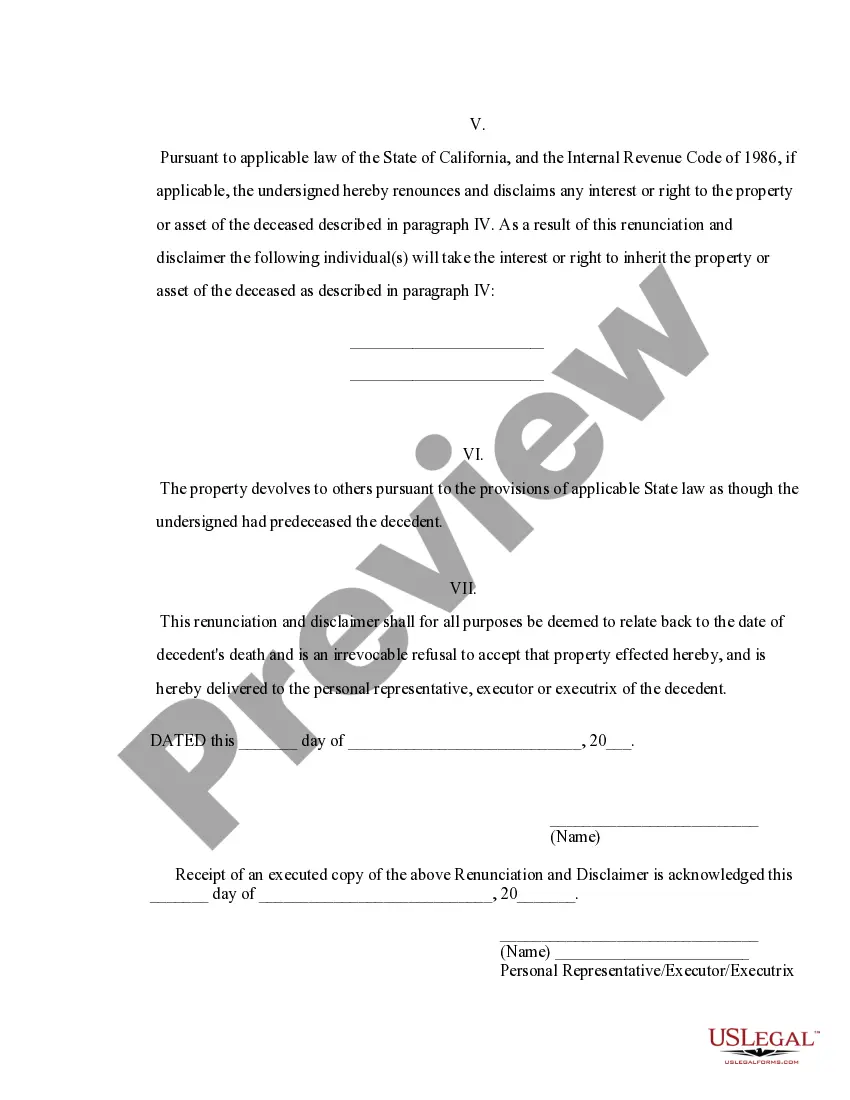
- List of individuals who will inherit the property after the disclaimer.
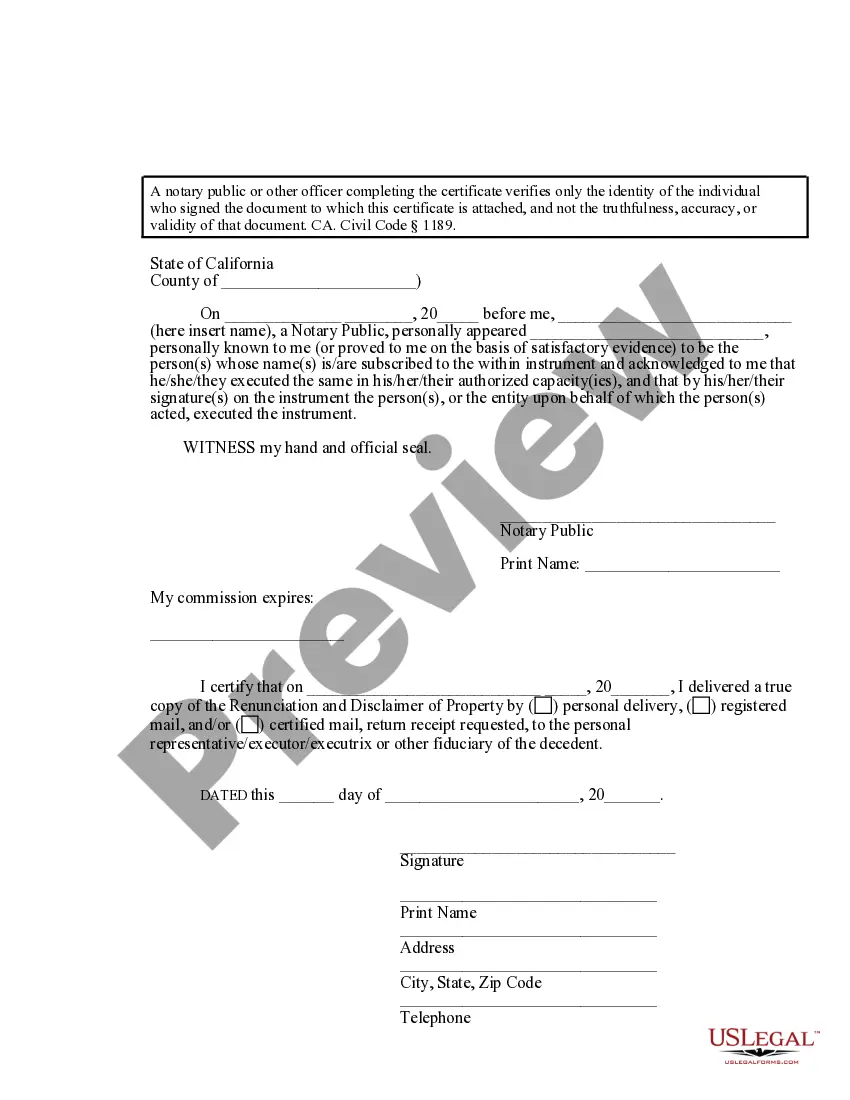
- Notary acknowledgment and delivery verification sections.
When to use this document
This form is used in scenarios where a surviving joint tenant wishes to refuse their inherited interest in a joint tenancy property due to various reasons, such as financial implications, personal circumstances, or to ensure that a different heir receives the property. It is particularly relevant when the decedent has passed away and the joint tenant wants to legally renounce any claims to the property to allow another party to inherit it instead.
Who this form is for
- Surviving joint tenants who wish to disclaim their interest in a property.
- Heirs or beneficiaries who need to clarify the distribution of property after a decedent's death.
- Individuals seeking to adjust property inheritance for personal or financial reasons.
How to prepare this document
- Identify yourself as the surviving joint tenant and provide your name.
- State the name of the decedent and the date of their death.
- List the property interest you are disclaiming in the designated section.
- Specify the individuals who will inherit the property after your disclaimer.
- Sign and date the form in the presence of a notary public.
- Ensure a copy is delivered to the personal representative or executor of the decedent.
Is notarization required?
Notarization is required for this form to take effect. Our online notarization service, powered by Notarize, lets you verify and sign documents remotely through an encrypted video session, available 24/7.
Get your form ready online
Our built-in tools help you complete, sign, share, and store your documents in one place.
Make edits, fill in missing information, and update formatting in US Legal Forms—just like you would in MS Word.
Download a copy, print it, send it by email, or mail it via USPS—whatever works best for your next step.
Sign and collect signatures with our SignNow integration. Send to multiple recipients, set reminders, and more. Go Premium to unlock E-Sign.
If this form requires notarization, complete it online through a secure video call—no need to meet a notary in person or wait for an appointment.
We protect your documents and personal data by following strict security and privacy standards.

Make edits, fill in missing information, and update formatting in US Legal Forms—just like you would in MS Word.

Download a copy, print it, send it by email, or mail it via USPS—whatever works best for your next step.

Sign and collect signatures with our SignNow integration. Send to multiple recipients, set reminders, and more. Go Premium to unlock E-Sign.

If this form requires notarization, complete it online through a secure video call—no need to meet a notary in person or wait for an appointment.

We protect your documents and personal data by following strict security and privacy standards.
Mistakes to watch out for
- Failing to file the disclaimer within the nine-month time limit.
- Not properly identifying the decedent or the property in question.
- Omitting the required declaration of who will inherit after the disclaimer.
- Not getting the form notarized, which could invalidate the disclaimer.
Benefits of completing this form online
- Easy access to the form anytime, with no need for physical visits to legal offices.
- Ability to edit, customize, and download the form quickly.
- Confidence that the form is compliant with California legal requirements.
Looking for another form?
Form popularity
FAQ
Yes, you can disclaim JTWros (Joint Tenancy with Right of Survivorship) property under certain conditions. The disclaimer must align with the principles of the California Renunciation and Disclaimer of Joint Tenant or Tenancy Interest to be valid. This action allows an individual to refuse their share without affecting the interest of the surviving joint tenant. For accurate guidance through this process, consider using uslegalforms to ensure your disclaimer meets legal requirements.
A disclaimer of interest in a deceased person's estate is a formal refusal to accept property distribution from the estate. This legal mechanism provides individuals with a way to renounce their share, particularly relevant in cases involving the California Renunciation and Disclaimer of Joint Tenant or Tenancy Interest. By utilizing a disclaimer, beneficiaries can clearly show their intent and prevent any future claims against the estate. You can find essential resources and templates on uslegalforms for drafting your disclaimer.
A beneficiary may want to disclaim property to avoid potential debts associated with the estate or to assist other heirs. Disclaiming property allows individuals to refuse an inheritance without losing their eligibility for government benefits or other financial assistance. It can be a strategic decision in the context of the California Renunciation and Disclaimer of Joint Tenant or Tenancy Interest, wherein the beneficiary's financial position may be better served by renouncing their interest. Platforms like uslegalforms can help you navigate the nuances of this process.
A probate disclaimer of interest in California refers to a legal document that allows a beneficiary to refuse property or assets within a deceased person's estate. This process is known as the California Renunciation and Disclaimer of Joint Tenant or Tenancy Interest. By filing this disclaimer, you can avoid accepting unwanted tax burdens or financial responsibilities. Using uslegalforms can simplify your process by offering clear guidelines and necessary paperwork.
To disclaim an inheritance in California, you must submit a written disclaimer that adheres to California laws. This document should clearly state your intent to renounce your interest in the property, specifically the California Renunciation and Disclaimer of Joint Tenant or Tenancy Interest. Ensure you file this disclaimer within the specified time frame after the decedent's death. Consider utilizing platforms like uslegalforms to access templates and ensure compliance with legal requirements.
To file a qualified disclaimer concerning your interest in a joint tenancy, you should start by preparing a written document that clearly states your intention to renounce your interest. This document must meet the requirements outlined in the California Renunciation and Disclaimer of Joint Tenant or Tenancy Interest statutes. Once completed, you must sign the document and file it with the appropriate county office, typically the County Recorder’s Office. Using resources like USLegalForms can simplify this process, providing you with templates and guidance tailored to your needs.
Yes, you can disclaim a joint bank account in California, which effectively means renouncing your rights to the funds within it. This legal action can prevent you from inheriting the account balance after the account holder's death. To ensure a smooth process, consulting a resource like the California Renunciation and Disclaimer of Joint Tenant or Tenancy Interest can clarify your options and next steps.
Contesting a joint bank account is possible, but you should be aware that it can be complex. If the account holder's intent was to create a survivorship right, it may be challenging to contest after their passing. Engaging with the California Renunciation and Disclaimer of Joint Tenant or Tenancy Interest can provide insights into your rights and obligations regarding contested accounts.
Yes, you can disclaim jointly owned property in California. Disclaiming your interest allows you to renounce any ownership rights in the property without transferring it to another party. This process can be part of a well-considered estate plan, and understanding the California Renunciation and Disclaimer of Joint Tenant or Tenancy Interest can offer guidance on how to properly execute this disclaimer.
In California, a joint tenant can transfer their interest in a property, but doing so often converts the ownership structure. Once a joint tenant transfers their share, the remaining co-owners may change to tenants in common, which has different implications for inheritance. It's essential to understand these changes fully, and the California Renunciation and Disclaimer of Joint Tenant or Tenancy Interest can be a helpful resource for navigating this process.