Waiver and Release From Liability For Adult for Land for Parking
What this document covers
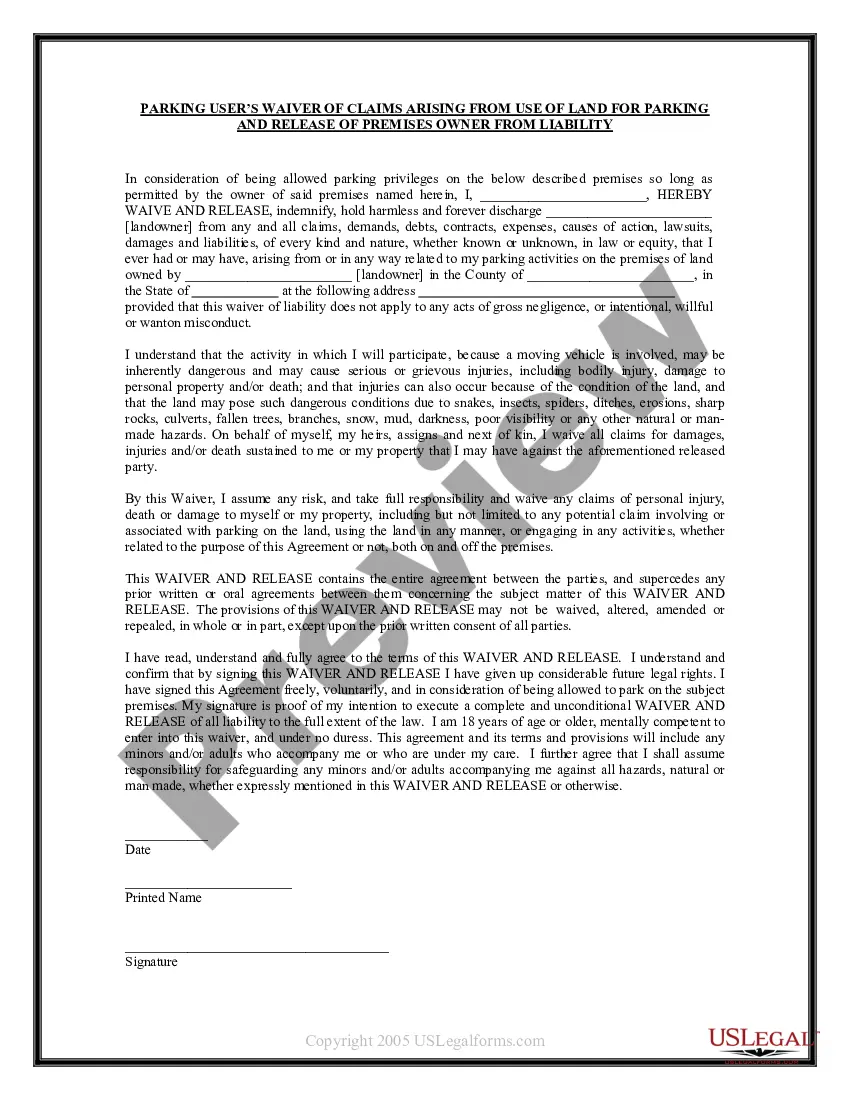
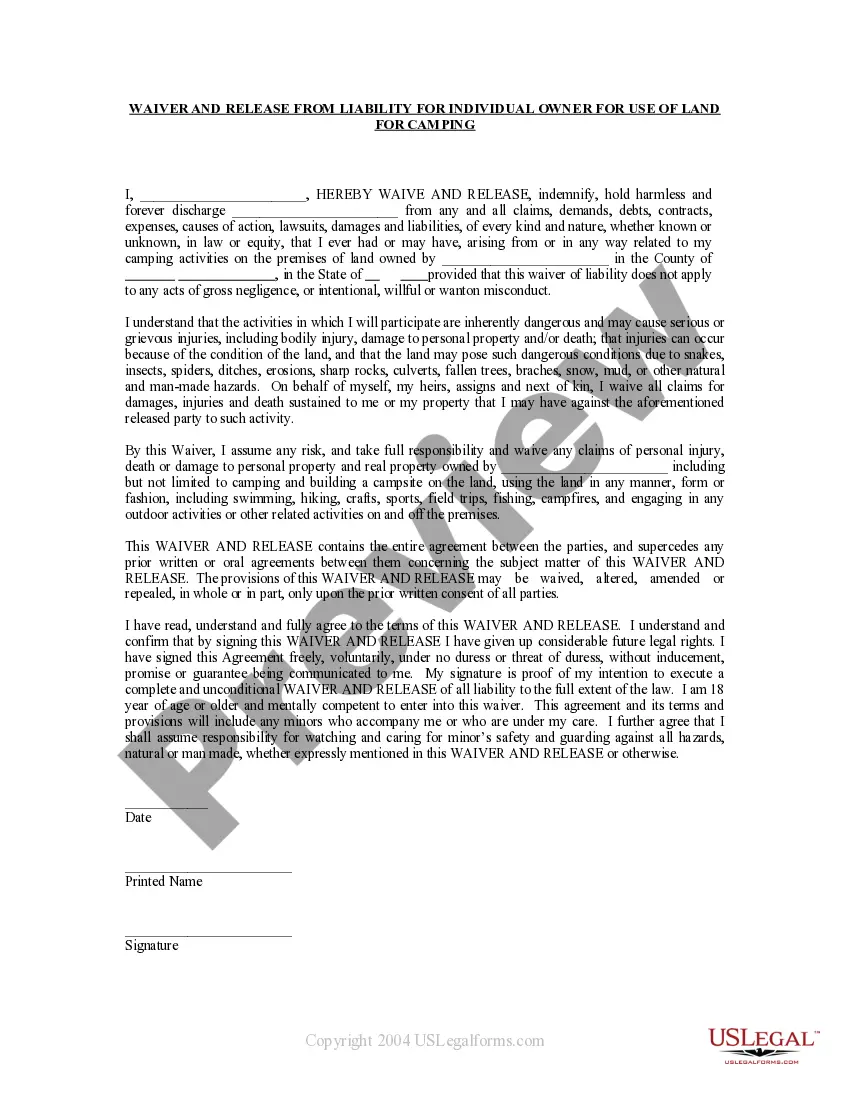
The Waiver and Release From Liability for Adult for Land used for Parking is a legal document that protects property owners from claims for damages or injuries that may occur while an individual is using their land for parking. Unlike other liability waivers, this form specifically addresses risks associated with both the use of vehicles and the natural conditions of the land, ensuring the property owner is not held responsible for unforeseen incidents.
Key parts of this document
- Acknowledgment of risk involved with parking a vehicle on the property.
- Waiver of claims for injuries or damages to the individual and their property.
- Assumption of risk for any activities conducted on the property.
- Confirmation of age and mental competency to sign the waiver.
- Indication of scope, including any minors under the signer's care.
- Signature and date section to validate the agreement.
When to use this form
This form should be used when a property owner allows individuals to park on their land. It is particularly important in situations where the property may have natural hazards, or when there is potential for accidents involving vehicles. It helps ensure that the property owner is not liable for injuries or damages that may occur as a result of parking or related activities.
Who can use this document
- Property owners allowing individuals to park on their land.
- Individuals wanting to assume responsibility while using another's land for parking.
- Businesses or organizations that offer parking spaces on private land.
- Event organizers who allow parking on site for attendees.
How to complete this form
- Read the entire document to understand all conditions and risks.
- Identify the parties involved, including the property owner and the individual parking.
- Specify the name and address of the land being used for parking.
- Fill in the date and your printed name.
- Sign the document, confirming your understanding and agreement.
- If applicable, indicate any minors accompanying you and your responsibility for their safety.
Does this document require notarization?
This form does not typically require notarization unless specified by local law. However, notarization can add an extra layer of validity. If notarization is needed, consider using integrated online notarization services for convenience and security.
Get your form ready online
Our built-in tools help you complete, sign, share, and store your documents in one place.
Make edits, fill in missing information, and update formatting in US Legal Forms—just like you would in MS Word.
Download a copy, print it, send it by email, or mail it via USPS—whatever works best for your next step.
Sign and collect signatures with our SignNow integration. Send to multiple recipients, set reminders, and more. Go Premium to unlock E-Sign.
If this form requires notarization, complete it online through a secure video call—no need to meet a notary in person or wait for an appointment.
We protect your documents and personal data by following strict security and privacy standards.

Make edits, fill in missing information, and update formatting in US Legal Forms—just like you would in MS Word.

Download a copy, print it, send it by email, or mail it via USPS—whatever works best for your next step.

Sign and collect signatures with our SignNow integration. Send to multiple recipients, set reminders, and more. Go Premium to unlock E-Sign.

If this form requires notarization, complete it online through a secure video call—no need to meet a notary in person or wait for an appointment.

We protect your documents and personal data by following strict security and privacy standards.
Mistakes to watch out for
- Failing to read the entire waiver thoroughly before signing.
- Not clearly identifying all parties involved in the agreement.
- Overlooking to sign and date the form, rendering it invalid.
- Neglecting to account for minors who may be on the property.
Benefits of using this form online
- Convenience of downloading and printing from home.
- Easy to fill out and edit as necessary.
- Access to legally vetted templates designed by licensed attorneys.
- Quick processing, saving time compared to traditional methods.
Legal use & context
- This waiver limits the property owner's liability in the event of accidents or injuries.
- It is important for users to understand that signing this document can relinquish certain legal rights.
- Enforceability may vary by jurisdiction, so local legal standards should be consulted.
Quick recap
- The waiver protects the property owner from liability when allowing parking on their land.
- It is crucial for participants to understand the risks associated with using the property.
- Ensure that all necessary fields are completed accurately to prevent future disputes.
- Always confirm whether notarization is needed based on jurisdiction.
Looking for another form?
Form popularity
FAQ
A liability waiver, or release of liability, is a legal document that a company or organization has you sign in order to protect them from being sued in the event that you are injured.
The main difference between releases and waivers is the transferring of ownership. When rights are released, they are transferred to another party. When rights are waived, they are gone altogether. If intellectual property rights are waived, the IP can be used by any other party that has access to it.
In California, a liability waiver must be clear, unambiguous, and explicit. In other words, waivers cannot be printed in faded ink, in small font, on the back of a paper, or in an otherwise ambiguous form. If the waiver that you sign is not represented clearly, it may not hold up in the event of a lawsuit.
In many cases, the waiver is not enforceable.If you've been injured due to negligent actions, you can sue even if you signed a waiver. Winning a lawsuit concerning negligence is not uncommon. Many celebrities have sued for negligence even though they signed documents stating they understood the risks.
If you've been injured due to negligent actions, you can sue even if you signed a waiver. Winning a lawsuit concerning negligence is not uncommon. Many celebrities have sued for negligence even though they signed documents stating they understood the risks.
A release and waiver agreement is an enforceable promise not to pursue legal action in exchange for compensation. The releasee gives money or some other form of compensation to the releasor, who then agrees not to press charges, sue, or take any other legal action against the releasee.
A liability waiver, or release waiver, is a legal document that a company or organization requires members of the public to sign in order to protect their organization from being sued if you sustain an injury.Depending on the facts of your case, you may still be able to file a lawsuit and recover damages.
Release Versus Waiver The main difference between releases and waivers is the transferring of ownership. When rights are released, they are transferred to another party. When rights are waived, they are gone altogether.In the case of the skydiver, they might be asked to sign a release form rather than a waiver.