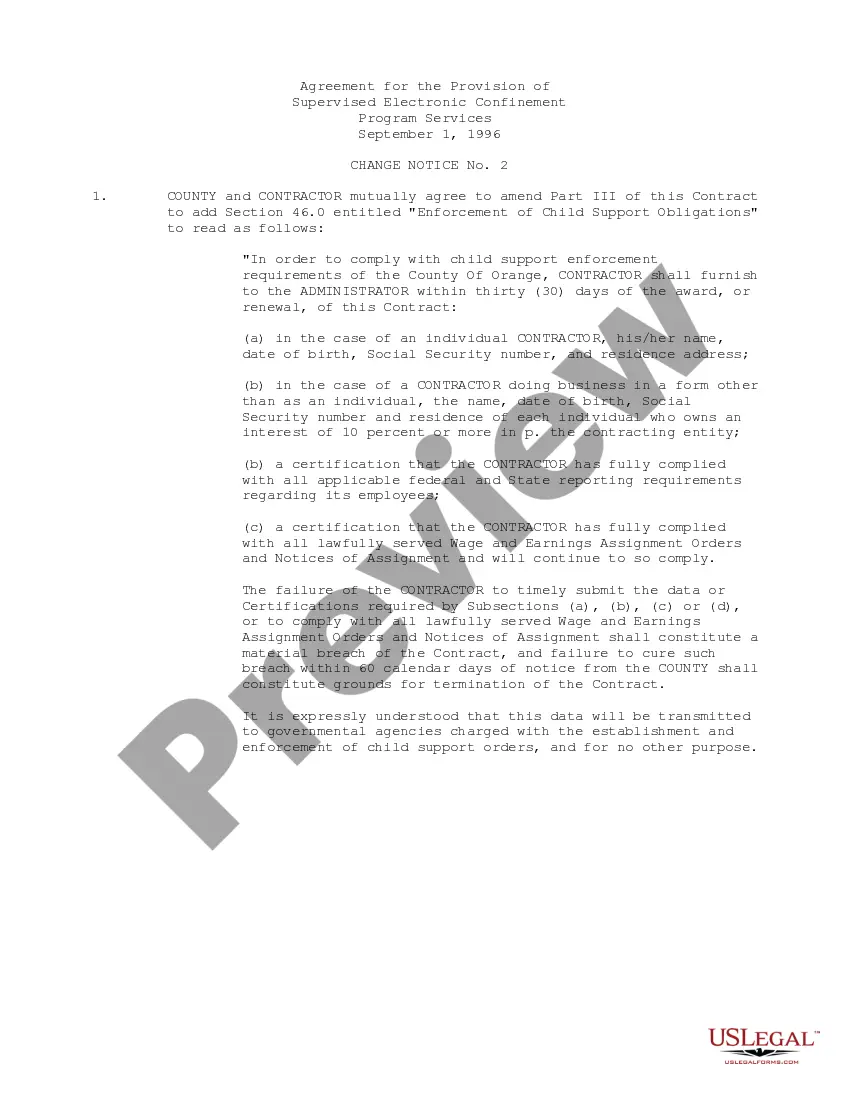
Agreement for the Provision of Supervised Electronic Confinement Program Services between Orange Co., CA and Sentencing Concepts
About this form
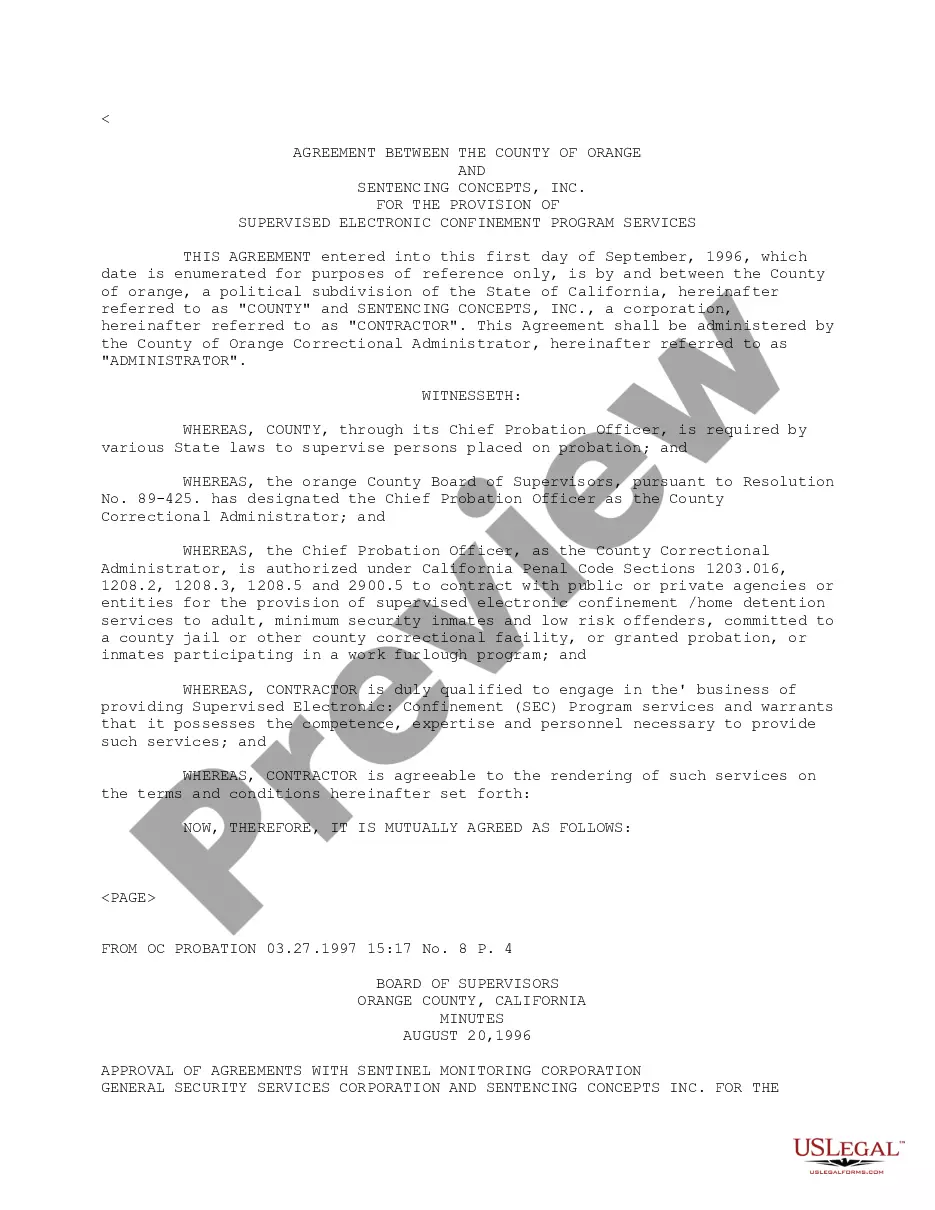
The Agreement for the Provision of Supervised Electronic Confinement Program Services is a legal document that outlines the terms and responsibilities between the County of Orange, California, and Sentencing Concepts, Inc. for providing supervised electronic confinement services. This agreement primarily focuses on managing low-risk offenders who qualify for home detention or electronic monitoring instead of traditional incarceration. This form ensures that the services provided align with state laws and county regulations, distinguishing it from other correctional services agreements.
Form components explained
- Identifying parties: Details the County of Orange and Sentencing Concepts, Inc.
- Definitions: Clarifies key terms relevant to the agreement, such as "supervised electronic confinement."
- Scope of services: Outlines the services to be offered by Sentencing Concepts, including supervision and monitoring of offenders.
- Compliance requirements: Affirms adherence to California Penal Code and local regulations.
- Agreement duration: Specifies the initial term of the agreement and renewal options.

Common use cases
This form is used when a county, like Orange County, California, seeks to contract a service provider to deliver supervised electronic confinement services for low-risk adult offenders. It is essential in situations where alternatives to traditional incarceration are required, enabling eligible offenders to complete their sentences while complying with monitoring protocols. This form is crucial for ensuring clarity and legal validity in such arrangements.
Who should use this form
- County officials responsible for managing offender programs.
- Probation departments looking for alternatives to jail for low-risk offenders.
- Service providers specializing in electronic monitoring and home detention.
How to complete this form
- Identify the parties: Clearly state the full names and addresses of both the County of Orange and Sentencing Concepts, Inc.
- Define the scope of services: Specify the services provided by Sentencing Concepts, including monitoring details.
- Incorporate compliance clauses: Include references to relevant California Penal Code sections that govern the agreement.
- State the agreement duration: Define the start date, end date, and any renewal terms.
- Obtain signatures: Ensure that authorized representatives from both parties sign and date the agreement.
Is notarization required?
This form usually doesn’t need to be notarized. However, local laws or specific transactions may require it. Our online notarization service, powered by Notarize, lets you complete it remotely through a secure video session, available 24/7.
Get your form ready online
Our built-in tools help you complete, sign, share, and store your documents in one place.
Make edits, fill in missing information, and update formatting in US Legal Forms—just like you would in MS Word.
Download a copy, print it, send it by email, or mail it via USPS—whatever works best for your next step.
Sign and collect signatures with our SignNow integration. Send to multiple recipients, set reminders, and more. Go Premium to unlock E-Sign.
If this form requires notarization, complete it online through a secure video call—no need to meet a notary in person or wait for an appointment.
We protect your documents and personal data by following strict security and privacy standards.

Make edits, fill in missing information, and update formatting in US Legal Forms—just like you would in MS Word.

Download a copy, print it, send it by email, or mail it via USPS—whatever works best for your next step.

Sign and collect signatures with our SignNow integration. Send to multiple recipients, set reminders, and more. Go Premium to unlock E-Sign.

If this form requires notarization, complete it online through a secure video call—no need to meet a notary in person or wait for an appointment.

We protect your documents and personal data by following strict security and privacy standards.
Typical mistakes to avoid
- Failing to include all necessary signatures from authorized officials.
- Not specifying the services clearly, leading to potential disputes.
- Ignoring compliance with relevant state laws and regulations.
Why use this form online
- Convenience: Easily get access to the form anytime and from anywhere.
- Editability: Customize the form to fit specific needs and requirements.
- Reliability: Ensure that the form is drafted by licensed attorneys, providing peace of mind regarding its legal adequacy.
Legal use & context
- Enforceability: This agreement becomes legally binding upon execution by both parties.
- Limitations: It must comply with California state laws governing probation and electronic monitoring.
Key takeaways
- The Agreement for the Provision of Supervised Electronic Confinement Program Services is crucial for counties looking to offer alternative sentencing solutions.
- It outlines essential terms and conditions, ensuring compliance with legal requirements.
- Proper completion and execution of this form can help avoid legal challenges in the future.
Looking for another form?

Form popularity
FAQ
Create your HelloSign account. Use the Google authenticator or enter in your email and a password. Upload your PDF document. Format the PDF using special formatting fields. Fill out and sign the PDF. Send and store. All done.
Generally, there are three types of E-Contracts, as follows; These contracts are generally containing in the CD Rom or software, and using of the CD Rom is considered as an acceptance of such terms and conditions. Click Wrap Contracts: A click wrap Contract is mostly found as a part of a software.
Upload the sales contract you'd like to sign or send. Use text boxes, signature boxes, or date boxes to format the appropriate fields in your document. Enter in recipient contact info (email) and add a personal message to recipients. Click "Request Signature."
Electronic signatures have carried the same legal weight as traditional, paper-based ones since the United States Electronic Signatures in Global and National Commerce Act (ESIGN) was passed in 2000. This legislation ensures that electronic signatures are legally binding in every state where federal law applies.
On a combined reading of the national and international laws, it can be said that e-agreements are valid and enforceable in the courts, however, since the risk associated with e-signatures are high, for high stake transactions, parties still insist on wet signatures on physical agreements.
Under the provisions of the Information Technology Act, 2000 particularly Section 10-A, an electronic contract is valid and enforceable. The only essential requirement to validate an electronic contract is compliance with the necessary pre-requisites provided under the Indian Contract Act, 1872.
The name of the person signing. The address of the person signing. The date the contract is signed. Space for your client (or new employee) to actually sign the contract.
E-contract is any kind of contract formed in the course of e-commerce by the interaction of two or more individuals using electronic means, such as e-mail, the interaction of an individual with an electronic agent, such as a computer program, or the interaction of at least two electronic agents that are programmed to