Investment Management Agreement between Fund, Asia Management and NICAM
About this form
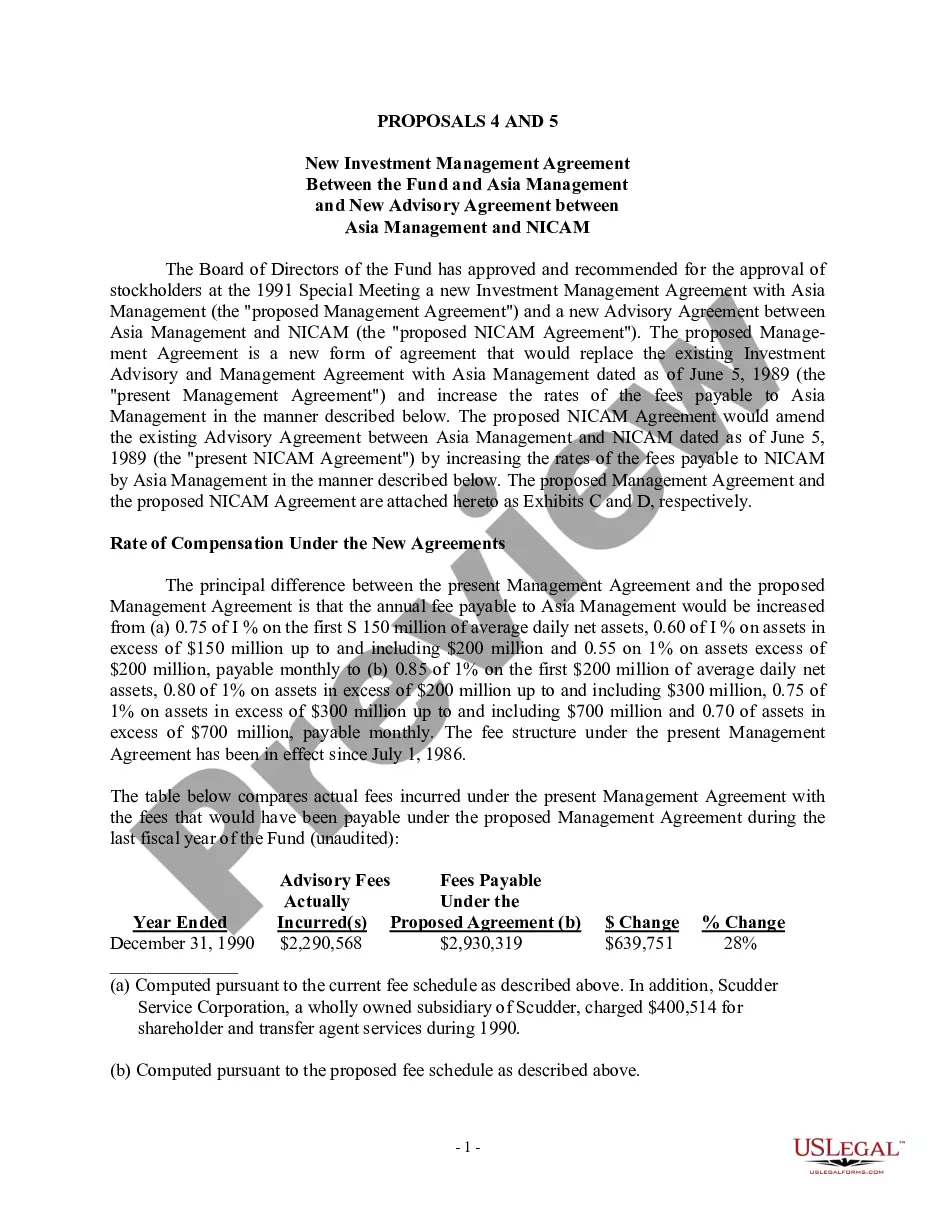
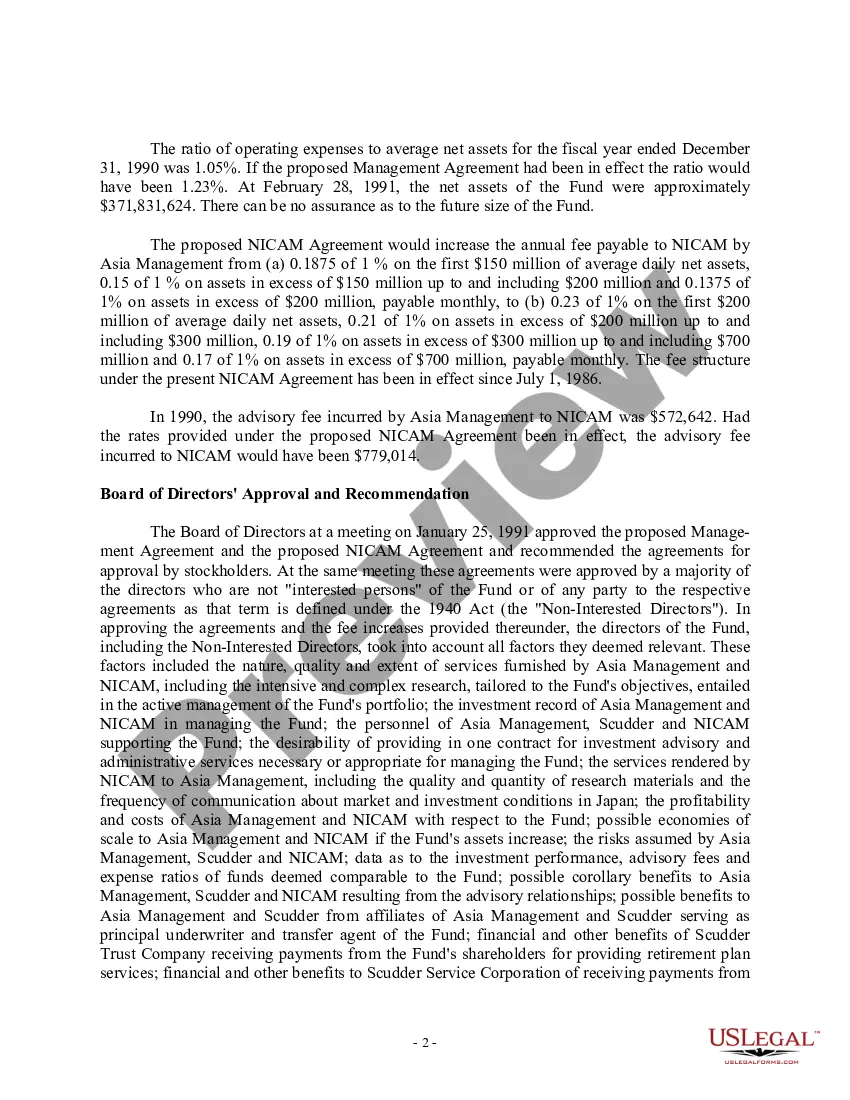
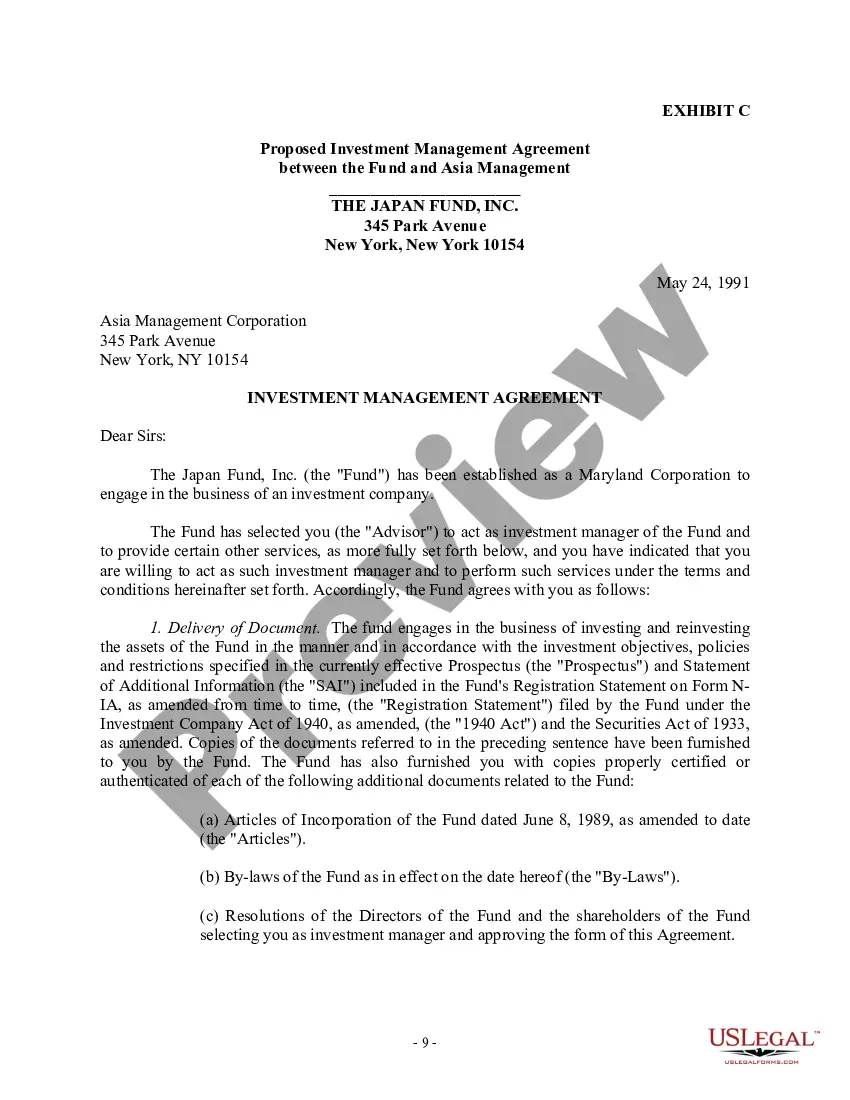
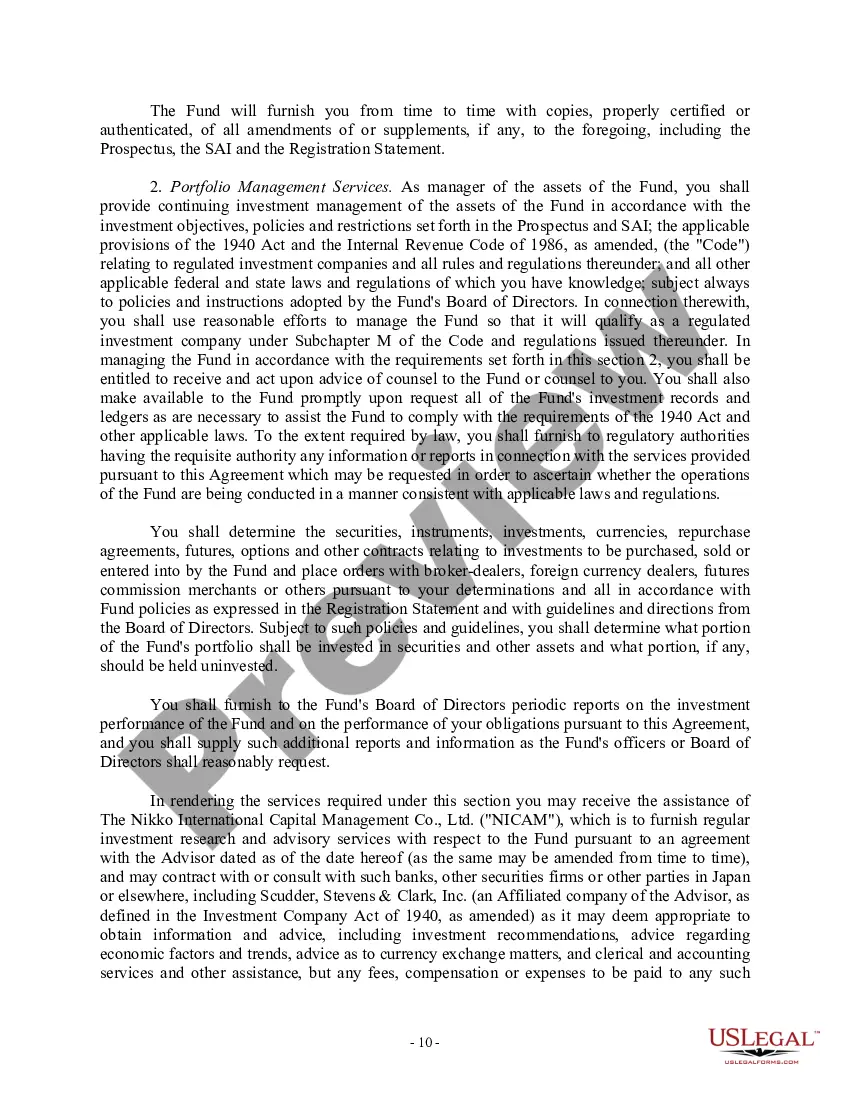
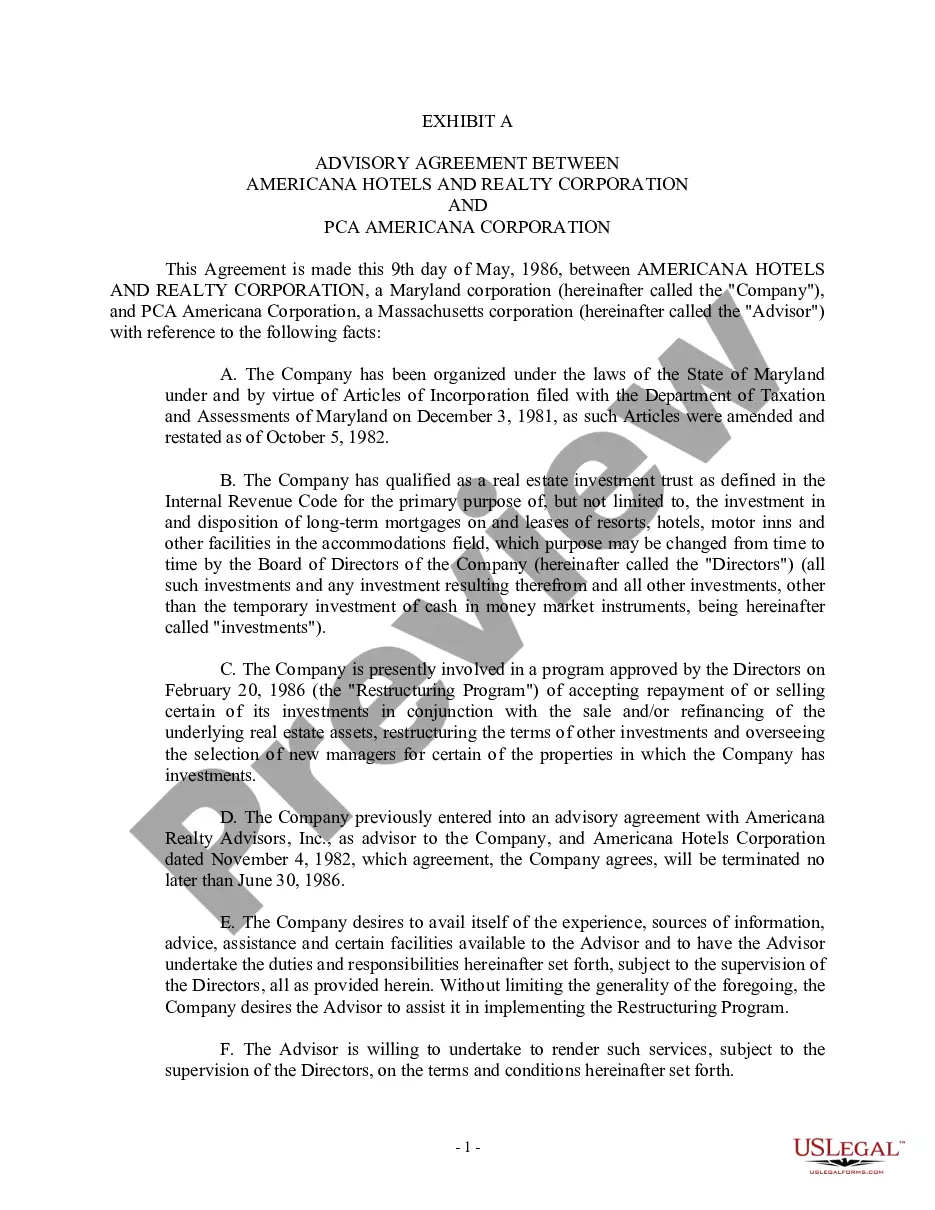
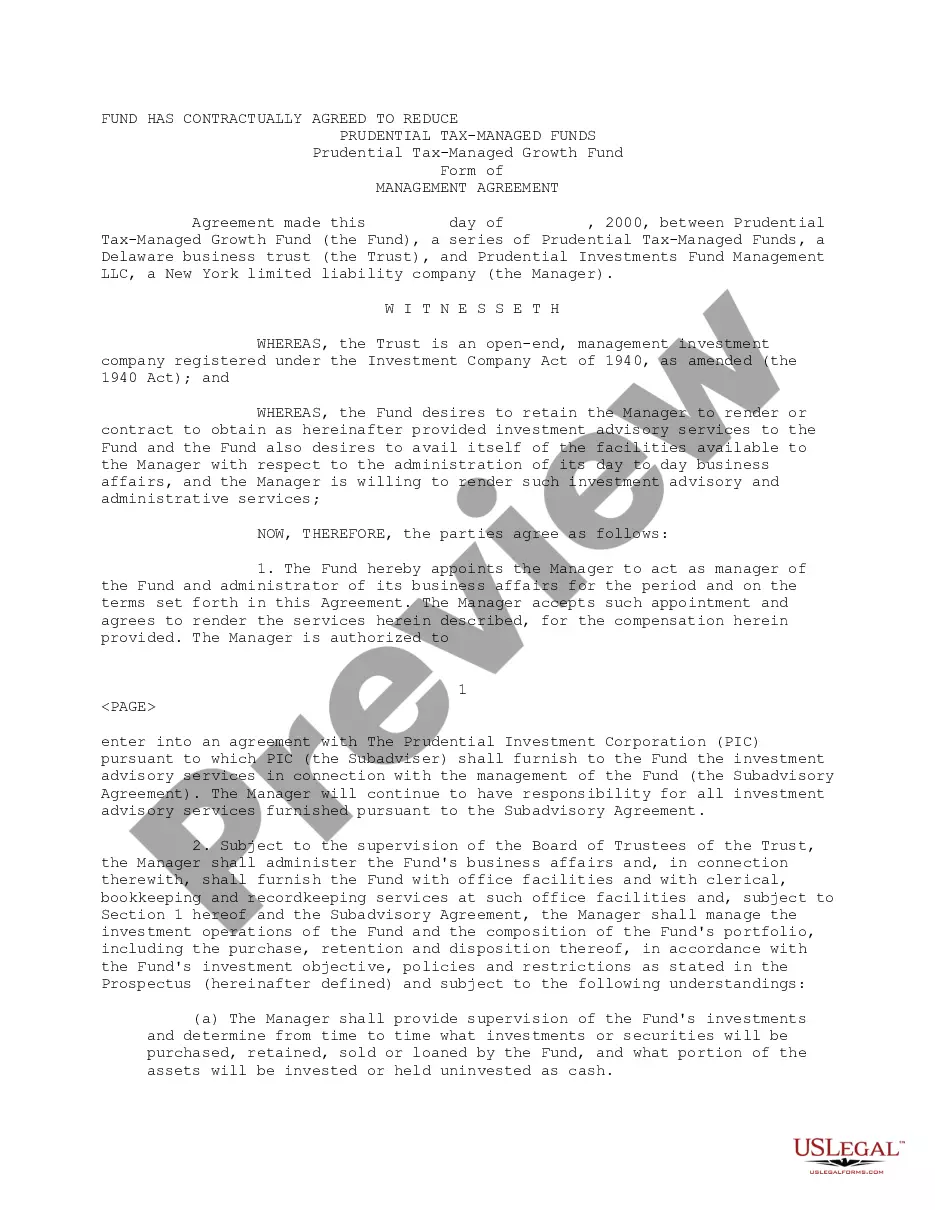
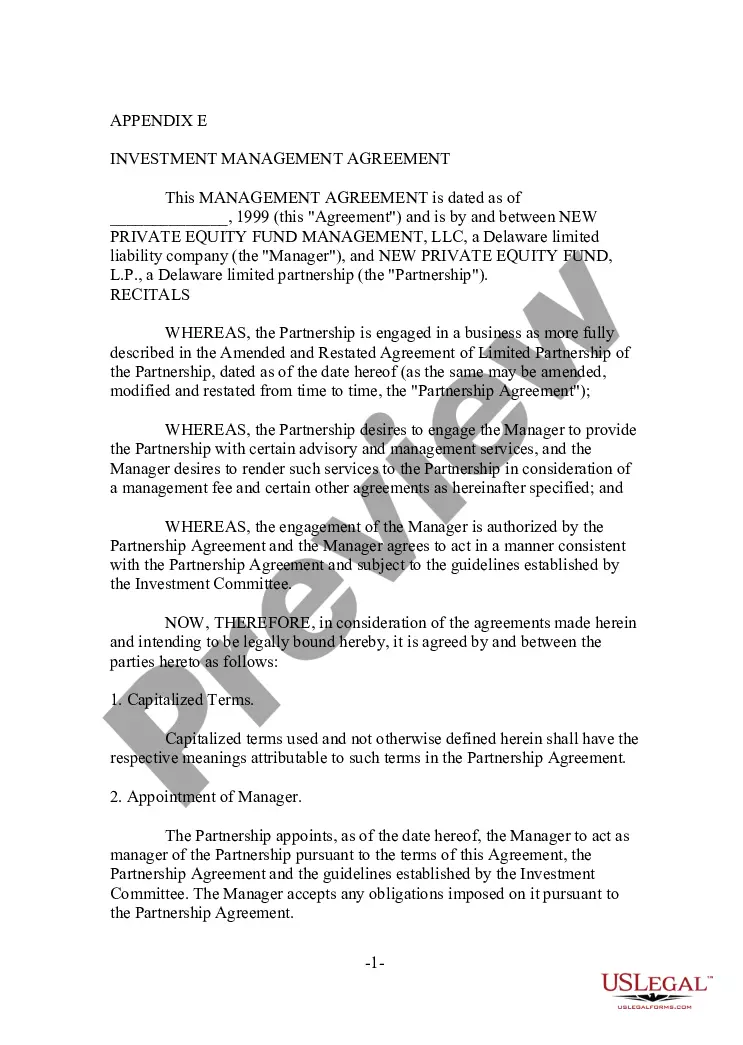
This Investment Management Agreement outlines the relationship between a mutual fund and its investment manager. It serves to establish terms under which the investment manager will receive higher fees while managing the fund's assets. This agreement is tailored for use across the United States and is crucial for mutual funds that wish to modify their management fee structure while ensuring compliance with relevant investment regulations.
Key components of this form
- Purpose of the Investment Management Agreement and its expected duration.
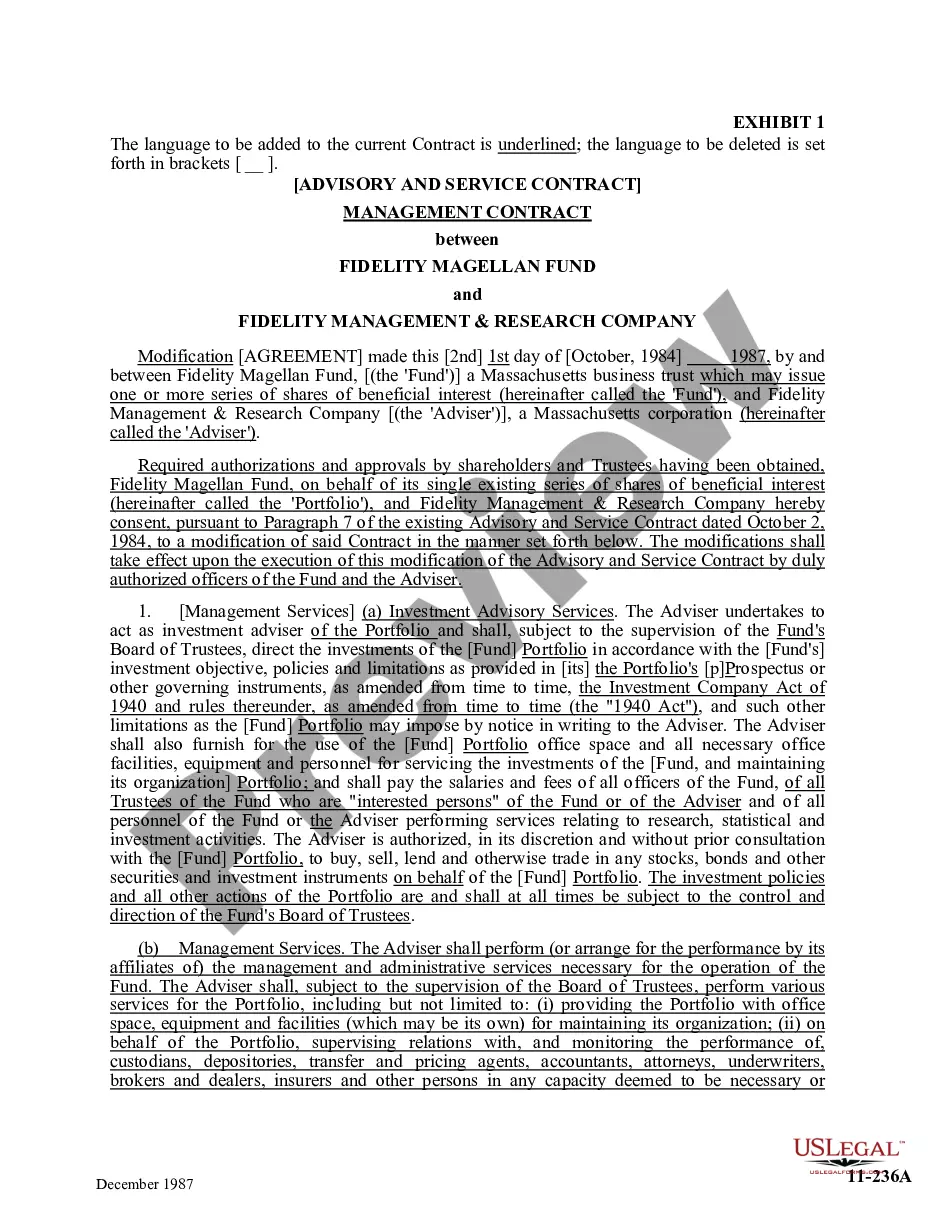
- Details of the fee structure, including the specific percentage increase applicable to different asset levels.
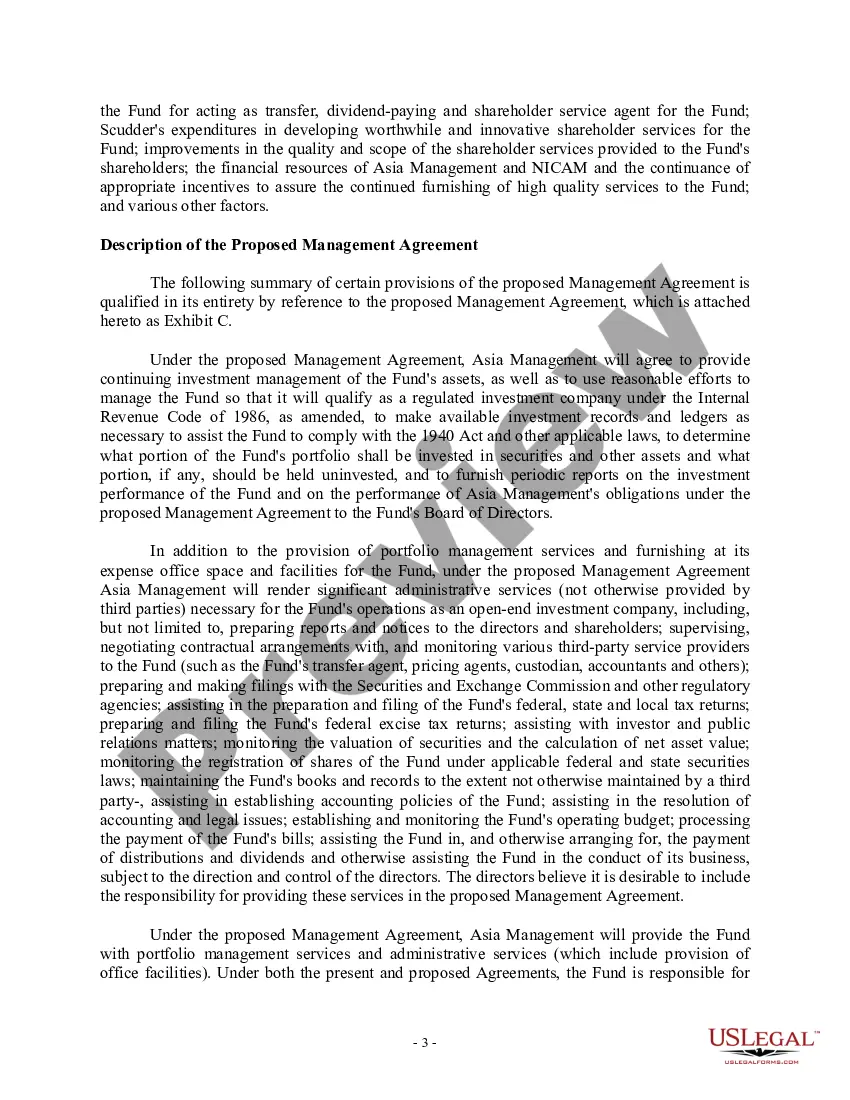
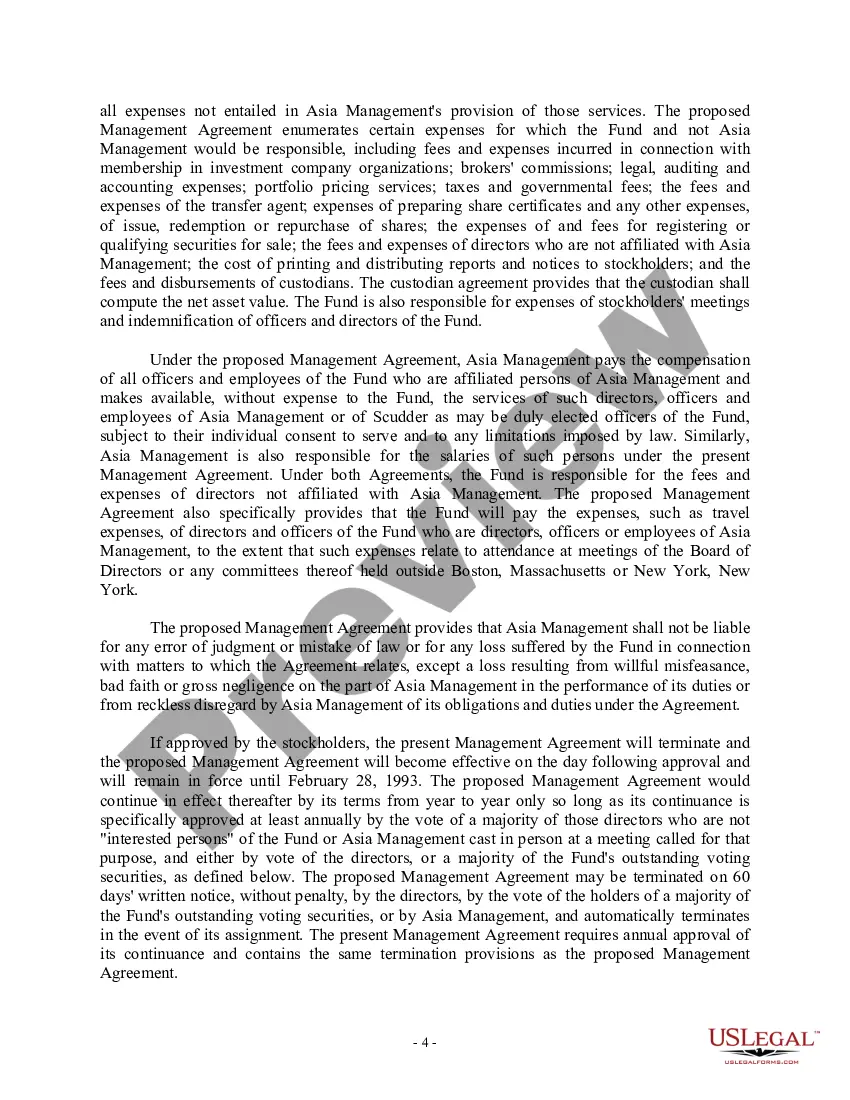
- Responsibilities of the investment manager in managing the fundâs portfolio and providing necessary administrative services.
- Approval requirement from the Board of Directors and shareholders for the agreement's effectiveness.
- Termination and amendment provisions for the agreement.

When to use this document
This form should be used when a mutual fund seeks to enter into or modify its existing investment management agreement. It is particularly applicable when the fund's board of directors has approved changes related to the management fee structure and requires a formal agreement to implement these changes. Additionally, it is essential in scenarios where the fund intends to engage third-party advisory services.
Who this form is for
Entities eligible to use this form include:
- Mutual funds looking to hire an investment manager or to alter their fee agreements.
- Investment management firms entering into contractual agreements with funds.
- Corporate boards and directors responsible for governance and approval of management agreements.
Instructions for completing this form
- Identify the parties involved in the agreement: the mutual fund and the investment manager.
- Specify the fee structure including the base fees based on asset levels.
- Outline the responsibilities of the investment manager regarding portfolio management and administrative services.
- Include provisions for approval by fund directors and shareholders.
- Establish terms for termination and amendment of the agreement.
Does this document require notarization?
This form does not typically require notarization unless specified by local law.
Get your form ready online
Our built-in tools help you complete, sign, share, and store your documents in one place.
Make edits, fill in missing information, and update formatting in US Legal Forms—just like you would in MS Word.
Download a copy, print it, send it by email, or mail it via USPS—whatever works best for your next step.
Sign and collect signatures with our SignNow integration. Send to multiple recipients, set reminders, and more. Go Premium to unlock E-Sign.
If this form requires notarization, complete it online through a secure video call—no need to meet a notary in person or wait for an appointment.
We protect your documents and personal data by following strict security and privacy standards.

Make edits, fill in missing information, and update formatting in US Legal Forms—just like you would in MS Word.

Download a copy, print it, send it by email, or mail it via USPS—whatever works best for your next step.

Sign and collect signatures with our SignNow integration. Send to multiple recipients, set reminders, and more. Go Premium to unlock E-Sign.

If this form requires notarization, complete it online through a secure video call—no need to meet a notary in person or wait for an appointment.

We protect your documents and personal data by following strict security and privacy standards.
Common mistakes
- Failing to ensure that all parties involved review and understand the terms of the agreement fully.
- Not obtaining the necessary approvals from the board of directors or shareholders before executing the agreement.
- Overlooking the impact of fee changes on fund performance and shareholder value.
- Neglecting to detail the specific roles and responsibilities of each party clearly.
Benefits of using this form online
- Online forms are easily editable, allowing quick adjustments to terms as needed.
- Users benefit from a clear, reliable template drafted by licensed attorneys, ensuring legal compliance.
- Accessible resources reduce the time needed to prepare complex legal documents.
- The Investment Management Agreement is enforceable under U.S. federal law and relevant state securities regulations.
- It is crucial to ensure that all sections of the agreement comply with the Investment Company Act of 1940.
- Provisions regarding termination and amendments should be adhered to, ensuring legal compliance throughout the lifecycle of the agreement.
What to keep in mind
- The Investment Management Agreement establishes terms between mutual funds and managers to facilitate fee changes.
- Clear identification of responsibilities for both parties ensures smooth management operations.
- Approval from the fund's board and shareholders is essential for legality and effectiveness.
Looking for another form?
Form popularity
FAQ
The Discretionary Investment Management Service The investment manager has complete discretion (often within agreed limits) to manage and invest your money without referring to you before it deals on your behalf.
The term asset management is often used to refer to the management of investment funds, while the more generic term fund management may refer to all forms of institutional investment, as well as investment management for private investors.
A contract stating the rights and responsibilities of two parties to an investment. The investment agreements sets forth the parameters of the investment; for example, it includes what money, if any, one party must pay to the other and the goods or services each must provide or produce.
Asset management refers to the management of investments on behalf of others. The process essentially has a dual mandate - appreciation of a client's assets over time while mitigating risk.The role of an asset manager consists of determining what investments to make, or avoid, that will grow a client's portfolio.
Funds managementalso referred to as asset managementcovers any kind of system that maintains the value of an entity.Funds management can also refer to the management of fund assets. In the financial world, the term "fund management" describes people and institutions that manage investments on behalf of investors.
For ambitious, high-performing economics and finance students, investment banking and asset management offer lucrative career paths. Entering either of these fields often means making a lot of money right out of school, and it confers a great deal of clout, as well.
Simply put, asset management firms manage funds for individuals and companies. They make well-timed investment decisions on behalf of their clients to grow their finances and portfolio. Working with a group of several investors, asset management firms are able to diversify their clients' portfolios.
Investment discretion means, with respect to an account, the sole or shared authority (whether or not that authority is exercised) to determine what securities or other assets to purchase or sell on behalf of the account.
The primary difference between these two jobs is that investment managers focus on securities and bonds while fund managers work with mutual funds.As a fund manager, you must monitor business developments, like mergers and acquisitions, to determine how those events may impact investments.