Sample Letter for Letter from Department Chair Disapproving Senior Graduate Thesis
About this form
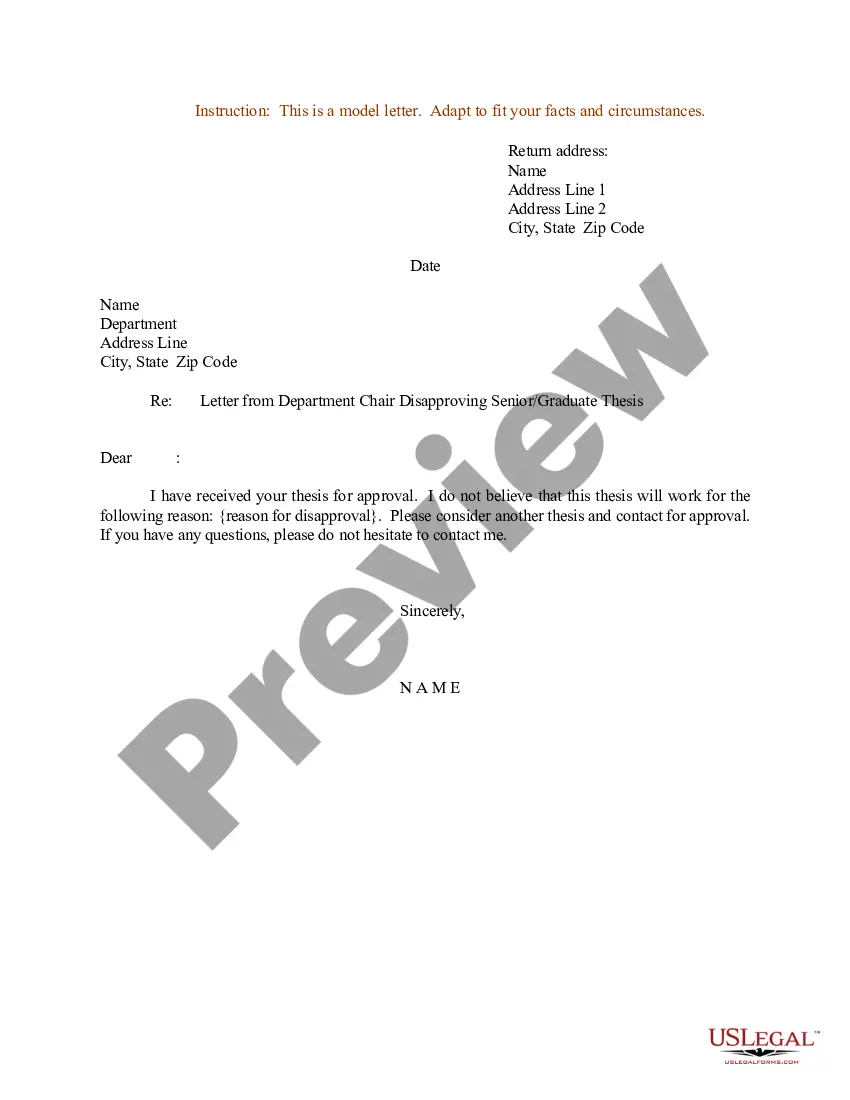
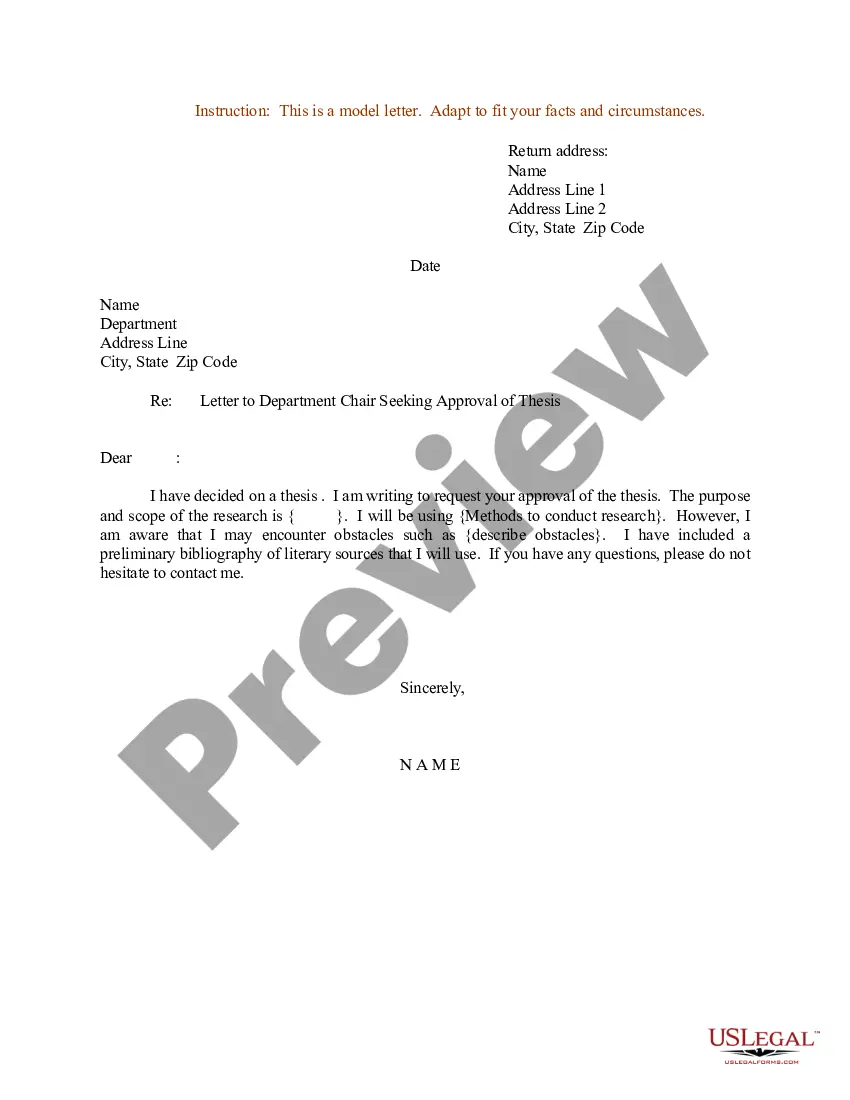
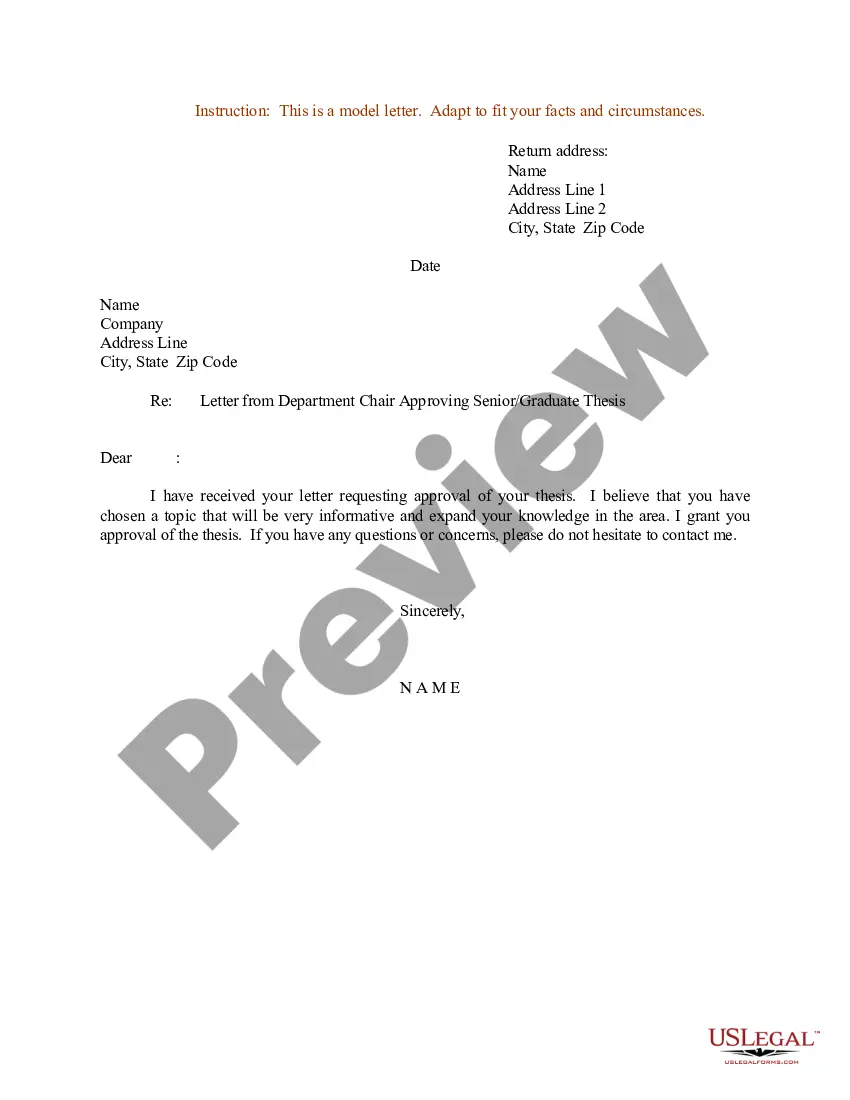
This Sample Letter for Letter from Department Chair Disapproving Senior Graduate Thesis is a formal communication template designed for department chairs to convey their disapproval of a senior or graduate student's thesis. It provides a structured approach tailored for academic settings, enabling faculty to communicate their concerns effectively and professionally. This form is particularly useful for ensuring clarity and maintaining formal standards in academic correspondence.
Form components explained
- Return address: Include your name and address as the sender.
- Date: Specify the date of the letter.
- Recipient's address: Provide the name and address of the student or corresponding party.
- Subject line: Clearly state the purpose of the letter regarding the thesis disapproval.
- Closing: End with a formal closing and your name.
When to use this form
This form is needed when a department chair must formally communicate their disapproval of a senior or graduate thesis. You may use this letter when the thesis does not meet department standards or fails to fulfill requirements outlined in the syllabus. It is also appropriate when providing constructive feedback or outlining the reasons for the disapproval.
Who this form is for
This form is intended for:
- Department chairs in academic institutions.
- Faculty members responsible for overseeing student theses.
- Administrators involved in academic program management.
- Any academic staff who need to provide formal feedback on student work.
Instructions for completing this form
- Identify and fill in your return address at the top of the letter.
- Insert the date on which you are sending the letter.
- Provide the recipient's full name and address under the date.
- Clearly state the subject of the letter regarding thesis disapproval.
- Convey your disapproval in the body of the letter, including reasons and any suggested next steps.
- Close the letter with a formal sign-off and your name.
Notarization guidance
This form does not typically require notarization unless specified by local law. It serves as a formal written communication and can be valid without notarization.
Get your form ready online
Our built-in tools help you complete, sign, share, and store your documents in one place.
Make edits, fill in missing information, and update formatting in US Legal Forms—just like you would in MS Word.
Download a copy, print it, send it by email, or mail it via USPS—whatever works best for your next step.
Sign and collect signatures with our SignNow integration. Send to multiple recipients, set reminders, and more. Go Premium to unlock E-Sign.
If this form requires notarization, complete it online through a secure video call—no need to meet a notary in person or wait for an appointment.
We protect your documents and personal data by following strict security and privacy standards.

Make edits, fill in missing information, and update formatting in US Legal Forms—just like you would in MS Word.

Download a copy, print it, send it by email, or mail it via USPS—whatever works best for your next step.

Sign and collect signatures with our SignNow integration. Send to multiple recipients, set reminders, and more. Go Premium to unlock E-Sign.

If this form requires notarization, complete it online through a secure video call—no need to meet a notary in person or wait for an appointment.

We protect your documents and personal data by following strict security and privacy standards.
Common mistakes
- Failing to include the recipient's address, which can lead to confusion.
- Using informal language instead of a professional tone.
- Neglecting to proofread for grammatical or spelling errors.
- Omitting specific reasons for the disapproval, which can leave the student unclear about necessary improvements.
Why complete this form online
- Convenient access: Download and complete the form at any time.
- Editability: Customize the letter easily to fit individual circumstances.
- Reliable format: Use a professionally designed template to ensure formal standards are met.
- Save time: Quickly generate necessary correspondence without drafting from scratch.
Legal use & context
- This letter is a formal record of communication within an academic setting.
- It helps to document the decision-making process regarding academic evaluations.
- Although not legally binding, it creates a clear understanding of expectations between faculty and students.
What to keep in mind
- This form is essential for department chairs to communicate thesis disapproval effectively.
- It provides a structured template for formal academic correspondence.
- Using the letter encourages clarity and professionalism in academic feedback.
Looking for another form?






Form popularity
FAQ
Respond by first restating the original request to prevent confusion. Be specific about the reason the request has been denied and offer an alternative if applicable, such as a different date when an absence would be feasible. Use polite and professional language. Being blunt could cause undue offence.
A letter of denial is usually written to notify the recipient that your certain request has been denied or it is not possible under certain parameters to fulfill the request.A letter of denial is usually a formal letter, it should be brief, amiable and direct.
I don't think so. (strong) No way. I'm afraid I disagree. (strong) I totally disagree. I beg to differ. (strong) I'd say the exact opposite. Not necessarily. That's not always true.
Write the application reference number and name/address of the scheme at the top of your letter. Make clear that you object. Refer to development plan. Make clear if there are any other material considerations that should be taken into account. Don't be emotive, focus on the issues.
I respect your point but from my perspective (or but in my opinion)2026 I take your point but that isn't the way I see it; instead, I think that2026 True, that is a fair point, but I have to say I disagree2026 I understand where you are coming from but2026
I see what you're saying but2026 I understand where you're coming from, but2026 That's a valid point, but2026 I'm sorry but I disagree with you about this.
Always thank the reader. Notice how Michael begins the sentence by thanking her for her proactiveness in following up on her previous request. State what you can do. Reaffirm your answer at the end of the email.
Consider diffusing the situation by using love and humor. Clearly describe the disagreement and explain what you want done to resolve it. Avoid accusations and threats, particularly in a first letter. Remember to remain courteous, despite the way you may feel. Keep the tone respectful.
Write the pertinent details such as the name of applicant, date, and address at the upper part of the letter. Specify the request which you are disapproving. Enumerate through narration or in bulleted form the specific requirements which the applicant have failed to adequately meet.