Revocation of Proxy
Overview of this form
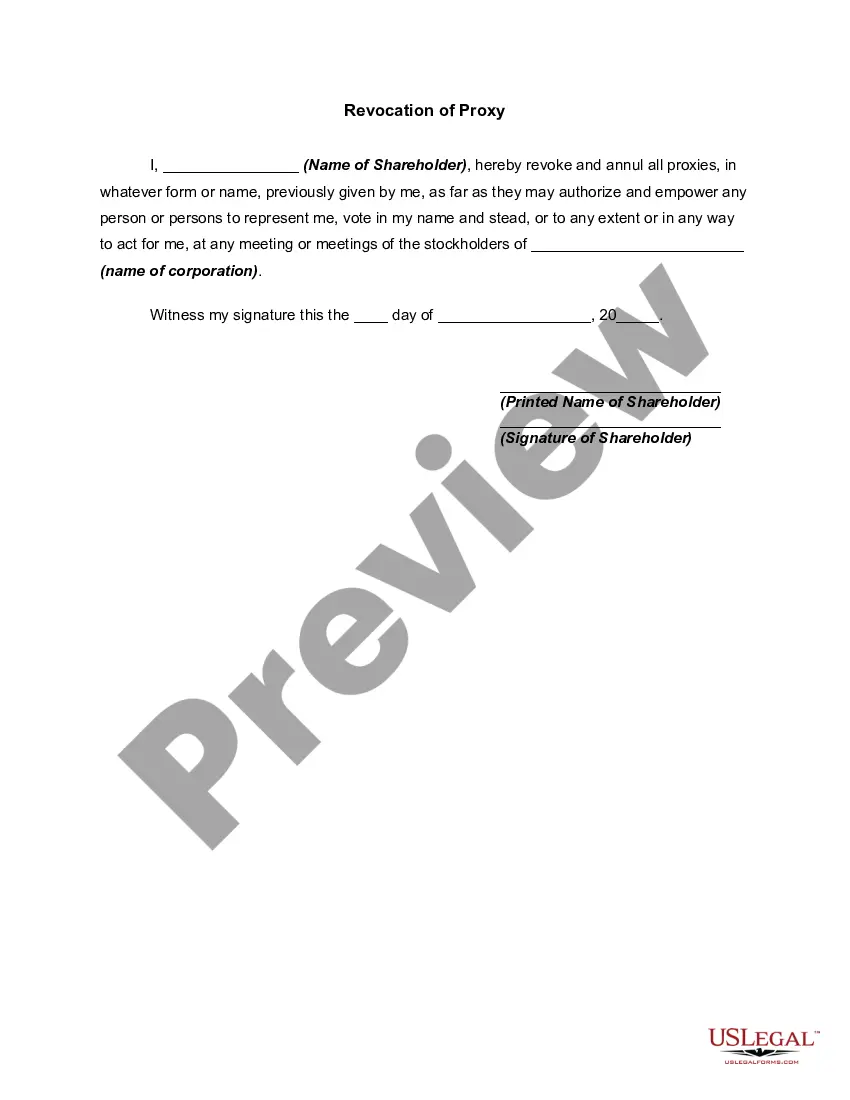
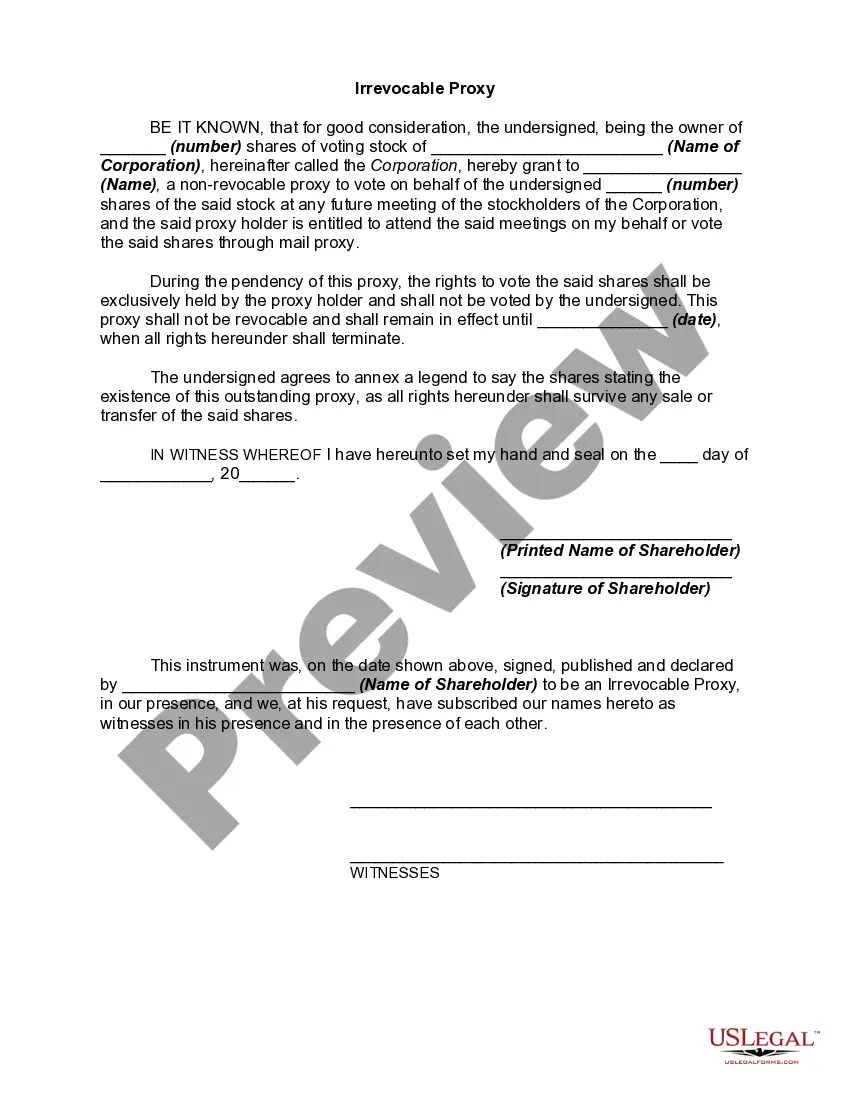
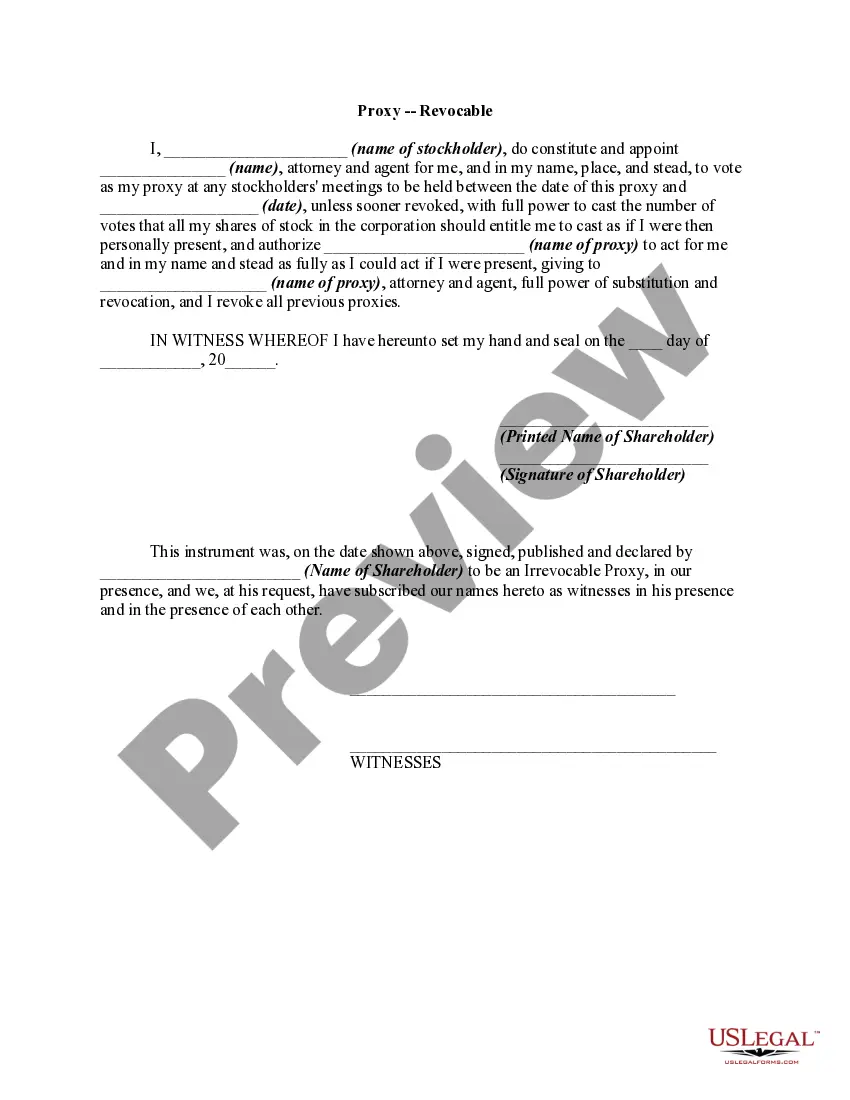
The Revocation of Proxy is a legal document used to annul any previously granted authority for someone to vote on your behalf at stockholder meetings. This form ensures that your voting rights are returned to you and that no other individual can cast your votes without your explicit permission. It differs from other proxy forms, as it specifically focuses on revoking any prior delegations of voting power.
Key components of this form
- Shareholder's name: Clearly state the name of the shareholder revoking the proxy.
- Corporate name: Specify the name of the corporation where the proxy was granted.
- Date field: Indicate the date on which the revocation is signed.
- Signature: The shareholder must sign to validate the revocation.
- Printed name: Include the printed name of the shareholder beneath the signature for clarity.
When this form is needed
This form should be used whenever a shareholder wishes to revoke the authority granted to a proxy. Common situations include changes in relationships, dissatisfaction with the current proxy, or a desire to vote in person rather than through a proxy. It can also be relevant if a corporate event arises that warrants personal voting on critical issues.
Intended users of this form
- Shareholders who have previously appointed a proxy to vote on their behalf.
- Individuals who no longer wish a designated proxy to represent their voting interests.
- Anyone needing to secure their voting rights for upcoming corporate meetings.
Instructions for completing this form
- Identify the shareholder: Fill in the name of the shareholder revoking the proxy.
- Specify the corporation: Write the name of the corporation related to the proxy authority.
- Enter the date: Complete the date field with the signing date of the revocation.
- Add signature: The shareholder must sign the document to make it legally binding.
- Include printed name: Clearly print the shareholder's name below the signature for verification purposes.
Notarization guidance
This form does not typically require notarization unless specified by local law. However, having a notarized signature can provide additional assurance of the document's validity in some jurisdictions.
Get your form ready online
Our built-in tools help you complete, sign, share, and store your documents in one place.
Make edits, fill in missing information, and update formatting in US Legal Forms—just like you would in MS Word.
Download a copy, print it, send it by email, or mail it via USPS—whatever works best for your next step.
Sign and collect signatures with our SignNow integration. Send to multiple recipients, set reminders, and more. Go Premium to unlock E-Sign.
If this form requires notarization, complete it online through a secure video call—no need to meet a notary in person or wait for an appointment.
We protect your documents and personal data by following strict security and privacy standards.

Make edits, fill in missing information, and update formatting in US Legal Forms—just like you would in MS Word.

Download a copy, print it, send it by email, or mail it via USPS—whatever works best for your next step.

Sign and collect signatures with our SignNow integration. Send to multiple recipients, set reminders, and more. Go Premium to unlock E-Sign.

If this form requires notarization, complete it online through a secure video call—no need to meet a notary in person or wait for an appointment.

We protect your documents and personal data by following strict security and privacy standards.
Avoid these common issues
- Failing to sign the form, which renders it invalid.
- Not including the corporationâs name, leading to ambiguity.
- Leaving the date field blank, which may raise questions about timing.
- Not revoking all prior proxies, which could lead to conflicting instructions.
Benefits of using this form online
- Convenience: Easily fill out and download the form from home.
- Editability: Make changes quickly before finalizing the document.
- Reliability: Forms are drafted by licensed attorneys, ensuring legality and precision.
- Immediate access: Obtain the form anytime without waiting for delivery.
Legal use & context
- This form serves as an official record of the revocation of proxy rights, thereby protecting the shareholder's voting authority.
- It complies with corporate laws that govern proxy voting and shareholder meetings.
Key takeaways
- The Revocation of Proxy allows shareholders to reclaim their right to vote.
- Ensure all relevant fields, especially names and dates, are correctly filled out.
- Use this form to clearly communicate your change in voting representation.
Looking for another form?
Form popularity
FAQ
Voters can revoke a proxy by issuing a new one or by providing written notice to the association secretary. The owner can also revoke a proxy by attending a meeting in person and casting their own ballot. In this case, the voter must attend the meeting AND vote at the meeting in order for their vote to count.
A proxy is valid for up to 90 days after the date of the first meeting for which it was given. Each proxy is revocable at any time at the pleasure of the unit owner executing it.
Most boards require a quorum to conduct voting and proxies can be useful in establishing a quorum.An organization's bylaws may allow for a member's proxy to be counted only for the purpose of establishing a quorum, but not as a vote for or against an issue.
A member of a company is entitled to appoint more than one proxy to exercise all or any of his rights to attend and to speak and vote at a meeting of the company, provided that each proxy is appointed to exercise the rights attached to a different share or shares held by the member.
Proxy limits The limits held by one person are: one proxy vote only for schemes with 20 lots or less, or. in schemes with more than 20 lots, a number that is equal to no more than 5 percent of the total number of lots.
There seems to be some confusion of late as to whether a person can hold more than two proxies or not. The simple answer is 'yes': a person can currently hold more than two proxies there is no limit at the moment.
The power of attorney revocation form allows a person to cancel a previous appointment that was made. The form, once signed by the principal, cancels and immediately terminates the rights of the agents listed in the original power of attorney document.
A proxy may refer to a person who is authorized to act for another or it may designate the function or authority of serving in another's stead. In the latter sense, it generally is preceded by the word by (vote by proxy).