Notice by Buyer of Rejection of Goods - Risk of Loss Remains on Seller
What this document covers
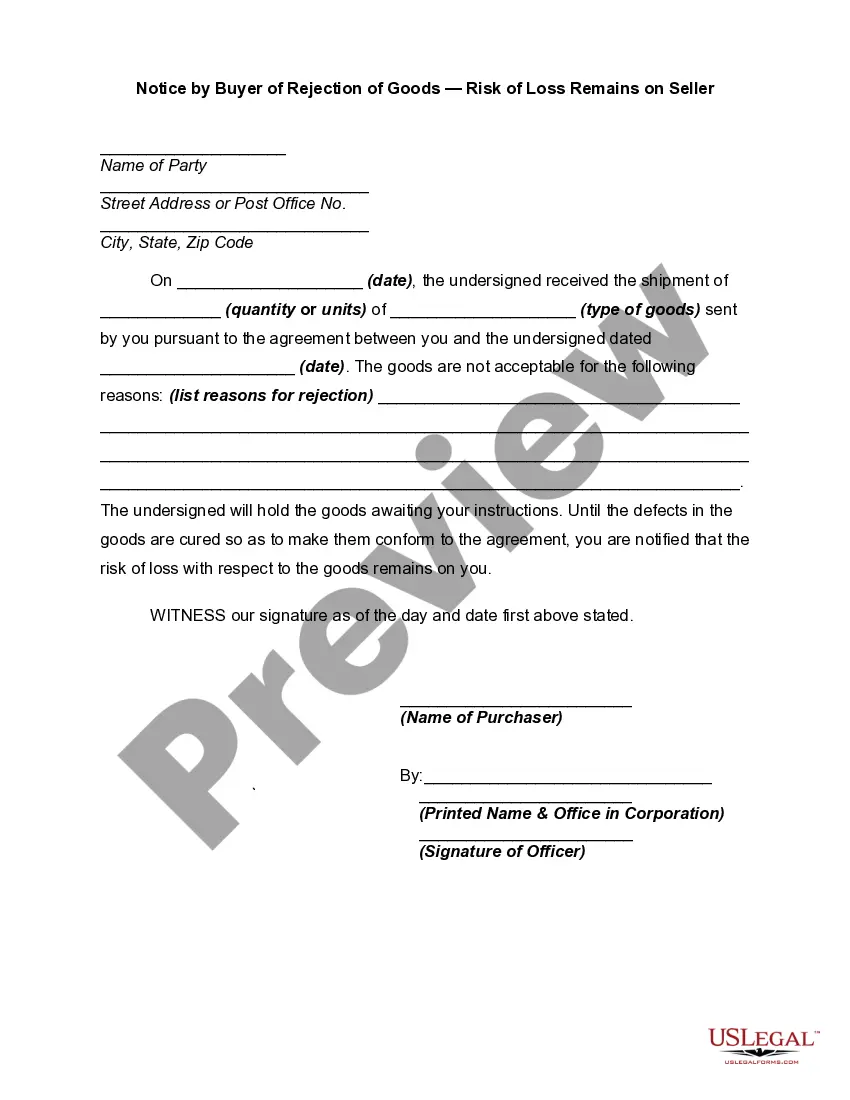
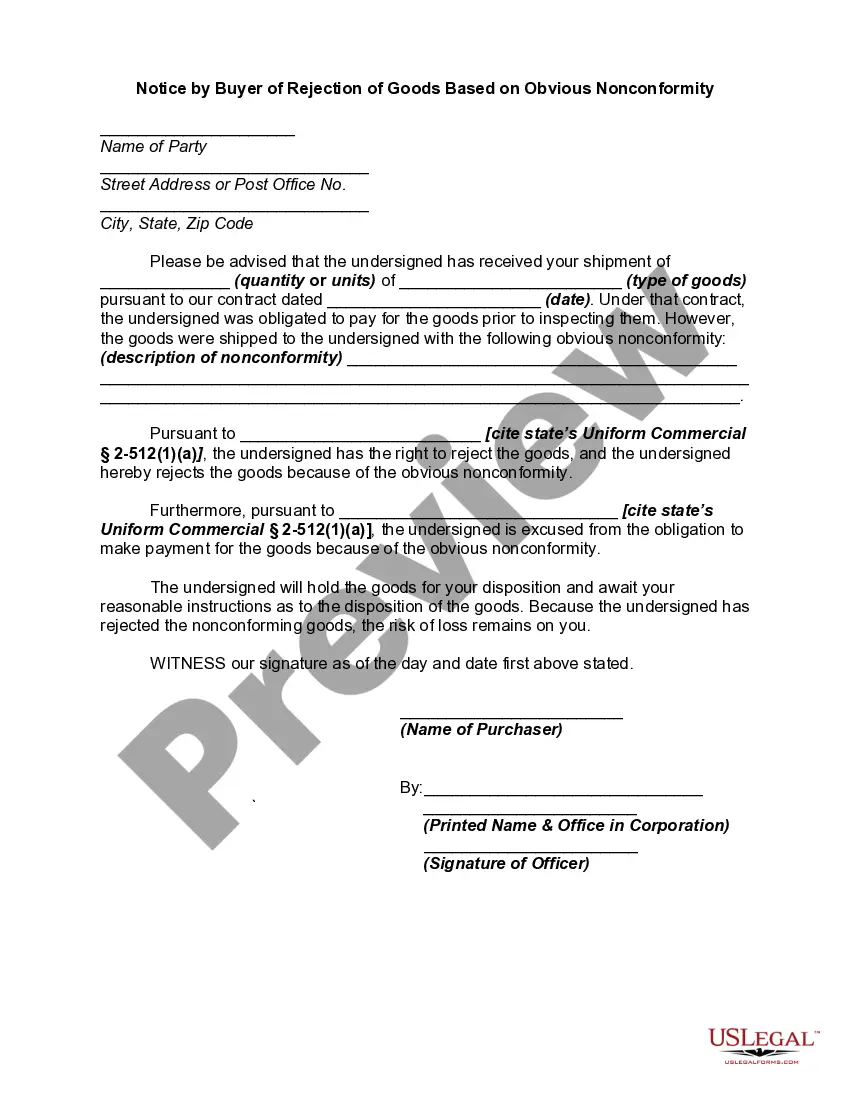
The Notice by Buyer of Rejection of Goods - Risk of Loss Remains on Seller is a legal document that allows a buyer to formally communicate their rejection of goods received. This form ensures that the seller is notified of the rejection within a reasonable timeframe, as required by the Uniform Commercial Code. This form is essential for maintaining the buyer's rights and clarifying the responsibilities regarding the risk of loss until the goods meet the agreed-upon standards.
Main sections of this form
- Contact information of the buyer and seller
- Date of receipt of the goods
- Details about the quantity and type of goods received
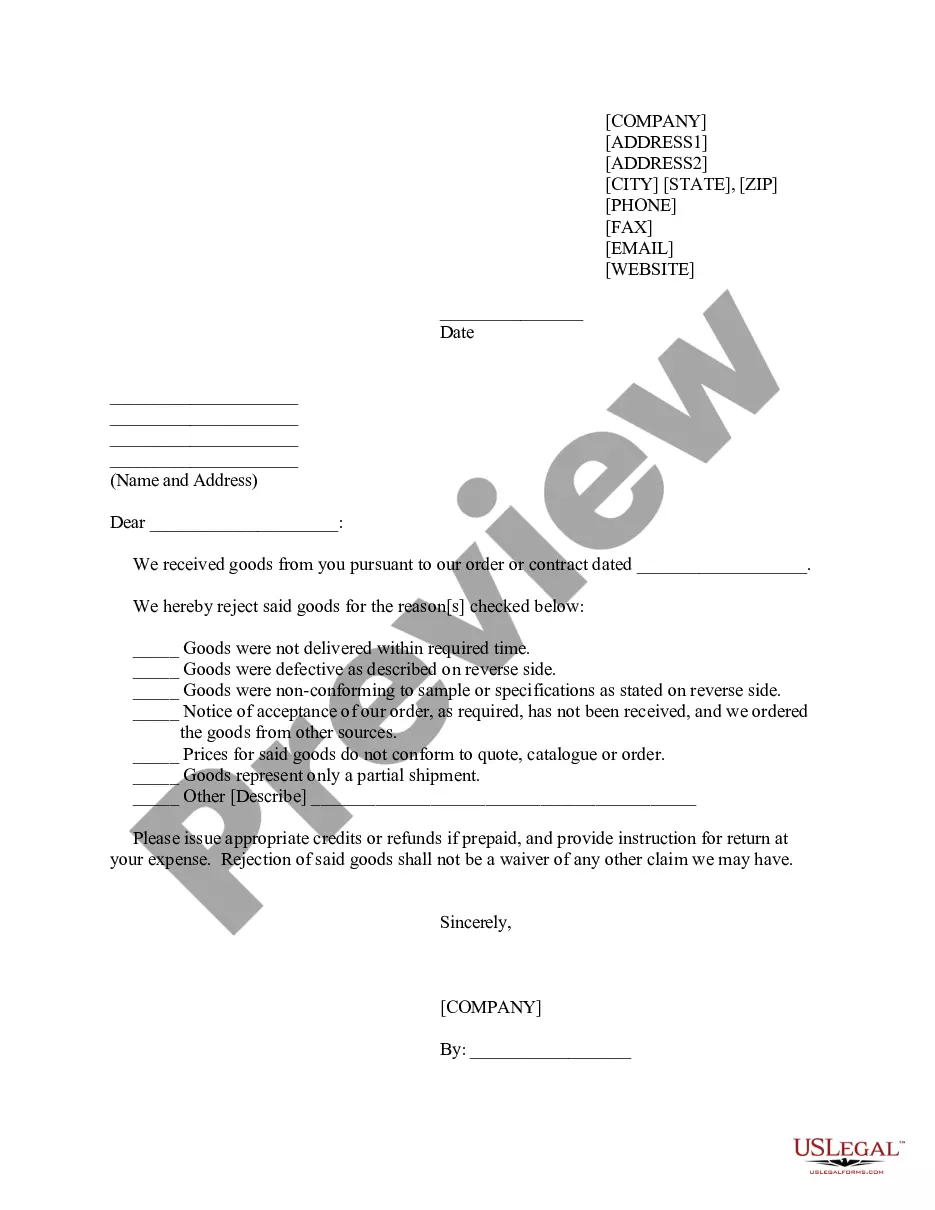
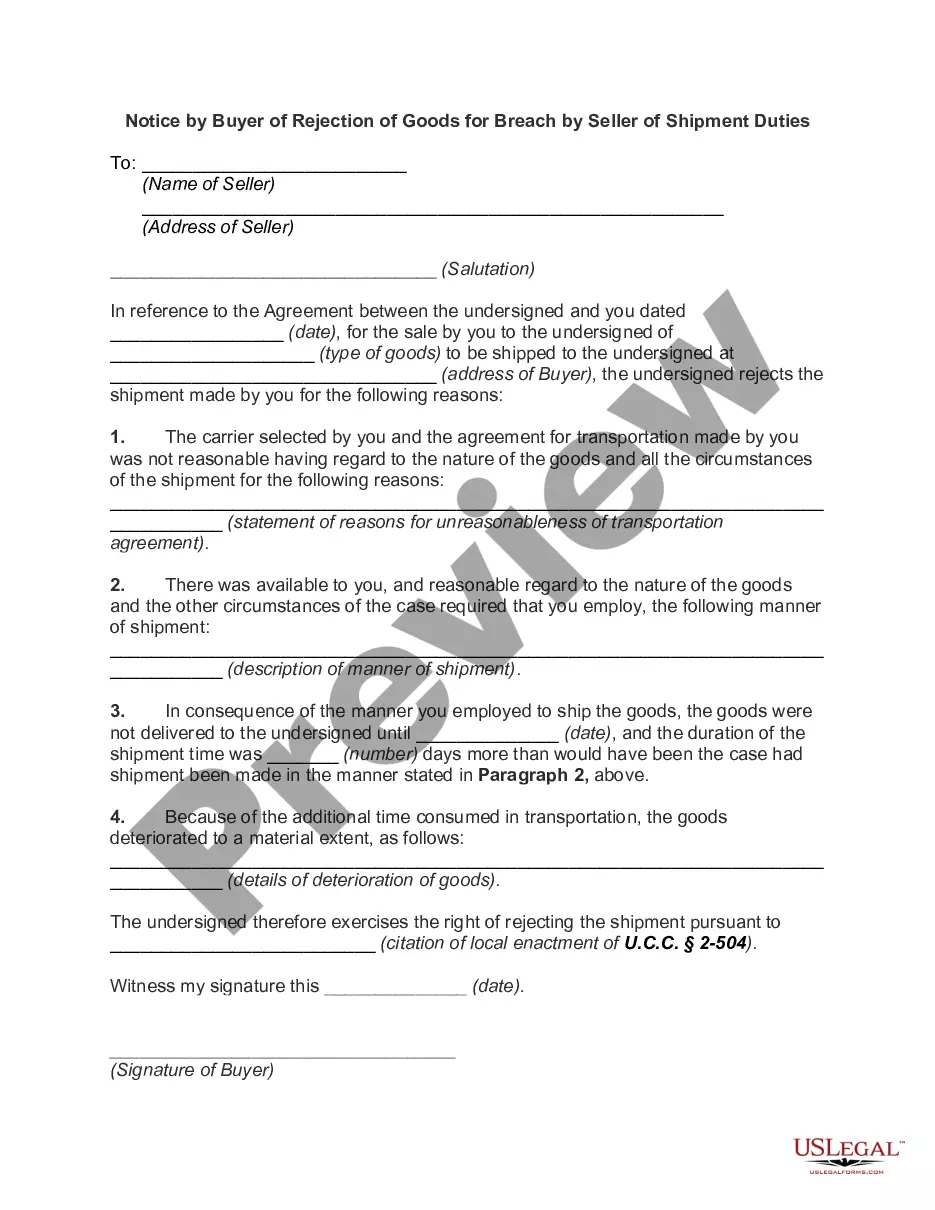
- Reasons for rejecting the goods
- Statement indicating that the risk of loss remains with the seller
- Signature of the buyer or authorized representative
When to use this form
This form should be used when a buyer receives goods that do not conform to the specifications agreed upon in a purchase agreement. Common scenarios include receiving damaged goods, items that do not meet quality standards, or incorrect shipments. By using this form, the buyer can protect their interests and clarify that the seller retains responsibility for the goods until the issue is resolved.
Who needs this form
- Buyers who have received defective or non-conforming goods
- Business owners managing commercial transactions
- Individuals involved in retail or wholesale agreements
- Legal representatives acting on behalf of a buyer
Completing this form step by step
- Identify and fill in the names and addresses of both the buyer and seller.
- Enter the date you received the shipment of goods.
- Specify the quantity and type of goods being rejected.
- Clearly list the reasons for rejecting the goods.
- State that the risk of loss remains with the seller until the issues are resolved.
- Sign the form and include the printed name and office title if applicable.
Does this form need to be notarized?
This form usually doesn’t need to be notarized. However, local laws or specific transactions may require it. Our online notarization service, powered by Notarize, lets you complete it remotely through a secure video session, available 24/7.
Get your form ready online
Our built-in tools help you complete, sign, share, and store your documents in one place.
Make edits, fill in missing information, and update formatting in US Legal Forms—just like you would in MS Word.
Download a copy, print it, send it by email, or mail it via USPS—whatever works best for your next step.
Sign and collect signatures with our SignNow integration. Send to multiple recipients, set reminders, and more. Go Premium to unlock E-Sign.
If this form requires notarization, complete it online through a secure video call—no need to meet a notary in person or wait for an appointment.
We protect your documents and personal data by following strict security and privacy standards.

Make edits, fill in missing information, and update formatting in US Legal Forms—just like you would in MS Word.

Download a copy, print it, send it by email, or mail it via USPS—whatever works best for your next step.

Sign and collect signatures with our SignNow integration. Send to multiple recipients, set reminders, and more. Go Premium to unlock E-Sign.

If this form requires notarization, complete it online through a secure video call—no need to meet a notary in person or wait for an appointment.

We protect your documents and personal data by following strict security and privacy standards.
Common mistakes
- Failing to notify the seller within a reasonable time after receipt.
- Not providing specific reasons for the rejection.
- Neglecting to include all necessary contact information.
- Not signing the form or omitting the title of the signatory.
Benefits of completing this form online
- Convenience of downloading and customizing the form from anywhere.
- Easy access to templates created by licensed attorneys.
- Time-saving as you can complete the form at your own pace.
- Secure storage of your documents in electronic format.
Looking for another form?







Form popularity
FAQ
21. When the risk of loss for goods passes from a seller to a buyer is generally determined by the contract between the parties.
Where the buyer wrongfully neglects or refuses to accept and pay for the goods, the seller may sue him for damages for non-acceptance. The damages are assessed on the basis of the principles contained in sections 73 and 74 of the Indian Contract Act, 1872.
Goods Held by the Seller: If the seller is a merchant, risk of loss passes to the buyer at the time he or she takes physical possession of the goods. If the seller is a non-merchant, risk of loss passes to the buyer when the seller tenders the goods to the buyer.
CancelA Seller may cancel a contract when a buyer has wrongfully rejected acceptance of the goods, failed to make payment due on or before delivery, or repudiated the contract.
1. Suit for Damages for Non-Delivery- When the seller wrongfully neglects or refuses to deliver the goods to the buyer, the buyer may sue the seller for damages for non-delivery. This is in addition to the buyer's right to recover the price, if already paid, in case of non-delivery.
(1) The seller may stop delivery of goods in the possession of a carrier or other bailee when he discovers the buyer to be insolvent (Section 2-702) and may stop delivery of carload, truckload, planeload or larger shipments of express or freight when the buyer repudiates or fails to make a payment due before delivery
15. When a buyer breaches a sales contract, the risk of loss remains with the seller to the extent of any deficiency in the buyer's insurance coverage.
When the Seller or Lessor Refuses to Deliver the Goods If the seller or lessor refuses to deliver the goods to the buyer or lessee, the basic remedies available to the buyer or lessee include the right to: 1. Cancel (rescind) the contract. 2. Obtain goods that have been paid for if the seller or lessor is insolvent.
(6) Recover Damages: If the seller repudiates a contract or wrongfully refuses to deliver conforming goods, the buyer can sue to recover the difference between the contract price and the fair market price of the goods (at the time that the buyer learned of the breach), plus incidental and consequential damages, less