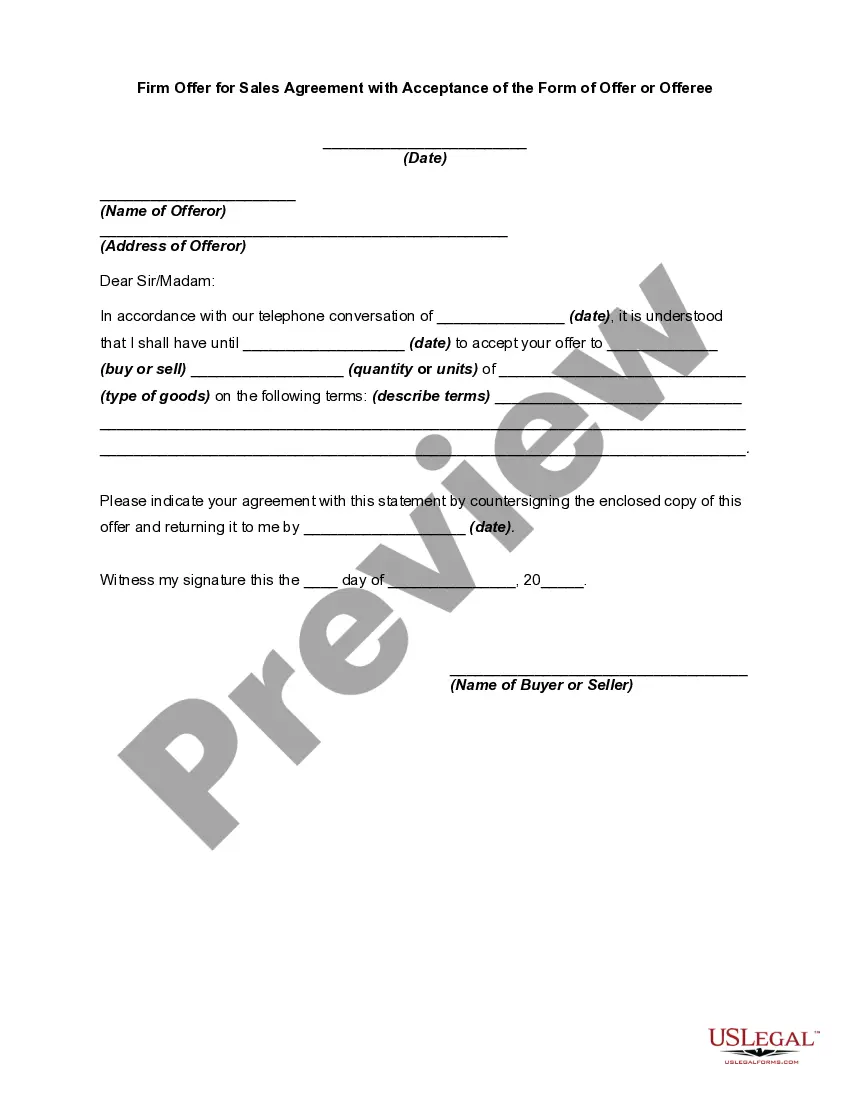
Firm Offer for Sales Agreement with Acceptance of the Form of Offer or Offeree
Understanding this form
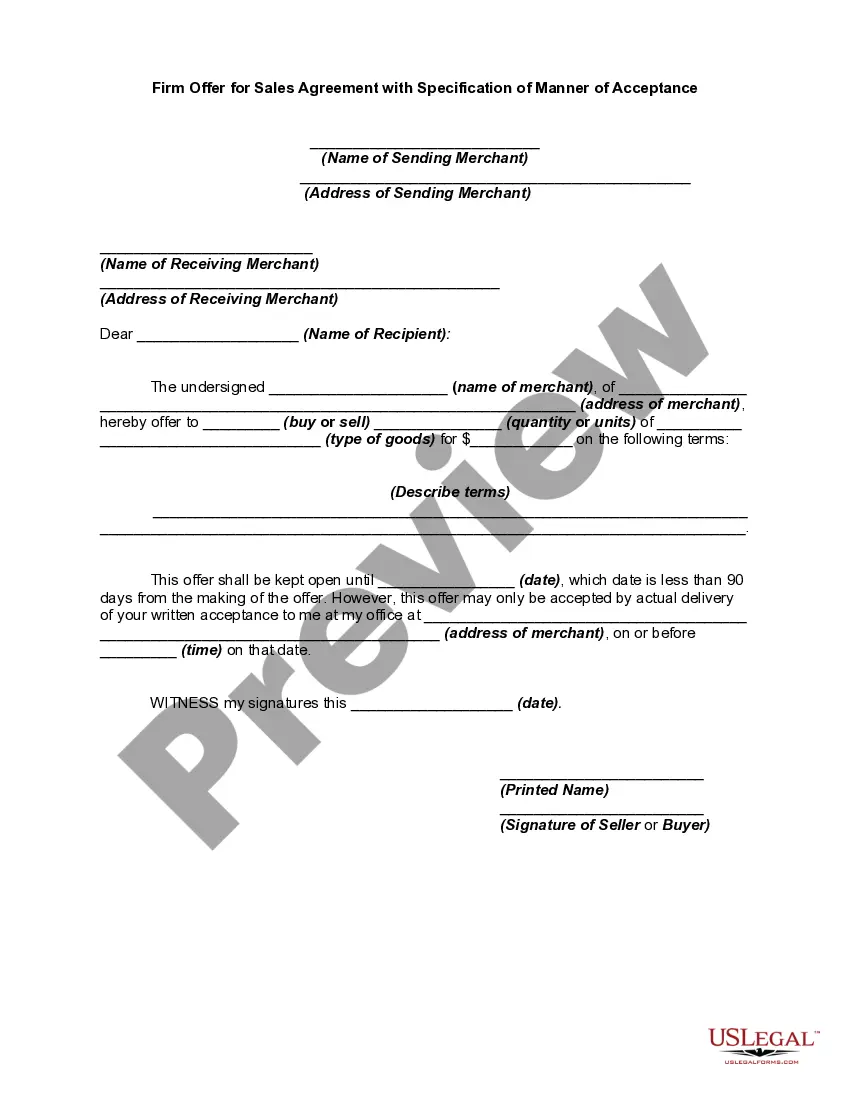
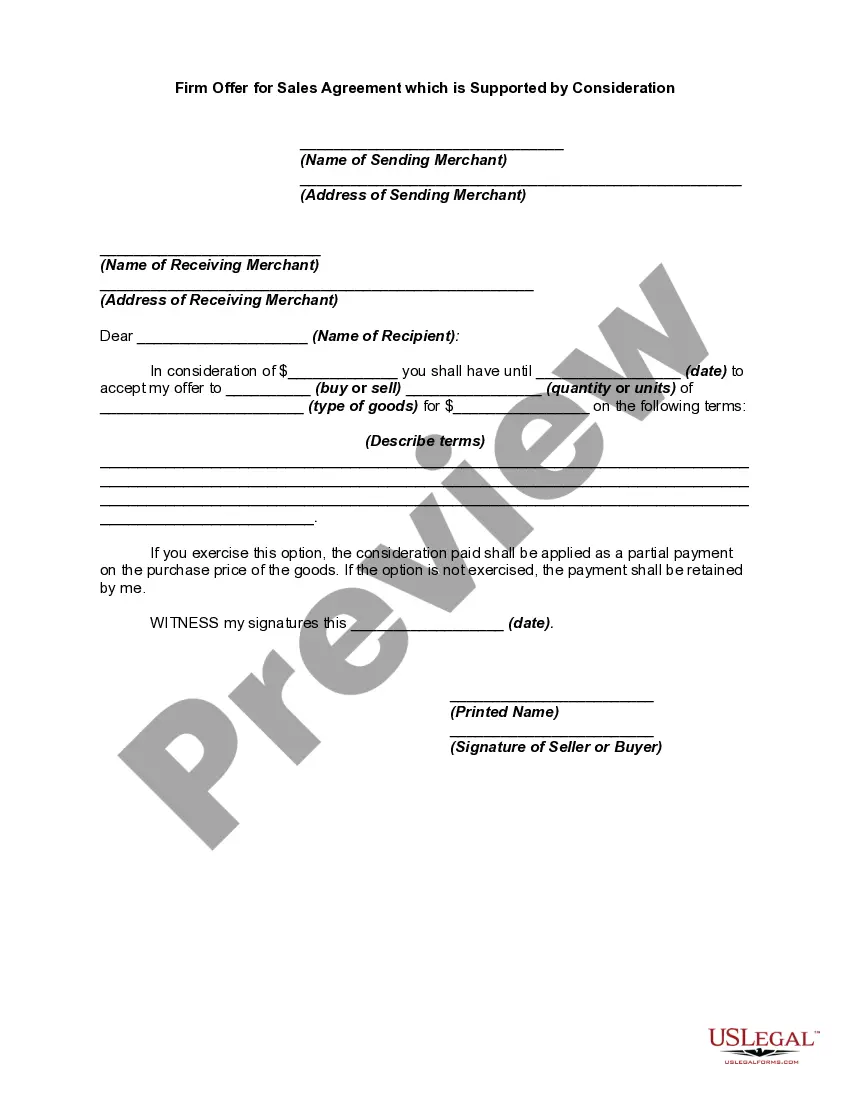
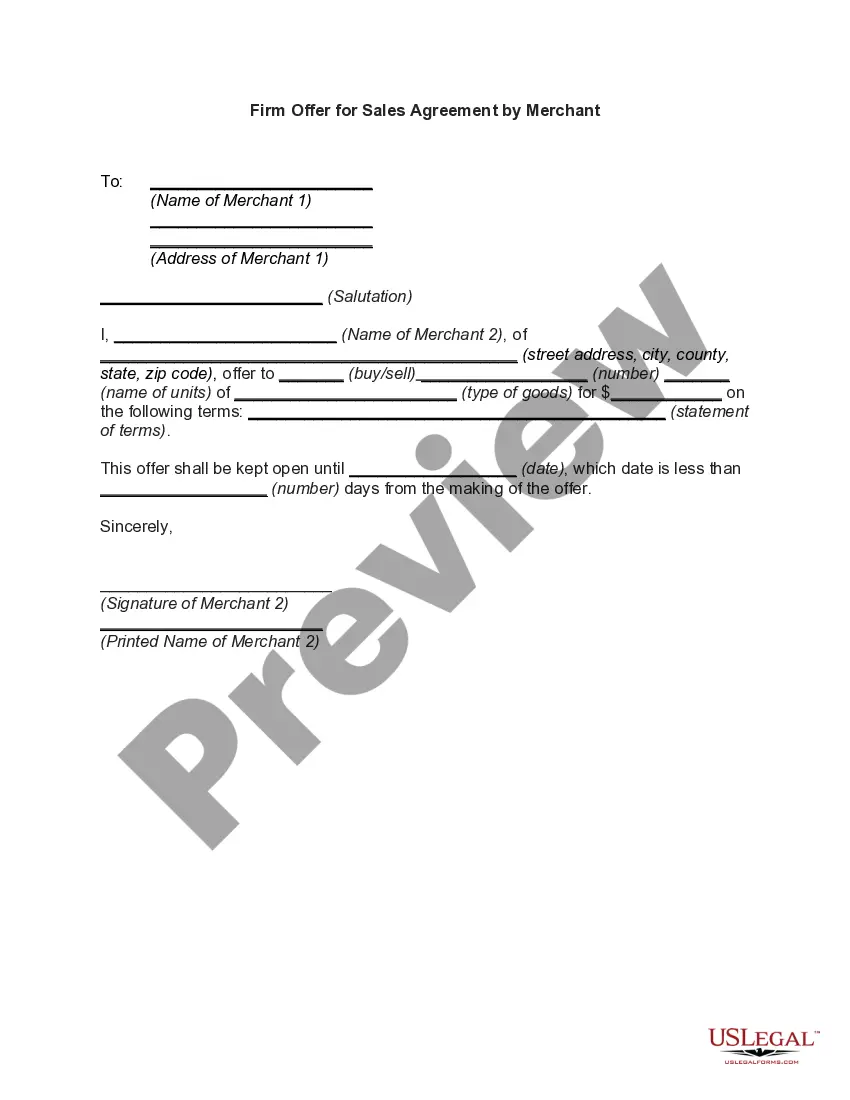
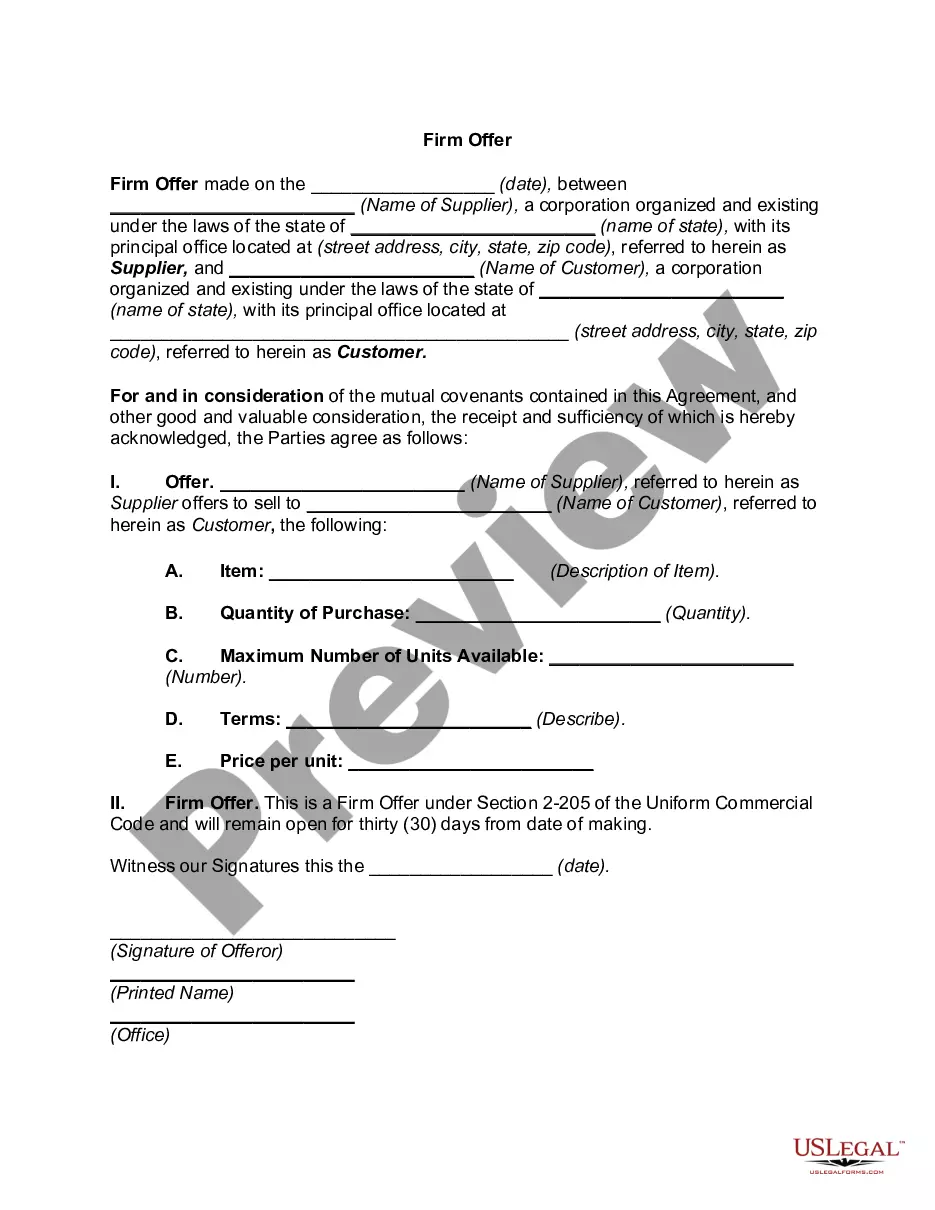
The Firm Offer for Sales Agreement with Acceptance of the Form of Offer or Offeree is a legal document that outlines a proposal to buy or sell goods, specifying that acceptance must be communicated in a certain way if indicated in the terms of the offer. This form is particularly useful because it clarifies the terms of the sale and ensures that both parties understand their rights and obligations. Unlike simple purchase agreements, this form emphasizes the importance of the acceptance manner, making it a vital tool in business transactions where clarity and formality are needed.
Key parts of this document
- Date of the offer
- Name and address of the offeror
- Details of the goods being bought or sold, including type and quantity
- Terms of the offer
- Deadline for acceptance of the offer
- Signature of the buyer or seller
When this form is needed
This form should be used when a party intends to make a firm offer to buy or sell goods and requires the recipient to accept the offer in a specified manner. It is ideal for situations in which both the seller and buyer desire a clear record of the offer and acceptance terms, especially in commercial transactions or repeated dealings where clarity is critical.
Who should use this form
- Business owners engaging in the sale or purchase of goods
- Individuals involved in commercial agreements
- Procurement officers facilitating transactions
- Anyone needing a formal record of an offer and how it may be accepted
Steps to complete this form
- Enter the date of the offer at the top of the form.
- Fill in the name and address of the offeror.
- Specify the goods involved, including type and quantity.
- Describe the terms of the offer clearly.
- Indicate the deadline for acceptance of the offer.
- Sign and date the form to validate the offer.
Notarization requirements for this form
This form does not typically require notarization to be legally valid. However, some jurisdictions or document types may still require it. US Legal Forms provides secure online notarization powered by Notarize, available 24/7 for added convenience.
Get your form ready online
Our built-in tools help you complete, sign, share, and store your documents in one place.
Make edits, fill in missing information, and update formatting in US Legal Forms—just like you would in MS Word.
Download a copy, print it, send it by email, or mail it via USPS—whatever works best for your next step.
Sign and collect signatures with our SignNow integration. Send to multiple recipients, set reminders, and more. Go Premium to unlock E-Sign.
If this form requires notarization, complete it online through a secure video call—no need to meet a notary in person or wait for an appointment.
We protect your documents and personal data by following strict security and privacy standards.

Make edits, fill in missing information, and update formatting in US Legal Forms—just like you would in MS Word.

Download a copy, print it, send it by email, or mail it via USPS—whatever works best for your next step.

Sign and collect signatures with our SignNow integration. Send to multiple recipients, set reminders, and more. Go Premium to unlock E-Sign.

If this form requires notarization, complete it online through a secure video call—no need to meet a notary in person or wait for an appointment.

We protect your documents and personal data by following strict security and privacy standards.
Mistakes to watch out for
- Failing to specify the method of acceptance clearly.
- Not including all necessary details about the goods being offered.
- Leaving the deadline for acceptance blank.
- Not signing the form, which could lead to disputes over authenticity.
Why complete this form online
- Convenient access to legal templates without the need for legal advice.
- Editable fields allow for customization to fit specific transactions.
- Quickly downloadable for immediate use.
- Reliable formats that ensure compliance with legal standards.
Looking for another form?








Form popularity
FAQ
The three requirements for a valid offer are: present intent to contract, definiteness and communication to the offeree.
In the law of contracts, the mirror image rule, also referred to as an unequivocal and absolute acceptance requirement, states that an offer must be accepted exactly with no modifications. The offeror is the master of their own offer.
There are three types of acceptance including express acceptance, implied acceptance, and conditional acceptance. In the world of merchant agreements, formal contracts are sometimes too tedious for a busy schedule. Instead, merchants, contractors, and buyers have developed these types of acceptance of a contract.
The difference is that an acceptance buy other than the stipulated means does not create a contract because it is an acceptance at variance with the terms of the offer. A unilateral contract involves the exchange of a promise for an act.
Offers and revocations must be received to be valid, and with the mailbox rule acceptances don't have to be received to be valid. Performance. Offeree must know of offer before acceptance by performance - offer must have been received by the offeree.
In order for an offer to be valid, it must be clearly communicated, giving the offeree a chance to accept or reject it. Clear communication can include actions, oral communication, or in writing. A valid offer can be made to a group, a single person, or the public at large. Valid offers are definite in their substance.
Generally, a simple price quote is not an offer.If a person rejects an offer, it is considered terminated. Likewise, if the recipient of an offer changes its terms, the original offer is terminated and a new offer is created. This new offer is called a counteroffer, and the original offerer may accept it.
Revocation means "cancellation". Revocation of an offer means its withdrawal by the offeror.Section 5 lays down "a proposal may be revoked at any time before the communication of its acceptance as against the proposer". An offer is made irrevocable by acceptance. Revocation may be express or implied.
If the offeree accepts the offeror's terms while complaining about them, it is called a grumbling acceptance.The intention to accept an offer must be a present intent to contract.