Notice to that Possession is not Adverse - Squatters Rights
What this document covers
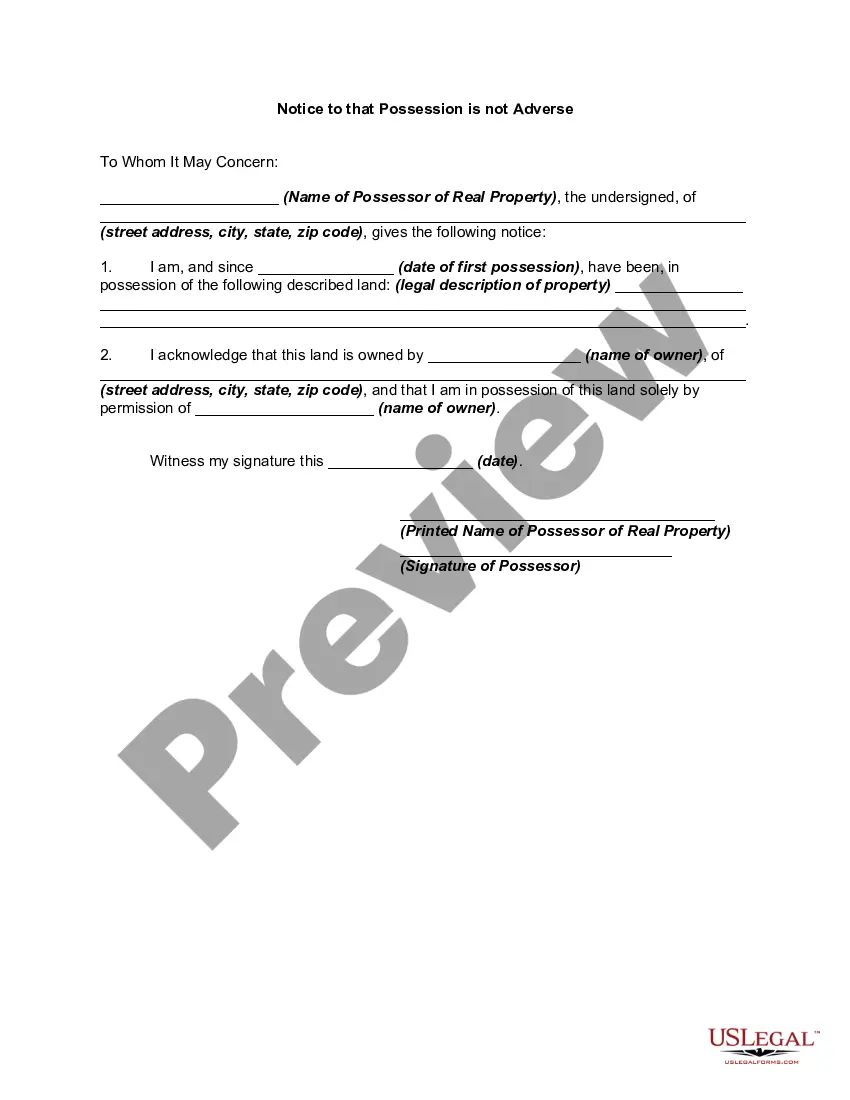
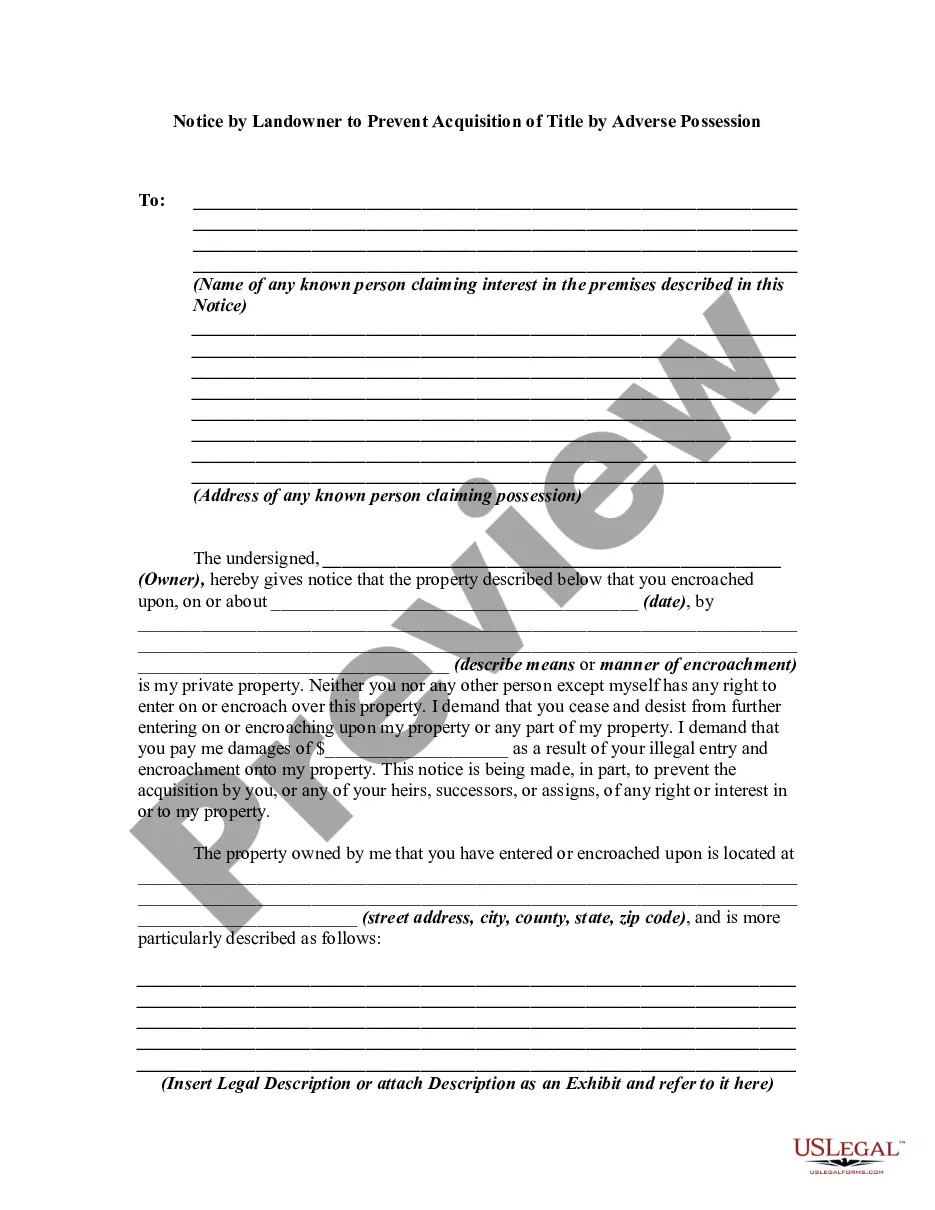
The Notice that Possession is not Adverse - Squatters Rights is a legal document used to inform the rightful owner of a property that the current possessor is not claiming the property adversely. This form is essential for protecting property rights and clarifying that the possessor recognizes the true ownership of the land, thus preventing disputes regarding adverse possession. Unlike other forms related to property rights, this notice emphasizes the acknowledgment of the owner's rights by the possessor.
Key parts of this document
- Name and address of the possessor of the real property.
- Date since possession began.
- Legal description of the property in question.
- Name and address of the true owner.
- Statement acknowledging possession is by permission of the owner.
- Signature of the possessor.
Common use cases
This form should be used when a person is in possession of a property but does not intend to claim it adversely to the true owner. Situations can include temporary arrangements where the possessor has explicit permission from the owner, or when a property has been occupied by a possessor for a long period without clear ownership disputes. The notice serves to formalize the relationship between the possessor and the owner, preventing misunderstandings regarding property rights.
Who should use this form
- Individuals currently in possession of a property with permission from the owner.
- Landowners who want to clarify their rights regarding a property being occupied.
- Anyone seeking to prevent adverse possession claims against their property.
Instructions for completing this form
- Identify the name and address of the person in possession of the property.
- State the date when possession began.
- Provide the legal description of the property.
- Acknowledge the name and address of the true owner.
- Sign and date the notice to complete it.
Notarization requirements for this form
This form usually doesn’t need to be notarized. However, local laws or specific transactions may require it. Our online notarization service, powered by Notarize, lets you complete it remotely through a secure video session, available 24/7.
Get your form ready online
Our built-in tools help you complete, sign, share, and store your documents in one place.
Make edits, fill in missing information, and update formatting in US Legal Forms—just like you would in MS Word.
Download a copy, print it, send it by email, or mail it via USPS—whatever works best for your next step.
Sign and collect signatures with our SignNow integration. Send to multiple recipients, set reminders, and more. Go Premium to unlock E-Sign.
If this form requires notarization, complete it online through a secure video call—no need to meet a notary in person or wait for an appointment.
We protect your documents and personal data by following strict security and privacy standards.

Make edits, fill in missing information, and update formatting in US Legal Forms—just like you would in MS Word.

Download a copy, print it, send it by email, or mail it via USPS—whatever works best for your next step.

Sign and collect signatures with our SignNow integration. Send to multiple recipients, set reminders, and more. Go Premium to unlock E-Sign.

If this form requires notarization, complete it online through a secure video call—no need to meet a notary in person or wait for an appointment.

We protect your documents and personal data by following strict security and privacy standards.
Mistakes to watch out for
- Failing to include the legal description of the property.
- Not providing accurate dates of possession.
- Missing the signature of the possessor.
Advantages of online completion
- Convenience of downloading and completing the form at your own pace.
- Editability allows the possessor to customize the form as needed.
- Reliable access to attorney-drafted content ensures legal validity.
Legal use & context
- The form serves to prevent claims of adverse possession by clarifying that the possessor has the owner's permission.
- Using this notice helps maintain a clear understanding of property rights and ownership status.
What to keep in mind
- The form provides clear communication between the property possessor and the true owner.
- It helps prevent potential legal disputes regarding property possession.
- Using this document is a proactive step for those occupying property under permission.
Looking for another form?







Form popularity
FAQ
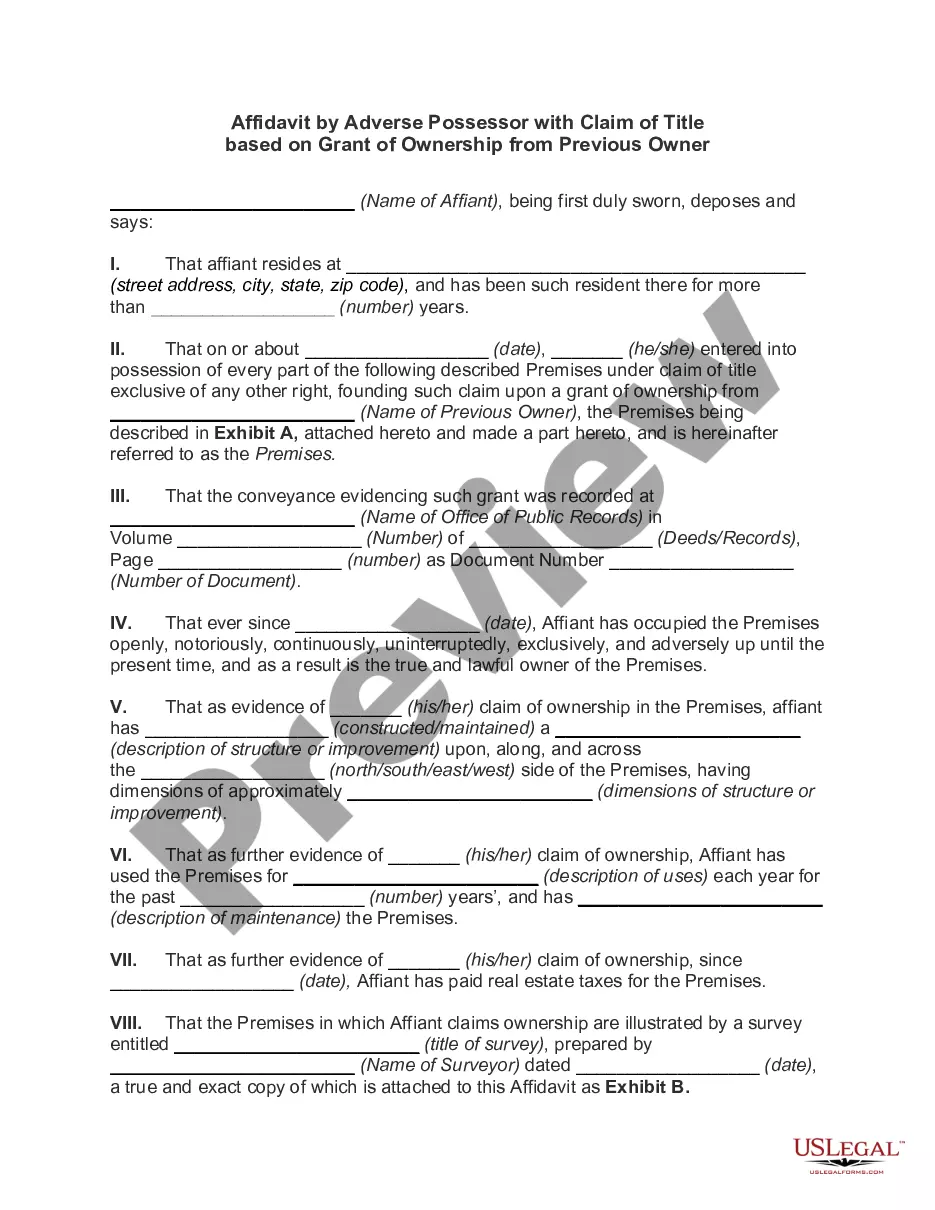
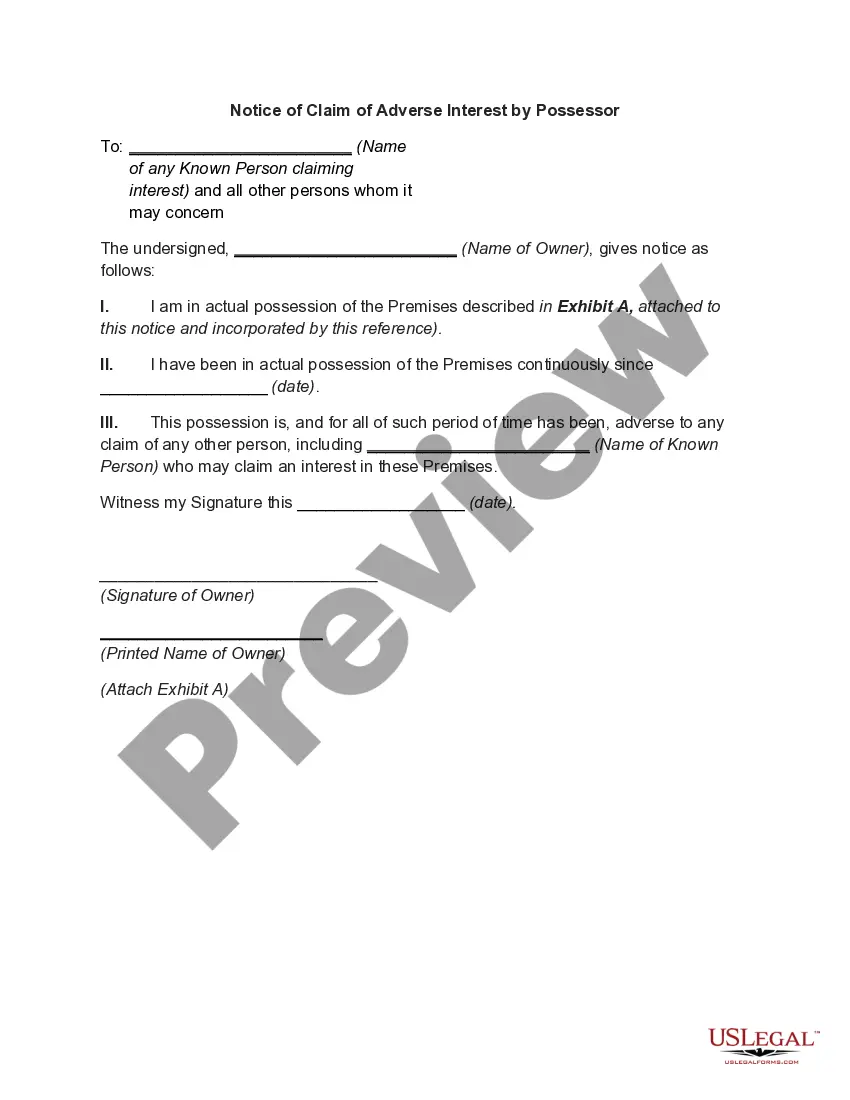
Adverse possession, sometimes colloquially described as "squatter's rights", is a legal principle under which a person who does not have legal title to a piece of property usually land (real property) may acquire legal ownership based on continuous possession or occupation of the property without the permission (
The possessor must have actually entered the property and must have exclusive possession of the property; the possession must be open and notorious; the possession must be adverse to the rightful owner and under a claim of right; and.
In order to claim adverse possession, there are basic tests you have to meet. You have to prove that your use was open, notorious, hostile, actual, exclusive and continuous.Proving adverse possession is not easy, and you have to go to court to get a judge to rule.
The best thing to do to prevent the possibility of squatters is to pay your own property taxes and check in on your property. Squatters won't be able to claim possession if you are the only paying the taxes.
Hostile occupation. If your state requires that you occupy the land because you have a deed, then get your copy of the deed. Open and notorious occupation. Use photographs or video that shows you openly possessed the land. Continuous possession. Payment of taxes.
Nonetheless, the requirements for claiming squatters rights are broadly similar across states. You must prove that you have physically possessed the property openly and for a continuous amount of time. Then, you will need to bring suit in court in order to get the title to the property.
Open and Notorious. The person seeking adverse possession must occupy a parcel of land in a manner that is open and obvious. Exclusive. Hostile. Statutory Period. Continuous and Uninterrupted.
These protections are not valid if the possession of the property is done in secret. California adverse possession laws require at least five years of possession and payment of taxes throughout that period in order to be eligible for legal title.
Open and Notorious. The person seeking adverse possession must occupy a parcel of land in a manner that is open and obvious.Exclusive.Hostile.Statutory Period.Continuous and Uninterrupted.