Affidavit Claiming Irreparable Harm in Support of a Motion for Temporary Restraining Order and Preliminary Injunction to restrain and Enjoin Trespass
Overview of this form
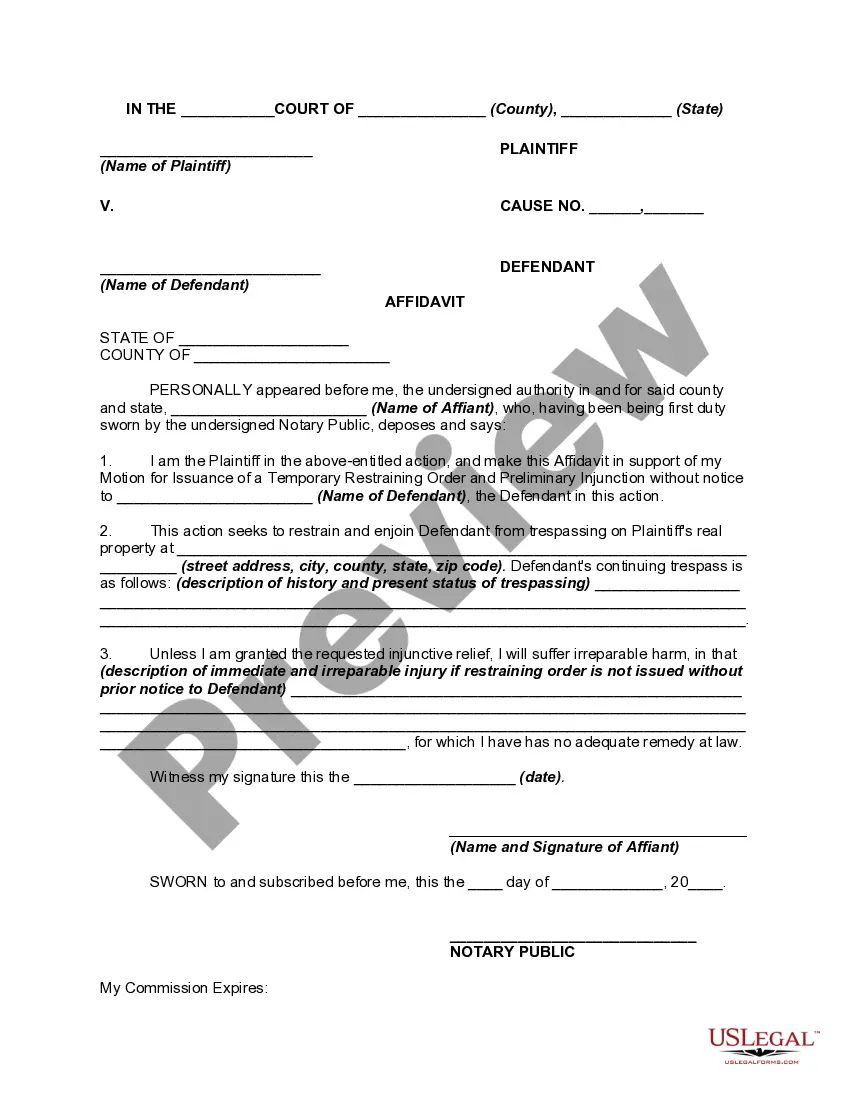
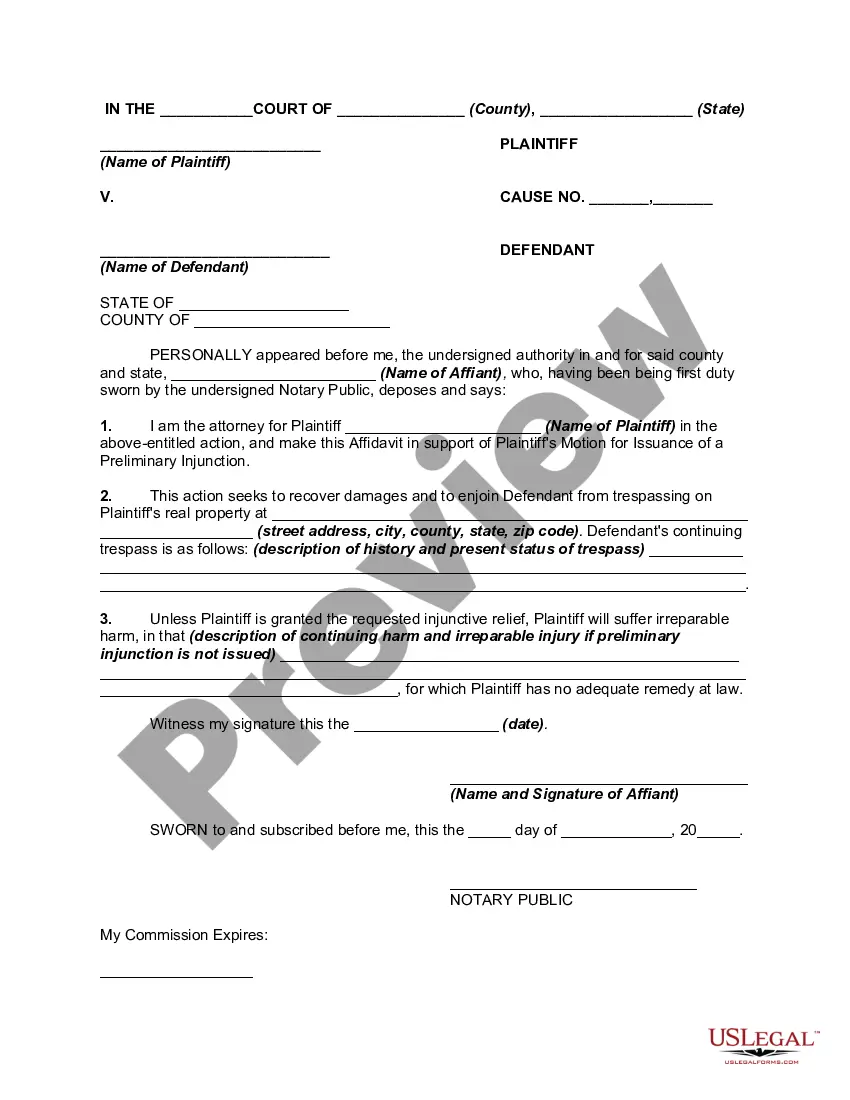
The Affidavit Claiming Irreparable Harm in Support of a Motion for Temporary Restraining Order and Preliminary Injunction is a legal document used to assert that a party will suffer harm that cannot be compensated by monetary damages. This form is essential for individuals seeking a court's intervention to prevent immediate and irreparable harm, particularly in cases of trespass. It differs from other legal forms because it is specifically focused on demonstrating the urgency and necessity for a temporary restraining order and preliminary injunction due to the threat of harm.
Key parts of this document
- Identification of the parties involved in the action.
- Details regarding the property being trespassed upon.
- Description of the current ongoing trespass situation.
- Explanation of the irreparable harm expected without the injunction.
- Affiant's signature and notarization section.

When to use this document
This form should be used when a property owner is facing an immediate threat of trespass that could result in damage or significant harm that cannot be rectified with financial compensation. Typical scenarios include disputes over land access, unauthorized construction, or other intrusions that compromise property rights.
Who this form is for
- Property owners facing trespassers on their land.
- Individuals requiring urgent judicial relief from harmful actions.
- Legal representatives assisting clients in seeking injunctions.
Instructions for completing this form
- Identify and enter the names of the Plaintiff and Defendant.
- Provide a detailed description of the property where trespass is occurring.
- Outline the history and nature of the trespass.
- Clearly articulate the irreparable harm that will result without the injunction.
- Sign the affidavit in the presence of a notary public.
Does this form need to be notarized?
This document requires notarization to meet legal standards. US Legal Forms provides secure online notarization powered by Notarize, allowing you to complete the process through a verified video call, available 24/7.
Get your form ready online
Our built-in tools help you complete, sign, share, and store your documents in one place.
Make edits, fill in missing information, and update formatting in US Legal Forms—just like you would in MS Word.
Download a copy, print it, send it by email, or mail it via USPS—whatever works best for your next step.
Sign and collect signatures with our SignNow integration. Send to multiple recipients, set reminders, and more. Go Premium to unlock E-Sign.
If this form requires notarization, complete it online through a secure video call—no need to meet a notary in person or wait for an appointment.
We protect your documents and personal data by following strict security and privacy standards.

Make edits, fill in missing information, and update formatting in US Legal Forms—just like you would in MS Word.

Download a copy, print it, send it by email, or mail it via USPS—whatever works best for your next step.

Sign and collect signatures with our SignNow integration. Send to multiple recipients, set reminders, and more. Go Premium to unlock E-Sign.

If this form requires notarization, complete it online through a secure video call—no need to meet a notary in person or wait for an appointment.

We protect your documents and personal data by following strict security and privacy standards.
Common mistakes
- Failing to provide detailed descriptions of the trespass.
- Not clearly explaining the nature of the irreparable harm.
- Omitting necessary signatures or not having the document notarized.
- Using vague language that does not fulfill legal standards for the affidavit.
Benefits of completing this form online
- Convenience of downloading and filling out the form at your own pace.
- Editable templates allow you to customize the affidavit to fit your specific situation.
- Assurance of legally compliant forms drafted by licensed attorneys.
Looking for another form?
Form popularity
FAQ
A violation of a restraining order will often result in arrest, and is a criminal offense.If there is a restraining order against you, but the person who filed the order repeatedly tries to have contact with you, you may go to court to ask the judge to vacate the restraining order.
To get a restraining order, you must prove that you have reasonable grounds to fear for your safety or the safety of any child in your custody. You must show why you are afraid for yourself or any child. A restraining order can be temporary or permanent. Most restraining orders are temporary.
A civil harassment restraining order is a court order that helps protect people from violence, stalking, serious harassment, or threats of violence. You can ask for a civil harassment restraining order if: A person has abused (or threatened to abuse), sexually assaulted, stalked, or seriously harassed you, and.
Usually yes, but sometimes no. Temporary restraining orders will appear so law enforcement officers can see it.But if the hearing results in a permanent restraining order, it goes on your record. But even restraining orders that should be expunged sometimes stay in the system longer.