Motion to have New Counsel Appointed - Marsden Motion
Overview of this form
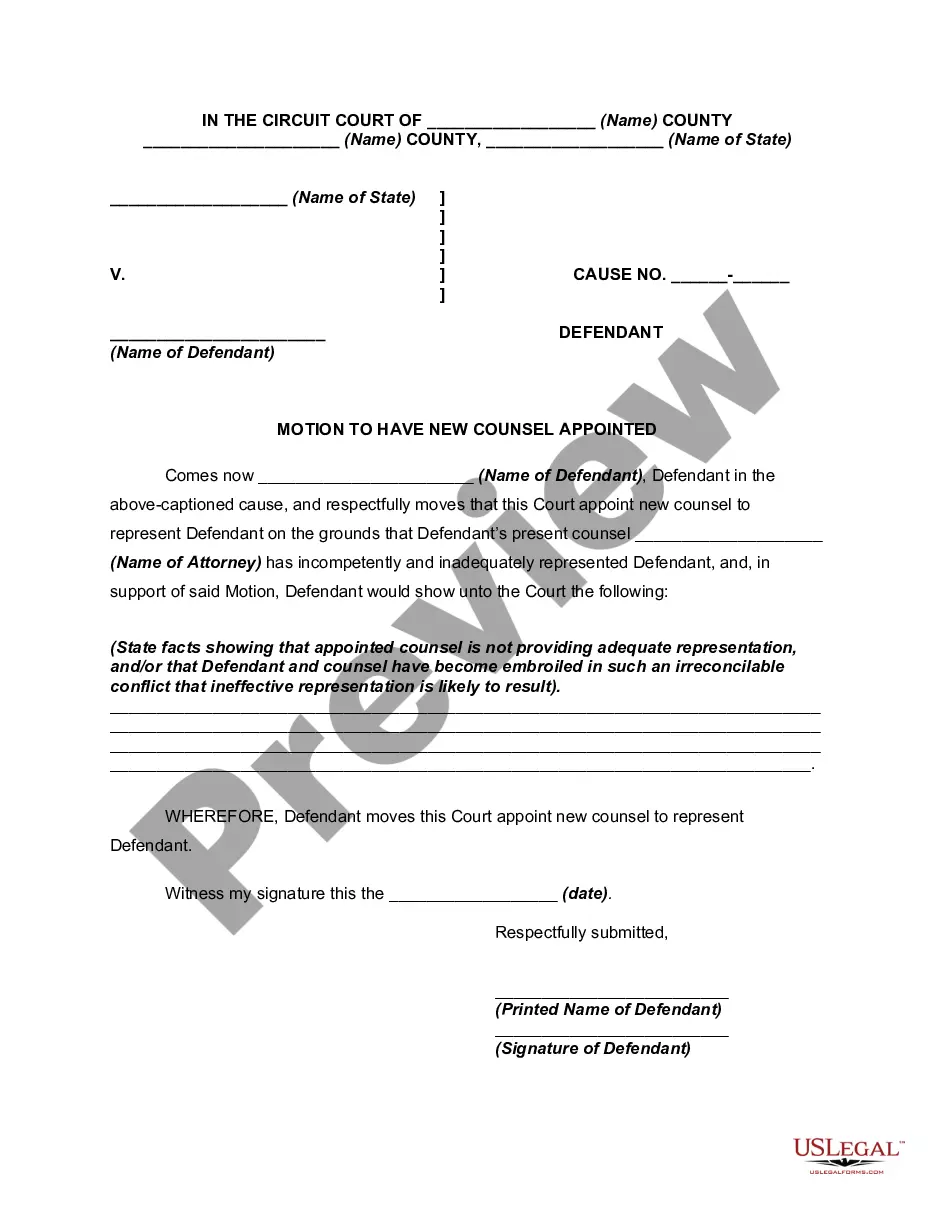
A Motion to have New Counsel Appointed, commonly known as a Marsden Motion, is a request made by a criminal defendant to a court for the discharge of their current attorney. This motion is specifically invoked when the defendant believes they are not receiving adequate representation, or when an irreconcilable conflict arises between the defendant and their counsel. It is essential for defendants to clearly outline the reasons for requesting new representation, distinguishing this process from standard legal proceedings.
Key components of this form
- Defendant's name and details: Identifies the individual making the motion.
- Current counsel's name: Specifies the attorney being discharged.
- Grounds for motion: Sets forth the reasons that justify the request for new counsel.
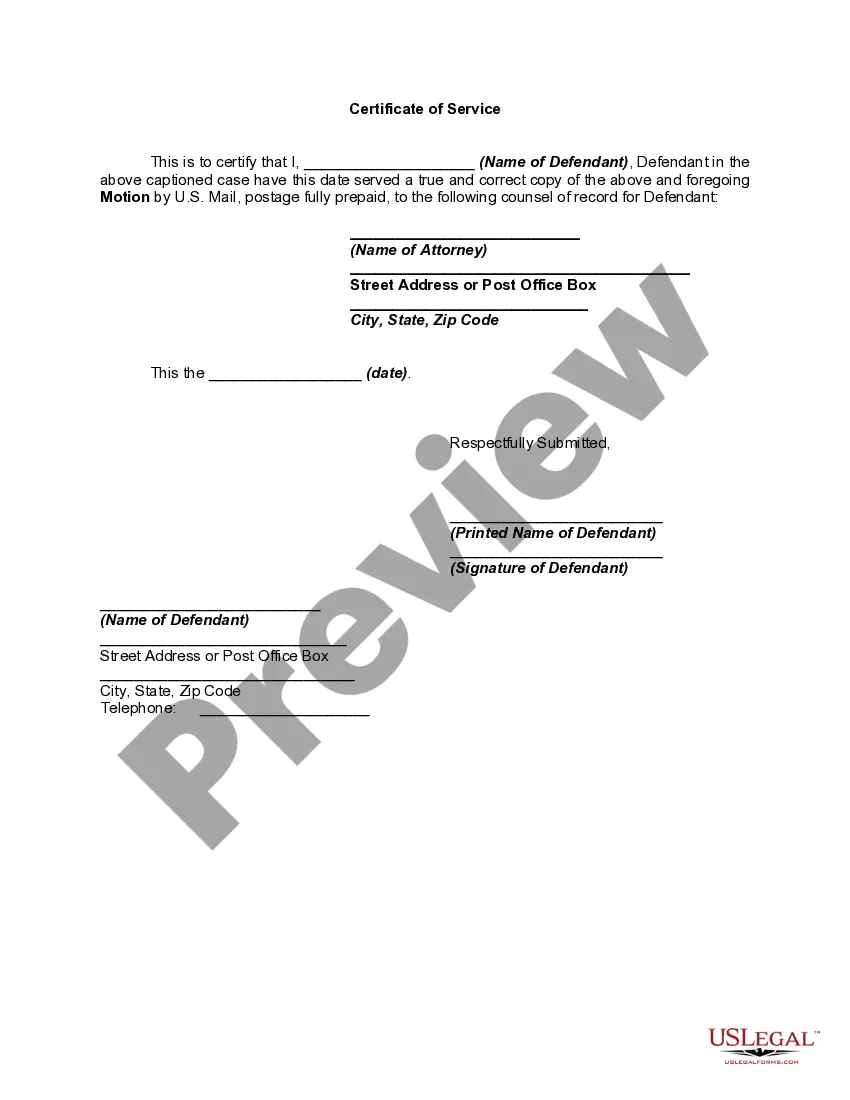
- Certification of service: Confirms that notice of the motion has been provided to the current attorney.
- Date of the motion: Marks the official date on which the motion is filed with the court.
When this form is needed
This form is necessary when a defendant feels that their current attorney is not performing adequately, either due to incompetence or a significant conflict that jeopardizes the defense. Common scenarios include lack of communication, differing legal strategies, or personal issues that impede a healthy attorney-client relationship.
Who should use this form
- Criminal defendants seeking to change their appointed counsel.
- Individuals who perceive their current attorney as ineffective or unhelpful.
- Defendants involved in cases where conflicts with their attorney have arisen.
Instructions for completing this form
- Fill in the defendant's full name and county/state details at the beginning of the form.
- Provide the name of the current attorney who is being discharged.
- Clearly state the reasons why adequate representation was not provided or outline the conflict with the attorney.
- Include the exact date when the motion is being filed.
- Sign and print the defendant's name at the end of the form, certifying its accuracy.
Does this form need to be notarized?
Notarization is not commonly needed for this form. However, certain documents or local rules may make it necessary. Our notarization service, powered by Notarize, allows you to finalize it securely online anytime, day or night.
Get your form ready online
Our built-in tools help you complete, sign, share, and store your documents in one place.
Make edits, fill in missing information, and update formatting in US Legal Forms—just like you would in MS Word.
Download a copy, print it, send it by email, or mail it via USPS—whatever works best for your next step.
Sign and collect signatures with our SignNow integration. Send to multiple recipients, set reminders, and more. Go Premium to unlock E-Sign.
If this form requires notarization, complete it online through a secure video call—no need to meet a notary in person or wait for an appointment.
We protect your documents and personal data by following strict security and privacy standards.

Make edits, fill in missing information, and update formatting in US Legal Forms—just like you would in MS Word.

Download a copy, print it, send it by email, or mail it via USPS—whatever works best for your next step.

Sign and collect signatures with our SignNow integration. Send to multiple recipients, set reminders, and more. Go Premium to unlock E-Sign.

If this form requires notarization, complete it online through a secure video call—no need to meet a notary in person or wait for an appointment.

We protect your documents and personal data by following strict security and privacy standards.
Common mistakes
- Failing to clearly articulate the reasons for dissatisfaction with current counsel.
- Not including necessary signatures or dates, which can delay the process.
- Neglecting to serve the current attorney with a copy of the motion.
Benefits of completing this form online
- Convenience of downloading and filling out the form at your own pace.
- Editability allows you to customize the form according to your specific situation.
- Access to reliable, attorney-drafted templates ensures legal correctness.
Looking for another form?
Form popularity
FAQ
A motion is a written request or proposal to the court to obtain an asked-for order, ruling, or direction.Courts usually have specific requirements for filing a motion, so either consult your attorney or look up the local court rules to understand what you will need as you move forward.
You can simply ask the Court to dismiss your attorney. You have a constitutional right to counsel, but you can waive that right and, unless the court determines that you are incompetent, you have the right to represent yourself.
You write your motion. You file your motion with the court clerk. The court clerk inserts the date and time your motion will be heard by the judge. You serve (mail) your motion to the other side.
1) Know where your courtroom is located. Once you receive your court date, take a trip and find your courtroom. 2) Present yourself as a business person at your hearing. 3) Prepare the evidence you will use in your case.
General format - each motion generally consists of a case caption, a title that briefly identifies the relief sought, a series of numbered paragraphs that explains -- in a logical way -- why you are entitled to that relief, a prayer for relief, a signature block, a certification that a copy of the motion was sent to
Get Straight To The Point. Be Firm. Make Your Case Plainly. Don't Be Spiteful. Acknowledge Your Responsibility For Applicable Lawyer Fees. Get A Copy Of Your Case File.
Motion to Dismiss an attempt to get the judge to dismiss a charge or the case. Motion to Suppress an attempt to keep certain statements or evidence from being introduced as evidence. Motion for Change of Venue may be made for various reasons including pre-trial publicity.
There is no specific way to "win" a Marsden motion.
There are three ways you can make an ineffective counsel claim under federal law: you can claim (1) that your lawyer was actually ineffective, (2) constructively ineffective, or (3) that he had a conflict of interest that caused him to be actually ineffective. Each claim requires you to prove different things.