Sample Letter for Proposed Final Judgment
About this form
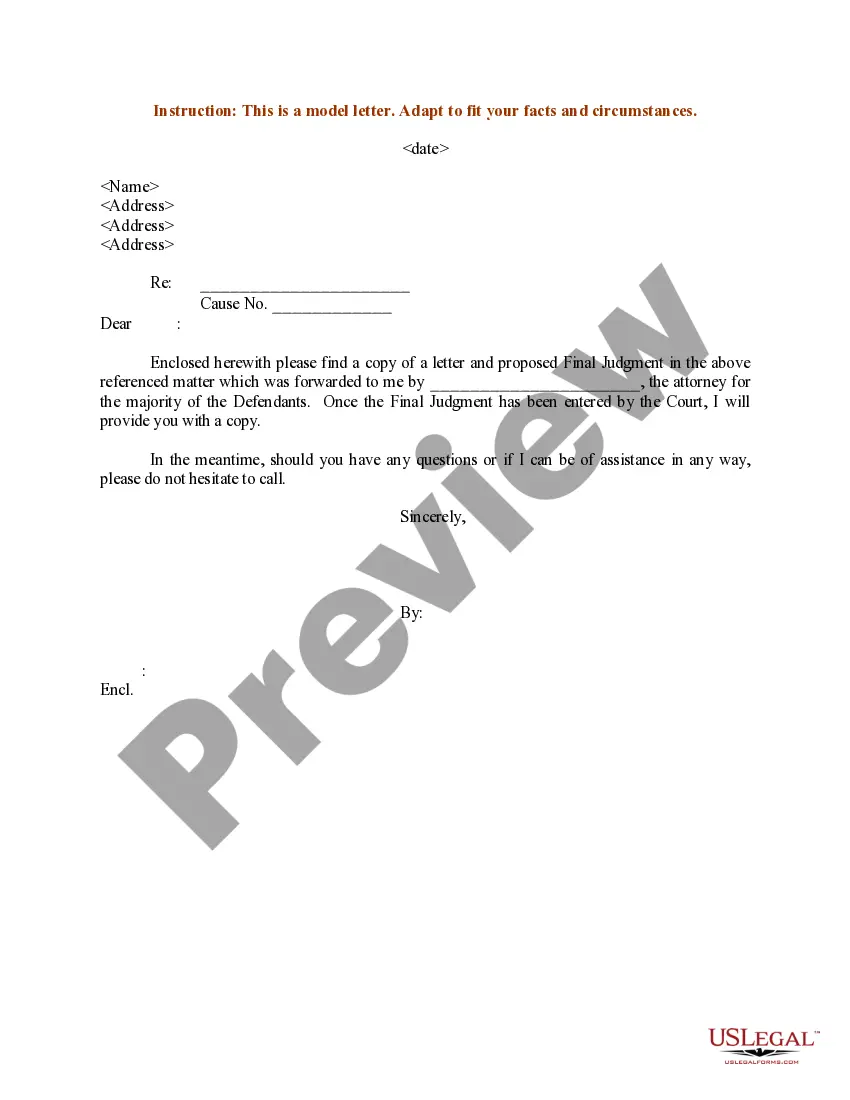
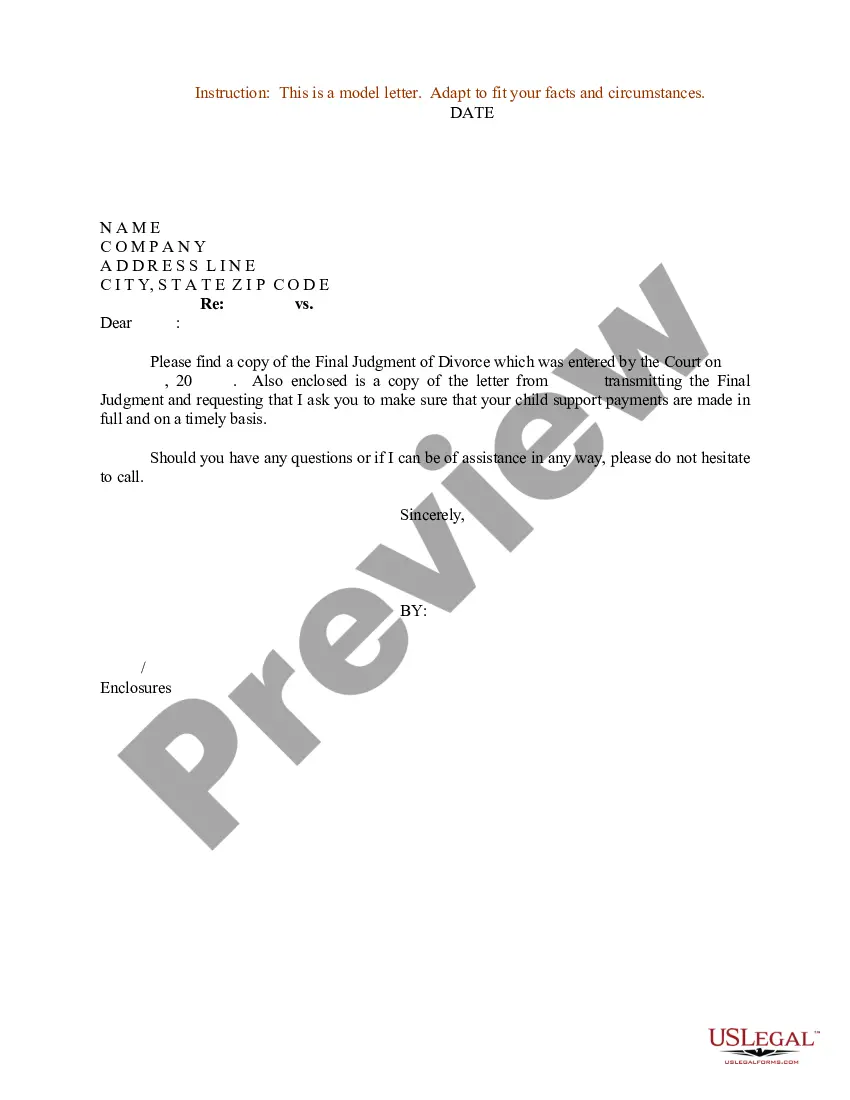
The Sample Letter for Proposed Final Judgment is a document designed to assist users in drafting a formal proposal for a final judgment in legal matters. This form provides a clear structure to communicate the desired outcome in legal proceedings, helping to ensure all relevant information is included. Unlike simpler letters, this sample offers specific legal language that may be appropriate for various situations in which a final judgment is sought.
Key components of this form
- Date of the letter.
- Recipient's name and address.
- Subject line for clarity of purpose.
- Reference to the cause number associated with the case.


Common use cases
This form should be used when you need to formally propose a final judgment to the court or to an opposing party. It is appropriate in situations where a resolution has been reached in a case, and you wish to document your request for the court to approve this outcome. Utilizing this letter can help streamline communication during the finalization of legal proceedings.
Who can use this document
- Individuals involved in legal disputes seeking a final resolution.
- Representatives of parties in litigation who need to communicate with the court.
- Attorneys preparing documents for clients involved in court proceedings.
How to complete this form
- Begin by entering the date of the letter at the top.
- Add the name and address of the recipient below the date.
- Clearly state the subject line to indicate the purpose of the letter.
- Include the cause number associated with the legal matter.
- Review the content for accuracy and completeness before sending.
Notarization guidance
This form does not typically require notarization unless specified by local law. It is advisable to check with legal counsel or local regulations to confirm any notarization needs.
Get your form ready online
Our built-in tools help you complete, sign, share, and store your documents in one place.
Make edits, fill in missing information, and update formatting in US Legal Forms—just like you would in MS Word.
Download a copy, print it, send it by email, or mail it via USPS—whatever works best for your next step.
Sign and collect signatures with our SignNow integration. Send to multiple recipients, set reminders, and more. Go Premium to unlock E-Sign.
If this form requires notarization, complete it online through a secure video call—no need to meet a notary in person or wait for an appointment.
We protect your documents and personal data by following strict security and privacy standards.

Make edits, fill in missing information, and update formatting in US Legal Forms—just like you would in MS Word.

Download a copy, print it, send it by email, or mail it via USPS—whatever works best for your next step.

Sign and collect signatures with our SignNow integration. Send to multiple recipients, set reminders, and more. Go Premium to unlock E-Sign.

If this form requires notarization, complete it online through a secure video call—no need to meet a notary in person or wait for an appointment.

We protect your documents and personal data by following strict security and privacy standards.
Avoid these common issues
- Failing to include the cause number, which is crucial for identification.
- Omitting the recipientâs correct address, resulting in delivery issues.
- Using vague language that may not clearly convey the intended outcome.
Advantages of online completion
- You can easily edit and customize the letter to fit your specific legal situation.
- Access to reliable templates drafted by licensed attorneys ensures legal compliance.
- Downloadable format allows for quick and convenient filing in legal matters.
Looking for another form?
Form popularity
FAQ
Related Definitionsproposed order means an order that must accompany all requests for relief, or an order to be prepared by the prevailing party in a contested matter, that contains findings and conclusions sufficient to comply with the applicable Code sections and the Court's rulings.
First, a proposed Order is something that you attach to a brief or a motion or petition where you are asking the Court to grant some type of relief that you are requesting.
An order is a direction by the court or judge entered into the record for a variety of matters. Whereas a Judgment is the written final determination/outcome of the lawsuit.
A Notice of Entry of Judgment is a document stating that an entry of judgment in a divorce in California is the final judgment signed by the judge.Your divorce is not official until the court enters judgment.
There is no set time. I have seen it as quick as 3 days and as long as 3 months. It depends mostly on how busy the Judge is. I genrally calendar a reminder to follow up in 30 days, and usually it gets done before then...
A judgment is a court order that is the decision in a lawsuit. If a judgment is entered against you, a debt collector will have stronger tools, like garnishment, to collect the debt. A judgment is an official result of a lawsuit in court.Ignore the lawsuit, or. Don't respond to the lawsuit in a timely manner.
A proposed judgment means the judgment you want entered. So you are proposing the terms in the judgment you have prepared.
Term Definition Proposed Findings; Proposed Orders - a document prepared by counsel setting forth a party's best case scenario about the court's findings of fact and conclusions of law.A judge is in no way bound by a lawyer's proposed findings, but they give the court a clear sense of the party's view of the case.
Noun. an act or instance of judging. the ability to judge, make a decision, or form an opinion objectively, authoritatively, and wisely, especially in matters affecting action; good sense; discretion: a man of sound judgment.