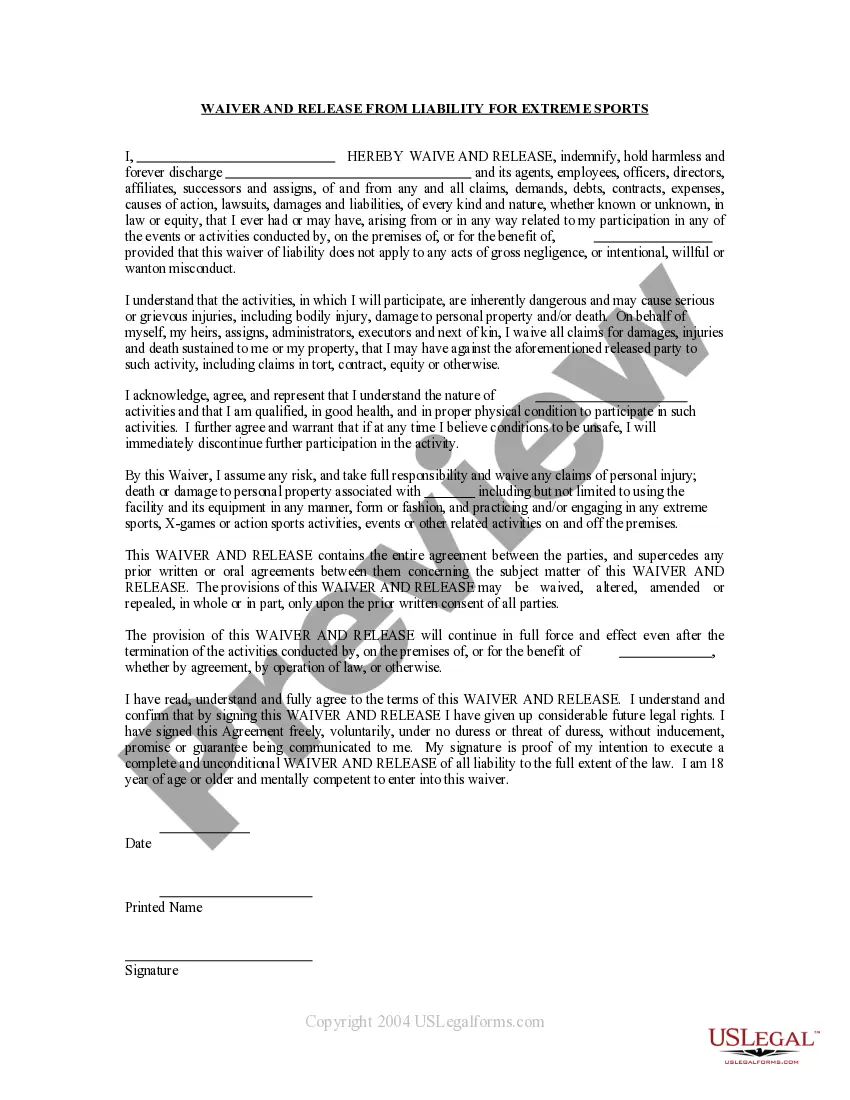
Release of Claims for Future Accidental Injuries or Death by Individual Participating in Music and Camping Festival
What is this form?
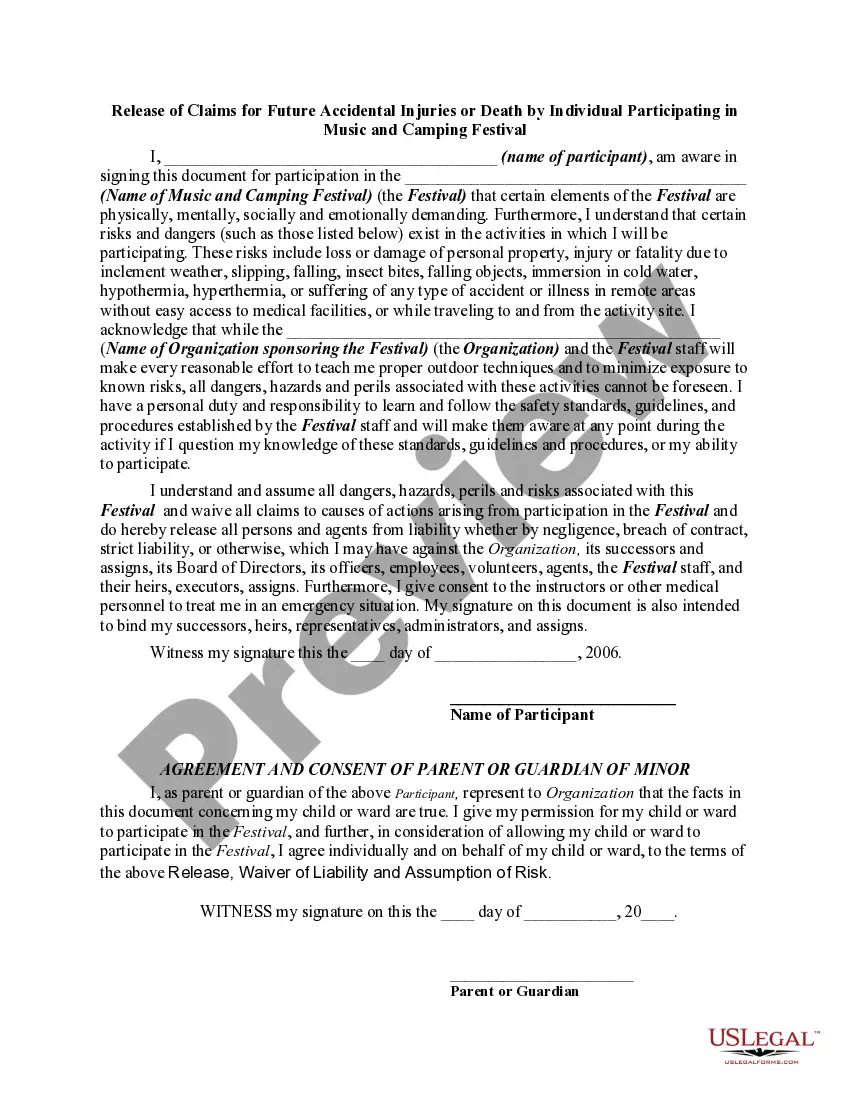
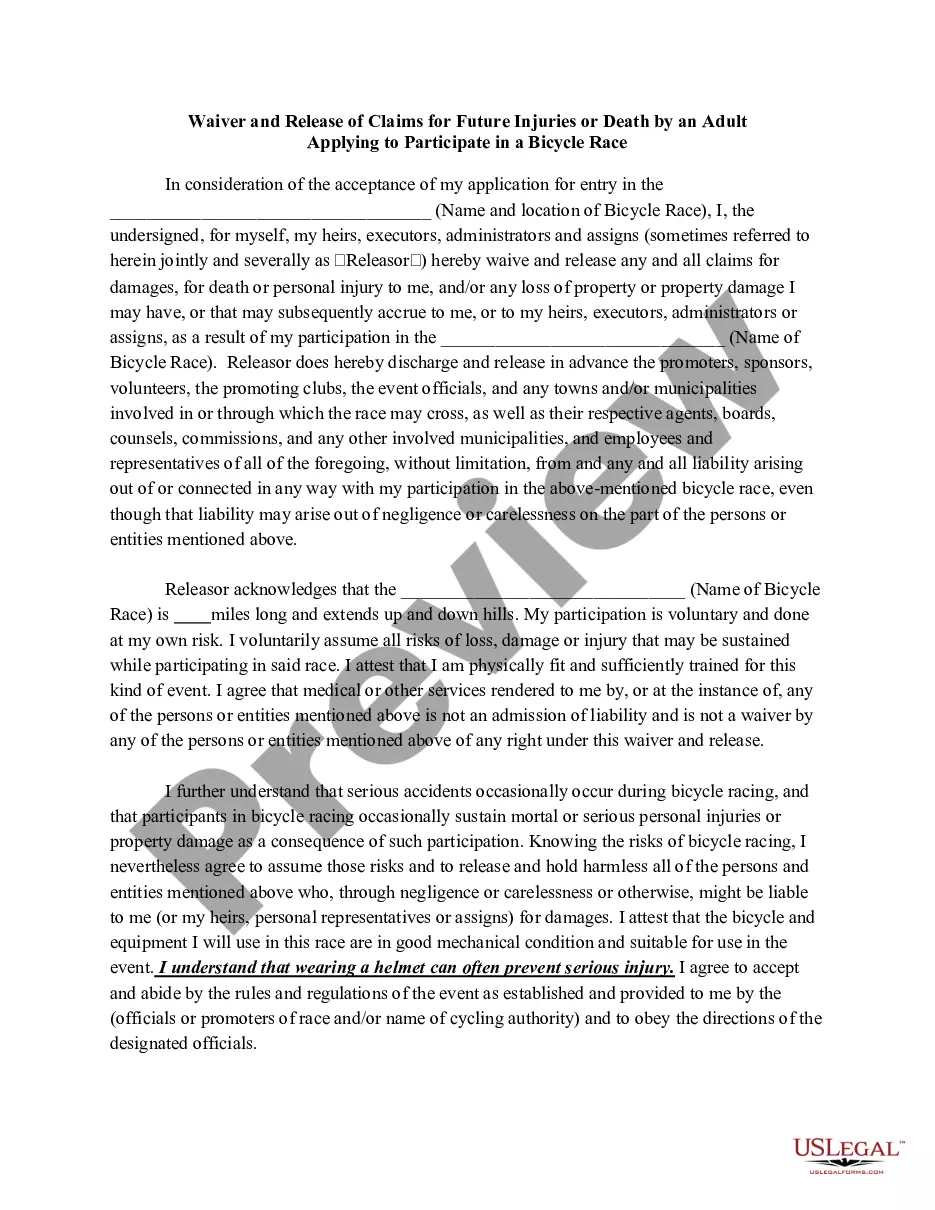
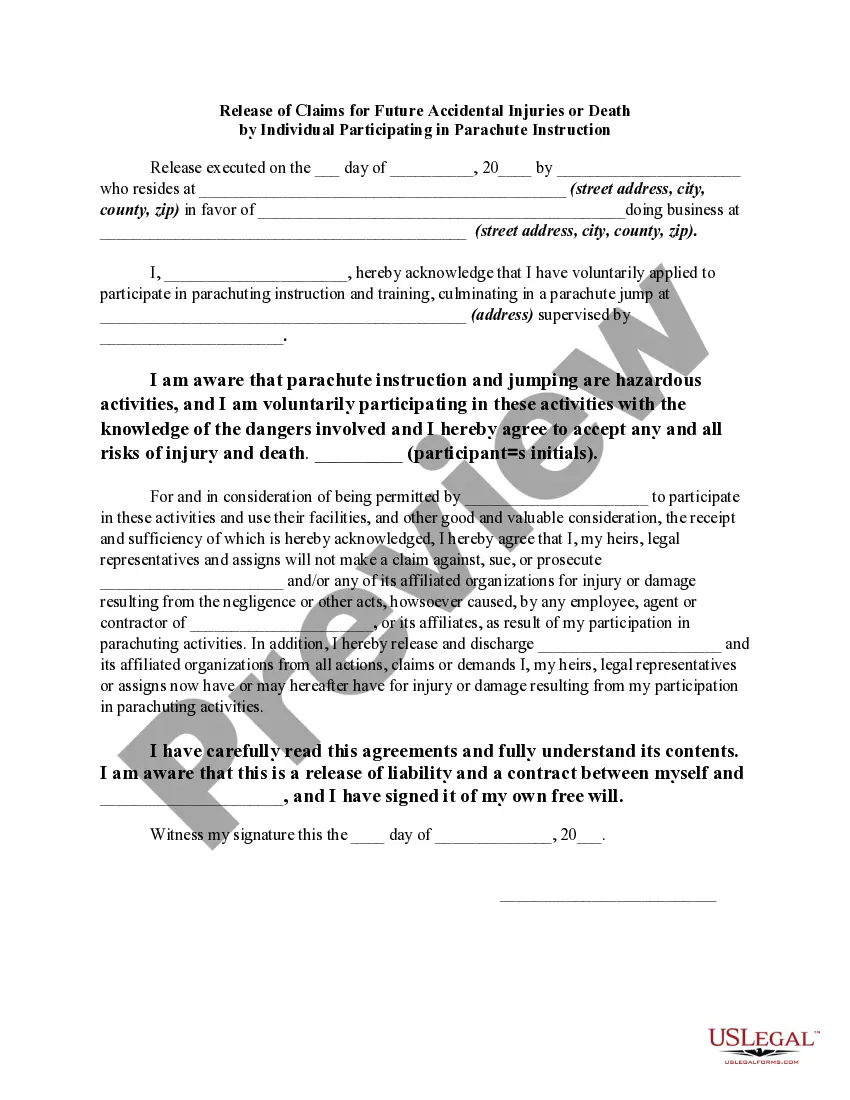
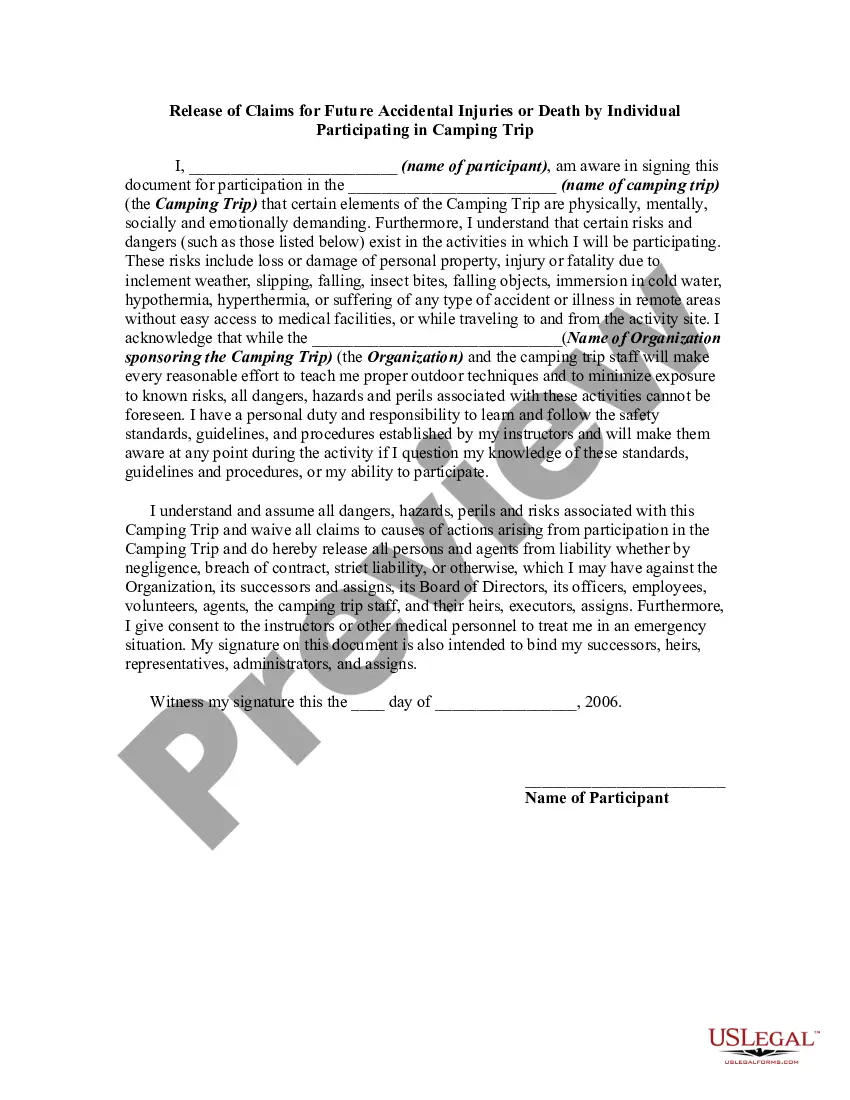
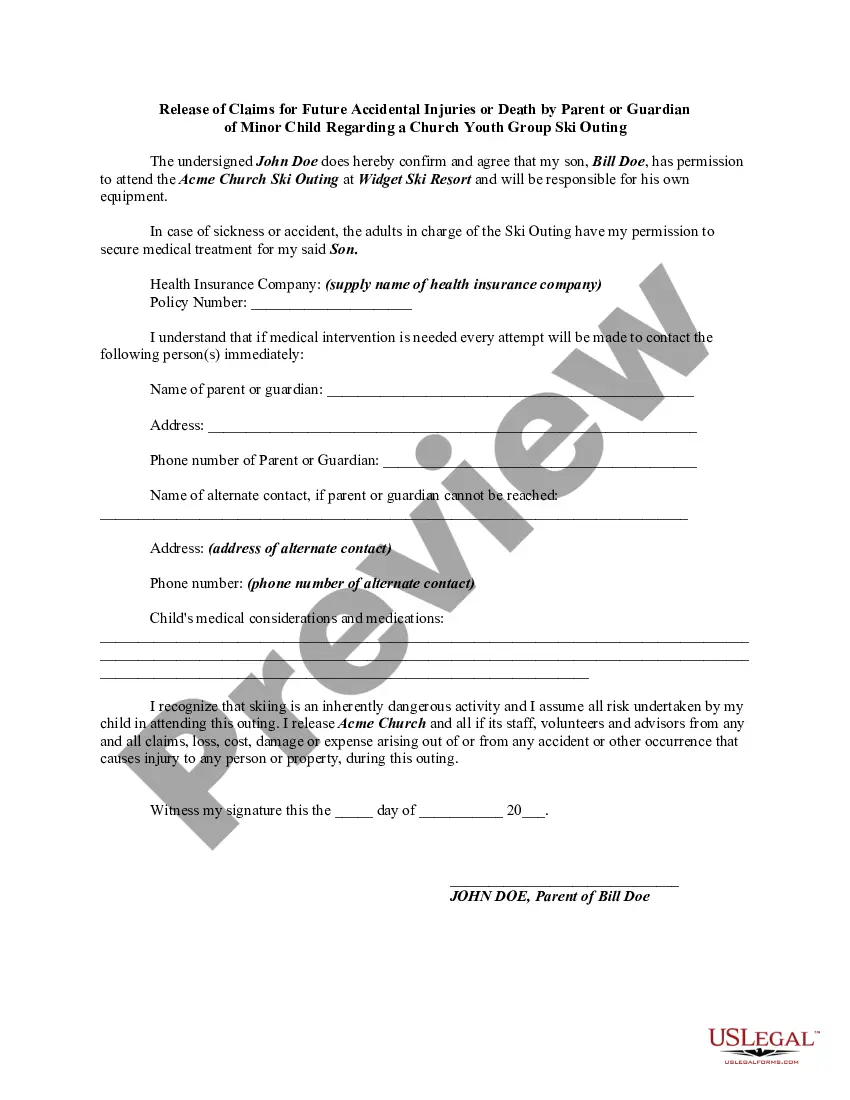
The Release of Claims for Future Accidental Injuries or Death by Individual Participating in Music and Camping Festival is a legal document designed to protect an organization from liability for injuries that may occur to participants during the event. This form captures the understanding of the participant regarding the potential risks associated with attending the festival, differentiating it from other liability waivers by specifically addressing accidents that may happen in physically and emotionally demanding outdoor activities.
What’s included in this form
- Participant's name and acknowledgment of risks involved in the festival.
- Specific dangerous activities and potential hazards listed for clarity.
- A waiver of claims against the sponsoring organization and its affiliates.
- Emergency treatment consent clause for medical personnel.
- Signature lines for both participant and, if applicable, a parent or guardian.
When this form is needed
This form is essential when individuals wish to participate in a music and camping festival that involves physically demanding activities. It is necessary for event organizers to ensure participants understand the risks and agree to release the organization from liability in case of accidents or injuries during the event. Using this form helps protect both the attendees and the organizers.
Who can use this document
- Individuals planning to participate in a music and camping festival.
- Event organizers seeking to limit their liability for participant injuries.
- Parents or guardians registering minors for attendance at the festival.
How to prepare this document
- Identify the participant's name and the name of the music and camping festival.
- Review and acknowledge the risks involved by signing the document.
- Waive any claims against the sponsoring organization by initialing or signing the appropriate section.
- Provide consent for emergency medical treatment in case of injury.
- Have a parent or guardian sign the form if the participant is a minor, confirming their agreement with the terms.
Notarization guidance
This form does not typically require notarization unless specified by local law. It is advisable to check state regulations to ensure compliance and validity.
Get your form ready online
Our built-in tools help you complete, sign, share, and store your documents in one place.
Make edits, fill in missing information, and update formatting in US Legal Forms—just like you would in MS Word.
Download a copy, print it, send it by email, or mail it via USPS—whatever works best for your next step.
Sign and collect signatures with our SignNow integration. Send to multiple recipients, set reminders, and more. Go Premium to unlock E-Sign.
If this form requires notarization, complete it online through a secure video call—no need to meet a notary in person or wait for an appointment.
We protect your documents and personal data by following strict security and privacy standards.

Make edits, fill in missing information, and update formatting in US Legal Forms—just like you would in MS Word.

Download a copy, print it, send it by email, or mail it via USPS—whatever works best for your next step.

Sign and collect signatures with our SignNow integration. Send to multiple recipients, set reminders, and more. Go Premium to unlock E-Sign.

If this form requires notarization, complete it online through a secure video call—no need to meet a notary in person or wait for an appointment.

We protect your documents and personal data by following strict security and privacy standards.
Common mistakes to avoid
- Failing to read and understand the risks outlined in the form.
- Not signing the document in the presence of a witness if required.
- Overlooking the requirement for a parent or guardian signature for minors.
Benefits of completing this form online
- Convenience of downloading and accessing the form anytime.
- Editability allows users to customize the form specific to their event.
- Reliability in ensuring compliance with legal standards through attorney-drafted templates.
Legal use & context
- This form serves to enforce liability waivers, but effectiveness can vary by jurisdiction.
- Releases may be invalidated if signed by minors or if the organization is found grossly negligent.
- Understanding local laws is critical to ensure the waiver holds up in court.
Quick recap
- The form is essential for protecting organizations from liability during potentially hazardous activities.
- Participants must fully understand and agree to the risks involved in their participation.
- Parental consent is necessary for minors, emphasizing responsibility on guardians.
Looking for another form?




Form popularity
FAQ
Whether you can sue after signing a release depends on the facts, the wording of the release, and your state's law, among other things. A court will first look to whether you specifically gave up your right to bring a discrimination, harassment, or retaliation claim in the release. If so, you may be out of luck.
A legal release is a legal instrument that acts to terminate any legal liability between the releasor and the releasee(s), signed by the releasor. A release may also be made orally in some circumstances.A general release may release any claims known or unknown that the releasor may have against the releasee.
Your average car accident settlement might be approximately $21,000. It is likely to fall somewhere between $14,000 and $28,000. The settlement is generally higher for more severe or permanent injuries. You'll also get paid more if the other driver was found to be driving under the influence.
Suggested clip Signing Injury Settlement Release Forms (Ep.60) - YouTubeYouTubeStart of suggested clipEnd of suggested clip Signing Injury Settlement Release Forms (Ep.60) - YouTube
In most cases, there's always room for negotiation. If you disagree with any part of the settlement offer, you shouldn't sign a release of all claims form. Once you sign the form, you will be personally responsible for any upcoming or future costs associated with the car accident.
Although not required, it is always a good idea to have the document notarized for extra protection.
A release is a legal document in which an individual agrees to give up, or release, certain legal rights. A release is also sometimes called a waiver. The purpose of the release is to end a legal matter (such as a civil lawsuit) and allow the parties to move on.
The purpose of a full and final release is simple. It is an explicit acknowledgement by the settling Plaintiff that it has agreed to resolve its claims as against one or more Defendants, and as a result of that settlement, it is releasing those Defendants from the claims at issue.
The standard talent release form is designed for the purpose of an individual to grant full permission to have images of their likeness and the sound of their voice to be recorded on audio or video and used at the user's discretion and without payment, other compensation or legal repercussion to the grantee.
When a case is settled, the document that brings the case to a close is sometimes referred to as a "full and final release". These words mean that there is no going back.Or, sometimes the person who settled simply thought the amount of the settlement was too low. Settlements must be carefully thought out.