Consent to Adoption by Unmarried Mother of Child
What is this form?
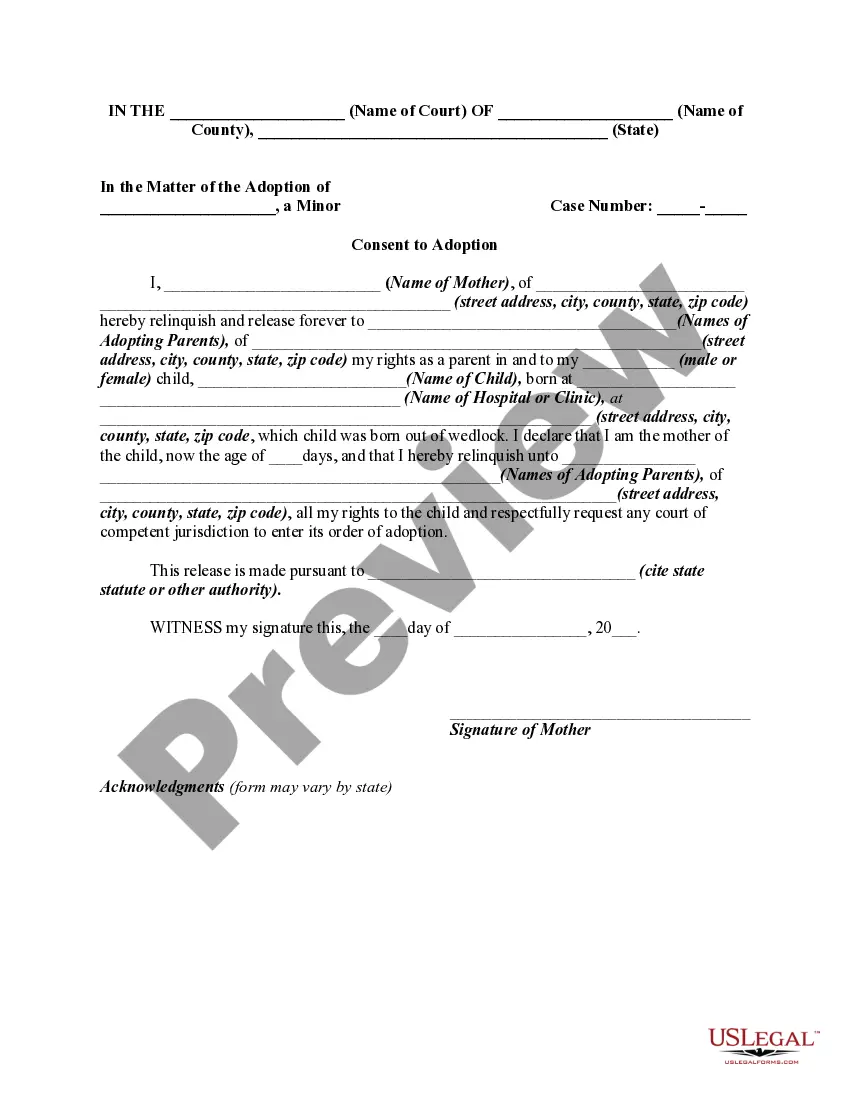
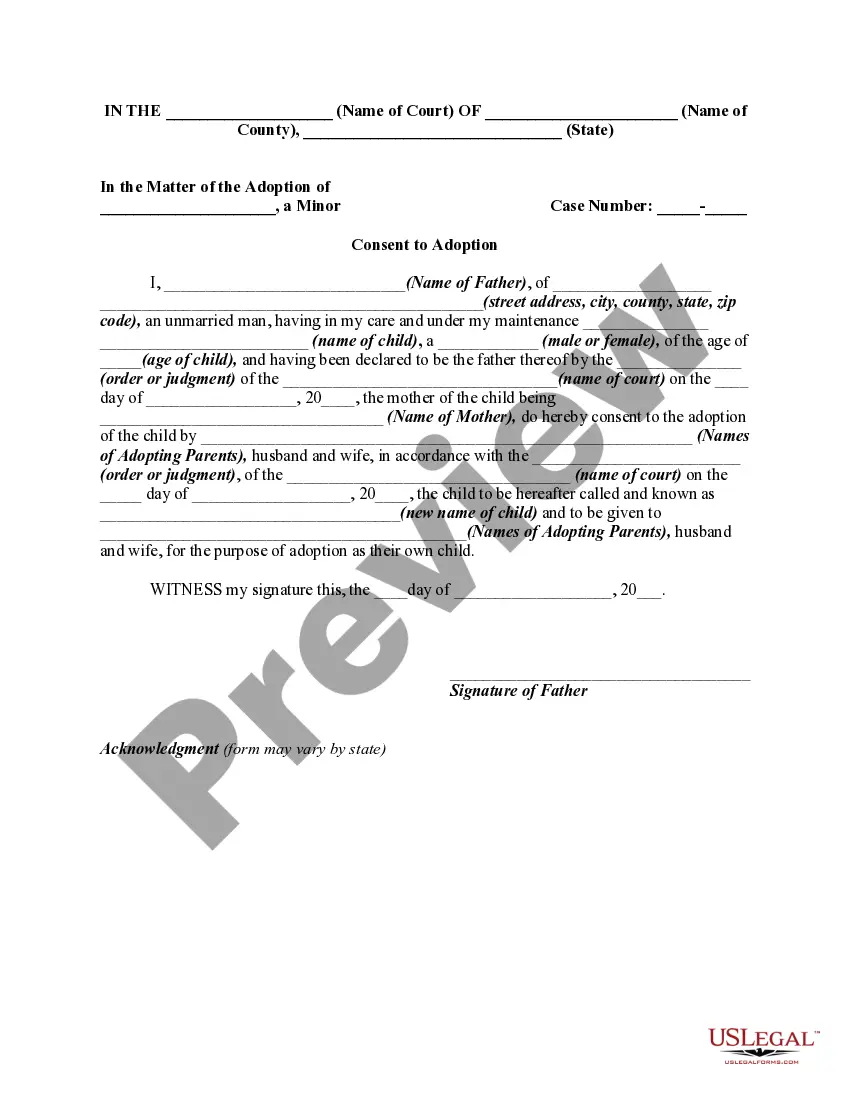
The Consent to Adoption by Unmarried Mother of Child is a legal document that allows a mother to relinquish her parental rights, enabling another party to adopt her child. This form ensures that the adoption process is compliant with state laws and provides a framework for the consent required from the biological mother. Unlike other adoption documents, this form specifically focuses on the consent aspect from an unmarried mother, streamlining the legal requirements for adoption scenarios involving her.
Form components explained
- Name and address of the mother and adopting parents.
- Name and details of the child being adopted.
- Declaration of relinquishment of parental rights.
- Citation of the applicable state statute facilitating the consent.
- Signature line for the mother and space for witnesses as needed.
Common use cases
This form should be used when an unmarried mother wishes to give her consent for the adoption of her child by another party. It is essential in cases where the mother has chosen not to retain parental rights and is seeking to facilitate a legal adoption. It may also be relevant in situations where the biological father is not involved, or the mother seeks to have the adopting parents assume full parental rights permanently.
Who needs this form
- Unmarried mothers seeking to consent to the adoption of their children.
- Adoptive parents who require confirmation of consent from the biological mother.
- Legal professionals advising clients in adoption scenarios.
Instructions for completing this form
- Enter the names and addresses of the mother and the adopting parents.
- Provide the name and birth details of the child being adopted.
- Specify the child's sex and age.
- Cite the relevant state statute governing adoption consents.
- Sign the form in the presence of a witness as required by local law.
Notarization requirements for this form
This form does not typically require notarization unless specified by local law. However, it is important to check your specific state requirements to confirm whether notarization is essential for your adoption process.
Get your form ready online
Our built-in tools help you complete, sign, share, and store your documents in one place.
Make edits, fill in missing information, and update formatting in US Legal Forms—just like you would in MS Word.
Download a copy, print it, send it by email, or mail it via USPS—whatever works best for your next step.
Sign and collect signatures with our SignNow integration. Send to multiple recipients, set reminders, and more. Go Premium to unlock E-Sign.
If this form requires notarization, complete it online through a secure video call—no need to meet a notary in person or wait for an appointment.
We protect your documents and personal data by following strict security and privacy standards.

Make edits, fill in missing information, and update formatting in US Legal Forms—just like you would in MS Word.

Download a copy, print it, send it by email, or mail it via USPS—whatever works best for your next step.

Sign and collect signatures with our SignNow integration. Send to multiple recipients, set reminders, and more. Go Premium to unlock E-Sign.

If this form requires notarization, complete it online through a secure video call—no need to meet a notary in person or wait for an appointment.

We protect your documents and personal data by following strict security and privacy standards.
Common mistakes
- Failing to properly cite the relevant state statute.
- Not signing the form in the presence of required witnesses.
- Inaccurately filling out the details of the child or adopting parents.
Why complete this form online
- Convenience of downloading and completing the form at your own pace.
- Editability allows for adjustments to ensure all information is accurate before submitting.
- Reliability through access to legally compliant documents drafted by licensed attorneys.
Legal use & context
- This form legally relinquishes parental rights and is binding upon signature.
- It is crucial to ensure the consent is given without coercion.
- Each state may have different enforceability rules regarding consent forms.
Key takeaways
- The Consent to Adoption by Unmarried Mother of Child is essential for formalizing parental rights relinquishment.
- Understanding state-specific regulations is important for effective completion.
- Accurate documentation is crucial to avoid legal complications during adoption proceedings.
Looking for another form?
Form popularity
FAQ
Child abuse or neglect. Spousal abuse or domestic battery. A crime against children, including child pornography. A crime involving violence, including rape, sexual assault, or homicide, but not including other physical assault or battery. Aggravated assault on a family or household member.
If you want to adopt a stepchild, you must have the consent (or agreement) of both your spouse and the child's other parent (the noncustodial parent) unless that parent has abandoned the child. By giving his or her consent, the noncustodial parent gives up all rights and responsibilities, including child support.
Generally, adoption requires the consent of both parents, provided they meet certain requirements. To gain parental rights, including the right to object to adoption, biological fathers unmarried to the mother must not only establish paternity, but also demonstrate a commitment to parenting the child.
If a parent does not have Parental Responsibility (PR), the court is not required to have their consent before making an adoption order. However, if this parent has a close connection with their child, it is likely the court will want to find out their views, as well as the child's.
A single parent should be between 30 45 years in age if she wishes to adopt a child in the age group of 0-3 years. The single parent should have an additional family support. According to the rules the adoptive parent has to be both medically fit and financially settled.
Another way to have a stepparent adoption without the consent of the other biological parent is if the parent has abandoned the child. For abandonment, the parent must have not paid child support or contacted the child for a certain period of time, usually a year.
Adoption is the same legal process whether the individual is a child or an adult.The second reason, almost as common, is to formalize an existing parent/child relationship. For example, parents can adopt a now adult foster child or stepchild.
In general, any single adult or a married couple together is eligible to adopt. A stepparent may also adopt the birth child of their spouse. Some states allow married persons to adopt alone if they're legally separated from their spouse or if their spouse is legally incompetent.
California has no marital requirements related to adoption. Single people can happily adopt children, although their single-parent status may affect their wait time for an adoption opportunity. Married stepparents can adopt their stepchildren, and unmarried domestic partners can adopt their partner's child.