Petition to Enforce Duty to Pay Spousal Support when Respondent is in Another State
About this form
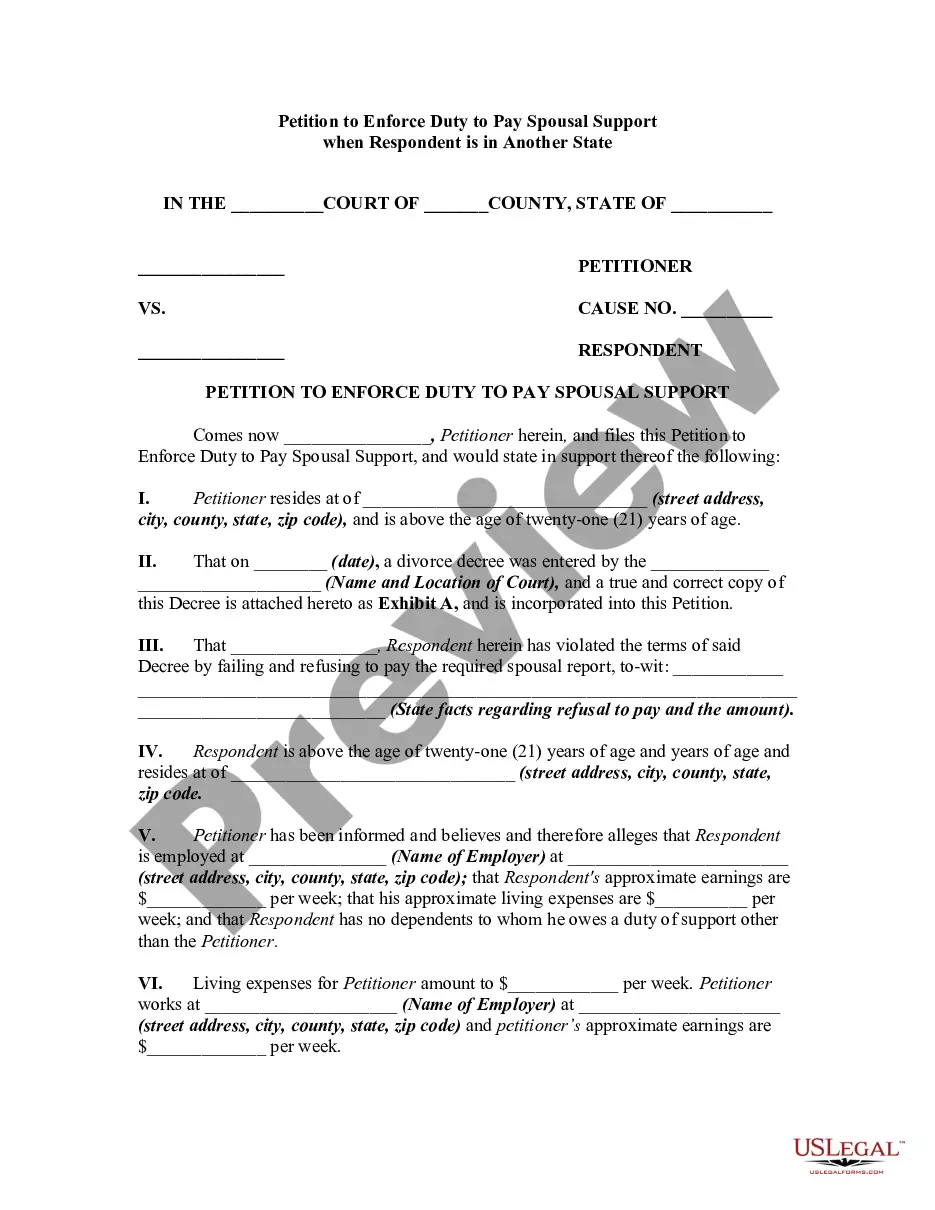
This Petition to Enforce Duty to Pay Spousal Support is a legal document used by individuals to seek enforcement of spousal support obligations when the respondent resides in another state. Unlike standard petitions, this form includes provisions for interstate communication and enforcement, ensuring that support obligations are upheld even across state lines. It is designed for use after a divorce decree has been issued and the respondent has failed to meet their financial responsibilities.
Key parts of this document
- Information on the petitioner and respondent, including addresses and ages.
- Details regarding the divorce decree, including the court name and date.
- Specific facts outlining the respondentâs failure to pay spousal support.
- Petitionerâs and respondent's financial situation and expenses.
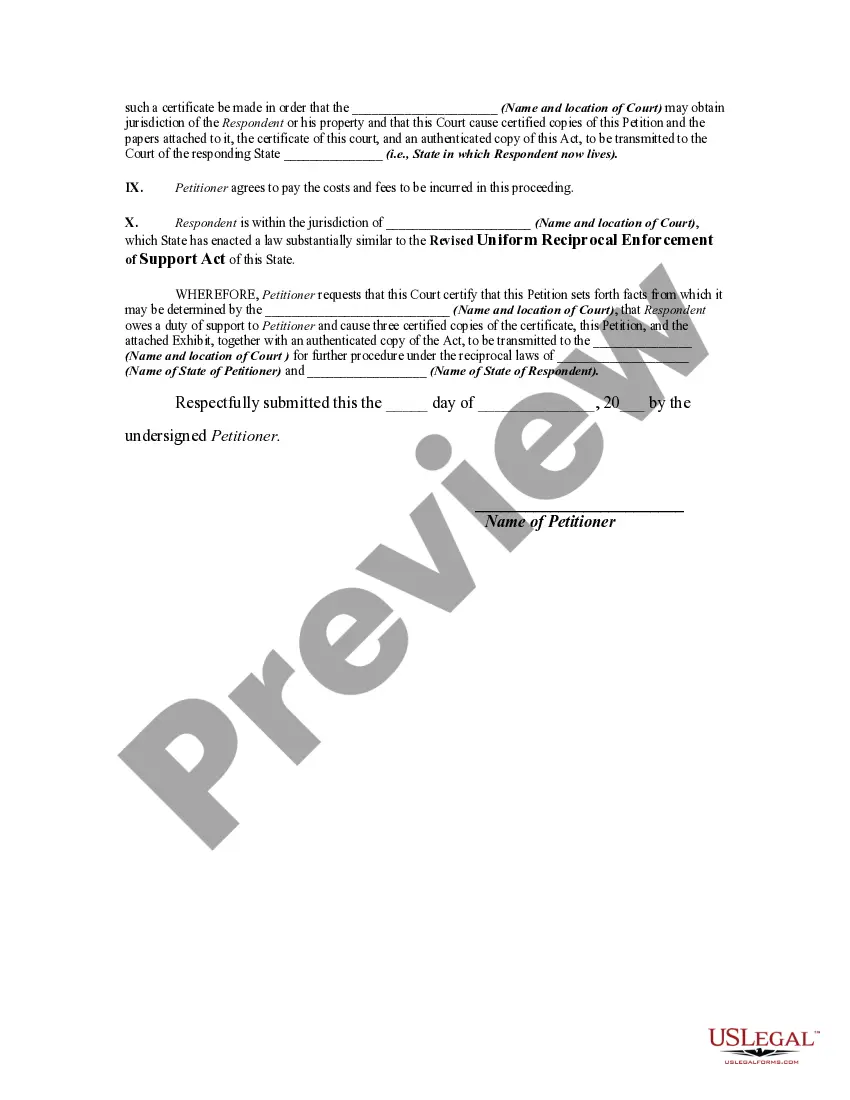
- Request for a court certificate enabling interstate jurisdiction.
- Agreement to pay costs associated with the proceeding.
When this form is needed
This form is needed in situations where a former spouse fails to pay court-ordered spousal support and lives in a different state than the petitioner. It can be utilized when attempts to collect support have been unsuccessful, and the petitioner requires legal documentation to seek enforcement across state lines.
Who should use this form
- Individuals who have a court order for spousal support that is not being fulfilled.
- Petitioners who need to enforce spousal support obligations from a respondent residing in another state.
- Persons who have initiated divorce proceedings and require additional legal steps to ensure compliance with spousal support orders.
Steps to complete this form
- Identify the parties involved, including their names and addresses.
- Provide the details of the original divorce decree, including the issuing court.
- State the specific facts regarding the failure of the respondent to pay the mandated support.
- Outline the financial circumstances of both the petitioner and respondent.
- Sign and date the petition, ensuring all information is accurate and complete.
Does this form need to be notarized?
This form does not typically require notarization unless specified by local law. However, ensure to check with your local court to verify if notarization is necessary for enforcement in your jurisdiction.
Get your form ready online
Our built-in tools help you complete, sign, share, and store your documents in one place.
Make edits, fill in missing information, and update formatting in US Legal Forms—just like you would in MS Word.
Download a copy, print it, send it by email, or mail it via USPS—whatever works best for your next step.
Sign and collect signatures with our SignNow integration. Send to multiple recipients, set reminders, and more. Go Premium to unlock E-Sign.
If this form requires notarization, complete it online through a secure video call—no need to meet a notary in person or wait for an appointment.
We protect your documents and personal data by following strict security and privacy standards.

Make edits, fill in missing information, and update formatting in US Legal Forms—just like you would in MS Word.

Download a copy, print it, send it by email, or mail it via USPS—whatever works best for your next step.

Sign and collect signatures with our SignNow integration. Send to multiple recipients, set reminders, and more. Go Premium to unlock E-Sign.

If this form requires notarization, complete it online through a secure video call—no need to meet a notary in person or wait for an appointment.

We protect your documents and personal data by following strict security and privacy standards.
Common mistakes to avoid
- Failing to provide sufficient details on the respondent's non-compliance.
- Not including a copy of the divorce decree as an exhibit.
- Incorrectly identifying the jurisdiction or court information.
Advantages of online completion
- Convenience of completing the form from home at any time.
- Ability to download and edit the form as needed.
- Access to attorney-drafted templates that ensure legal compliance.
Legal use & context
- Used primarily in cases where spousal support obligations are not met across state lines.
- Assists in establishing the Respondent's duty to pay, enabling further legal action if necessary.
- Integrates the Revised Uniform Reciprocal Enforcement of Support Act provisions for enforceability in different states.
Summary of main points
- The Petition to Enforce Duty to Pay Spousal Support is essential for enforcing spousal support across state lines.
- Completing the form accurately and providing supporting documents is crucial for success.
- Adhering to state-specific requirements can enhance the effectiveness of the petition.
Looking for another form?










Form popularity
FAQ
If you and your spouse live in different states, you may divorce in either state in which one of you has met the residency requirements before filing. It may be to your advantage to file before your spouse, to save yourself the fees associated with traveling to the other state for court appearances, for example.
If you stop making alimony payments (regardless of the reason), you could face civil or criminal charges for contempt of court. Contempt of court means that you violated a court order during your divorce proceedings.The court might give you extra time to pay or establish a new payment plan.
A: The home state of the child has custody jurisdiction, unless one state asserts continuing jurisdiction. The state that rendered the original custody decree can assert jurisdiction in any modification proceeding as long as one of the parties remains a resident and that state has jurisdiction under its own laws.
Fill out your court forms. Have your forms reviewed. Make at least 2 copies of all your forms. File your forms with the court clerk. Get your court date. Serve your papers on your former spouse or domestic partner. File your proof of service. Go to your court hearing.
Three states -- Alaska, South Dakota and Washington -- have no residency requirement. Most states also require that the party be a resident in the county of filing for a shorter a period of time than the state requirement.
A spouse who refuses to make the required alimony payments can be held in contempt of court. This means the supported spouse can file a show cause action (motion) against the spouse refusing to make alimony payments. The court will set a hearing to determine why payments aren't being made.
Here are some cases in which California spousal support may be denied: The spouse is able to earn a sufficient income to maintain the standard of living enjoyed during the marriage. The lower-income spouse has separate property or assets that are enough to provide support.The lower-income spouse was abusive.
A judge will assess if one spouse has a demonstrated financial need and if the other spouse has the ability to pay alimony. Alimony is generally awarded in cases where the spouses have very unequal earning power and have been married a long time.
Dalton's original court-ordered support alimony and the QDRO associated therewith. While your state's case law may not have dealt with the issues raised in the Dalton case, your state's laws will determine whether or not your clients' out-of-state spousal support orders can be enforced in your jurisdiction.