Officers Bonus - Percent of Profit - Resolution Form
Understanding this form
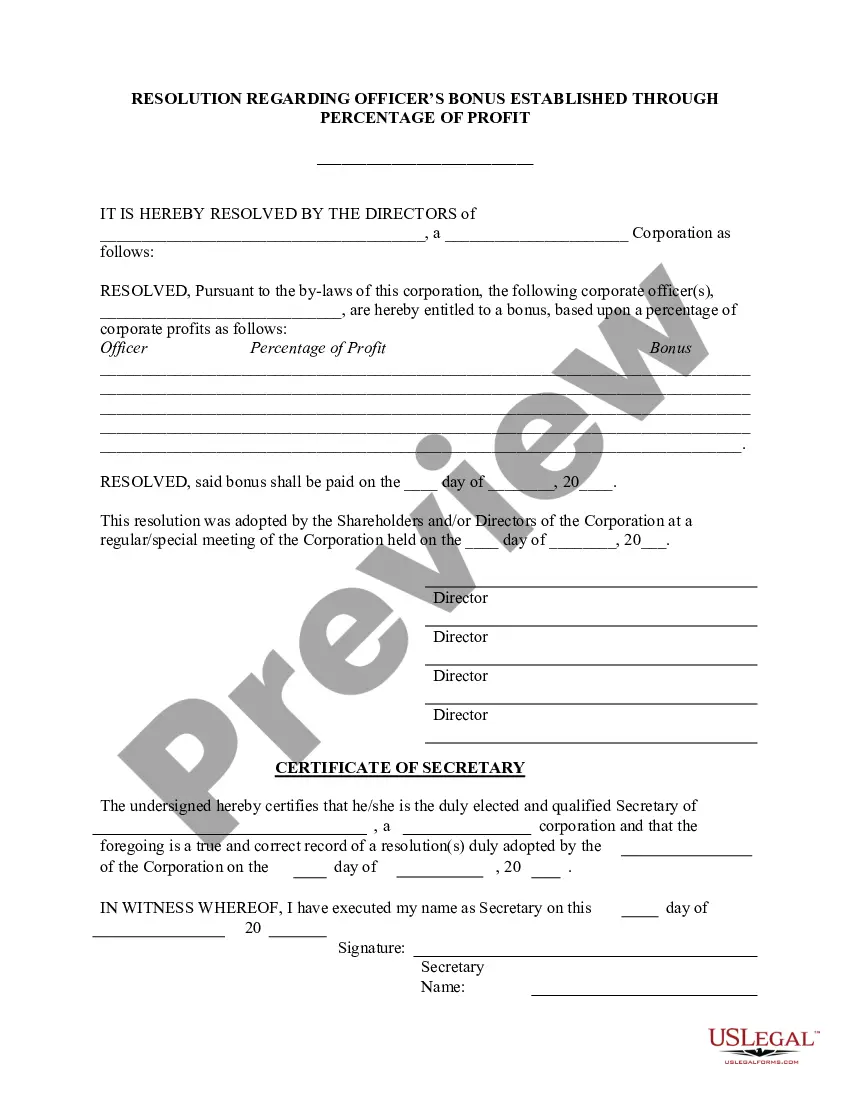
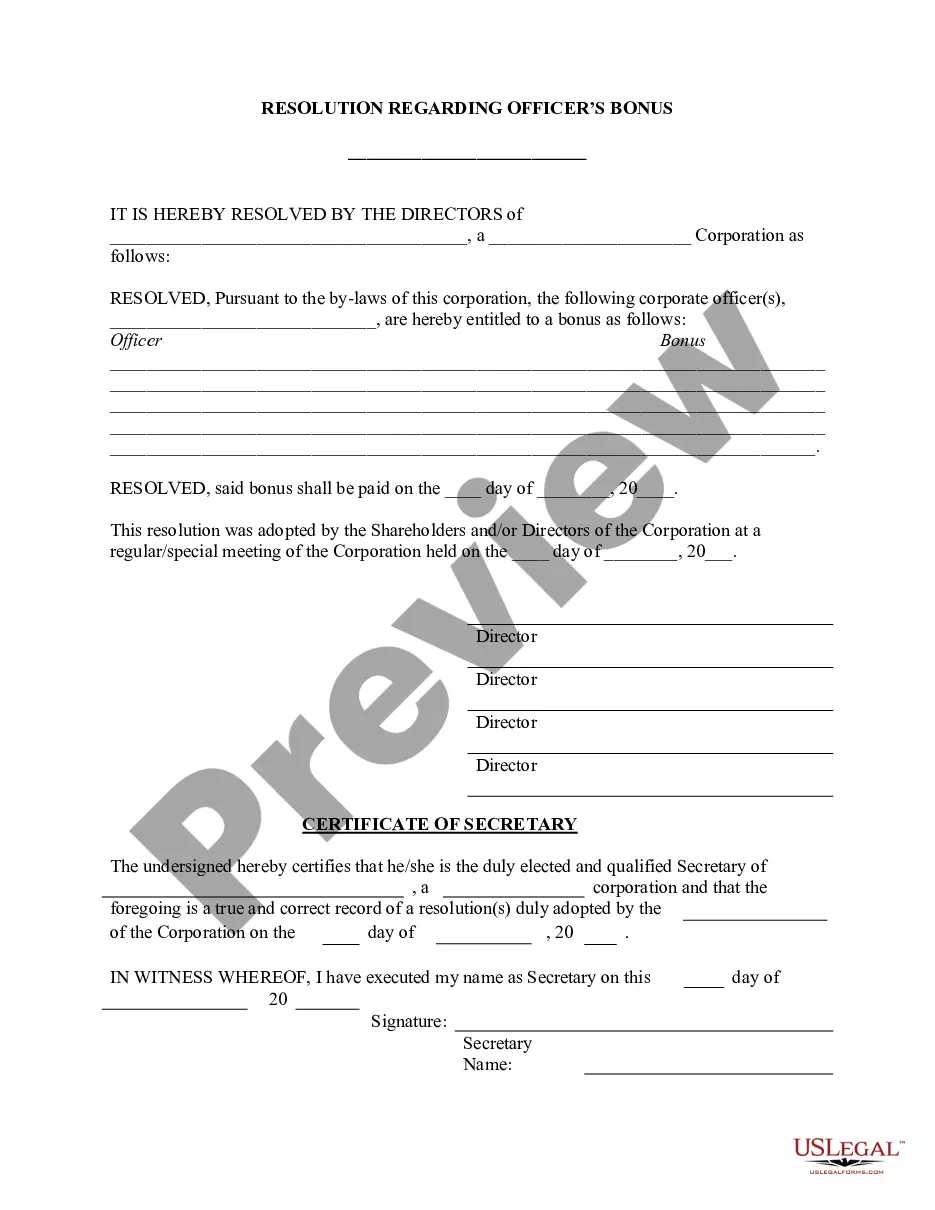
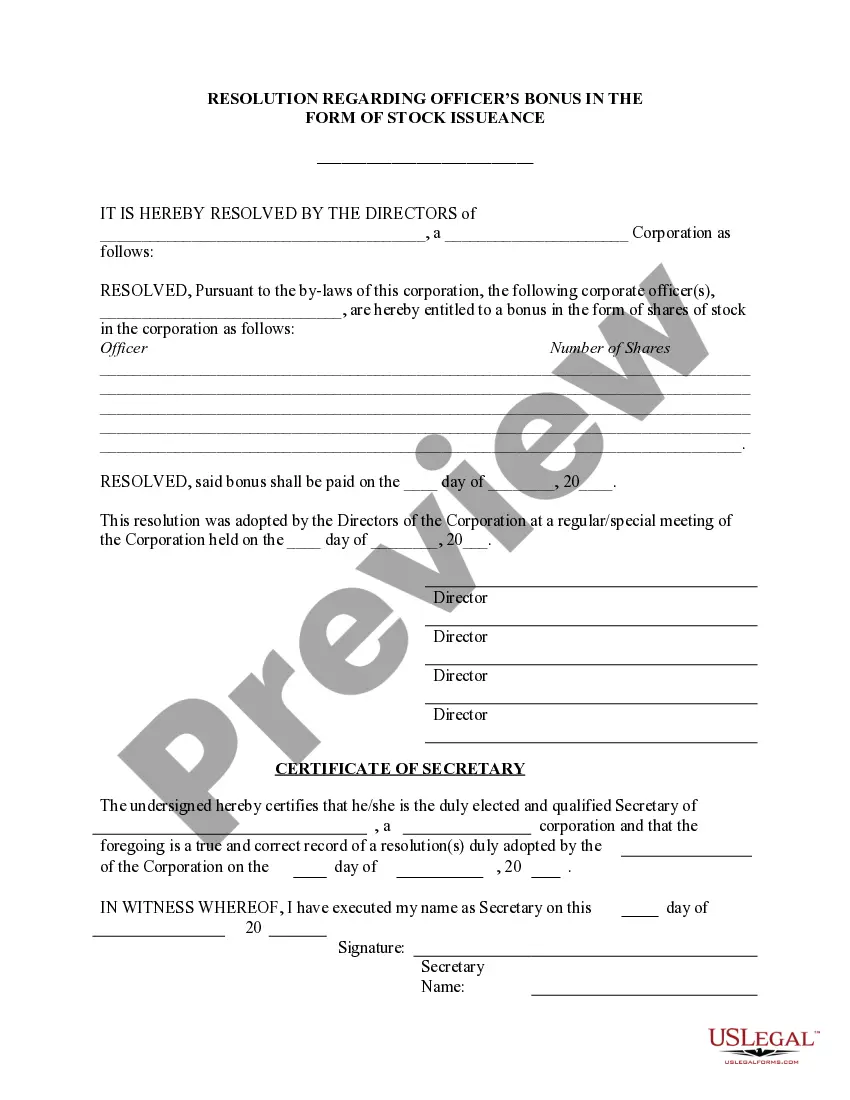
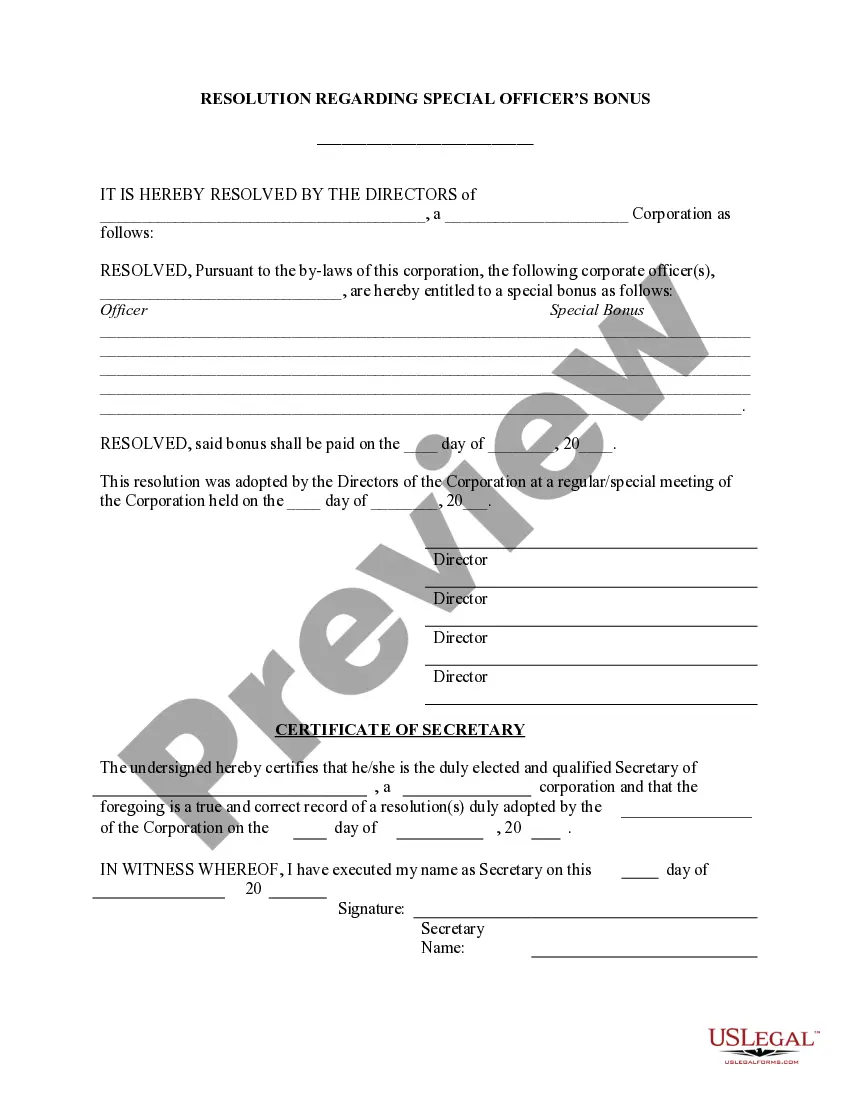
The Officers Bonus - Percent of Profit - Resolution Form is a legal document that allows the directors of a corporation to authorize bonuses for corporate officers based on a set percentage of corporate profits. This form formalizes the decision-making process, ensuring clarity and adherence to corporate by-laws. Unlike other compensation forms, this resolution specifically ties officer bonuses to the companyâs financial performance, providing an incentive aligned with profit maximization.
What’s included in this form
- Resolution declaring the entitlement to bonuses based on profit percentages.
- Listing of corporate officers eligible for the bonus.
- Specification of the percentage of profit that corresponds to each officer's bonus.
- Payment date for the approved bonuses.
- Certification section for the Secretary of the Corporation to validate the resolution.
Common use cases
This form should be used during a regular or special meeting of the corporation when the directors want to establish or modify the bonus structure for corporate officers. It is particularly relevant during profit review sessions, when the corporation decides to reward executives based on their contributions to the companyâs profitability.
Who can use this document
- Corporate directors responsible for setting compensation packages.
- Secretaries of corporations who need to document resolutions properly.
- CFOs or financial officers involved in determining corporate profit distributions.
- Any corporation looking to implement performance-based bonus structures for their executives.
Completing this form step by step
- Identify the corporationâs name and type, replacing the placeholders in the resolution.
- List the eligible corporate officers and specify the percentage of profit corresponding to each of their bonuses.
- Fill in the date on which the bonus will be paid.
- Record the date of the meeting during which the resolution is adopted.
- Have the directors sign the form, and ensure it is certified by the Secretary of the Corporation.
Does this document require notarization?
This form does not typically require notarization unless specified by local law. However, reviewing state-specific regulations is advisable to ensure full compliance with all legal requirements.
Get your form ready online
Our built-in tools help you complete, sign, share, and store your documents in one place.
Make edits, fill in missing information, and update formatting in US Legal Forms—just like you would in MS Word.
Download a copy, print it, send it by email, or mail it via USPS—whatever works best for your next step.
Sign and collect signatures with our SignNow integration. Send to multiple recipients, set reminders, and more. Go Premium to unlock E-Sign.
If this form requires notarization, complete it online through a secure video call—no need to meet a notary in person or wait for an appointment.
We protect your documents and personal data by following strict security and privacy standards.

Make edits, fill in missing information, and update formatting in US Legal Forms—just like you would in MS Word.

Download a copy, print it, send it by email, or mail it via USPS—whatever works best for your next step.

Sign and collect signatures with our SignNow integration. Send to multiple recipients, set reminders, and more. Go Premium to unlock E-Sign.

If this form requires notarization, complete it online through a secure video call—no need to meet a notary in person or wait for an appointment.

We protect your documents and personal data by following strict security and privacy standards.
Avoid these common issues
- Failing to specify the exact percentages for each officer.
- Not including the payment date, which can lead to confusion.
- Omitting the certification by the Secretary, making the resolution less formal.
- Using incorrect or outdated corporate information.
Advantages of online completion
- Convenient access to the form from anywhere at any time.
- Editability allows you to tailor the form to your corporationâs needs quickly.
- Reliable templates ensure compliance with legal standards.
- Easy downloading for your records or further documentation steps.
Looking for another form?


Form popularity
FAQ
What is a Good Bonus Percentage? A good bonus percentage for an office position is 10-20% of the base salary. Some Manager and Executive positions may offer a higher cash bonus, however this is less common.
Usually a lump-sum payment (cash, shares, etc.) made once a year in addition to an employee's normal salary or wage for a fiscal or calendar year. Generally nondiscretionary and not based on predetermined performance criteria or standards.
Key Takeaways. A bonus payment is additional pay on top of an employee's regular earnings. A bonus payment can be discretionary or nondiscretionary, depending on whether it meets certain criteria. Bosses hand out bonus payments for a variety of reasons, including as a reward for meeting individual or company goals.
Put the employee bonus plan in writing. Base the bonus on results that are measurable or quantifiable. Give incentives to employees to meet goals. Be clear on the WHAT, the WHY, and the HOW. Make sure everybody gets something. Make the financial reward a strong enough incentive.
An annual bonus is usually based on overall company performance. So you may get a large or small bonus (or no bonus at all) depending on how successful your organization or specific department was that year, as well as how big a part of that success you were. This can also be considered profit sharing.
The average retention bonus is between 10-15% of an employee's base income, but the amount can go up to 25%. Employers must consider why they are giving the retention bonus to determine the amount given.
A company sets aside a predetermined amount; a typical bonus percentage would be 2.5 and 7.5 percent of payroll but sometimes as high as 15 percent, as a bonus on top of base salary. Such bonuses depend on company profits, either the entire company's profitability or from a given line of business.
A 35% pay increase seems to be the current average. The size of a raise will vary greatly by one's experience with the company as well as the company's geographic location and industry sector. Sometimes raises will include non-cash benefits and perks that are not figured into the percentage increase surveyed.
As an example, a company might pay one employee $50,000 a year and make them eligible for a 5% bonus if goals are met, but pay another employee $100,000 a year with a possible 10% bonus. Bonuses based on pay grade recognize that a senior employee may have a more significant impact on the company's performance.