Release of Claims for Future Accidental Injuries or Death by Individual Participating in Camping Trip
About this form
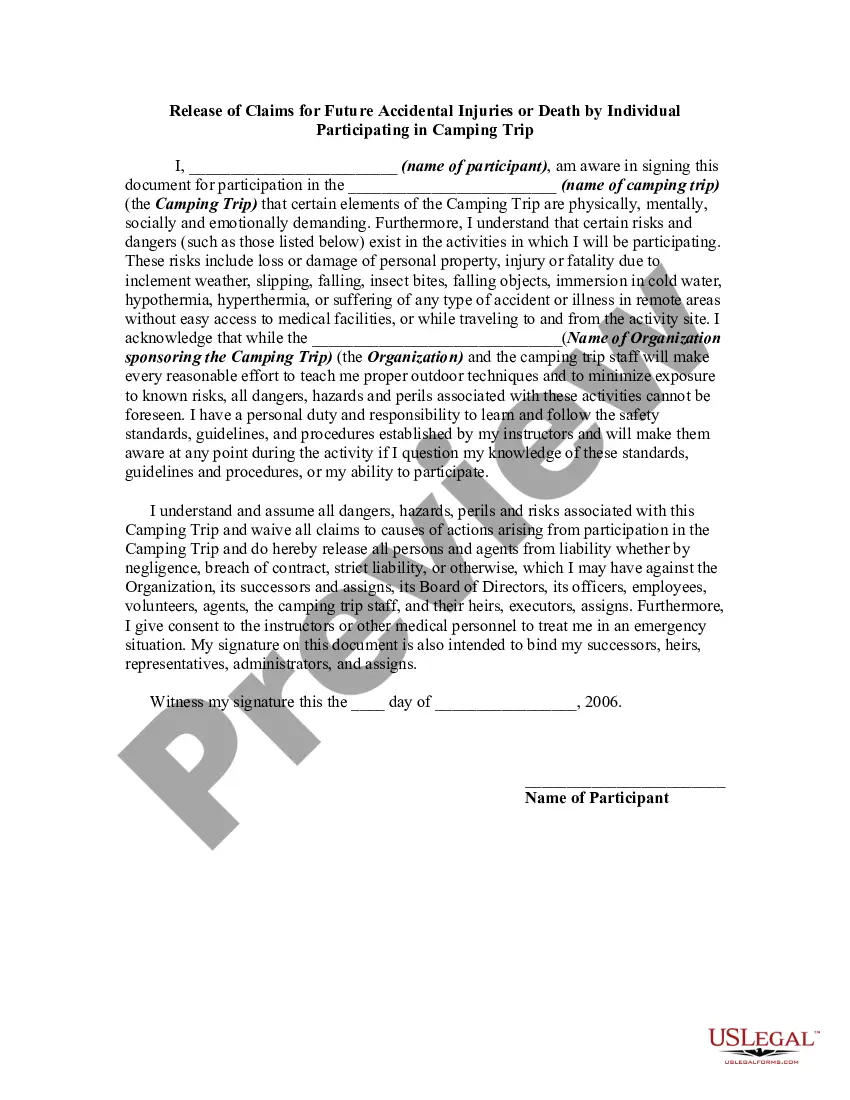
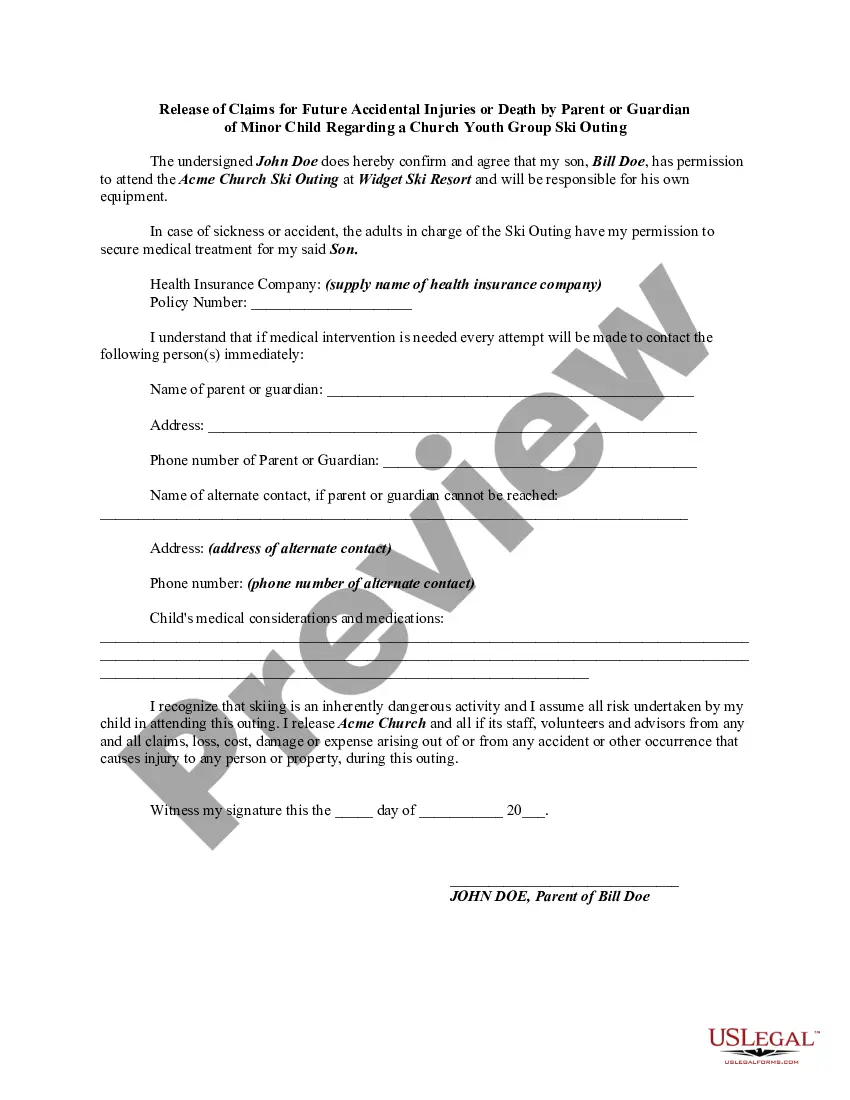
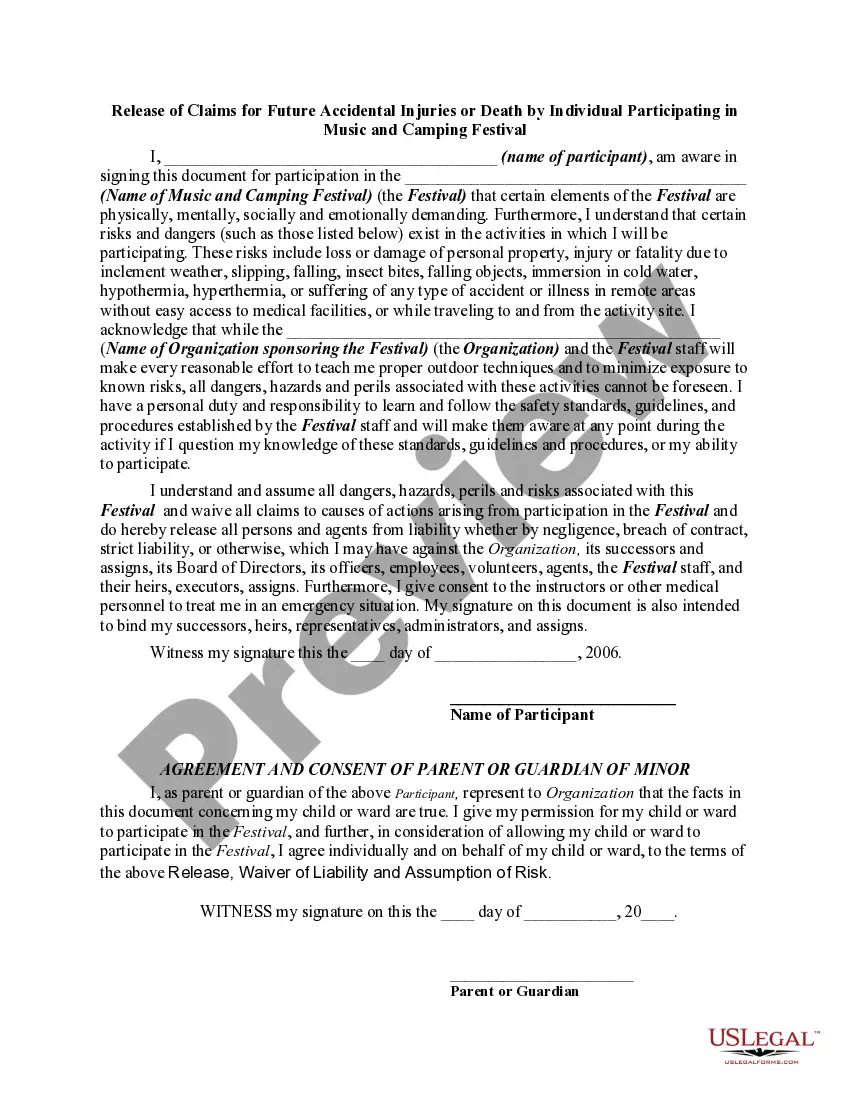
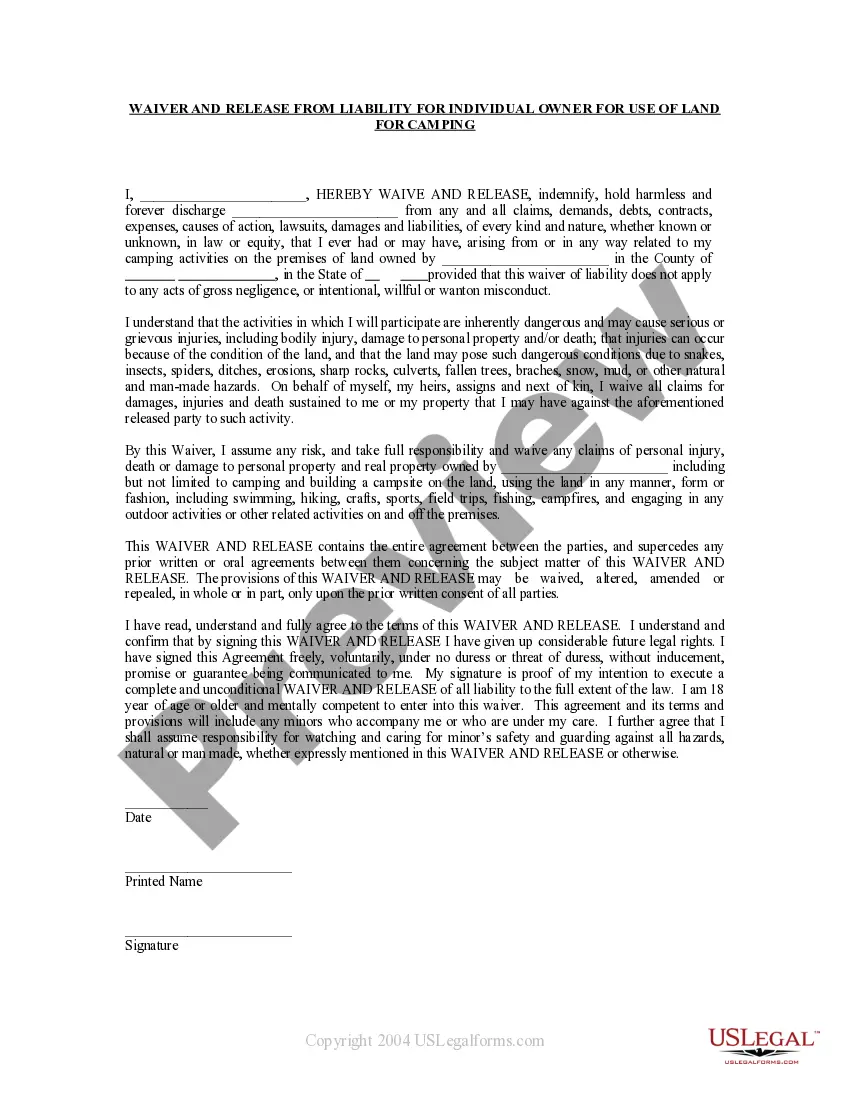
The Release of Claims for Future Accidental Injuries or Death by Individual Participating in Camping Trip is a legal document that protects organizations and their staff from liability associated with risks during a camping trip. This form serves as a release and assumption of risk agreement, ensuring that participants acknowledge the potential dangers involved in activities related to the camping trip. It differs from liability waivers in other contexts by specifically addressing the unique hazards of outdoor activities and camping experiences.
Key parts of this document
- Name of the participant entering the agreement.
- Name of the camping trip or event being attended.
- Description of risks associated with the camping activities.
- Acknowledgment of the participant's responsibility to follow safety guidelines.
- Release of liability for the organization and its representatives.
- Consent for medical treatment in emergency situations.
Common use cases
This form should be utilized by participants who are about to engage in a camping trip organized by an organization, such as schools, youth groups, or outdoor adventure companies. It is essential when participants are informed of the various risks associated with outdoor activities, such as hiking, swimming, or camping. By signing this document, participants acknowledge these risks before partaking in the experience.
Who needs this form
This form is intended for:
- Individuals participating in organized camping trips
- Parents or guardians signing on behalf of minors
- Organizations coordinating camping activities
How to complete this form
- Identify the participant by entering their name in the designated field.
- Specify the name of the camping trip in which the participant is engaging.
- Read and understand the list of risks associated with the camping activities.
- Include the name of the sponsoring organization in the appropriate section.
- Sign and date the form to indicate agreement and understanding of the outlined terms.
Does this document require notarization?
This form usually doesn’t need to be notarized. However, local laws or specific transactions may require it. Our online notarization service, powered by Notarize, lets you complete it remotely through a secure video session, available 24/7.
Get your form ready online
Our built-in tools help you complete, sign, share, and store your documents in one place.
Make edits, fill in missing information, and update formatting in US Legal Forms—just like you would in MS Word.
Download a copy, print it, send it by email, or mail it via USPS—whatever works best for your next step.
Sign and collect signatures with our SignNow integration. Send to multiple recipients, set reminders, and more. Go Premium to unlock E-Sign.
If this form requires notarization, complete it online through a secure video call—no need to meet a notary in person or wait for an appointment.
We protect your documents and personal data by following strict security and privacy standards.

Make edits, fill in missing information, and update formatting in US Legal Forms—just like you would in MS Word.

Download a copy, print it, send it by email, or mail it via USPS—whatever works best for your next step.

Sign and collect signatures with our SignNow integration. Send to multiple recipients, set reminders, and more. Go Premium to unlock E-Sign.

If this form requires notarization, complete it online through a secure video call—no need to meet a notary in person or wait for an appointment.

We protect your documents and personal data by following strict security and privacy standards.
Typical mistakes to avoid
- Failing to read and understand the risks before signing.
- Not specifying the camping trip name correctly, which can lead to issues of enforceability.
- Forgetting to have a parent or guardian sign for minors.
- Leaving signature or date fields blank.
Benefits of completing this form online
- Convenient access to legal forms from anywhere with internet access.
- Editable templates to customize for specific camping trips.
- Instant downloads available for immediate use.
- Forms certified for accuracy and compliance by licensed attorneys.
Legal use & context
- This release of claims form is designed to limit the liability of the organization sponsoring the camping trip.
- While participants can waive certain rights, they should understand the risks involved fully.
- The effectiveness of this form may vary based on jurisdiction and specific situations.
Quick recap
- The Release of Claims form protects organizations by informing participants of risks.
- Signing this form waives the right to hold the organization liable for accidents.
- Ensure clarity and accuracy when filling out the form to avoid legal issues.
Looking for another form?




Form popularity
FAQ
A waiver of liability (AKA a release or disclaimer) will be upheld if the following is found to have occurred:The waiver is properly worded according to contract law in the state in which it was drafted; and. The injury arises from risks stated in the contract or from the disclaiming company's simple negligence.
Release Form Enforceability A minor usually cannot legally release his or her rights.So, a release signed only by the minor is not enforceable. In addition, the release must be signed before any injury has occurred.
In many cases, the waiver is not enforceable.If you've been injured due to negligent actions, you can sue even if you signed a waiver. Winning a lawsuit concerning negligence is not uncommon. Many celebrities have sued for negligence even though they signed documents stating they understood the risks.
Essentially, a waiver removes a real or potential liability for the other party in the agreement. For example, in a settlement between two parties, one party might, by means of a waiver, relinquish its right to pursue any further legal action once the settlement is finalized.
When you sign a service provider's liability waiver, you are agreeing not to hold the service provider responsible for any injury you may sustain as a result of ordinary negligence. Ordinary negligence and gross negligence are the two types that factor into these types of cases.
In California, a liability waiver must be clear, unambiguous, and explicit. In other words, waivers cannot be printed in faded ink, in small font, on the back of a paper, or in an otherwise ambiguous form. If the waiver that you sign is not represented clearly, it may not hold up in the event of a lawsuit.
A waiver explained A release form or a waiver is simply a legal document containing an agreement between two parties.A waiver is an essential document that informs participants of the risks involved in certain activities and also protects you from liability.
Many people believe the myth that if you sign a waiver, you're not allowed to sue. However, that is simply not true. Waivers are intended to inform the participant of possible harm. Upon signing, the participant is surrendering a known right or acknowledging that harm may occur.
In California, a liability waiver must be clear, unambiguous, and explicit. In other words, waivers cannot be printed in faded ink, in small font, on the back of a paper, or in an otherwise ambiguous form. If the waiver that you sign is not represented clearly, it may not hold up in the event of a lawsuit.