Tennessee Agreement for Delayed or Partial Rent Payments
Overview of this form
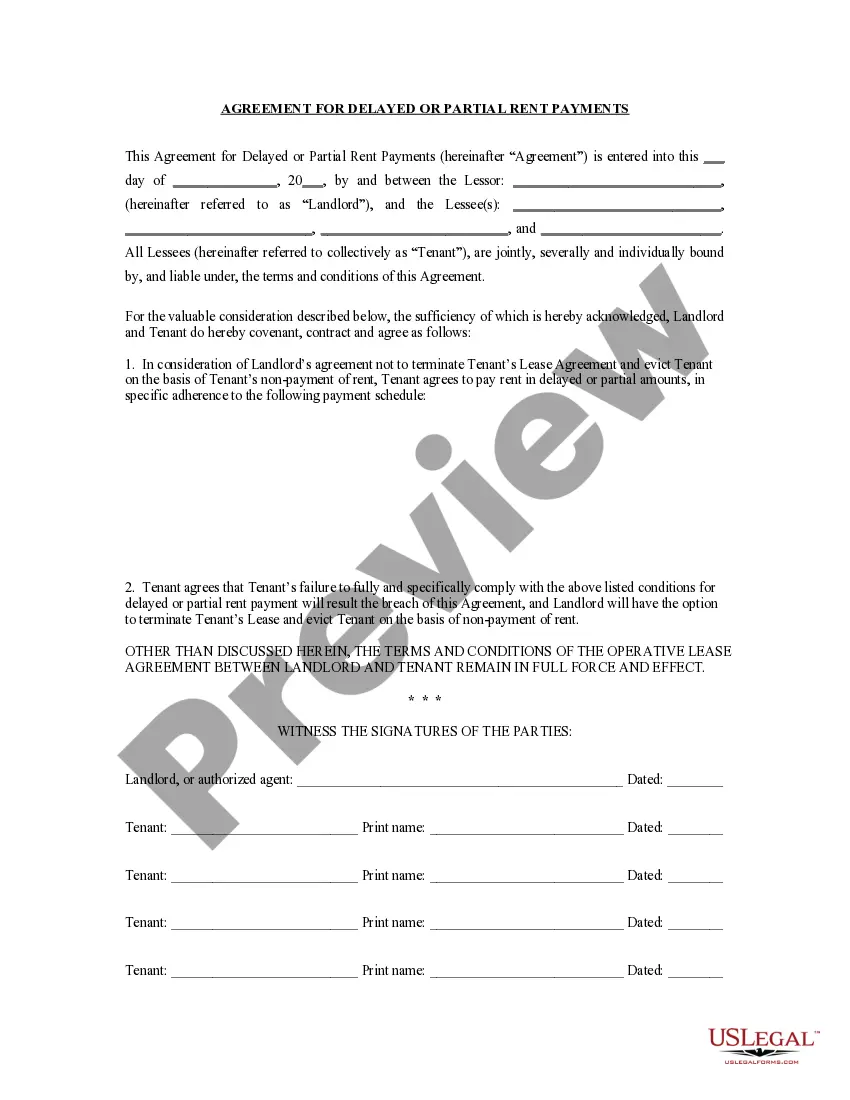
The Agreement for Delayed or Partial Rent Payments is a legal document that outlines the terms under which a tenant can pay rent either partially or with a delay. This agreement is essential for landlords and tenants facing temporary financial difficulties, as it prevents eviction for non-payment while establishing a structured repayment plan. Unlike standard lease agreements, this form specifically addresses late or partial payments, providing clarity and protection for both parties involved.
Key components of this form
- Identification of the landlord and tenant parties involved in the agreement.
- Terms specifying the amount and schedule for delayed or partial rent payments.
- Conditions under which the landlord agrees not to terminate the lease or evict the tenant.
- A clause affirming that all other terms of the original lease remain in effect.
- Signatures of both landlord and tenant(s) to validate the agreement.

When to use this document
This form is particularly useful in situations where a tenant is unable to pay the full rent on time due to unforeseen circumstances, such as loss of income or unexpected expenses. It provides a legal foundation for the tenant to propose a temporary modification to their payment obligations while ensuring that the landlord is aware and agrees to these changes. Use this agreement to prevent eviction and maintain a positive landlord-tenant relationship during challenging times.
Who should use this form
This agreement is intended for:
- Landlords who want to provide flexibility to tenants experiencing financial hardship.
- Tenants seeking to establish a clear, legal arrangement for making delayed or partial rent payments.
- Property managers acting on behalf of landlords who require formal documentation regarding payment alterations.
Steps to complete this form
- Identify and fill in the names of the landlord and tenant(s).
- Specify the date the agreement is being entered into.
- Clearly outline the payment amount and schedule for delayed or partial payments.
- Include any special conditions agreed upon by both the landlord and tenant.
- Ensure all parties sign and date the document to validate the agreement.
Is notarization required?
This form does not typically require notarization unless specified by local law. It is advisable to check your state requirements to ensure compliance.
Get your form ready online
Our built-in tools help you complete, sign, share, and store your documents in one place.
Make edits, fill in missing information, and update formatting in US Legal Forms—just like you would in MS Word.
Download a copy, print it, send it by email, or mail it via USPS—whatever works best for your next step.
Sign and collect signatures with our SignNow integration. Send to multiple recipients, set reminders, and more. Go Premium to unlock E-Sign.
If this form requires notarization, complete it online through a secure video call—no need to meet a notary in person or wait for an appointment.
We protect your documents and personal data by following strict security and privacy standards.

Make edits, fill in missing information, and update formatting in US Legal Forms—just like you would in MS Word.

Download a copy, print it, send it by email, or mail it via USPS—whatever works best for your next step.

Sign and collect signatures with our SignNow integration. Send to multiple recipients, set reminders, and more. Go Premium to unlock E-Sign.

If this form requires notarization, complete it online through a secure video call—no need to meet a notary in person or wait for an appointment.

We protect your documents and personal data by following strict security and privacy standards.
Mistakes to watch out for
- Failing to specify payment amounts or deadlines clearly.
- Not having all parties sign the agreement.
- Neglecting to include terms from the original lease that remain in effect.
- Using informal language that may not hold up in a legal context.
Benefits of completing this form online
- Convenient access to legal documents from any location at any time.
- Editability allows users to customize the agreement to their specific situation.
- Reliability, as forms are drafted by licensed attorneys ensuring legal compliance.
- Instant download, saving time compared to traditional legal consultations.
Quick recap
- The Agreement for Delayed or Partial Rent Payments helps Landlords and Tenants navigate financial difficulties without resorting to eviction.
- Clearly defined terms help prevent misunderstandings during challenging times.
- Both parties must carefully review and understand the agreement before signing.
Looking for another form?



Form popularity
FAQ
A five day grace period means that rent due on the 1st wouldn't get a late fee until the 6th. However, this does not mean that rent is actually due on the 5th but that's the message that is inadvertently conveyed. Rent is due on the due date please don't make a habit out of paying within the grace period.
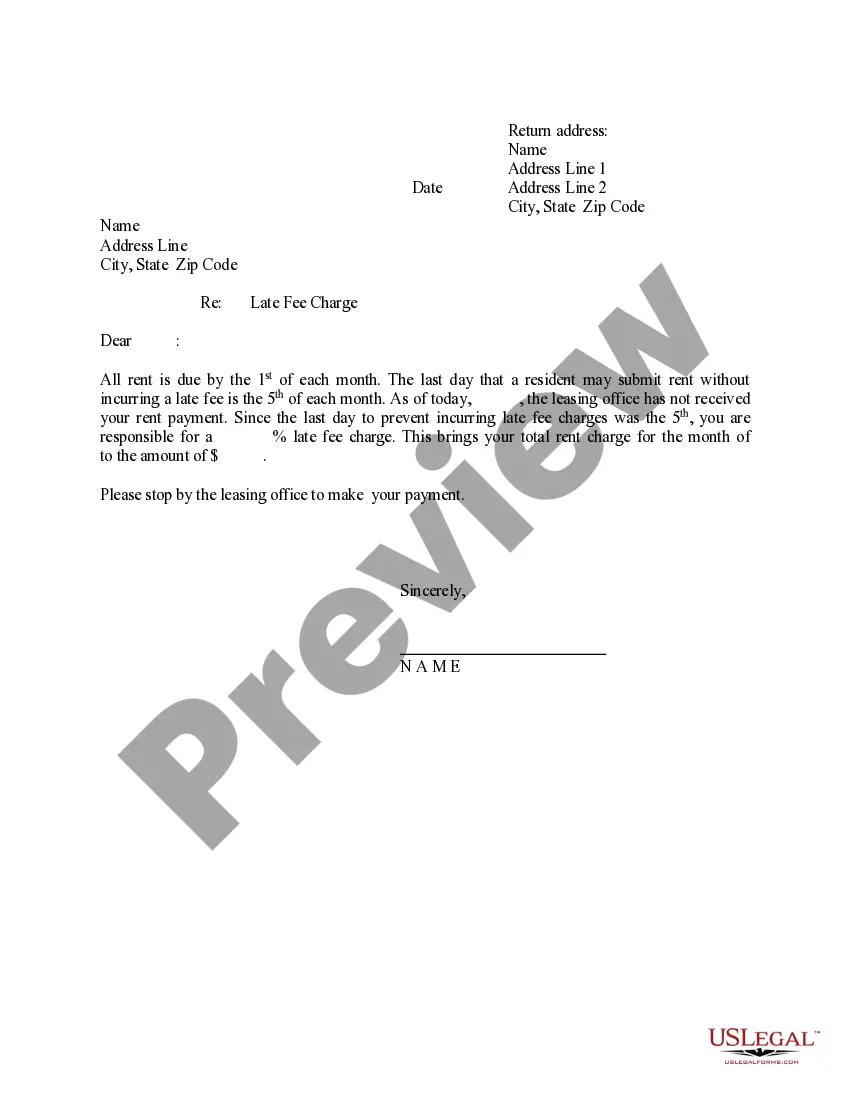
Under California law, a late fee will be enforced only if the fee is a reasonable estimate of the amount that the lateness of the payment will cost the landlord, and if specified language is include in a written lease or rental agreement.
Late fees Most rental agreements include a late fee clause. You might have to pay a late fee if you're even a few minutes past the due date. Or, you might have a grace period of a day or two.If you pay on the second, you won't have to pay a late fee, but your payment may still be flagged as a late payment.
Your landlord can evict you if you fall behind with your rent - you could lose your home. Coronavirus (COVID-19) has not changed this, but there are new rules that mean your landlord must give you at least 6 months' notice if they plan to evict you, unless you owe at least 6 months' rent.
Step 1: Check Your Lease Documents and Payment Records. Step 2: Send a Late Rent Notice. Step 3: Make a Phone Call. Step 4: Send a Pay or Quit Notice. Step 5: Take Legal Action.
Step 1: Check Your Lease Documents and Payment Records. Step 2: Send a Late Rent Notice. Step 3: Make a Phone Call. Step 4: Send a Pay or Quit Notice. Step 5: Take Legal Action.
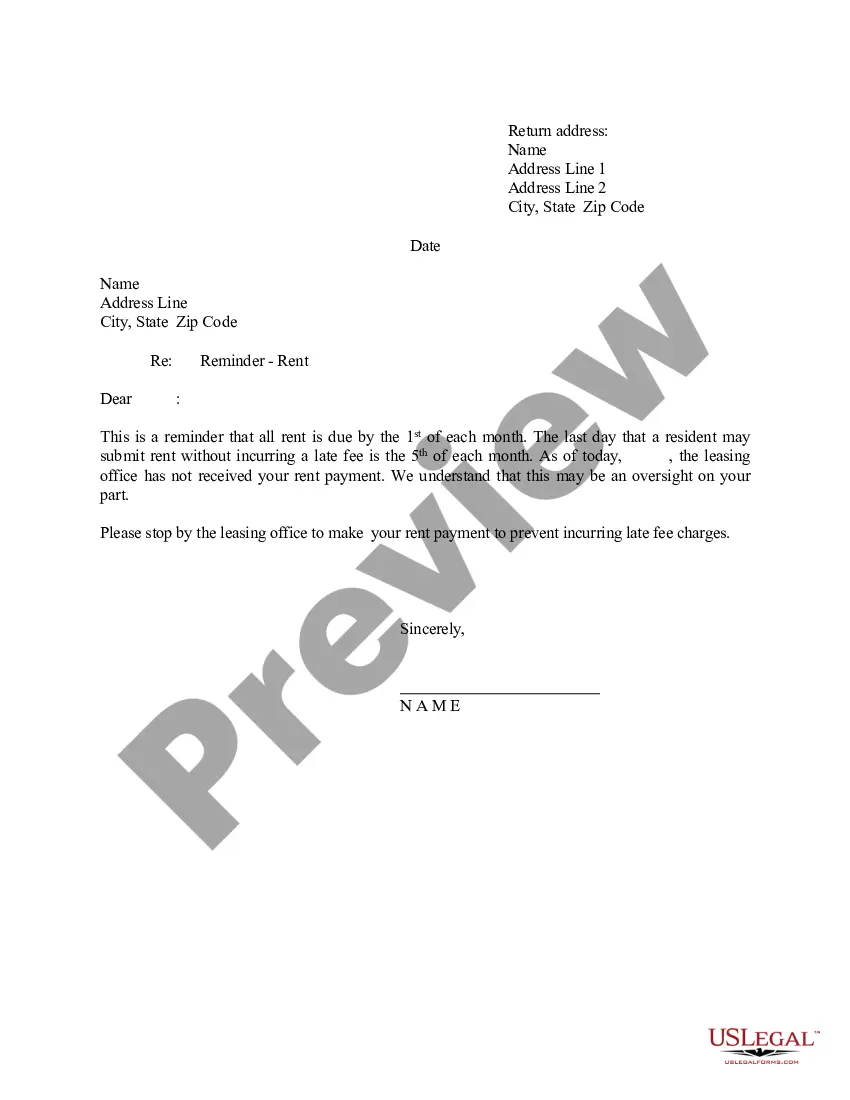
Grace periods are quite common, usually varying between three and five days. Grace periods provide tenants extra time to pay rent before the landlord can legally charge a late fee.
Grace periods are quite common, usually varying between three and five days. Grace periods provide tenants extra time to pay rent before the landlord can legally charge a late fee.
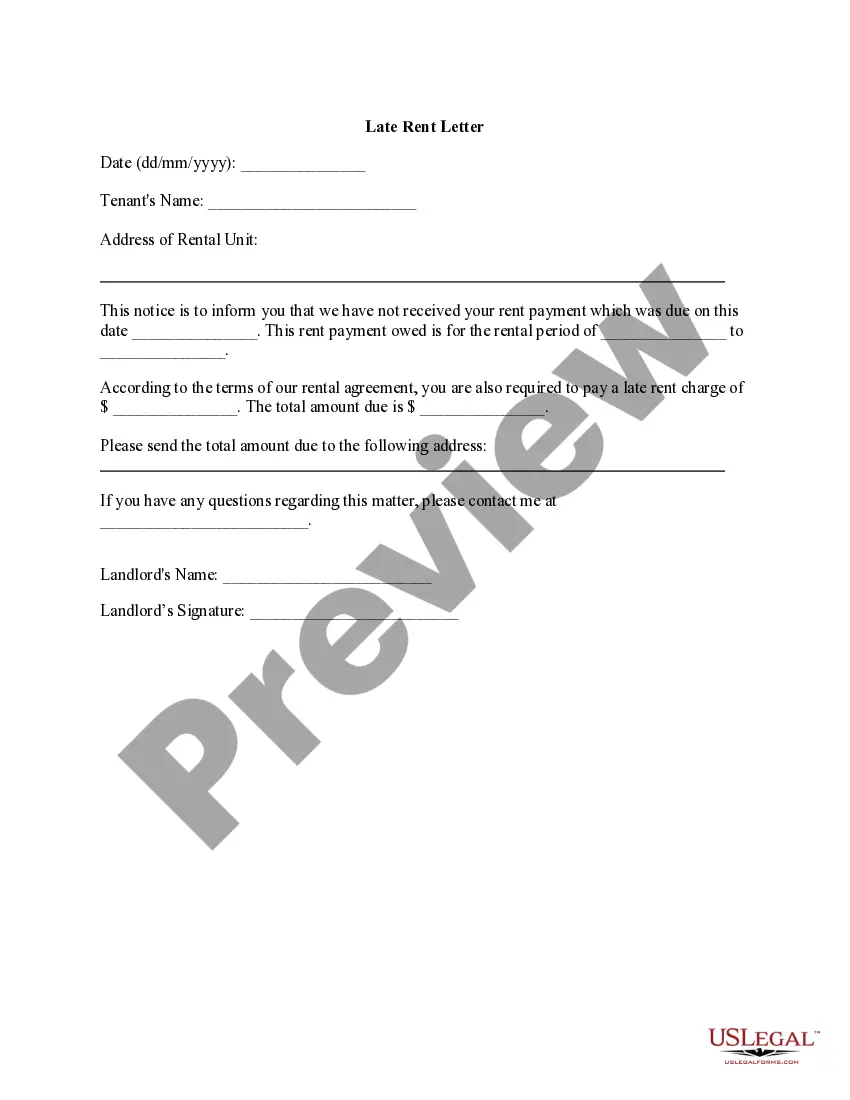
Dear Landlord's Name, I'm writing to inform you that my rent payment will be late this month. I was recently laid off from my job and won't be able to make the payment on time. I have applied for unemployment benefits, but it may take up to 2 weeks before I receive my first payment.