Tennessee Acknowledgment of Satisfaction for Corporation
About this form
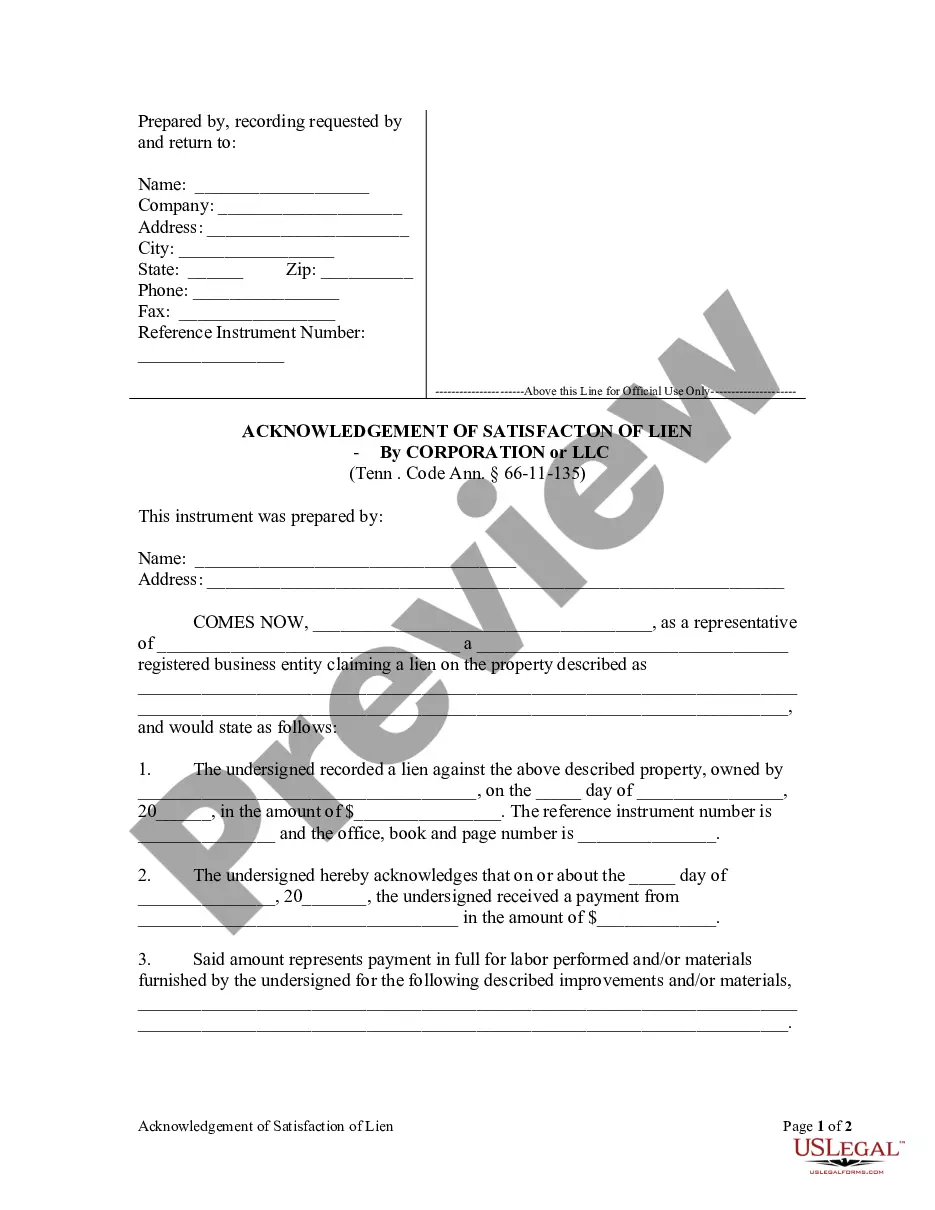
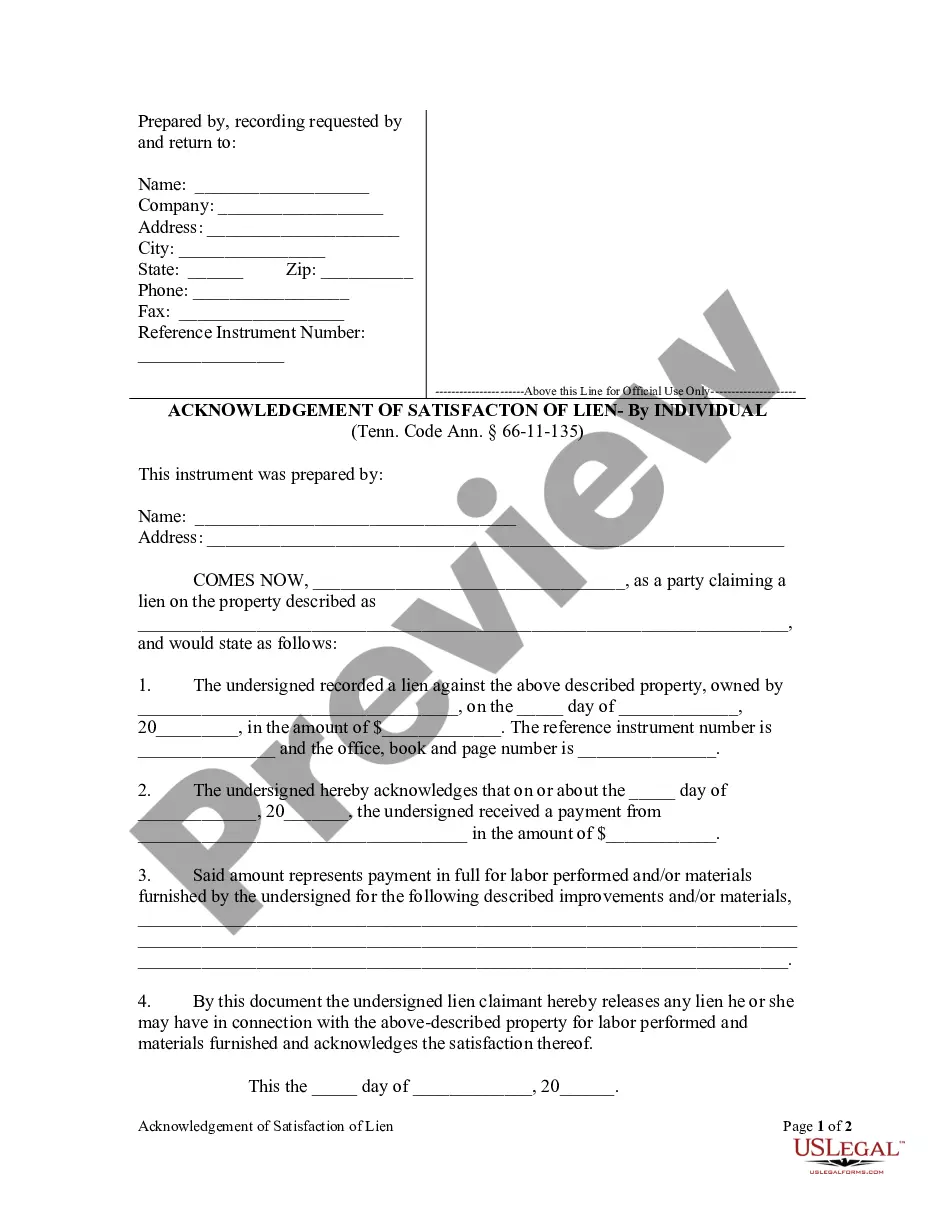
The Acknowledgment of Satisfaction for Corporation is a legal document used when a lien on a property has been satisfied. This form serves as proof that the corporation has received payment for any outstanding debts related to labor or materials provided for property improvements. Unlike other lien forms, this document specifically acknowledges that the claim has been fully satisfied, thereby releasing any rights to the lien on the property.
Key components of this form
- Name and contact information of the lien claimant.
- Details of the corporation that initially claimed the lien.
- Description of the property connected to the lien.
- Initial amount of the lien and reference instrument number.
- Date of satisfaction and amount paid.
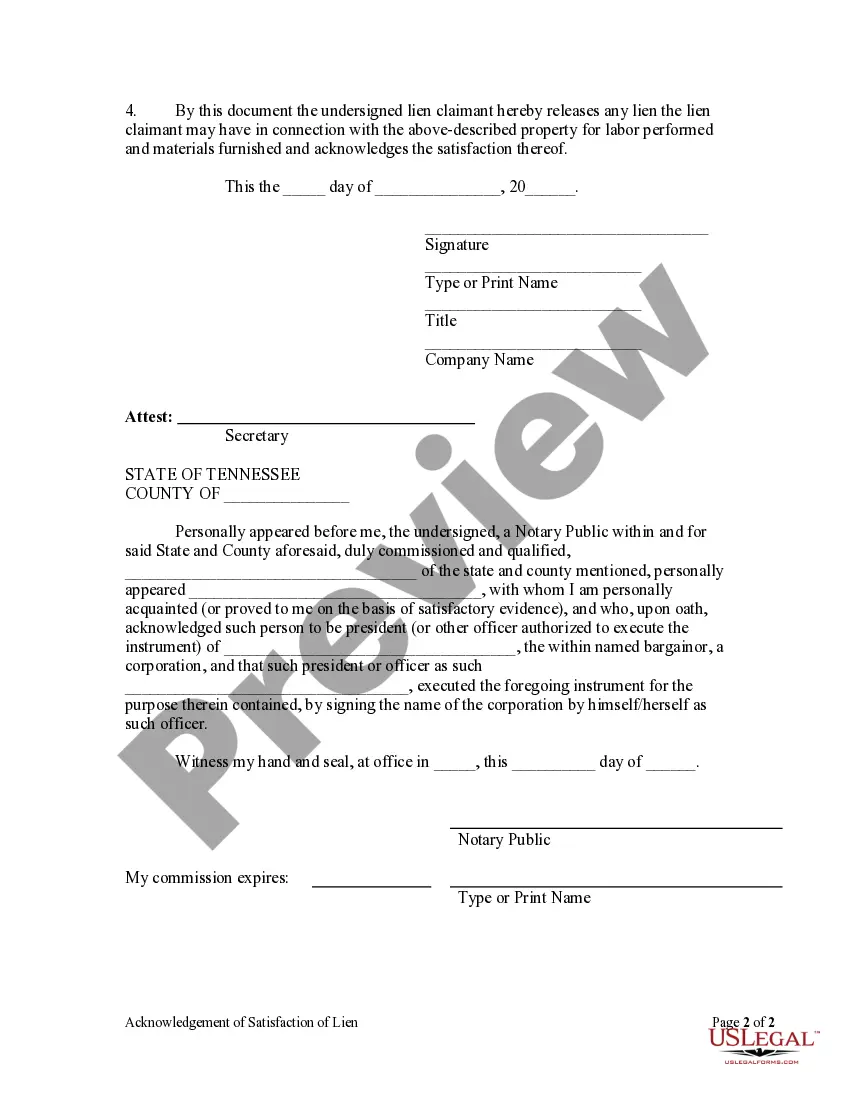
- Signature of an authorized corporate officer and notarization section.
Situations where this form applies
This form should be used when a corporation has received payment for services rendered or materials supplied and needs to formally acknowledge that the lien on the property is satisfied. It is typically used in scenarios where the property owner has completed payment, and the corporation must release their claim to the lien within legal timeframes.
Who needs this form
This form is intended for:
- Corporations that have filed a lien against a property for unpaid bills.
- Corporate officers authorized to act on behalf of the corporation.
- Property owners who wish to clear any lien claims against their property.
Instructions for completing this form
- Identify the parties involved by filling out the names and contact information of the lien claimant and corporation.
- Clearly describe the property against which the lien was filed.
- Enter the details of the lien, including the date it was filed and the reference instrument number.
- Specify the amount of payment received and the date it was made.
- Have the appropriate corporate officer sign the document and ensure it is notarized for legal validation.
Notarization requirements for this form
Yes, this form must be notarized to be legally valid. This ensures that the signatures are verified and that the document holds up in legal situations. US Legal Forms offers integrated online notarization, allowing you to complete this step securely via a video call, without the need for travel.
Get your form ready online
Our built-in tools help you complete, sign, share, and store your documents in one place.
Make edits, fill in missing information, and update formatting in US Legal Forms—just like you would in MS Word.
Download a copy, print it, send it by email, or mail it via USPS—whatever works best for your next step.
Sign and collect signatures with our SignNow integration. Send to multiple recipients, set reminders, and more. Go Premium to unlock E-Sign.
If this form requires notarization, complete it online through a secure video call—no need to meet a notary in person or wait for an appointment.
We protect your documents and personal data by following strict security and privacy standards.

Make edits, fill in missing information, and update formatting in US Legal Forms—just like you would in MS Word.

Download a copy, print it, send it by email, or mail it via USPS—whatever works best for your next step.

Sign and collect signatures with our SignNow integration. Send to multiple recipients, set reminders, and more. Go Premium to unlock E-Sign.

If this form requires notarization, complete it online through a secure video call—no need to meet a notary in person or wait for an appointment.

We protect your documents and personal data by following strict security and privacy standards.
Common mistakes to avoid
- Failing to provide complete information about the lien or property.
- Not having the form signed by an authorized officer of the corporation.
- Neglecting to notarize the document, if required by law.
Why use this form online
- Convenience of downloading and printing the form at your office.
- Editable fields allow for accurate and quick input of required information.
- Ensures compliance with legal requirements for lien satisfaction.
Key takeaways
- The Acknowledgment of Satisfaction for Corporation formally releases a lien once payment is received.
- Complete and accurate information is critical for its enforceability.
- Notarization is required for legal validation of the document.
Looking for another form?

Form popularity
FAQ
Satisfaction by Levy A judgment creditor's obligation to give or file an acknowledgement of satisfaction arises only when the judgment creditor received the full amount required to satisfy the judgment from the levying officer.
Once a judgment is paid, whether in installments or a lump sum, a judgment creditor (the person who won the case) must acknowledge that the judgment has been paid by filing a Satisfaction of Judgment form with the court clerk.
A Satisfaction of Judgment is a document signed by one party acknowledge receipt of the payment. The Satisfaction of Judgment is then filed with the court. This is beneficial to the paying party for multiple reasons. One, the court is put on notice that the debt has been satisfied.
You may ask your judgment creditor to file a satisfaction of judgment form. The length of time gives to the creditor to file the form varies from state to state, but it is usually between 14 and 30 days after your request.
A document signed by the party who is owed money under a court judgment (called the judgment creditor) stating that the full amount due on the judgment has been paid.
A document signed by the party who is owed money under a court judgment (called the judgment creditor) stating that the full amount due on the judgment has been paid.
Satisfaction of judgment. n. a document signed by a judgment creditor (the party owed the money judgment) stating that the full amount due on the judgment has been paid.
A document signed by the party who is owed money under a court judgment (called the judgment creditor) stating that the full amount due on the judgment has been paid.
A Satisfaction of Judgment is basically an official receipt which says that you owed a certain amount, but that it has been paid, either partially or in full.