South Dakota Letter from Tenant to Landlord about Fair Housing Reduction or Denial of services to Family with Children
About this form
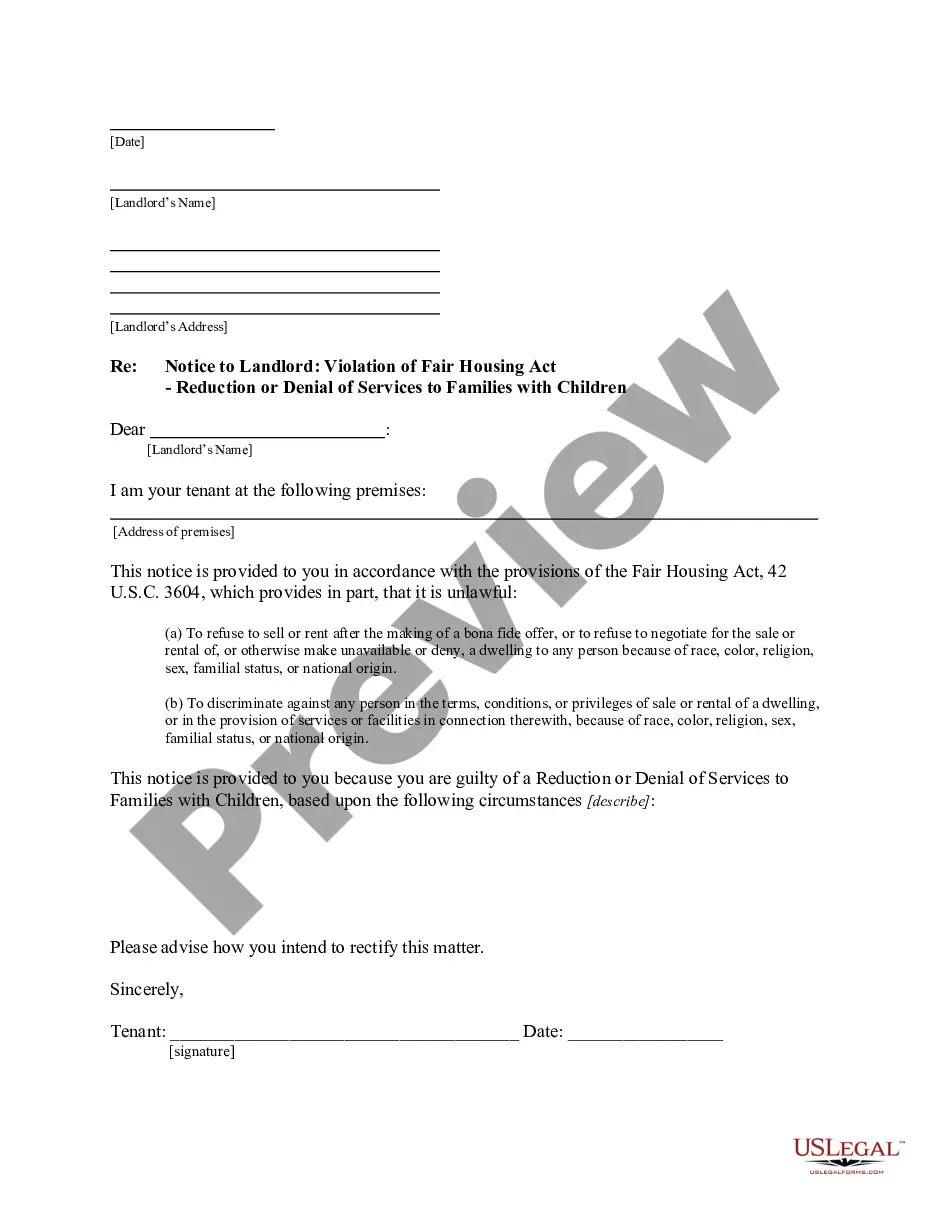
This form is a letter from a tenant to a landlord addressing violations of the Fair Housing Act concerning the reduction or denial of services to families with children. It serves to officially notify the landlord of discriminatory practices and outlines the legal protections afforded to families under federal law. This form is essential for tenants who believe they have been unfairly treated and seek to rectify the situation through formal communication.
What’s included in this form
- Identification of the tenant and landlord involved
- Description of the specific denial or reduction of services
- Citation of relevant Fair Housing Act provisions
- Detailed explanation of how the landlord's actions violate the law
- Request for resolution from the landlord

Situations where this form applies
This form should be used when a tenant believes that their landlord has unlawfully denied services or made housing unavailable to them and their children due to familial status. It is particularly relevant in situations where families feel their rights are being infringed upon, such as being turned away from housing opportunities or not receiving equal treatment. By using this form, tenants can formally address their concerns and seek a resolution.
Who should use this form
- Families with children facing housing discrimination
- Tenants who suspect their landlord has violated their Fair Housing rights
- Individuals seeking to formally communicate concerns about unequal treatment in housing
- Any tenant wanting to register a complaint under the Fair Housing Act
Steps to complete this form
- Identify yourself and the landlord with full names and contact information.
- Clearly state the nature of the violation regarding the reduction or denial of services.
- Cite relevant sections of the Fair Housing Act that apply to your situation.
- Provide a detailed account of your circumstances and any supporting evidence.
- Sign and date the letter before sending it to the landlord.
Notarization requirements for this form
In most cases, this form does not require notarization. However, some jurisdictions or signing circumstances might. US Legal Forms offers online notarization powered by Notarize, accessible 24/7 for a quick, remote process.
Get your form ready online
Our built-in tools help you complete, sign, share, and store your documents in one place.
Make edits, fill in missing information, and update formatting in US Legal Forms—just like you would in MS Word.
Download a copy, print it, send it by email, or mail it via USPS—whatever works best for your next step.
Sign and collect signatures with our SignNow integration. Send to multiple recipients, set reminders, and more. Go Premium to unlock E-Sign.
If this form requires notarization, complete it online through a secure video call—no need to meet a notary in person or wait for an appointment.
We protect your documents and personal data by following strict security and privacy standards.

Make edits, fill in missing information, and update formatting in US Legal Forms—just like you would in MS Word.

Download a copy, print it, send it by email, or mail it via USPS—whatever works best for your next step.

Sign and collect signatures with our SignNow integration. Send to multiple recipients, set reminders, and more. Go Premium to unlock E-Sign.

If this form requires notarization, complete it online through a secure video call—no need to meet a notary in person or wait for an appointment.

We protect your documents and personal data by following strict security and privacy standards.
Common mistakes
- Failing to provide detailed examples of the discrimination encountered
- Not citing the specific Fair Housing laws being violated
- Missing or incorrect contact information for either party
- Neglecting to sign and date the letter
Advantages of online completion
- Convenient access to legally-drafted templates, ensuring compliance with laws
- Edit the form to tailor it to your specific situation
- Instant download and easy access for future reference
- Secure storage of your documents for peace of mind
Legal use & context
- This form serves as a formal notification and is a step toward legal action if necessary.
- It is enforceable under the Fair Housing Act and may help establish evidence in cases of discrimination.
- Using this form does not preclude pursuing other remedies available under the law.
Key takeaways
- This letter is a vital tool for tenants facing discrimination due to familial status.
- Addressing violations promptly can help safeguard your housing rights.
- Leveraging this template can ensure you communicate effectively and legally with your landlord.
Looking for another form?

Form popularity
FAQ
Yes, there are four important exceptions to the Fair Housing Act: Single family homes, as long as the home is also rented or sold by the owner, the owner does not own more than 3 such homes at a time, the advertising for the sale or rental was not discriminatory, and the owner did not use a real estate agent or broker.
Under California law, it is unlawful for a landlord, managing agent, real estate broker, or salesperson to discriminate against a person or harass a person because of the person's race, color, religion, sex (including gender and perception of gender), sexual orientation, marital status, national origin, ancestry,
HUD Settles Disability Discrimination Fair Housing Act Case For $80,000.
It is against Fair Housing guidelines to provide discounts to the elderly.
Which would be exempt under the Federal Fair Housing Acts of 1968? An individual selling a personal residence who does not use a broker or discriminatory advertising:Some groups are not covered by the Federal Fair Housing protected classes. These are age, marital status, and occupation.
It's fair to be angry and scaredthe direct federal fines for violations of the Fair Housing Act are usually $17,000 per violation; total settlements on race, familial status, age and sex discrimination cases often reach well into the six figuresbut those overwhelming emotions are why you should go straight to your
The Fair Housing Act covers most housing. In some circumstances, the Act exempts owner-occupied buildings with no more than four units, single-family housing sold or rented without the use of a broker and housing operated by organizations and private clubs that limit occupancy to members.
The federal Fair Housing Act of 1968 and the federal Fair Housing Act Amendments Act of 1988 prohibit discrimination on the basis of the following criteria (called protected categories): race or color; religion; national origin; familial status or ageincludes families with children under the age of 18 and pregnant
Race, color, religion, sex, handicap, familial status, national origin. Although some interest groups have tried to lobby to include sexual orientation and marital status, these aren't protected classes under the federal law, but are sometimes protected by certain local state fair housing laws.