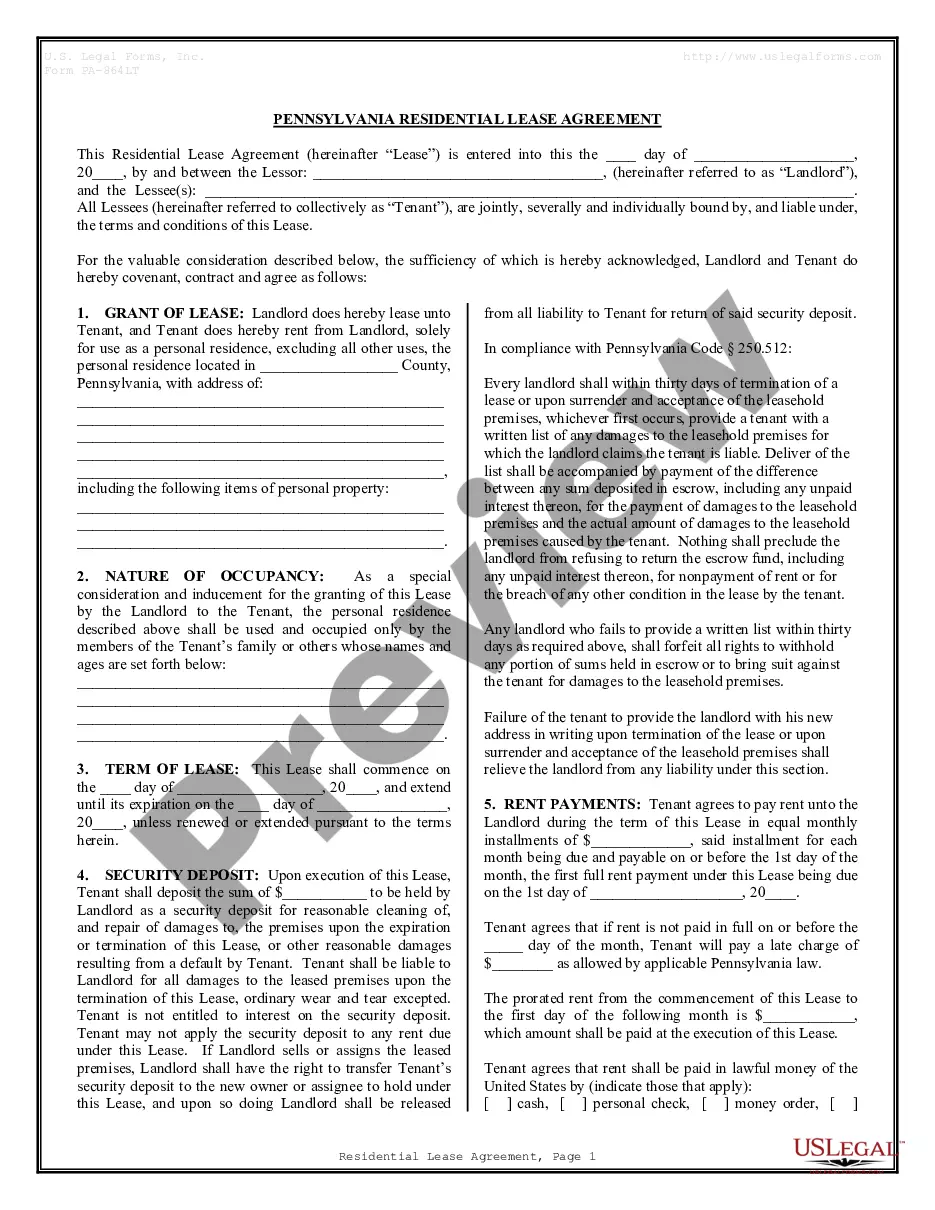
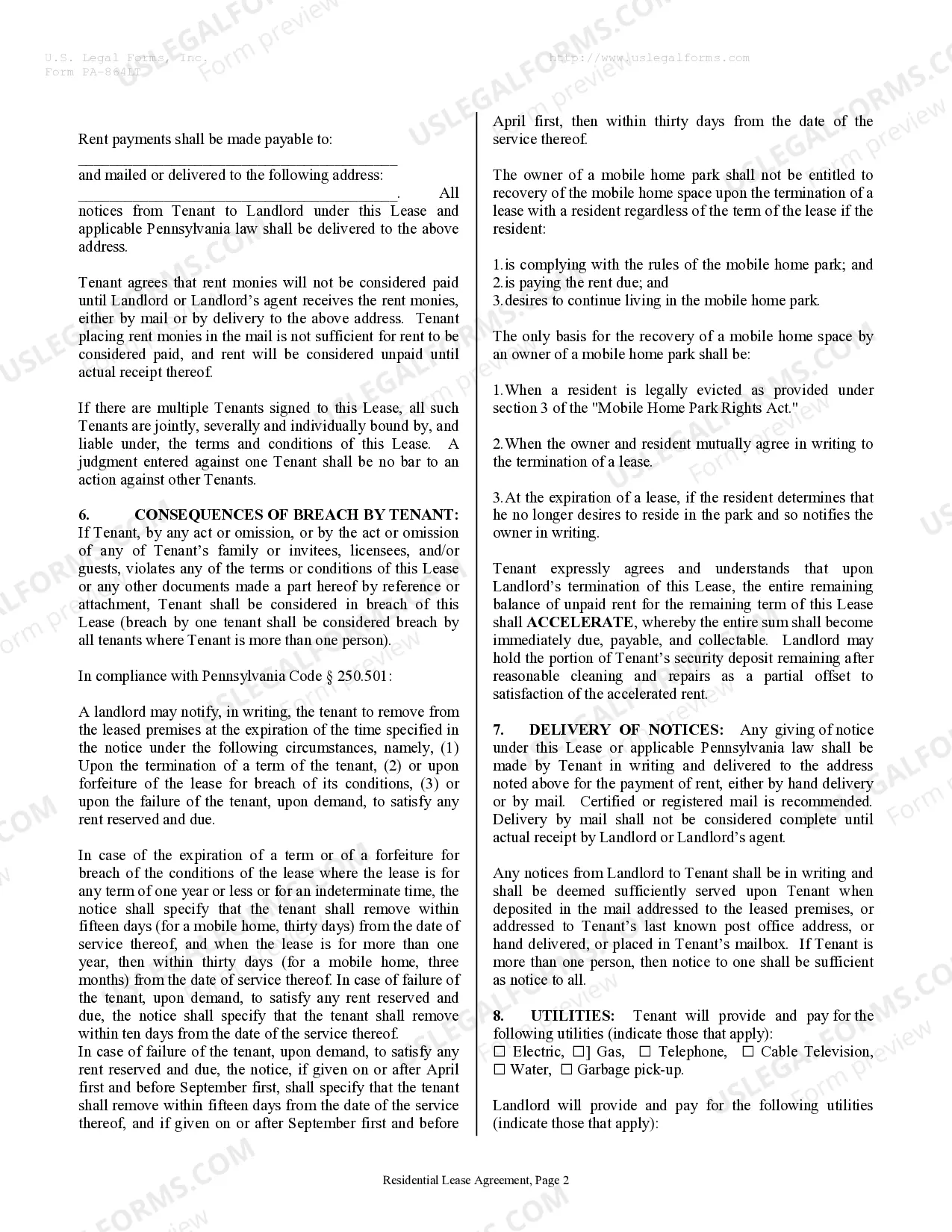
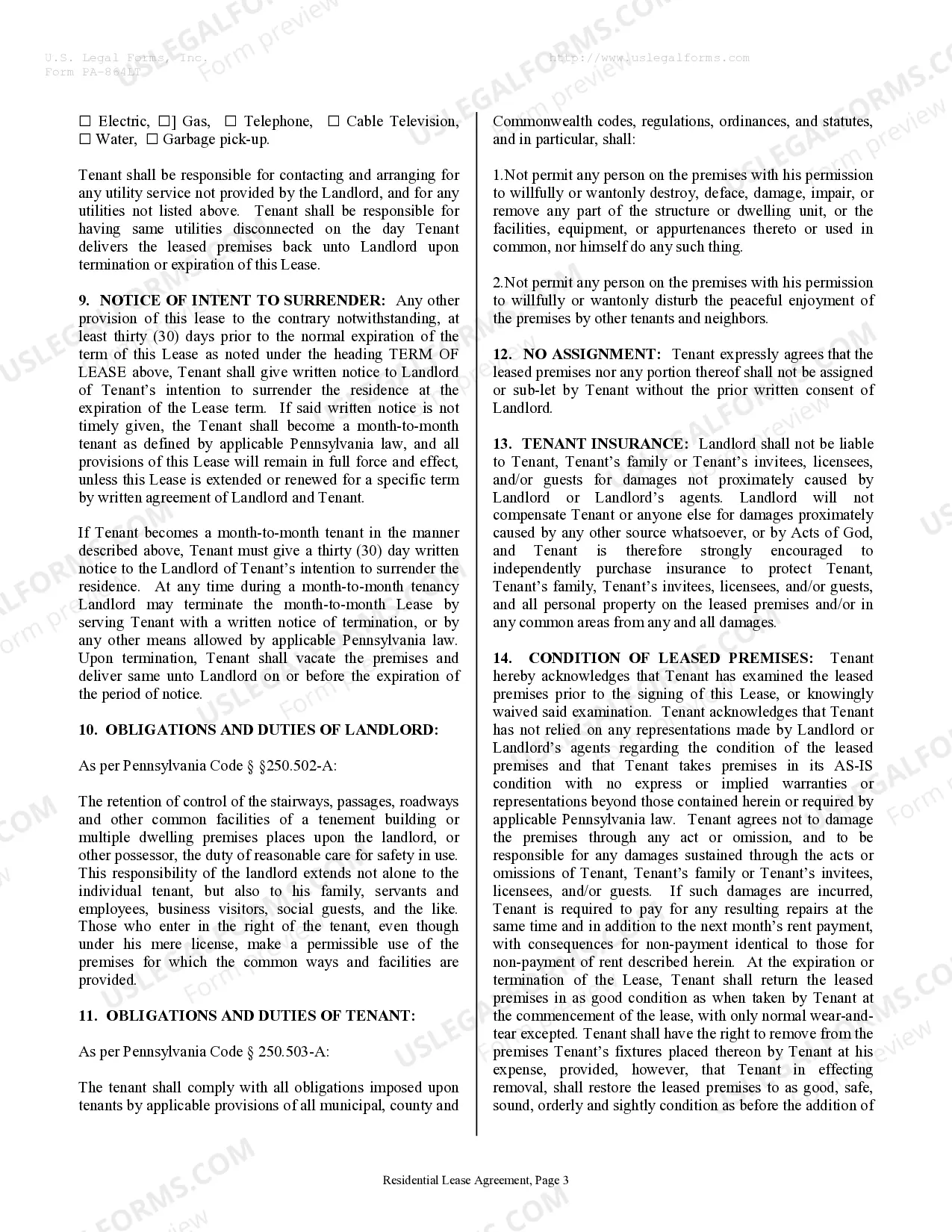
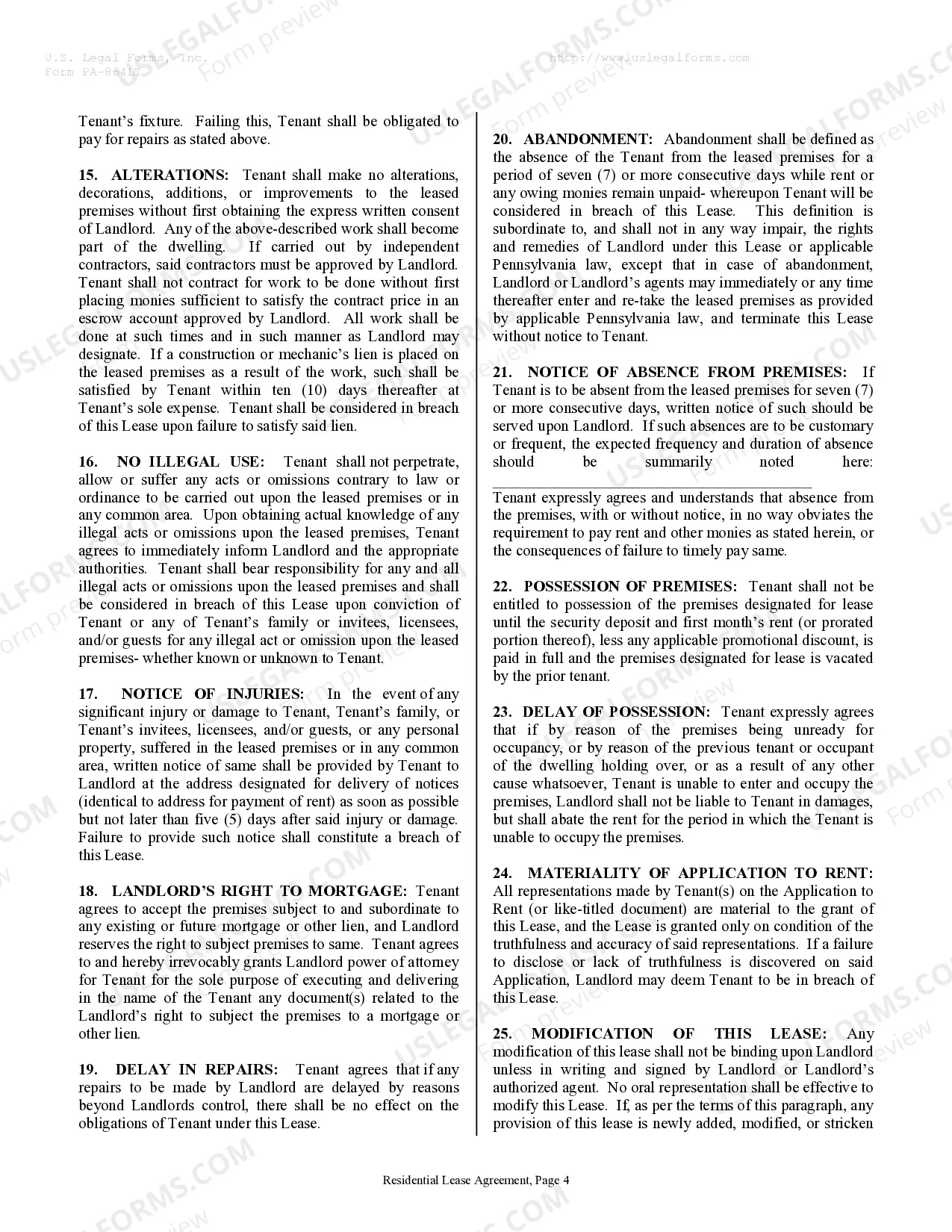
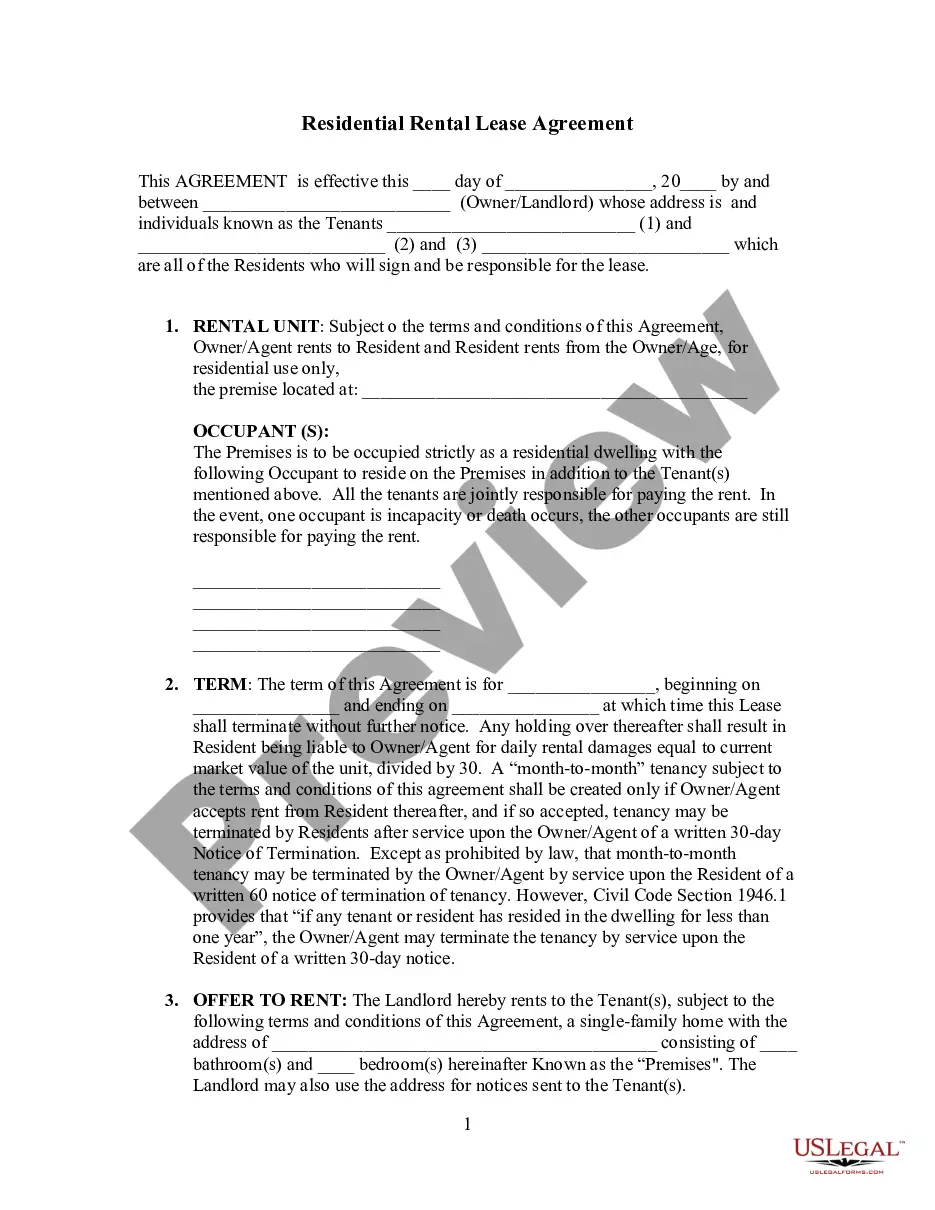
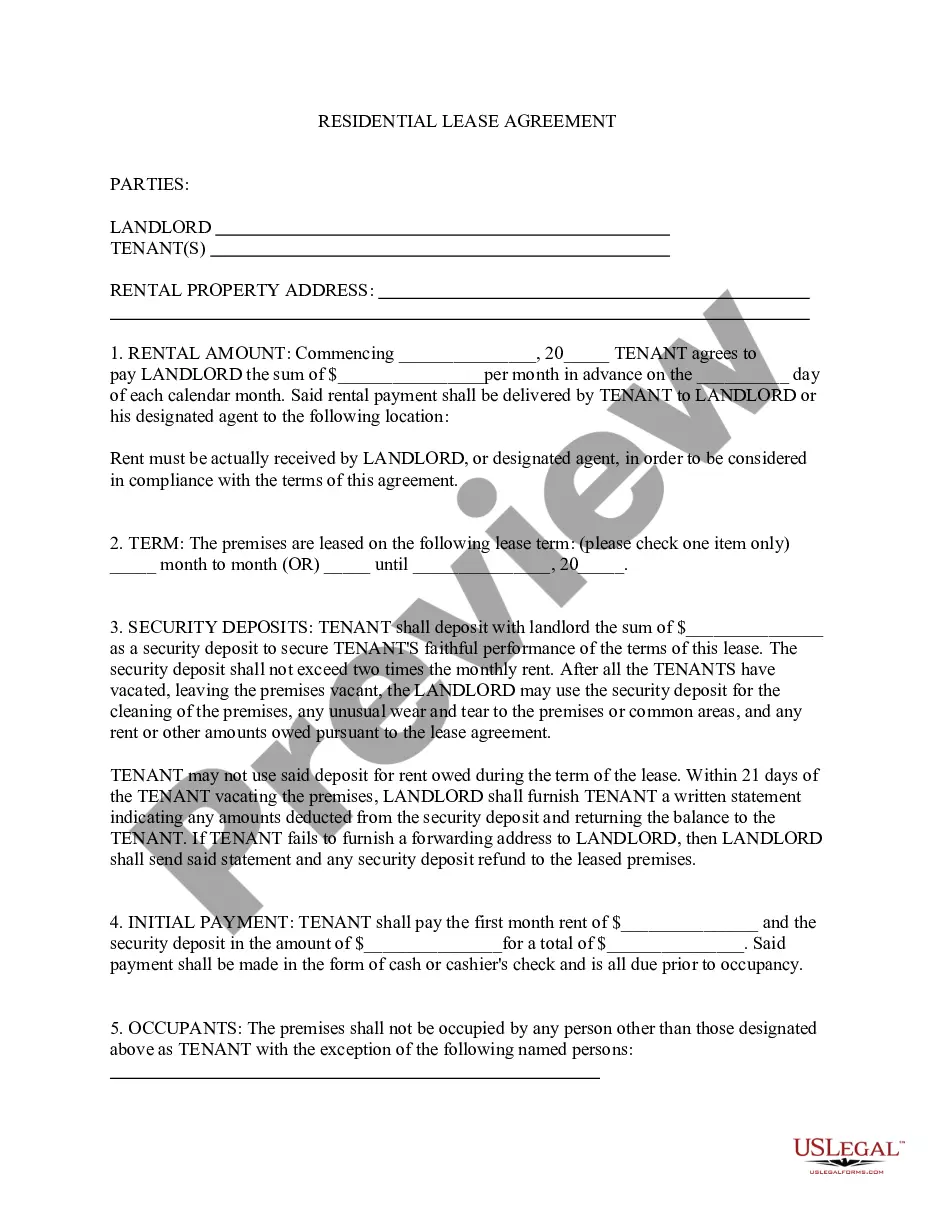
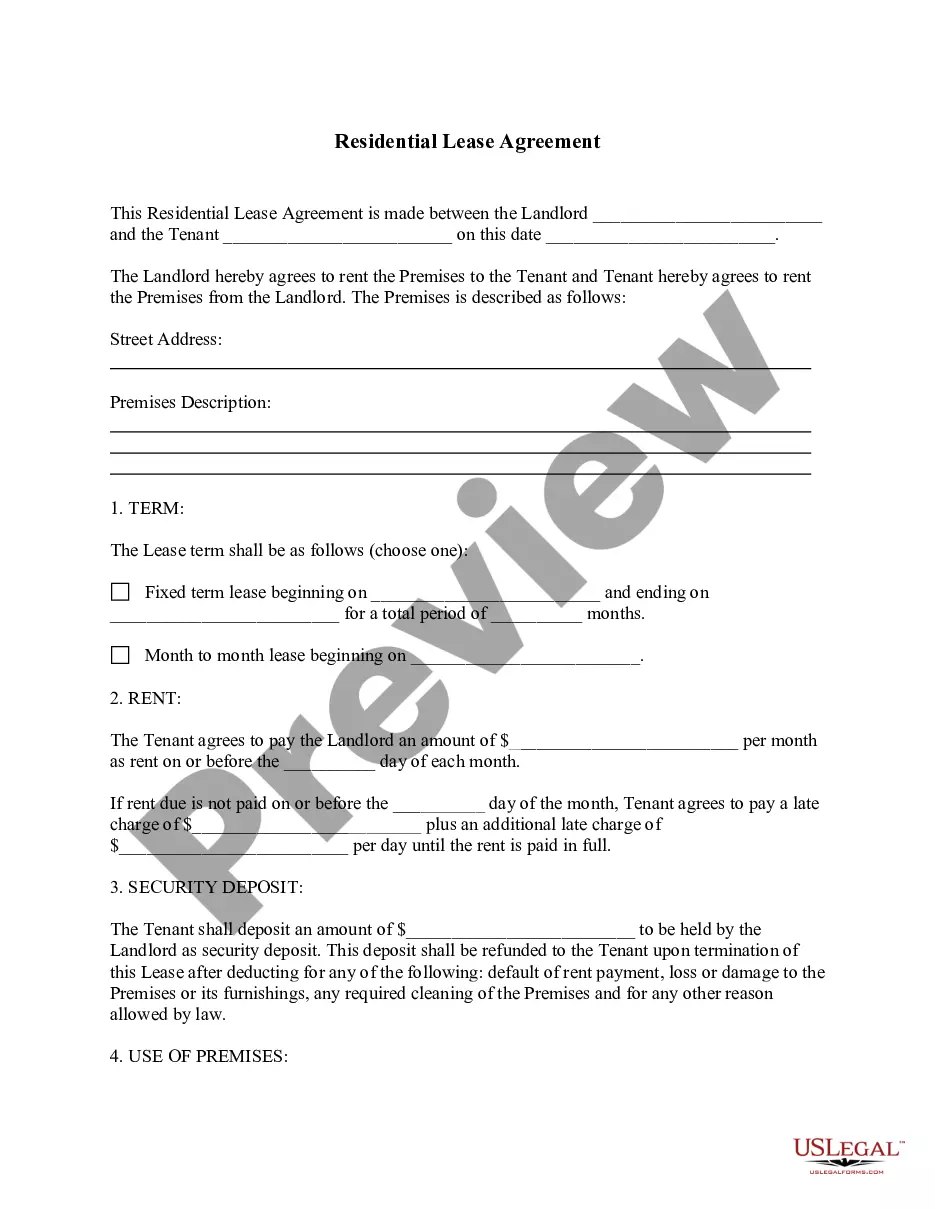
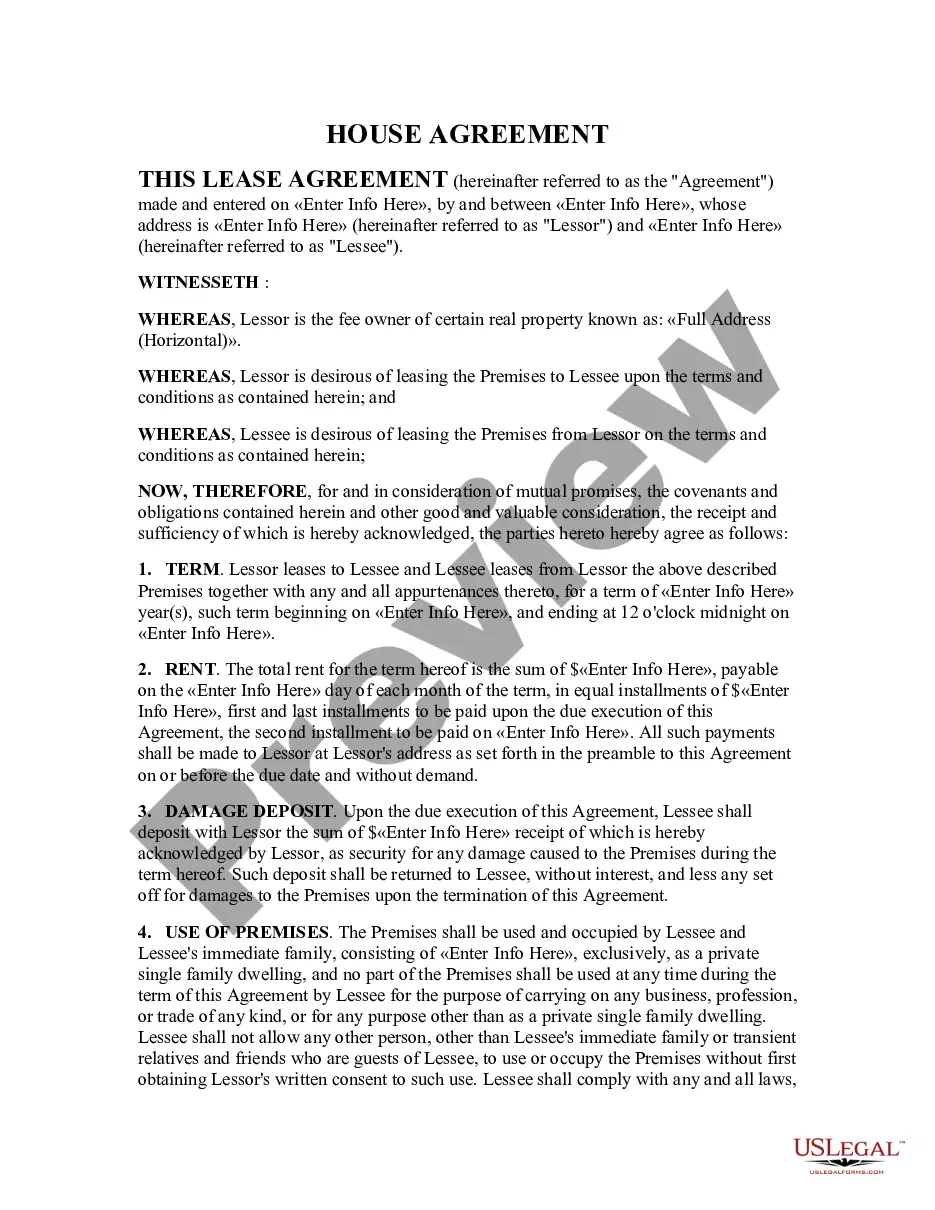
Residential Rental Lease Agreement
Unconsolidated Pennsylvania Statutes
REAL AND PERSONAL PROPERTY (TITLE 68)
CHAPTER 8 LANDLORD AND TENANT
LANDLORD AND TENANT ACT OF 1951
ARTICLE I. PRELIMINARY PROVISIONS
Short title:
This act shall be known and may be cited as "The Landlord and Tenant Act of 1951." § 250.101.
Definitions:
As used in this act- "Abandoned mobile
home" means the vacating of a mobile home by a resident without notice
to the community, together with the nonpayment of required rent, fees,
service charges and assessments and one or more of the following:
1. The removal of most or all personal property from the mobile
home.
2. Failure to use, maintain or return to the mobile home.
3. Cancellation of insurance covering the mobile home.
4. Termination of utility services to the mobile home.
"Justice of the peace" means district justices, aldermen, magistrates
or any other court having jurisdiction over landlord and tenant matters,
excluding a court of common pleas.
"Mobile home park" means any site, lot, field or tract of land,
privately or publicly owned or operated, upon which three or more mobile
homes occupied for dwelling or sleeping purposes are or are intended to
be located, regardless of whether or not a charge is made for such accommodation.
"Mobile home resident" or "resident" means an owner of a mobile
home who leases or rents space in a mobile home park. The term does not
include a person who rents or leases a mobile home.
"Mobile home space" means a plot of ground within a mobile home
park designed for the accommodation of one mobile home.
"Person" means natural persons, copartnerships, associations, private
and public corporations, authorities, fiduciaries, the United States and
any other country and their respective governmental agencies, this Commonwealth
and any other state and their respective political subdivisions and agencies.
"Personal property" means goods and chattels, including fixtures
and buildings erected by the tenant and which he has the right to remove,
agricultural crops, whether harvested or growing, and livestock and poultry.
"Real property" means messuages, lands, tenements, real estate,
buildings, parts thereof or any estate or interest therein and shall include
any personalty on real property which is demised with the real property.
"Tenants' organization or association" means a group of tenants
organized for any purpose directly related to their rights or duties as
tenants. § 250.102.
Rights of persons acquiring title by descent or purchase:
Any person who acquires title to real property by descent or purchase
shall be liable to the same duties and shall have the same rights, powers
and remedies in relation to the property as the person from whom title
was acquired. § 250.104.
Subleases:
Any person who is a sublessee shall be subject
to the provisions of the lease between the lessor and the lessee.
§ 250.105.
ARTICLE II
CREATION OF LEASES; STATUTE OF FRAUDS; MORTGAGING OF LEASEHOLDS
Leases for not more than three years:
Real property, including any personal property thereon, may be leased for a term of not
more than three years by a landlord or his agent to a tenant or his agent,
by oral or written contract or agreement. § 250.201.
Leases for more than three years:
Real property, including any personal property thereon, may be leased for a term of more than three
years by a landlord to a tenant or by their respective agents lawfully
authorized in writing.
Any such lease must be in writing and signed by the parties making
or creating the same, otherwise it shall have the force and effect of a
lease at will only and shall not be given any greater force or effect either
in law or equity, notwithstanding any consideration therefor,
unless the tenancy has continued for more than one year and the landlord
and tenant have recognized its rightful existence by claiming and admitting
liability for the rent, in which case the tenancy shall become one from
year to year. § 250.202.
Assignment, grant and surrender of leases to be in writing; exception:
No lease of any real property made or created for a term of more than three
years shall be assigned, granted or surrendered except in writing signed
by the party assigning, granting or surrendering the same or his agent,
unless such assigning, granting or surrendering shall result from operation
of law. § 250.203.
Participation in Tenants Association:
No individual unit lease on residential property shall be terminated or nonrenewed on
the basis of the participation of any tenant or member of the tenant's
family in a tenants' organization or association. § 250.205.
Statement of Escrowed Funds:
Whenever an agency or department certifies that a dwelling is uninhabitable and a tenant elects
to pay rent into an escrow account established under the act of January
24, 1966 (1965 P.L. 1534, No. 536; 35 P.S. § 1700-1), referred to
as the City Rent Withholding Act, it shall be the duty of the certifying
agency or department to submit a monthly statement of escrowed funds to
the landlord affected by first class mail. § 250.206.
ARTICLE III
RECOVERY OF RENT BY ASSUMPSIT AND DISTRESS
Recovery of rent by assumpsit:
Any landlord may recover from a tenant rent in arrears in an action of assumpsit as debts of similar
amount are by law recoverable. In any such action, interest at the legal
rate on the amount of rent due may be allowed if deemed equitable under
the circumstances of the particular case. Section 250.301.
ARTICLE V. RECOVERY OF POSSESSION
Notice to Quit:
(a) A landlord desirous of repossesing real property from a tenant
except real property which is a mobile home space as defined in the act
of November 24, 1976 (P.L. 1176, No. 261), known as the "Mobile Home Park
Rights Act," may notify, in writing, the tenant to remove from the same
at the expiration of the time specified in the notice under the following
circumstances, namely, (1) Upon the termination of a term of the tenant,
(2) or upon forfeiture of the lease for breach of its conditions, (3) or
upon the failure of the tenant, upon demand, to satisfy any rent reserved
and due.
(b) Except as provided for in subsection (c), in case of the expiration
of a term or of a forfeiture for breach of the conditions of the lease
where the lease is for any term of one year or less or for an indeterminate
time, the notice shall specify that the tenant shall remove within fifteen
days from the date of service thereof, and when the lease is for more than
one year, then within thirty days from the date of service thereof. In
case of failure of the tenant, upon demand, to satisfy any rent reserved
and due, the notice shall specify that the tenant shall remove within ten
days from the date of the service thereof.
(c) In case of the expiration of a term or of a forfeiture for breach
of the conditions of the lease involving a tenant of a mobile home park
as defined in the "Mobile Home Park Rights Act," where the lease is for
any term of less than one year or for an indeterminate time, the notice
shall specify that the tenant shall remove within thirty days from the
date of service thereof, and when the lease is for one year or more, then
within three months from the date of service thereof. In case of failure
of the tenant, upon demand, to satisfy any rent reserved and due, the notice,
if given on or after April first and before September first, shall specify
that the tenant shall remove within fifteen days from the date of the service
thereof, and if given on or after September first and before April first,
then within thirty days from the date of the service thereof.
(c.1) The owner of a mobile home park shall not be entitled to recovery
of the mobile home space upon the termination of a lease with a resident
regardless of the term of the lease if the resident:
(c.2) The only basis for the recovery of a mobile home space by
an owner of a mobile home park shall be:
1. When a resident is legally evicted as provided under section 3
of the "Mobile Home Park Rights Act."
3. At the expiration of a lease, if the resident determines that
he no longer desires to reside in the park and so notifies the owner in
writing.
(d) In case of termination due to the provisions of section 505-A,
the notice shall specify that the tenant shall remove within ten days from
the date of service thereof.
(e) The notice above provided for may be for a lesser time or may
be waived by the tenant if the lease so provides.
(f) The notice above provided for may be served personally on the
tenant, or by leaving the same at the principal building upon the premises,
or by posting the same conspicuously on the leased premises. Section
250.501.
Summons and Service:
(a) Upon the filing of the complaint, the justice of the peace
shall issue a summons which recites substantially the complaint, is directed
to any writ server, constable or the sheriff of the county and commands
that writ server, constable or sheriff to summon the tenant to appear before
the justice of the peace to answer the complaint on a date not less than
seven nor more than ten days from the date of the summons.
(b) The summons may be served personally on the tenant, by mail
or by posting the summons conspicuously on the leased premises. Section
250.502.
HEARING; JUDGMENT; WRIT OF POSSESSION; PAYMENT OF RENT BY TENANT:
(a) On the day and at the time appointed or on a day to which the
case may be adjourned, the justice of the peace shall proceed to hear the
case. If it appears that the complaint has been sufficiently proven, the
justice of the peace shall enter judgment against the tenant:
2. for damages, if any, for the unjust detention of the demised
premises; and
3. for the amount of rent, if any, which remains due and unpaid.
(b) At the request of the landlord, the justice of the peace shall,
after the fifth day after the rendition of the judgment, issue a writ of
possession directed to the writ server, constable or sheriff, commanding
him to deliver forthwith actual possession of the real property to the
landlord and to levy the costs and amount of judgment for damages and rent,
if any, on the tenant, in the same manner as judgments and costs are levied
and collected on writs of execution. This writ is to be served within no
later than forty-eight hours and executed on the eleventh day following
service upon the tenant of the leased premises. Service of the writ of
possession shall be served personally on the tenant by personal service
or by posting the writ conspicuously on the leased premises.
(c) At any time before any writ of possession is actually executed,
the tenant may, in any case for the recovery of possession solely because
of failure to pay rent due, supersede and render the writ of no effect
by paying to the writ server, constable or sheriff the rent actually in
arrears and the costs. § 250.503.
RETURN BY CONSTABLE OR SHERIFF:
The writ server, constable or sheriff shall make return of the writ of possession to the justice of
the peace within ten days after receiving the writ. The return shall show:
(1) the date, time, place and manner of service of the writ;
(2) if the writ was satisfied by the payment of rent due or in
arrears and costs by or on behalf of the tenant, the amount of that payment
and its distribution;
(3) the time and date of any forcible entry and ejectment, or that
no entry for the purpose of ejectment had been made; and
(4) his expenses and fees, which expenses and fees shall have been
paid by the tenant or, if paid by the landlord, reimbursed to the landlord
by the tenant in order to satisfy the writ. § 250.504.
Abandoned Mobile Homes:
(a) If a mobile home is abandoned by its residents for a period
of thirty days or more, the owner of the mobile home park or other person
or persons responsible for operation of the park may:
1. Enter the mobile home and secure any appliances, furnishings,
materials, supplies or other personal property therein and disconnect the
mobile home from any utilities.
2. Move the mobile home to a storage area within the mobile home
park or to another location deemed necessary and proper without the requirement
of obtaining a removal permit from the local taxing authority which would
otherwise be required under section 407(e) of the act of May 22, 1933 (P.L.
853, No. 155), known as "The General County Assessment Law," or section
617.1 of the act of May 21, 1943 (P.L. 571, No. 254), known as "The Fourth
to Eighth Class County Assessment Law." The mobile home shall continue
to be subject to the lien for taxes assessed against it, but the real estate
on which the home was and is located shall not be encumbered by the lien.
The former mobile home residents shall be notified by mail and by posting
on the home and at any other known address, or by any other means by which
notice may be achieved, that the mobile home has been moved and of the
new location of the mobile home.
(b) A person or persons acting as authorized under subsection (a)
are not responsible for any loss or damage to a home or its contents or
for any taxes, fees, assessments or other charges of any kind relating
to the abandoned mobile home unless it is proven that the home removed
was not an abandoned home, in which case the community owner and his agent
shall be liable for the loss incurred by the homeowner. § 250.505.
Remedy to recover possession by ejectment preserved:
Nothing contained in this article shall be construed as abolishing
the right of any landlord to recover possession of any real property from
a tenant by action of ejectment, or from instituting any amicable action
of ejectment to recover possession of any real property by confessing judgment
in accordance with the terms of any written contract or agreement.
§ 250.511.
Escrow Funds Limited:
(a) No landlord may require a sum in excess of two months' rent
to be deposited in escrow for the payment of damages to the leasehold premises
and/or default in rent thereof during the first year of any lease.
(b) During the second and subsequent years of the lease or
during any renewal of the original lease the amount required to be deposited
may not exceed one month's rent.
(c) If, during the third or subsequent year of a lease, or during
any renewal after the expiration of two years of tenancy, the landlord
requires the one month's rent escrow provided herein, upon termination
of the lease, or on surrender and acceptance of the leasehold premises,
the escrow funds together with interest shall be returned to the tenant in
accordance with sections 511.2 and 512.
(d) Whenever a tenant has been in possession of premises for a
period of five years or greater, any increase or increases in rent shall
not require a concomitant increase in any security deposit.
(e) This section applies only to the rental of residential property.
(f) Any attempted waiver of this section by a tenant by contract
or otherwise shall be void and unenforceable. § 250.511a.
Interest On Escrow Funds Held More Than Two Years:
(a) Except as otherwise provided in this section, all funds over
one hundred dollars ($100) deposited with a lessor to secure the execution
of a rental agreement on residential property in accordance with section
511.1 and pursuant to any lease newly executed or reexecuted after the
effective date of this act shall be deposited in an escrow account of an
institution regulated by the Federal Reserve Board, the Federal Home Loan
Bank Board, Comptroller of the Currency, or the Pennsylvania Department
of Banking. When any funds are deposited in any escrow account, interest-bearing
or noninterest-bearing, the lessor shall thereupon notify in writing each
of the tenants making any such deposit, giving the name and address of
the banking institution in which such deposits are held, and the amount of such deposits.
(b) Whenever any money is required to be deposited in an interest-bearing
escrow savings account, in accordance with section 511.1, then the lessor
shall be entitled to receive as administrative expenses, a sum equivalent
to one per cent per annum upon the security money so deposited, which shall
be in lieu of all other administrative and custodial expenses. The balance
of the interest paid shall be the money of the tenant making the deposit
and will be paid to said tenant annually upon the anniversary date of the
commencement of his lease.
(c) The provisions of this section shall apply only after the second
anniversary of the deposit of escrow funds. § 250.511b.
Bond In Lieu Of Escrowing:
Every landlord subject to the provisions of this act may, in lieu
of depositing escrow funds, guarantee that any escrow funds, less cost
of necessary repairs, including interest thereon, shall be returned to
the tenant upon termination of the lease, or on surrender and acceptance
of the leasehold premises. The guarantee of repayment of said escrow funds
shall be secured by a good and sufficient guarantee bond issued by a bonding
company authorized to do business in Pennsylvania. § 250.511c.
RECOVERY OF IMPROPERLY HELD ESCROW FUNDS:
(a) Every landlord shall within thirty days of termination of a
lease or upon surrender and acceptance of the leasehold premises, whichever
first occurs, provide a tenant with a written list of any damages to the
leasehold premises for which the landlord claims the tenant is liable.
Delivery of the list shall be accompanied by payment of the difference between
any sum deposited in escrow, including any unpaid interest thereon, for
the payment of damages to the leasehold premises and the actual amount
of damages to the leasehold premises caused by the tenant.
Nothing in this section shall preclude the landlord from refusing
to return the escrow fund, including any unpaid interest thereon, for nonpayment
of rent or for the breach of any other condition in the lease by the tenant.
(b) Any landlord who fails to provide a written list within thirty
days as required in subsection (a), above, shall forfeit all rights to
withhold any portion of sums held in escrow, including any unpaid interest
thereon, or to bring suit against the tenant for damages to the leasehold
premises.
(c) If the landlord fails to pay the tenant the difference between
the sum deposited, including any unpaid interest thereon, and the actual
damages to the leasehold premises caused by the tenant within thirty days
after termination of the lease or surrender and acceptance of the leasehold
premises, the landlord shall be liable in assumpsit to double the amount
by which the sum deposited in escrow, including any unpaid interest thereon,
exceeds the actual damages to the leasehold premises caused by the tenant
as determined by any court of record or court not of record having jurisdiction
in civil actions at law. The burden of proof of actual damages caused by
the tenant to the leasehold premises shall be on the landlord.
(d) Any attempted waiver of this section by a tenant by contract
or otherwise shall be void and unenforceable.
(e) Failure of the tenant to provide the landlord with his new
address in writing upon termination of the lease or upon surrender and
acceptance of the leasehold premises shall relieve the landlord from any
liability under this section.
(f) This section shall apply only to residential leaseholds and
not to commercial leaseholds. § 250.512.
LANDLORD AND TENANT ACT OF 1951
APPEAL BY TENANT TO COMMON PLEAS COURT:
(a) Every tenant who files an appeal to a court of common pleas
of a judgment of the lower court involving an action under this act for
the recovery of possession of real property or for rent due shall deposit
with the prothonotary a sum equal to the amount of rent due as determined
by the lower court. This sum representing the rent due or in question shall
be placed in a special escrow account by the prothonotary. The prothonotary
shall only dispose of these funds by order of court.
(b) Within ten days after the rendition of judgment by a lower
court arising out of residential lease or within thirty days after a judgment
by a lower court arising out of a nonresidential lease or a residential
lease involving a victim of domestic violence, either party may appeal
to the court of common pleas, and the appeal by the tenant shall operate
as a supersedeas only if the tenant pays in cash or bond the amount of
any judgment rendered by the lower court or is a victim of domestic violence
and pays in cash any rent which becomes due during the court of common
pleas proceedings within ten days after the date each payment is due into
an escrow account with the prothonotary or the supersedeas shall be summarily
terminated.
(c) Upon application by the landlord, the court shall release appropriate
sums from the escrow account on a continuing basis while the appeal is
pending to compensate the landlord for the tenant's actual possession and
use of the premises during the pendency of the appeal.
(d) Upon application by the tenant, the court shall release appropriate
sums from the escrow account on a continuing basis while the appeal is
pending to directly compensate those providers of habitable services which
the landlord is required to provide under law or under the lease.
(e) As used in this section, the following words and phrases shall
have the meanings given to them in this subsection:
"Lower court." District justice, magistrate or any other court having
jurisdiction over landlord and tenant matters, excluding a court of common
pleas.
"Victim of domestic violence." A person who has obtained a
protection from abuse order against another individual or can provide other
suitable evidence as the court shall direct. § 250.513.
ARTICLE V-A
TENEMENT BUILDINGS AND MULTIPLE DWELLING PREMISES
Definitions: As used in this article, the following terms shall
have the meanings ascribed to them in this section
Unless the context otherwise indicates:
1."Tenement building" any house or building, or portion thereof,
which is intended or designed to be occupied or leased for occupation,
or actually occupied, as a home or residence for three or more households
living in separate apartments, and doing their cooking upon the premises.
2."Apartment" a room or suite of two or more rooms, occupied or
leased for occupation, or intended or designed to be occupied, as a domicile.
3."Multiple dwelling premises" any area occupied by dwelling units,
appurtenances thereto, grounds and facilities which dwelling units are
intended or designed to be occupied or leased for occupation, or actually
occupied, as individual homes or residences for three or more households.
"Multiple dwelling premises" shall include, inter alia, mobile home
parks. §250.501-A.
Landlord's duties:
The retention of control of the stairways, passages, roadways and other common facilities of a tenement
building or multiple dwelling premises places upon the landlord, or other
possessor, the duty of reasonable care for safety in use. This responsibility
of the landlord extends not alone to the individual tenant, but also to
his family, servants and employees, business visitors, social guests, and
the like. Those who enter in the right of the tenant, even though under
his mere license, make a permissible use of the premises for which the
common ways and facilities are provided. §250.502-A.
Tenants' duties:
The tenant shall comply with all obligations
imposed upon tenants by applicable provisions of all municipal, county
and Commonwealth codes, regulations, ordinances, and statutes, and in particular,
shall:
1. Not permit any person on the premises with his permission to
wilfully or wantonly destroy, deface, damage, impair, or remove any part
of the structure or dwelling unit, or the facilities, equipment, or appurtenances
thereto or used in common, nor himself do any such thing.
2. Not permit any person on the premises with his permission to
wilfully or wantonly disturb the peaceful enjoyment of the premises by
other tenants and neighbors. §250.503-A.
Tenants' rights:
The tenant shall have a right to invite to his apartment or dwelling
unit such employees, business visitors, tradesmen, deliverymen, suppliers
of goods and services, and the like as he wishes so long as his obligations
as a tenant under this article are observed. The tenant also shall have the
right to invite to his apartment or dwelling unit, for a reasonable period
of time, such social guest, family or visitors as he wishes so long as
his obligations as a tenant under this article are observed. These rights
may not be waived by any provisions of a written rental agreement and the
landlord and/or owner may not charge any fee, service charge or additional
rent to the tenant for exercising his rights under this act.
It is the intent of this article to insure that the landlord may
in no way restrict the tenant's right to purchase goods, services and the
like from a source of the tenant's choosing and as a consequence any provision
in a written agreement attempting to limit this right shall be void and
unenforceable in the courts of this Commonwealth. §250.504-A.
Use of illegal drugs:
(a) The following acts relating to illegal drugs shall be a breach
of condition of the lease and shall be grounds for removal of the tenant
from a single-family dwelling, apartment, multiple dwelling premises
or tenement building:
(1) The first conviction for an illegal sale, manufacture or distribution
of any drug in violation of the act of April 14, 1972 (P.L. 233, No. 64),
known as The Controlled Substance, Drug, Device and Cosmetic Act, on a
single-family dwelling or any portion of the multiple dwelling premises
or tenement;
(2) The second violation of any of the provisions of The Controlled
Substance, Drug, Device and Cosmetic Act on a single-family dwelling or
any portion of the multiple dwelling premises or tenement.
(3) The seizure by law enforcement officials of any illegal drugs
on the leased premises in the single-family dwelling or multiple dwelling
premises or tenement.
(b) Failure to remove any tenant for violation of any of the provisions
of subsection (a) shall not act as a waiver of the landlord's rights with
regard to the same or any other tenant relating to any subsequent acts.
§250.505-A.
ARTICLE V-B
TENANTS RIGHTS TO CABLE TELEVISION
Definitions:
As used in this article-
1. "CATV system" or "cable television system" shall include a system
or facility or part thereof which consists of a set of transmission paths
and associated signal generation, reception, amplification and control
equipment which is operated or intended to be operated to perform the service
of receiving and amplifying and distributing and redistributing signals
broadcast or transmitted by one or more television or radio stations or
information distribution service companies, including, but not limited
to, the cable communications system owner, operator or manager itself,
to subscribers. The term shall include the service of distributing any
video, audio, digital, light or audio-video signals whether broadcast or
otherwise.
2. "Holding a franchise" shall include obtaining municipal consent
to or approval of the construction or operation of a CATV system and the
rendering of CATV services whether granted by resolution, ordinance or
written agreement. The term shall include a person who has constructed
and is operating a CATV system within the public right-of-way of a municipality
which, at the time of construction and initial operation of such CATV system,
did not require that municipal consent be obtained.
3. "Landlord" shall include an individual or entity owning, controlling,
leasing, operating or managing multiple dwelling premises.
4. "Multiple dwelling premises" shall include any area occupied
by dwelling units, appurtenances thereto, grounds and facilities, which
dwelling units are intended or designed to be occupied or leased for occupation,
or actually occupied, as individual homes or residences for three or more
households. The term shall include mobile home parks.
5. "Operator" shall include the operator of a CATV system holding
a franchise granted by the municipality or municipalities in which the
multiple dwelling premises to be served is located. §250.501-B.
Tenants protected:
A landlord may not discriminate in rental or other charges between
tenants who subscribe to the services of a CATV system and those who do
not. The landlord may, however, require reasonable compensation in exchange
for a permanent taking of his property resulting from the installation
of CATV system facilities within and upon his multiple dwelling premises,
to be paid by an operator. The compensation shall be determined in accordance
with this article. §250.502-B.
Tenants' rights:
The tenant has the right to request and receive CATV services from
an operator or a landlord provided that there has been an agreement between
a landlord and an operator through the negotiation process outlined in section
504-B or through a ruling of an arbitrator as provided for in this article.
A landlord may not prohibit or otherwise prevent a tenant from requesting
or acquiring CATV services from an operator of the tenant's choice provided
that there has been an agreement between a landlord and an operator through
the negotiation process outlined in section 504-B or through a ruling of
an arbitrator as provided for in this article. A landlord may not prevent
an operator from entering such premises for the purposes of constructing,
reconstructing, installing, servicing or repairing CATV system facilities
or maintaining CATV services if a tenant of a multiple dwelling premises
has requested such CATV services and if the operator complies with this
article. The operator shall retain ownership of all wiring and equipment
used in any installation or upgrade of a CATV system in multiple dwelling
premises. An operator shall not provide CATV service to an individual dwelling
unit unless permission has been given by or received from the tenant occupying
the unit. §250.503-B.
Right to render services; notices:
If a tenant of a multiple dwelling premises requests an operator
to provide CATV services and if the operator decides that it will provide
such services, the operator shall so notify the landlord in writing within
ten days after the operator decides to provide such service. If the operator
fails to provide such notice, then the tenant's request shall be terminated.
If the operator agrees to provide said CATV services, then a forty-five
day period of negotiation between the landlord and the operator shall be
commenced. This original notice shall state as follows: "The landlord,
tenants and operators have rights granted under Article V-B of the act
of April 6, 1951 (P.L. 69, No. 20), known as 'The Landlord and Tenant Act
of 1951.'" The original notice shall be accompanied by a proposal outlining
the nature of the work to be performed and including an offer of compensation
for loss in value of property given in exchange for the permanent installation
of CATV system facilities. The proposal also shall include a statement
that the operator is liable to the landlord for any physical damage, shall
set forth the means by which the operator will comply with the installation
requirements of the landlord pursuant to section 505-B and shall state
the time period for installation and security to be provided. The landlord
may waive his right to security at any time in the negotiation process.
During the forty-five day period, the landlord and the operator
will attempt to reach an agreement concerning the terms upon which CATV
services shall be provided. If, within the forty-five day period or at
any time thereafter, the proposal results in an agreement between the landlord
and the operator, CATV services shall be provided in accordance with the
agreement. If, at the end of the forty-five day period, the proposal does
not result in an agreement between the landlord and the operator, then
this article shall apply. The right of a tenant to receive CATV service
from an operator of his choice may not be delayed beyond the forty-five
day period contained in the original notice or otherwise impaired unless
the matter proceeds to arbitration or court as provided in this article.
An operator may bring a civil action to enforce the right of CATV services
installation given under this article. §250.504-B.
Compensation for physical damage:
An operator shall be liable to the landlord for any physical damage
caused by the installation, operation or removal of CATV system facilities.
A landlord may require that the installation of cable television facilities
conform to such reasonable conditions as are necessary to protect the safety,
functioning and appearance of the premises and the convenience and well-being
of tenants. A landlord may also require that the installation of cable
television facilities conforms to reasonable requirements as to the location
of main cable connections to the premises, the routing of cable lines through
the premises and the overall appearance of the finished installation. To
the extent possible, the location of the entry of a main cable connection
to the premises of public utility connections. A second or subsequent installation of cable
television facilities, if any, shall conform to such reasonable requirements
in such a way as to minimize further physical intrusion to or through the
premises. §250.505-B.
Compensation for loss of value:
(a) A landlord shall be entitled to just compensation from the
operator resulting from loss in value of property resulting from the permanent
installation of CATV system facilities on the premises.
(b) If a landlord believes that the loss in value of the property
exceeds the compensation contained in the proposal accompanying the original
notice or believes that the terms involving the work to be performed contained
in the proposal are unreasonable, or both, the issue of just compensation
or reasonableness of terms shall be determined in accordance with the following
procedure:
1. At any time prior to the end of the forty-five day period from
the date when the landlord receives the original notice that the operator
intends to construct or install a CATV system facility in multiple dwelling
premises, the landlord shall serve upon the operator written notice that
the landlord demands a greater amount of compensation or believes that
the terms involving the work to be performed are unreasonable.
2. If the operator is dissatisfied with the result of the negotiations
at the conclusion of the forty-five day negotiation period, then he shall
notify the landlord of the terms which the operator believes to be unreasonable
and shall accompany this notice with a formal request for arbitration.
3. Arbitration proceedings shall be conducted in accordance with
the procedures of the American Arbitration Association or any successor
thereto. The proceedings shall be held in the county in which the multiple
dwelling premises or part thereof are located.
Requirements of this act relating to time, presumptions and compensation
for loss of value shall apply in the proceedings. The cost of the proceedings
shall be shared equally by the landlord and the operator. The arbitration
proceedings, once commenced, shall be concluded and a written decision
by the arbitrator shall be rendered within fourteen days of commencement.
Judgment upon any award may be entered in any court having jurisdiction.
4. Within thirty days of the date of the notice of the decision
of the arbitrators, either party may appeal the decision of the arbitrators
in a court of common pleas, regarding the amount awarded as compensation
for loss of value or for physical damages to the property. During the pendency
of an appeal, the operator may not enter the multiple dwelling premises
to provide CATV services, except as to those units that have existing CATV
services. The court shall order each party to pay one-half of the arbitration
costs.
(c) In determining reasonable compensation, evidence that a landlord
has a specific alternative use for the space occupied or to be occupied
by CATV system facilities, the loss of which will result in a monetary
loss to the owner, or that installation of CATV system facilities upon
such multiple dwelling premises will otherwise substantially interfere
with the use and occupancy of such premises to an extent which causes a
decrease in the resale or rental value thereof shall be considered. In
determining the damages to any landlord in an action under this section,
compensation shall be measured by the loss in value of the landlord's property.
An amount representing increase in value of the property occurring by reason
of the installation of CATV system facilities shall be deducted from the
compensation.
(d) The time periods set forth in this section may be extended
by mutual agreement between the landlord and the operator. §250.506-B.
Venue:
The court of common pleas of the county in which the
multiple dwelling premises or part thereof is located shall have venue
of all actions to enforce the provisions of this article or to hear any
appeal from the award of arbitrators or any dispute between the parties.
§250.507-B.
Alternative service:
Nothing in this act shall preclude a landlord from offering alternative
CATV services to tenants provided that the provisions of this article are
not violated. §250.508-B.
Compliance with requirements for historical buildings:
The operator shall comply with all Federal, State or local statutes,
rules, regulations or ordinances with respect to buildings located in historical
districts. §250.509-B.
Existing CATV services protected:
CATV services being provided to tenants in multiple dwelling premises on the effective date of this
act may not be prohibited or otherwise prevented so long as the tenant
in an individual dwelling unit continues to request such services.
§250.510-B.