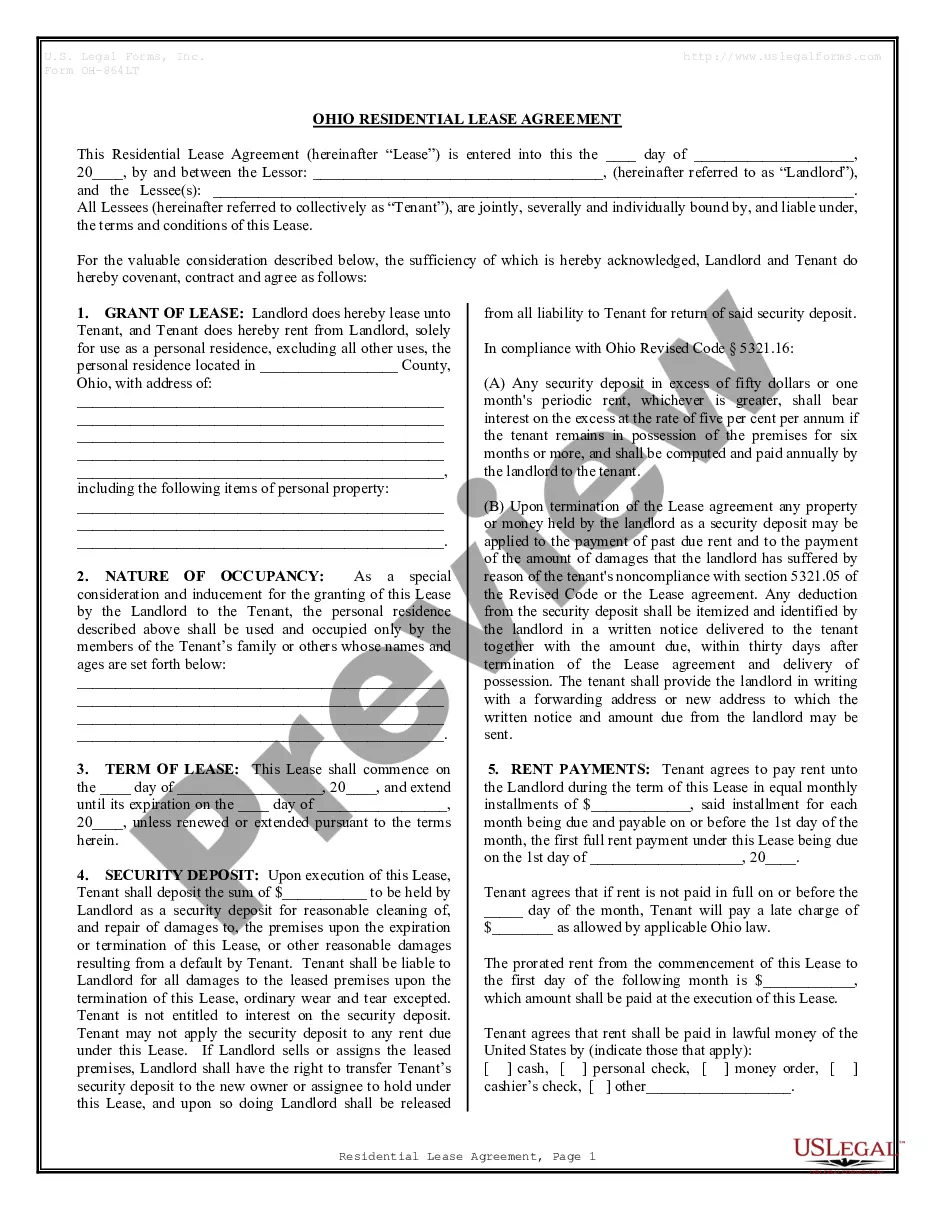
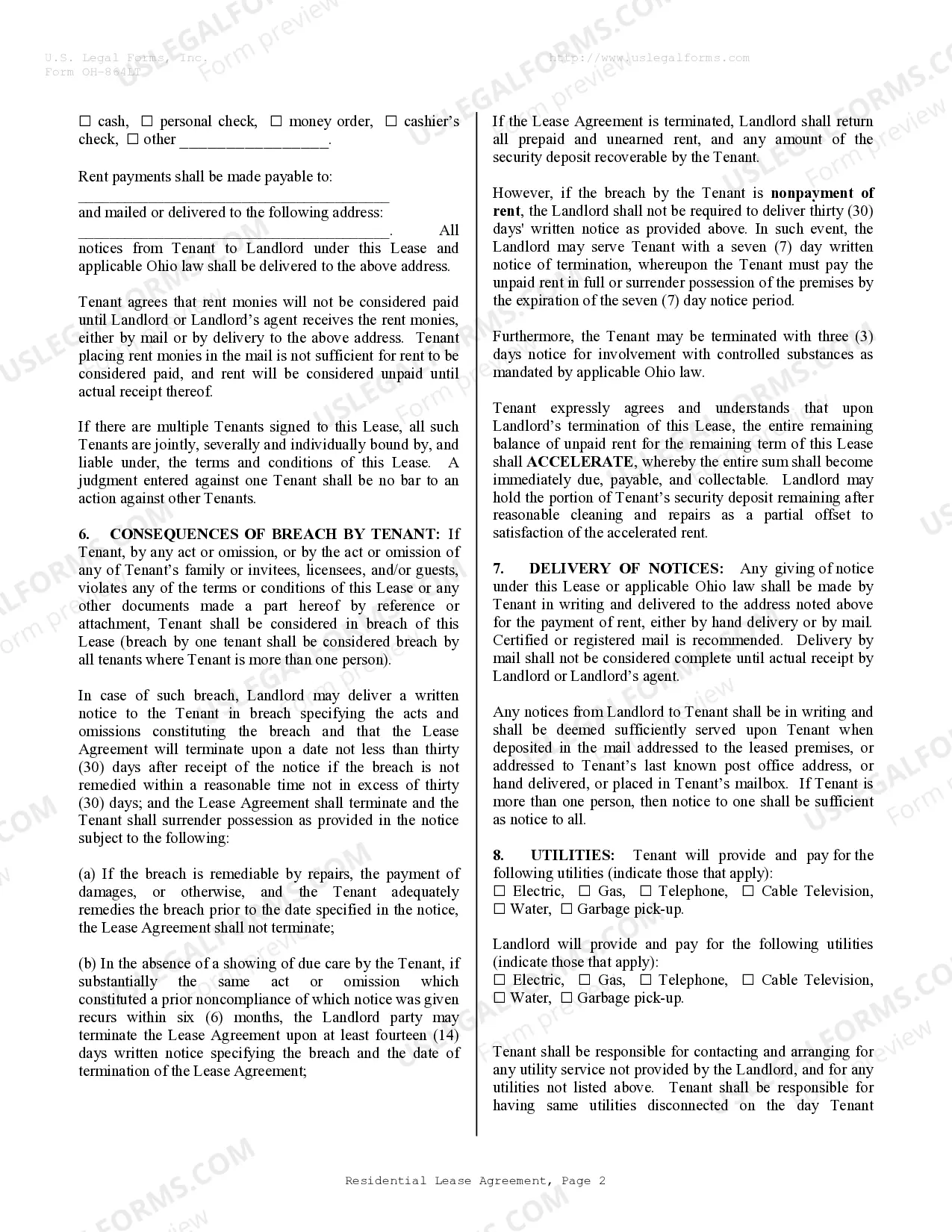
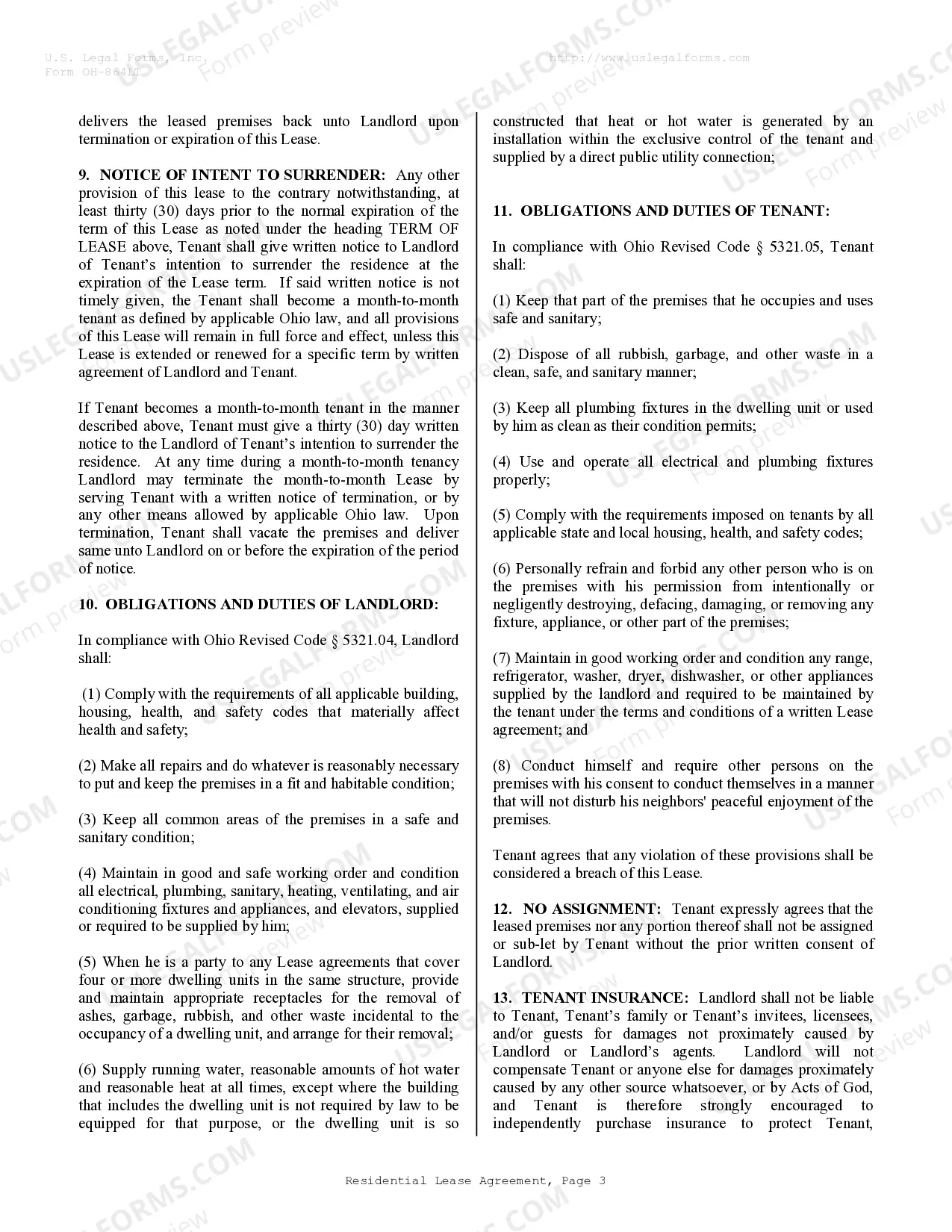
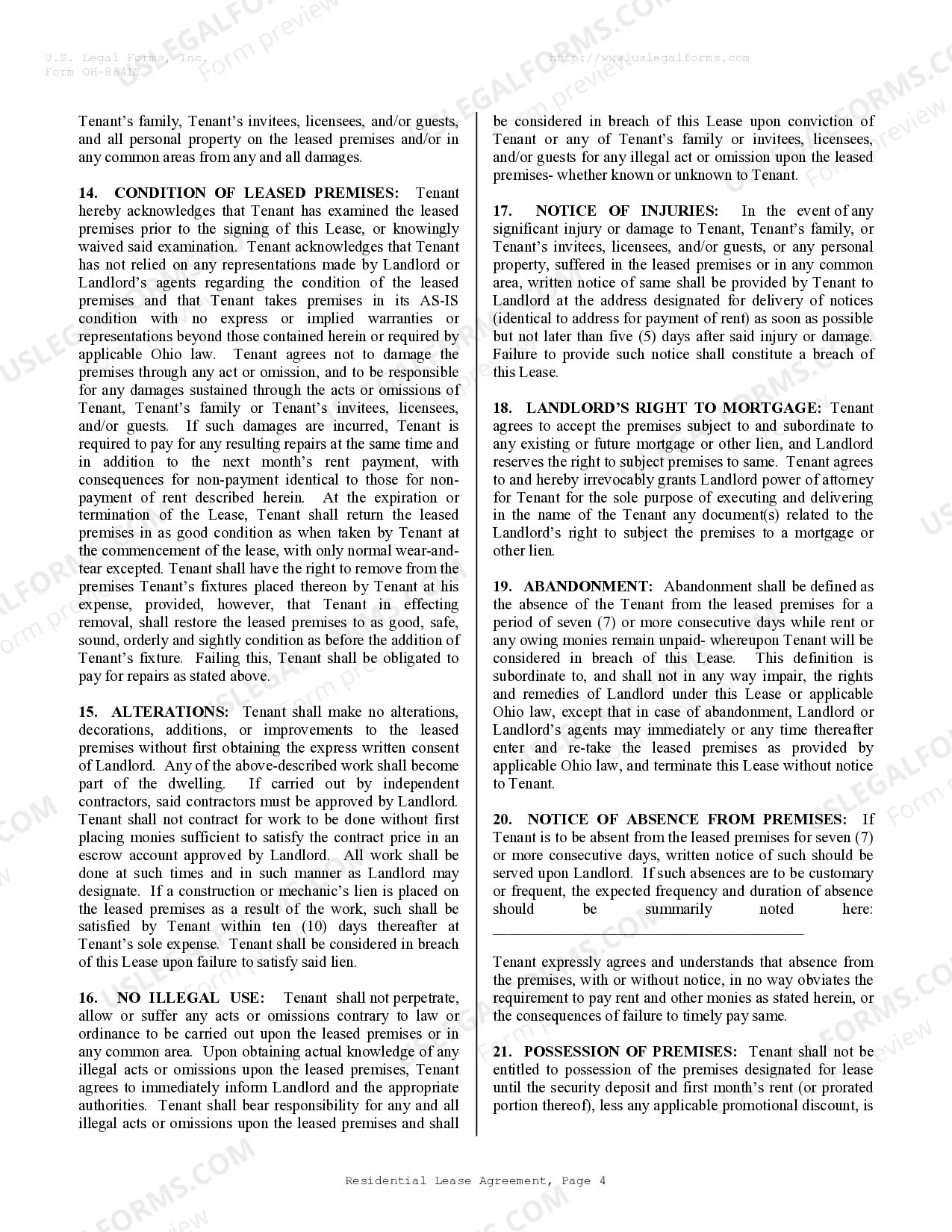
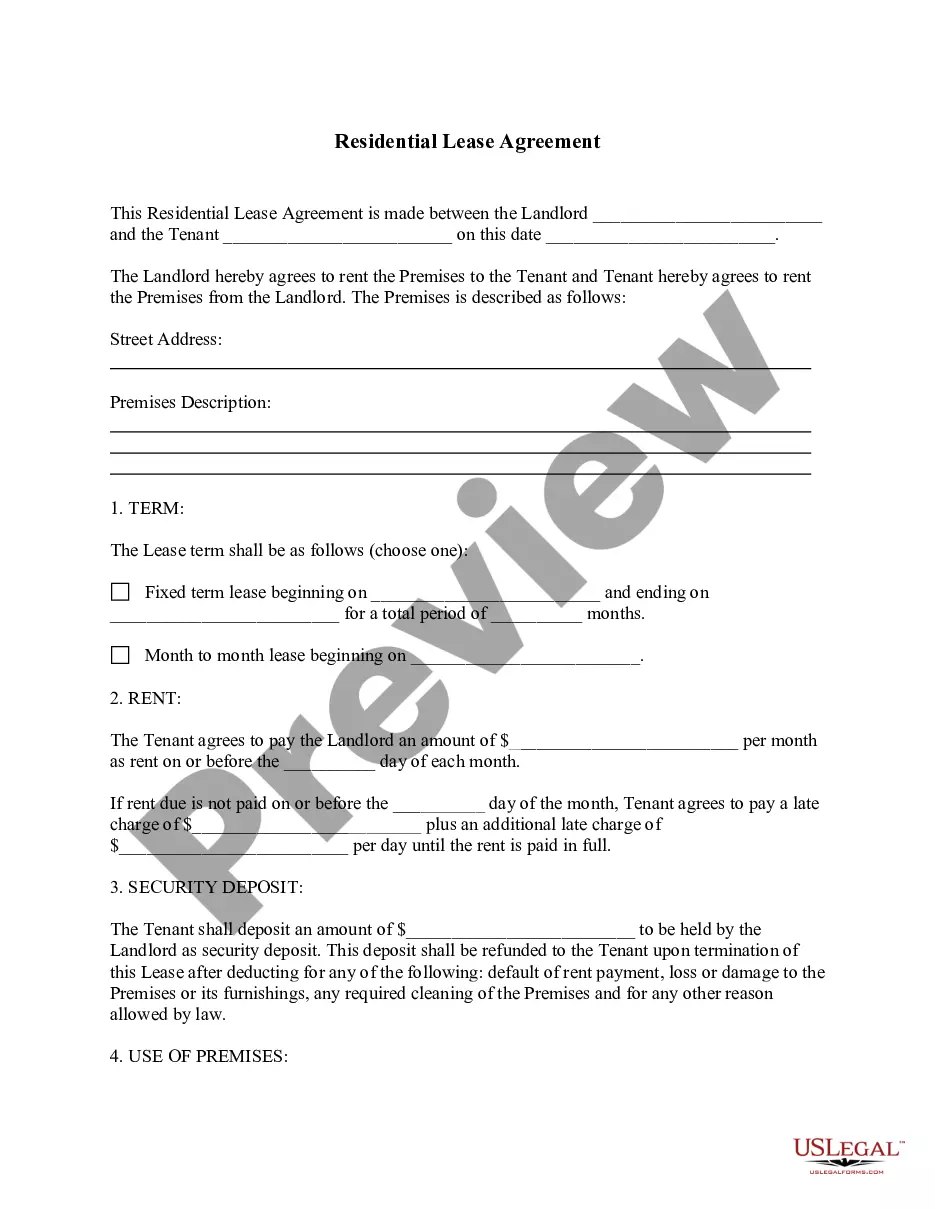
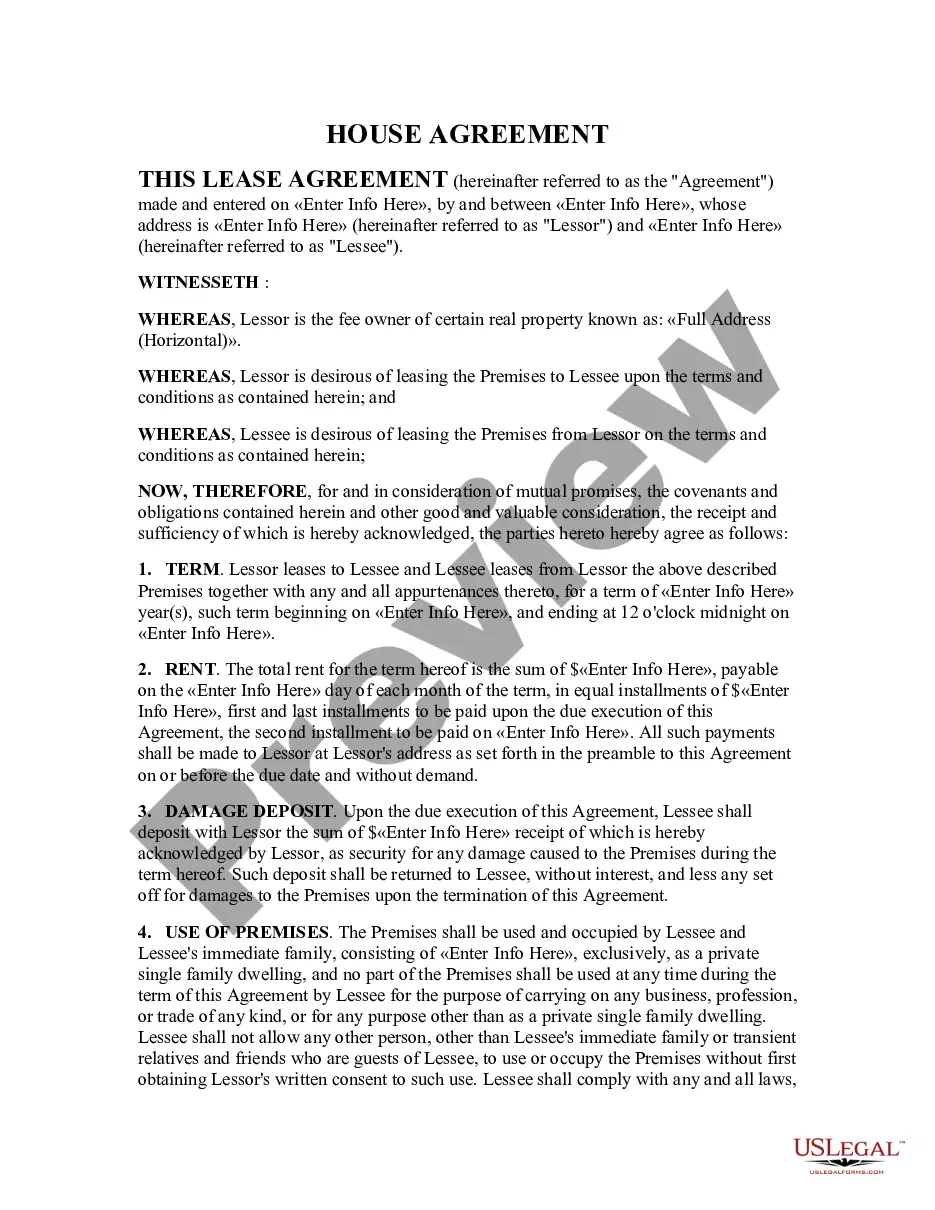
Residential Rental Lease Agreement
Title 53 Real Property
Chapter 5321 Landlord Tenant
Definitions.
As used in this chapter:
(A) "Tenant" means a person entitled under a rental agreement to
the use and occupancy of residential premises to the exclusion of others.
(B) "Landlord" means the owner, lessor, or sublessor of residential
premises, the agent of the owner, lessor, or sublessor, or any person authorized
by the owner, lessor, or sublessor to manage the premises or to receive
rent from a tenant under a rental agreement.
(C) "Residential premises" means a dwelling unit for residential
use and occupancy and the structure of which it is a part, the facilities
and appurtenances in it, and the grounds, areas, and facilities for the
use of tenants generally or the use of which is promised the tenant. "Residential
premises" includes a dwelling unit that is owned or operated by a college
or university. "Residential premises" does not include any of the following:
(1) Prisons, jails, workhouses, and other places of incarceration
or correction, including, but not limited to, halfway houses or residential
arrangements which are used or occupied as a requirement of probation or
parole;
(2) Hospitals and similar institutions with the primary purpose
of providing medical services, and homes licensed pursuant to Chapter 3721.
of the Revised Code;
(3) Tourist homes, hotels, motels, and other similar facilities
where circumstances indicate a transient occupancy;
(4) Elementary and secondary boarding schools, where the cost of
room and board is included as part of the cost of tuition;
(5) Orphanages and similar institutions;
(6) Farm residences furnished in connection with the rental of land
of a minimum of two acres for production of agricultural products by one
or more of the occupants;
(7) Dwelling units subject to sections 3733.41 to 3733.49 of the
Revised Code;
(8) Occupancy by an owner of a condominium unit;
(9) Occupancy in a facility licensed as an SRO facility pursuant
to Chapter 3731. of the Revised Code, if the facility is owned or operated
by an organization that is exempt from taxation under section 501(c)(3)
of the "Internal Revenue Code of 1986," 100 Stat. 2085, 26 U.S.C.A. 501,
as amended, or by an entity or group of entities in which such an organization
has a controlling interest, and if either of the following applies:
(a) The occupancy is for a period of less than sixty days;
(b) The occupancy is for participation in a program operated by
the facility, or by a public entity or private charitable organization
pursuant to a contract with the facility, to provide either of the following:
(i) Services licensed, certified, registered, or approved by a
governmental agency or private accrediting organization for the rehabilitation
of mentally ill persons, developmentally disabled persons, adults or juveniles
convicted of criminal offenses, or persons suffering from substance abuse;
(ii) Shelter for juvenile runaways, victims of domestic violence,
or homeless persons.
(10) Emergency shelters operated by organizations exempt from federal
income taxation under section 501(c)(3) of the "Internal Revenue Code of
1986," 100 Stat. 2085, 26 U.S.C.A. 501, as amended, for persons whose circumstances
indicate a transient occupancy, including homeless people, victims of domestic violence,
and juvenile runaways.
(D) "Rental agreement" means any agreement or lease, written or
oral, which establishes or modifies the terms, conditions, rules, or any
other provisions concerning the use and occupancy of residential premises
by one of the parties.
(E) "Security deposit" means any deposit of money or property to
secure performance by the tenant under a rental agreement.
(F) "Dwelling unit" means a structure or the part of a structure
that is used as a home, residence, or sleeping place by one person who
maintains a household or by two or more persons who maintain a common household.
(G) "Controlled substance" has the same meaning as in section 3719.01
of the Revised Code.
(H) "Student tenant" means a person who occupies a dwelling unit
owned or operated by the college or university at which the person is a
student, and who has a rental agreement that is contingent upon the person's
status as a student. Title 53, Chap. 5321, § 5321.01
The provisions of § 6 of SB 258 (143 v --) read as follows:
SECTION 6. Sections 1923.01, 1923.02, 1923.04, 5321.01, 5321.04,
5321.05, 5321.07, 5321.09, 5321.11, 5321.13, 5321.17, and 5321.19 of the
Revised Code, as amended by Section 1 of this act, and section 1923.051
of the Revised Code, as enacted by Section 1 of this act,apply to landlords
and tenants under week-to-week tenancies, month-to-month tenancies, and other rental agreements for residential
premises, as defined in section 5321.01 of the Revised Code, that were
or are entered into prior to, on, or after the effective date of this act.
Retaliatory conduct of landlord prohibited.
(A) Subject to section 5321.03 of the Revised Code, a landlord
may not retaliate against a tenant by increasing the tenant's rent, decreasing
services that are due to the tenant, or bringing or threatening to bring
an action for possession of the tenant's premises because:
(1) The tenant has complained to an appropriate governmental agency
of a violation of a building, housing, health, or safety code that is applicable
to the premises, and the violation materially affects health and safety;
(2) The tenant has complained to the landlord of any violation of
section 5321.04 of the Revised Code;
(3) The tenant joined with other tenants for the purpose of negotiating
or dealing collectively with the landlord on any of the terms and conditions
of a rental agreement.
(B) If a landlord acts in violation of division (A) of this section
the tenant may:
(1) Use the retaliatory action of the landlord as a defense to
an action by the landlord to recover possession of the premises;
(2) Recover possession of the premises; or
(3) Terminate the rental agreement.
In addition, the tenant may recover from the landlord any actual
damages together with reasonable attorneys' fees.
(C) Nothing in division (A) of this section shall prohibit a landlord
from increasing the rent to reflect the cost of improvements installed
by the landlord in or about the premises or to reflect an increase in other
costs of operation of the premises. Title 53, Chap. 5321, §
5321.02
Actions by landlord authorized.
(A) Notwithstanding section 5321.02 of the Revised Code, a landlord
may bring an action under Chapter 1923. of the Revised Code for possession
of the premises if:
(1) The tenant is in default in the payment of rent;
(2) The violation of the applicable building, housing, health, or
safety code that the tenant complained of was primarily caused by any act
or lack of reasonable care by the tenant, or by any other person in the
tenant's household, or by anyone on the premises with the consent of the
tenant;
(3) Compliance with the applicable building, housing, health, or
safety code would require alteration, remodeling, or demolition of the
premises which would effectively deprive the tenant of the use of the dwelling
unit;
(4) A tenant is holding over his term.
(B) The maintenance of an action by the landlord under this section
does not prevent the tenant from recovering damages for any violation by
the landlord of the rental agreement or of section 5321.04 of the Revised
Code.
(C) This section does not apply to a dwelling unit occupied by a
student tenant. Title 53, Chap. 5321, § 5321.03
Termination of student tenant rental agreements.
A college or university may terminate a rental agreement with a
student tenant prior to the expiration of the term of the agreement and
require that the student vacate the dwelling unit only when the termination
follows a hearing in which it was determined by the college or university
that the student violated a term of the rental agreement or violated the
college's or university's code of conduct or other policies and procedures. The hearing must be preceded by a written
notice to the student, must include a right to be heard, and must otherwise
comply with the college's or university's procedures for disciplinary hearings.
The written rental agreement must specify the conditions under which the
rental agreement may be terminated and specify the college's or university's
notice and hearing procedures that will be followed in making a determination
under this section. Title 53, Chap. 5321, [§ 5321.03.1] §
5321.031
Obligations of landlord.
(A) A landlord who is a party to a rental agreement shall do all
of the following:
(1) Comply with the requirements of all applicable building, housing,
health, and safety codes that materially affect health and safety;
(2) Make all repairs and do whatever is reasonably necessary to
put and keep the premises in a fit and habitable condition;
(3) Keep all common areas of the premises in a safe and sanitary
condition;
(4) Maintain in good and safe working order and condition all electrical,
plumbing, sanitary, heating, ventilating, and air conditioning fixtures
and appliances, and elevators, supplied or required to be supplied by him;
(5) When he is a party to any rental agreements that cover four
or more dwelling units in the same structure, provide and maintain appropriate
receptacles for the removal of ashes, garbage, rubbish, and other waste
incidental to the occupancy of a dwelling unit, and arrange for their removal;
(6) Supply running water, reasonable amounts of hot water and reasonable
heat at all times, except where the building that includes the dwelling
unit is not required by law to be equipped for that purpose, or the dwelling
unit is so constructed that heat or hot water is generated by an installation
within the exclusive control of the tenant and supplied by a direct public
utility connection;
(7) Not abuse the right of access conferred by division (B) of section
5321.05 of the Revised Code;
(8) Except in the case of emergency or if it is impracticable to
do so, give the tenant reasonable notice of his intent to enter and enter
only at reasonable times. Twenty-four hours is presumed to be a reasonable
notice in the absence of evidence to the contrary.
(9) Promptly commence an action under Chapter 1923. of the Revised
Code, after complying with division (C) of section 5321.17 of the Revised
Code, to remove a tenant from particular residential premises, if the tenant
fails to vacate the premises within three days after the giving of the
notice required by that division and if the landlord has actual knowledge
of or has reasonable cause to believe that the tenant, any person in the
tenant's household, or any person on the premises with the consent of the
tenant previously has or presently is engaged in a violation as described
in division (A)(6)(a)(i) of section 1923.02 of the Revised Code, whether
or not the tenant or other person has been charged with, has pleaded guilty
to or been convicted of, or has been determined to be a delinquent child
for an act that, if committed by an adult, would be a violation as described
in that division. Such actual knowledge or reasonable cause to believe
shall be determined in accordance with that division.
(B) If the landlord makes an entry in violation of division (A)(8)
of this section, makes a lawful entry in an unreasonable manner, or makes
repeated demands for entry otherwise lawful that have the effect of harassing
the tenant, the tenant may recover actual damages resulting from the entry
or demands, obtain injunctive relief to prevent the recurrence of the conduct,
and obtain a judgment for reasonable attorney's fees, or may terminate
the rental agreement. Title 53, Chap. 5321, § 5321.04
See provisions, § 6 of SB 258 (143 v --) following RC §
5321.01.
Obligations of tenant.
(A) A tenant who is a party to a rental agreement shall do all
of the following:
(1) Keep that part of the premises that he occupies and uses safe
and sanitary;
(2) Dispose of all rubbish, garbage, and other waste in a clean,
safe, and sanitary manner;
(3) Keep all plumbing fixtures in the dwelling unit or used by him
as clean as their condition permits;
(4) Use and operate all electrical and plumbing fixtures properly;
(5) Comply with the requirements imposed on tenants by all applicable
state and local housing, health, and safety codes;
(6) Personally refrain and forbid any other person who is on the
premises with his permission from intentionally or negligently destroying,
defacing, damaging, or removing any fixture, appliance, or other part of
the premises;
(7) Maintain in good working order and condition any range, refrigerator,
washer, dryer, dishwasher, or other appliances supplied by the landlord
and required to be maintained by the tenant under the terms and conditions
of a written rental agreement;
(8) Conduct himself and require other persons on the premises with
his consent to conduct themselves in a manner that will not disturb his
neighbors' peaceful enjoyment of the premises;
(9) Conduct himself, and require persons in his household and persons
on the premises with his consent to conduct themselves, in connection with
the premises so as not to violate the prohibitions contained in Chapters
2925. and 3719. of the Revised Code, or in municipal ordinances that are
substantially similar to any section in either of those chapters, which
relate to controlled substances.
(B) The tenant shall not unreasonably withhold consent for the
landlord to enter into the dwelling unit in order to inspect the premises,
make ordinary, necessary, or agreed repairs, decorations, alterations,
or improvements, deliver parcels that are too large for the tenant's mail
facilities, supply necessary or agreed services, or exhibit the dwelling
unit to prospective or actual purchasers, mortgagees, tenants, workmen,
or contractors.
(C)
(1) If the tenant violates any provision of this section, other
than division (A)(9) of this section, the landlord may recover any actual
damages that result from the violation together with reasonable attorney's
fees. This remedy is in addition to any right of the landlord to terminate
the rental agreement, to maintain an action for the possession of the premises,
or to obtain injunctive relief to compel access under division (B) of this
section.
(2) If the tenant violates division (A)(9) of this section and if
the landlord has actual knowledge of or has reasonable cause to believe
that the tenant, any person in the tenant's household, or any person on
the premises with the consent of the tenant previously has or presently
is engaged in a violation as described in division (A)(6)(a)(i) of section
1923.02 of the Revised Code, whether or not the tenant or other person
has been charged with, has pleaded guilty to or been convicted of, or has
been determined to be a delinquent child for an act that, if committed
by an adult, would be a violation as described in that division, then the
landlord promptly shall give the notice required by division (C) of section
5321.17 of the Revised Code. If the tenant fails to vacate the premises
within three days after the giving of that notice, then the landlord promptly
shall comply with division (A)(9) of section 5321.04 of the Revised Code.
For purposes of this division, actual knowledge or reasonable cause to
believe as described in this division shall be determined in accordance
with division (A)(6)(a)(i) of section 1923.02 of the Revised Code.
Title 53, Chap. 5321, § 5321.05
See provisions, § 6 of SB 258 (143 v --) following RC §
5321.01.
Rental agreement terms.
A landlord and a tenant may include in a rental agreement any terms
and conditions, including any term relating to rent, the duration of an
agreement, and any other provisions governing the rights and obligations
of the parties that are not inconsistent with or prohibited by Chapter
5321. of the Revised Code or any other rule of law. Title 53, Chap.
5321, § 5321.06
Notice to landlord to remedy condition; deposit of rent with
court or other remedies.
(A) If a landlord fails to fulfill any obligation imposed upon
him by section 5321.04 of the Revised Code, other than the obligation specified
in division (A)(9) of that section, or any obligation imposed upon him
by the rental agreement, if the conditions of the residential premises
are such that the tenant reasonably believes that a landlord has failed
to fulfill any such obligations, or if a governmental agency has found
that the premises are not in compliance with building, housing, health,
or safety codes that apply to any condition of the premises that could
materially affect the health and safety of an occupant, the tenant may
give notice in writing to the landlord, specifying the acts, omissions,
or code violations that constitute noncompliance. The notice shall be sent
to the person or place where rent is normally paid.
(B) If a landlord receives the notice described in division (A)
of this section and after receipt of the notice fails to remedy the condition
within a reasonable time considering the severity of the condition and
the time necessary to remedy it, or within thirty days, whichever is sooner,
and if the tenant is current in rent payments due under the rental agreement,
the tenant may do one of the following:
(1) Deposit all rent that is due and thereafter becomes due the
landlord with the clerk of the municipal or county court having jurisdiction
in the territory in which the residential premises are located;
(2) Apply to the court for an order directing the landlord to remedy
the condition. As part of the application, the tenant may deposit rent
pursuant to division (B)(1) of this section, may apply for an order reducing
the periodic rent due the landlord until the landlord remedies the condition,
and may apply for an order to use the rent deposited to remedy the condition.
In any order issued pursuant to this division, the court may require the
tenant to deposit rent with the clerk of court as provided in division
(B)(1) of this section.
(3) Terminate the rental agreement.
(C) This section does not apply to any landlord who is a party
to rental agreements that cover three or fewer dwelling units and who provides
notice of that fact in a written rental agreement or, in the case of an
oral tenancy, delivers written notice of that fact to the tenant at the
time of initial occupancy by the tenant.
(D) This section does not apply to a dwelling unit occupied by a
student tenant. Title 53, Chap. 5321, § 5321.07
See provisions, § 6 of SB 258 (143 v --) following RC §
5321.01.
Duties of clerk of court.
(A) Whenever a tenant deposits rent with the clerk of a court as
provided in section 5321.07 of the Revised Code, the clerk shall give written
notice of this fact to the landlord and to his agent, if any.
(B) The clerk shall place all rent deposited with him in a separate
rent escrow account in the name of the clerk in a bank or building and
loan association domiciled in this state.
(C) The clerk shall keep in a separate docket an account of each
deposit, with the name and address of the tenant, and the name and address
of the landlord and of his agent, if any.
(D) For his costs, the clerk may charge a fee of one per cent of
the amount of the rent deposited, which shall be assessed as court costs.
(E) All interest that has accrued on the rent deposited by the clerk
of a county court under division (B) of this section shall be paid into
the treasury of the political subdivision for which the clerk performs
his duties. All interest that has accrued on the rent deposited by the
clerk of a municipal court under division (B) of this section shall be
paid into the city treasury as defined in division (B) of section 1901.03
of the Revised Code. Title 53, Chap. 5321, § 5321.08
Landlord may apply for release of rent.
(A) A landlord who receives notice that rent due him has been deposited
with a clerk of a municipal or county court pursuant to section 5321.07
of the Revised Code, may do any of the following:
(1) Apply to the clerk of the court for release of the rent on
the ground that the condition contained in the notice given pursuant to
division (A) of section 5321.07 of the Revised Code has been remedied.
The clerk shall forthwith release the rent, less costs, to the landlord
if the tenant gives written notice to the clerk that the condition has
been remedied.
(2) Apply to the court for release of the rent on the ground that
the tenant did not comply with the notice requirement of division (A) of
section 5321.07 of the Revised Code, or that the tenant was not current
in rent payments due under the rental agreement at the time the tenant
initiated rent deposits with the clerk of the court under division (B)(1)
of section 5321.07 of the Revised Code.
(3) Apply to the court for release of the rent on the ground that
there was no violation of any obligation imposed upon the landlord by section
5321.04 of the Revised Code, other than the obligation specified in division
(A)(9) of that section, any obligation imposed upon him by the rental agreement,
or any obligation imposed upon him by any building, housing, health, or
safety code, or that the condition contained in the notice given pursuant
to division (A) of section 5321.07 of the Revised Code has been remedied.
(B) The tenant shall be named as a party to any action filed by
the landlord under this section, and shall have the right to file an answer
and counterclaim, as in other civil actions. A trial shall be held within
sixty days of the date of the filing of the landlord's complaint, unless,
for good cause shown, the court continues the period for trial.
(C) If the court finds that there was no violation of any obligation
imposed upon the landlord by section 5321.04 of the Revised Code, other
than the obligation specified in division (A)(9) of that section, any obligation
imposed upon him by the rental agreement, or any obligation imposed upon
him by any building, housing, health, or safety code, that the condition
contained in the notice given pursuant to division (A) of section 5321.07
of the Revised Code has been remedied, that the tenant did not comply with
the notice requirement of division (A) of section 5321.07 of the Revised
Code, or that the tenant was not current in rent payments at the time the
tenant initiated rent deposits with the clerk of court under division (B)(1)
of section 5321.07 of the Revised Code, the court shall order the release
to the landlord of rent on deposit with the clerk, less costs.
(D) If the court finds that the condition contained in the notice
given pursuant to division (A) of section 5321.07 of the Revised Code was
the result of an act or omission of the tenant, or that the tenant intentionally
acted in bad faith in proceeding under section 5321.07 of the Revised Code,
the tenant shall be liable for damages caused to the landlord and costs,
together with reasonable attorney's fees if the tenant intentionally acted
in bad faith. Title 53, Chap. 5321, § 5321.09
See provisions, § 6 of SB 258 (143 v --) following RC §
5321.01.
Partial release of rent.
(A) If a landlord brings an action for the release of rent deposited
with a clerk of court, the court may, during the pendency of the action,
upon application of the landlord, release part of the rent on deposit for
payment of the periodic interest on a mortgage on the premises, the periodic
principal payments on a mortgage on the premises, the insurance premiums
for the premises, real estate taxes on the premises, utility services,
repairs, and other customary and usual costs of operating the premises
as a rental unit.
(B) In determining whether to release rent for the payments described
in division (A) of this section, the court shall consider the amount of
rent the landlord receives from other rental units in the buildings of
which the residential premises are a part, the cost of operating those
units, and the costs which may be required to remedy the condition contained
in the notice given pursuant to division (A) of section 5321.07 of the
Revised Code. Title 53, Chap. 5321, § 5321.10
Noncompliance by tenant terminates agreement.
If the tenant fails to fulfill any obligation imposed upon him
by section 5321.05 of the Revised Code that materially affects health and
safety, other than the obligation described in division (A)(9) of that
section, the landlord may deliver a written notice of this fact to the
tenant specifying the act or omission that constitutes noncompliance with the pertinent obligations and specifying that
the rental agreement will terminate upon a date specified in the notice,
not less than thirty days after receipt of the notice. If the tenant fails
to remedy the condition specified in the notice, the rental agreement shall
terminate as provided in the notice. Title 53, Chap. 5321, §
5321.11
See provisions, § 6 of SB 258 (143 v --) following RC §
5321.01.
Recover damages.
In any action under Chapter 5321. of the Revised Code, any party
may recover damages for the breach of contract or the breach of any duty
that is imposed by law. Title 53, Chap. 5321, § 5321.12
Rental agreement terms barred.
(A) No provision of this chapter may be modified or waived by any
oral or written agreement except as provided in division (F) of this section.
(B) No warrant of attorney to confess judgment shall be recognized
in any rental agreement or in any other agreement between a landlord and
tenant for the recovery of rent or damages to the residential premises.
(C) No agreement to pay the landlord's or tenant's attorney's fees
shall be recognized in any rental agreement for residential premises or
in any other agreement between a landlord and tenant.
(D) No agreement by a tenant to the exculpation or limitation of
any liability of the landlord arising under law or to indemnify the landlord
for that liability or its related costs shall be recognized in any rental
agreement or in any other agreement between a landlord and tenant.
(E) A rental agreement, or the assignment, conveyance, trust deed,
or security instrument of the landlord's interest in the rental agreement
may not permit the receipt of rent free of the obligation to comply with
section 5321.04 of the Revised Code.
(F) The landlord may agree to assume responsibility for fulfilling
any duty or obligation imposed on a tenant by section 5321.05 of the Revised
Code, other than the obligation specified in division (A)(9) of that section.
Title 53, Chap. 5321, § 5321.13
See provisions, § 6 of SB 258 (143 v --) following RC §
5321.01.
Unconscionable agreement.
(A) If the court as a matter of law finds a rental agreement, or
any clause thereof, to have been unconscionable at the time it was made,
it may refuse to enforce the rental agreement or it may enforce the remainder
of the rental agreement without the unconscionable clause, or it may so
limit the application of any unconscionable clause as to avoid any unconscionable
result.
(B) When it is claimed or appears to the court that the rental agreement,
or any clause thereof, may be unconscionable, the parties shall be afforded
a reasonable opportunity to present evidence as to its setting, purpose,
and effect to aid the court in making the determination. Title 53,
Chap. 5321, § 5321.14
Residential premises landlord restrictions.
(A) No landlord of residential premises shall initiate any act,
including termination of utilities or services, exclusion from the premises,
or threat of any unlawful act, against a tenant, or a tenant whose right
to possession has terminated, for the purpose of recovering possession
of residential premises, other than as provided in Chapters 1923., 5303.,
and 5321. of the Revised Code.
(B) No landlord of residential premises shall seize the furnishings
or possessions of a tenant, or of a tenant whose right to possession has
terminated, for the purpose of recovering rent payments, other than in
accordance with an order issued by a court of competent jurisdiction.
(C) A landlord who violates this section is liable in a civil action
for all damages caused to a tenant, or to a tenant whose right to possession
has terminated, together with reasonable attorneys fees. Title 53,
Chap. 5321, § 5321.15
Security deposit procedures.
(A) Any security deposit in excess of fifty dollars or one month's
periodic rent, whichever is greater, shall bear interest on the excess
at the rate of five per cent per annum if the tenant remains in possession
of the premises for six months or more, and shall be computed and paid
annually by the landlord to the tenant.
(B) Upon termination of the rental agreement any property or money
held by the landlord as a security deposit may be applied to the payment
of past due rent and to the payment of the amount of damages that the landlord
has suffered by reason of the tenant's noncompliance with section 5321.05
of the Revised Code or the rental agreement. Any deduction from the security
deposit shall be itemized and identified by the landlord in a written notice
delivered to the tenant together with the amount due, within thirty days
after termination of the rental agreement and delivery of possession. The
tenant shall provide the landlord in writing with a forwarding address
or new address to which the written notice and amount due from the landlord
may be sent. If the tenant fails to provide the landlord with the forwarding
or new address as required, the tenant shall not be entitled to damages
or attorneys fees under division (C) of this section.
(C) If the landlord fails to comply with division (B) of this section,
the tenant may recover the property and money due him, together with damages
in an amount equal to the amount wrongfully withheld, and reasonable attorneys
fees. Title 53, Chap. 5321, § 5321.16
Termination of periodic tenancies.
(A) Except as provided in division (C) of this section, the landlord
or the tenant may terminate or fail to renew a week-to-week tenancy by
notice given the other at least seven days prior to the termination date
specified in the notice.
(B) Except as provided in division (C) of this section, the landlord
or the tenant may terminate or fail to renew a month-to-month tenancy by
notice given the other at least thirty days prior to the periodic rental
date.
(C) If a tenant violates division (A)(9) of section 5321.05 of the
Revised Code and if the landlord has actual knowledge of or has reasonable
cause to believe that the tenant, any person in the tenant's household,
or any person on the residential premises with the consent of the tenant
previously has or presently is engaged in a violation as described in division
(A)(6)(a)(i) of section 1923.02 of the Revised Code, the landlord shall
terminate the week-to-week tenancy, month-to-month tenancy, or other rental
agreement with the tenant by giving a notice of termination to the tenant
in accordance with this division. The notice shall specify that the tenancy
or other rental agreement is terminated three days after the giving of
the notice, and the landlord may give the notice whether or not the tenant
or other person has been charged with, has pleaded guilty to or been convicted
of, or has been determined to be a delinquent child for an act that, if
committed by an adult, would be a violation as described in division (A)(6)(a)(i)
of section 1923.02 of the Revised Code. If the tenant fails to vacate the
premises within three days after the giving of that notice, then the landlord
promptly shall comply with division (A)(9) of section 5321.04 of the Revised
Code. For purposes of this division, actual knowledge or reasonable cause
to believe as described in this division shall be determined in accordance
with division (A)(6)(a)(i) of section 1923.02 of the Revised Code.
(D) This section does not apply to a termination based on the breach
of a condition of a rental agreement or the breach of a duty and obligation
imposed by law, except that it does apply to a breach of the obligation
imposed upon a tenant by division (A)(9) of section 5321.05 of the Revised
Code. Title 53, Chap. 5321, § 5321.17
See provisions, § 6 of SB 258 (143 v --) following RC §
5321.01.
Contents of residential rental agreement.
(A) Every written rental agreement for residential premises shall
contain the name and address of the owner and the name and address of the
owner's agent, if any. If the owner or the owner's agent is a corporation,
partnership, limited partnership, association, trust, or other entity,
the address shall be the principal place of business in the county in which
the residential property is situated or if there is no place of business
in such county then its principal place of business in this state, and
shall include the name of the person in charge thereof.
(B) If the rental agreement is oral, the landlord, at the commencement
of the term of occupancy, shall deliver to tenant a written notice containing
the information required in division (A) of this section.
(C) If the landlord fails to provide the notice of the name and
address of the owner and owner's agent, if any, required under division
(A) or (B) of this section, the notices to the landlord required under
division (A) of section 5321.07 and division (A) of section 5321.08 of
the Revised Code shall be waived by the landlord and his agent. Title
53, Chap. 5321, § 5321.18
Effect on municipal ordinances, township resolutions.
No municipal corporation may adopt or continue in existence any
ordinance and no township may adopt or continue in existence any resolution
that is in conflict with this chapter, or that regulates the rights and
obligations of parties to a rental agreement that are regulated by this
chapter. This chapter does not preempt any housing, building, health, or
safety code, or any ordinance as described in division (A)(9) of section 5321.04 of the Revised Code, of any
municipal corporation or township. Title 53, Chap. 5321, § 5321.19