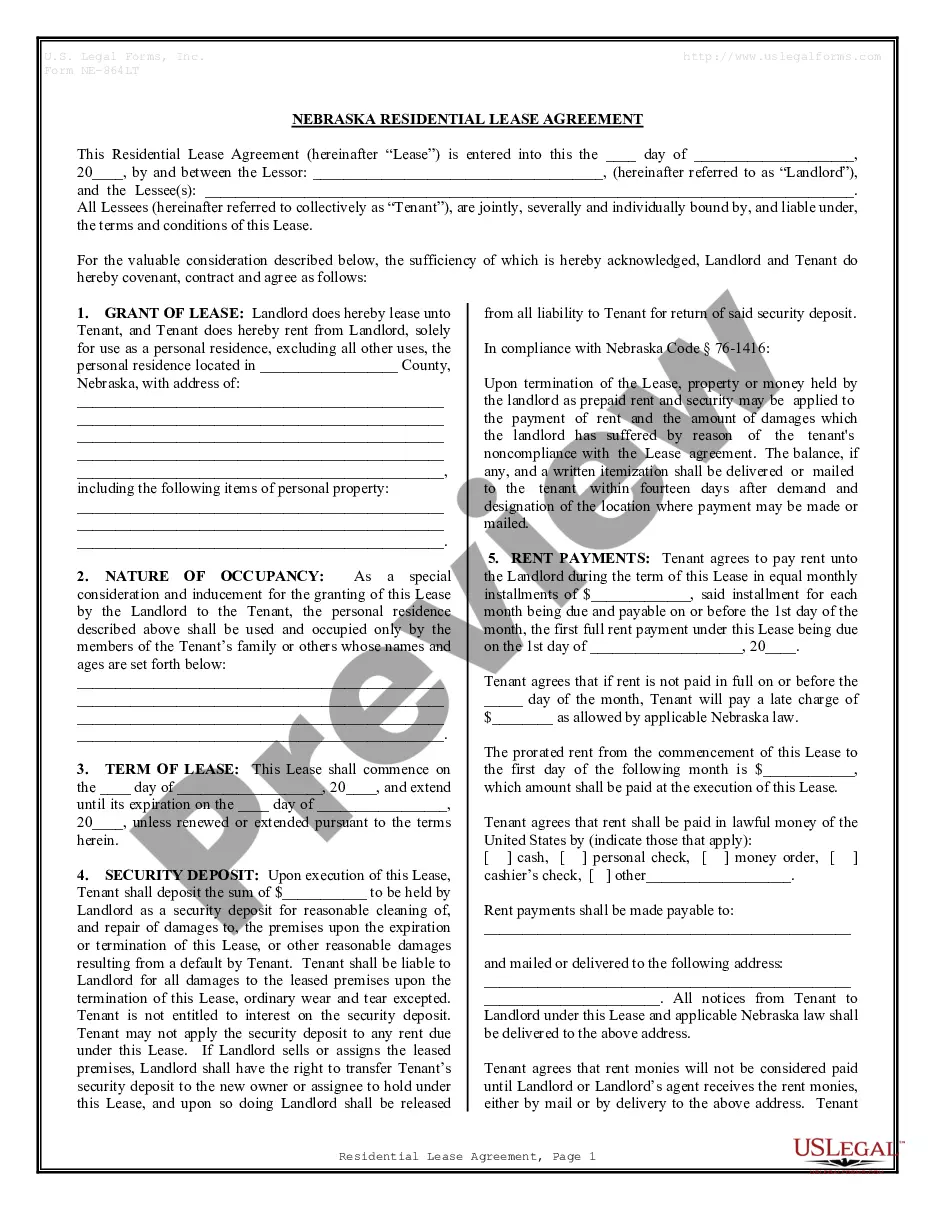
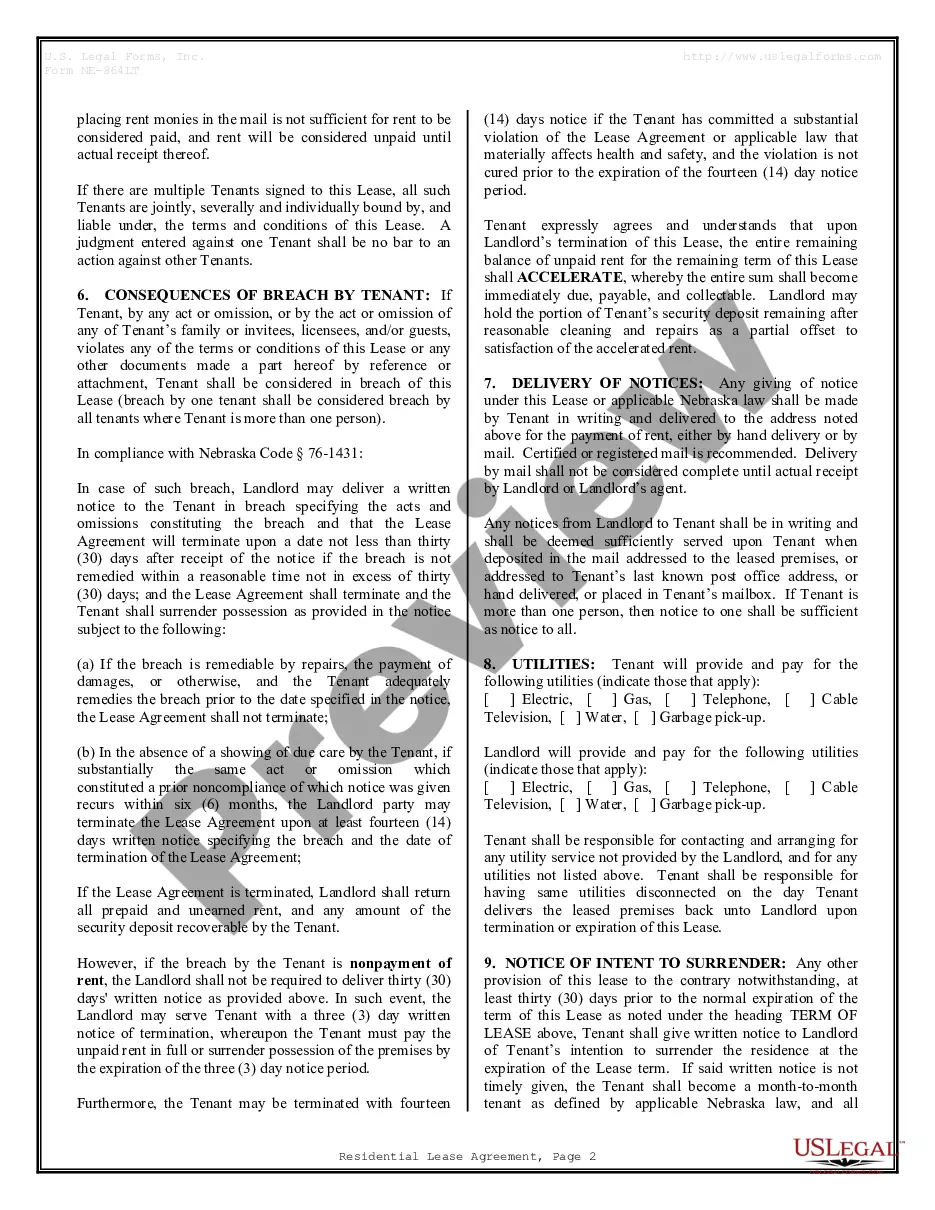
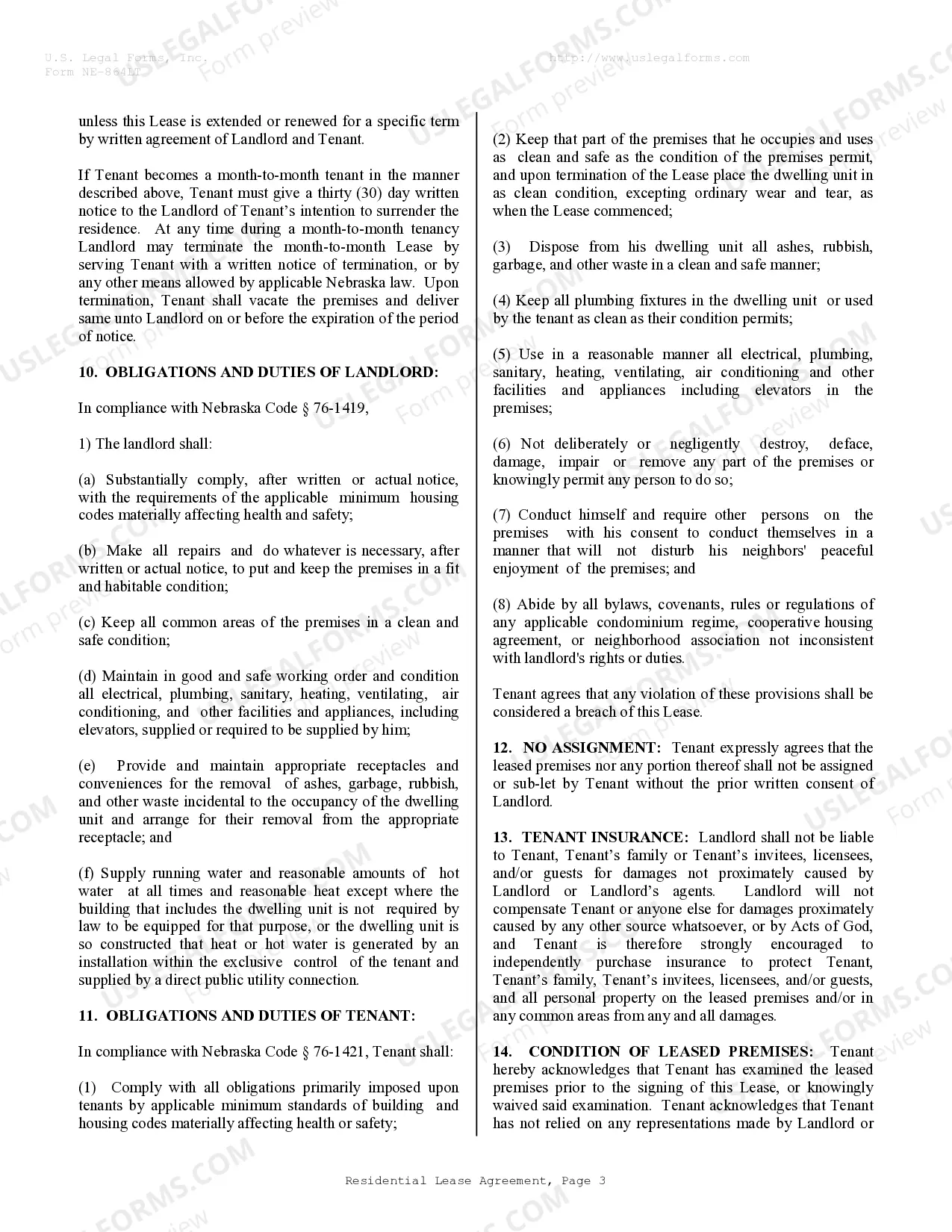
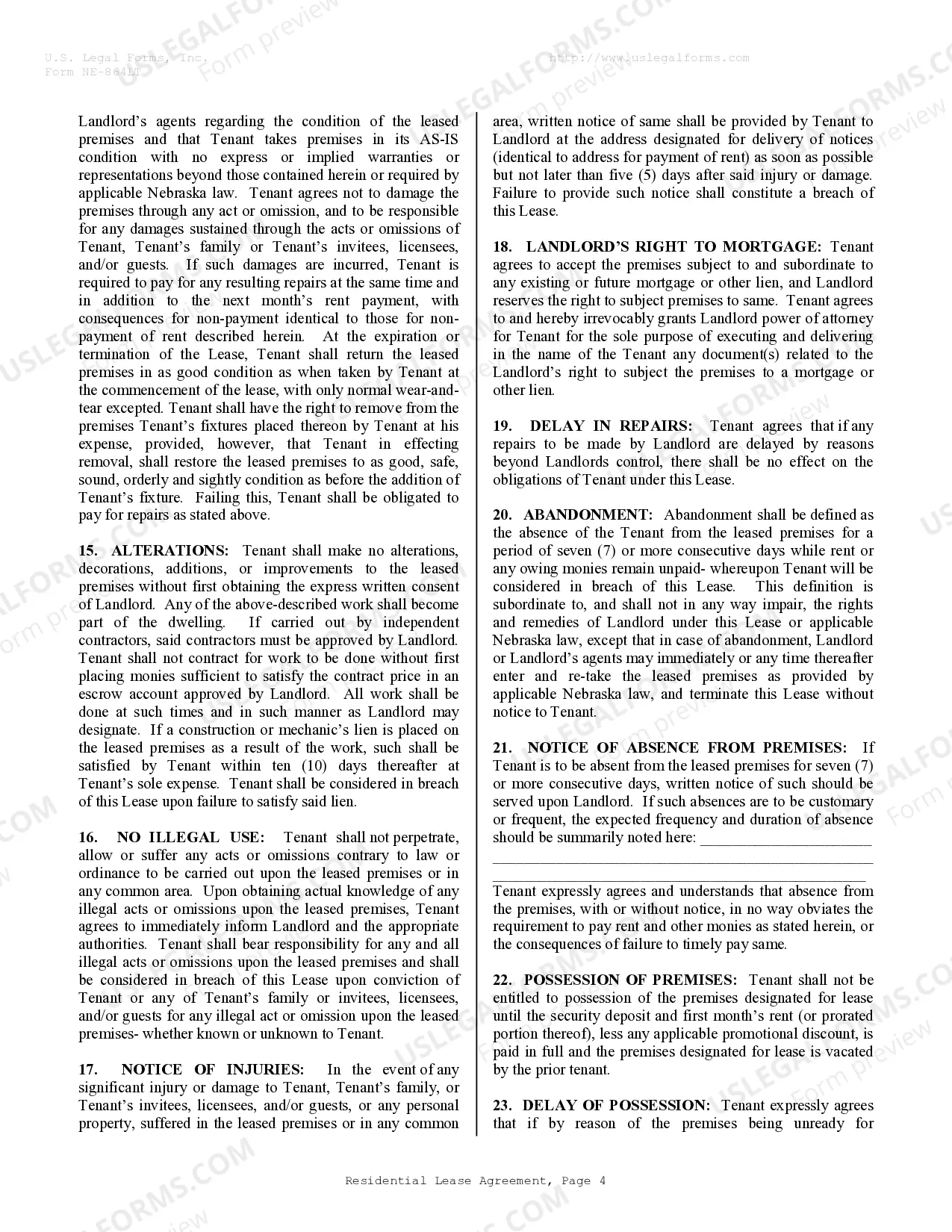
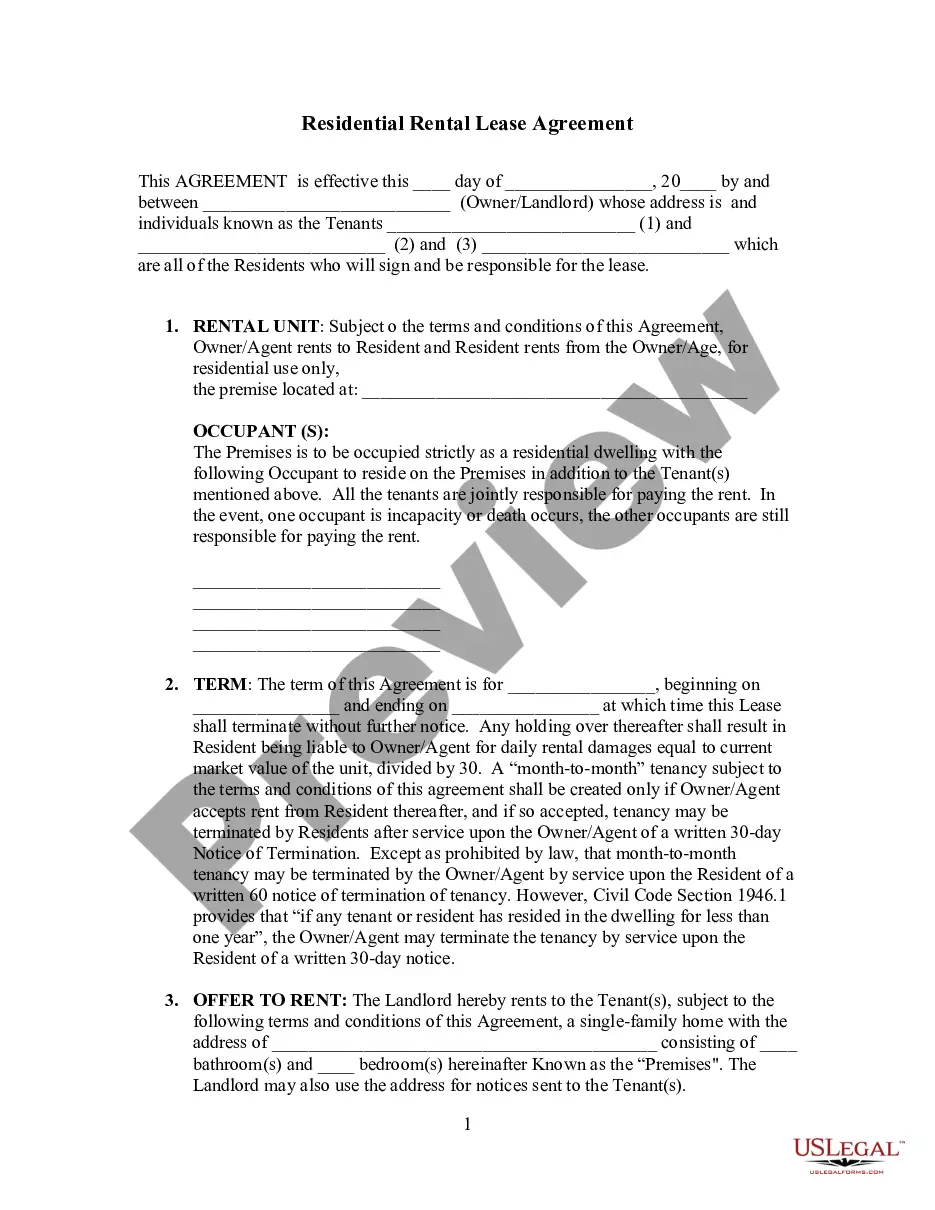
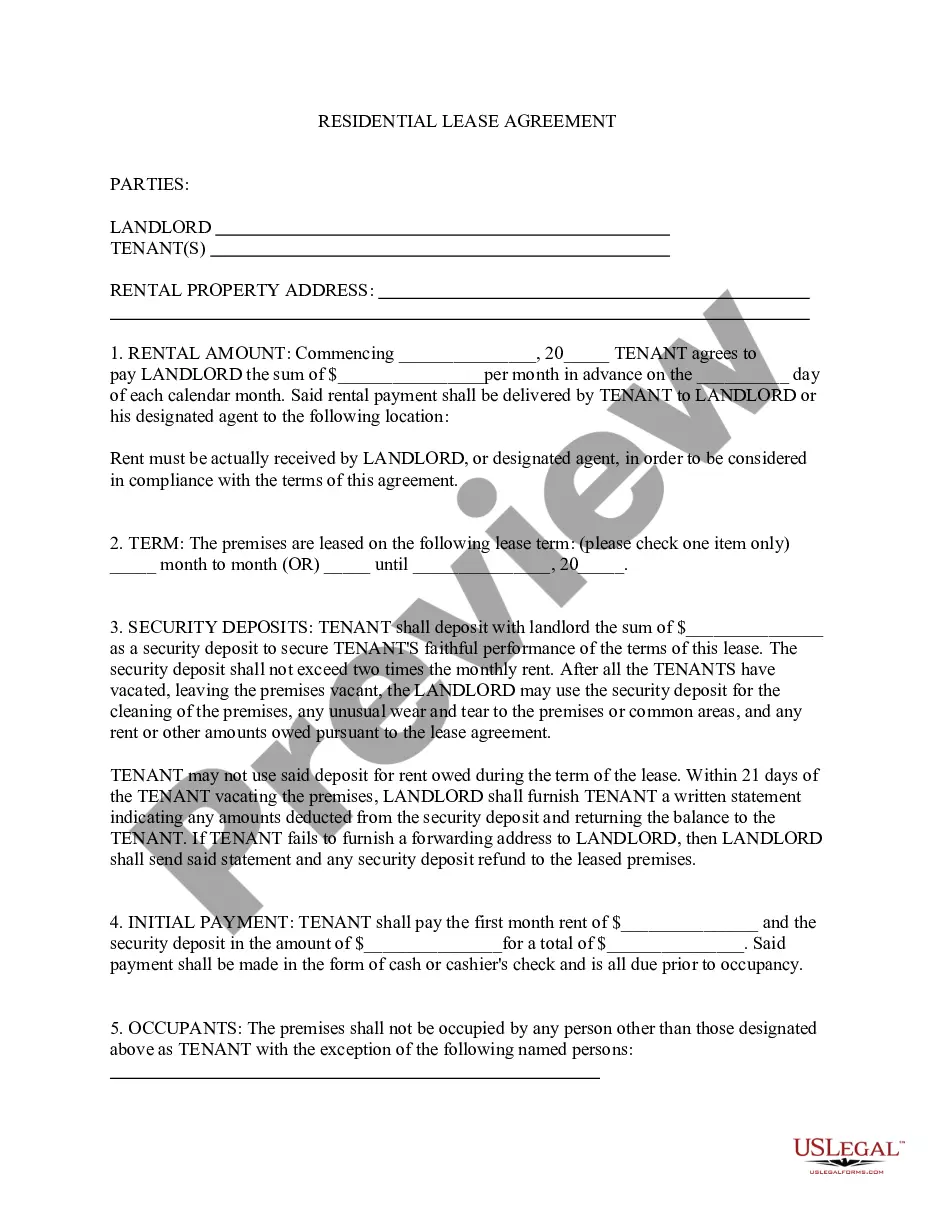
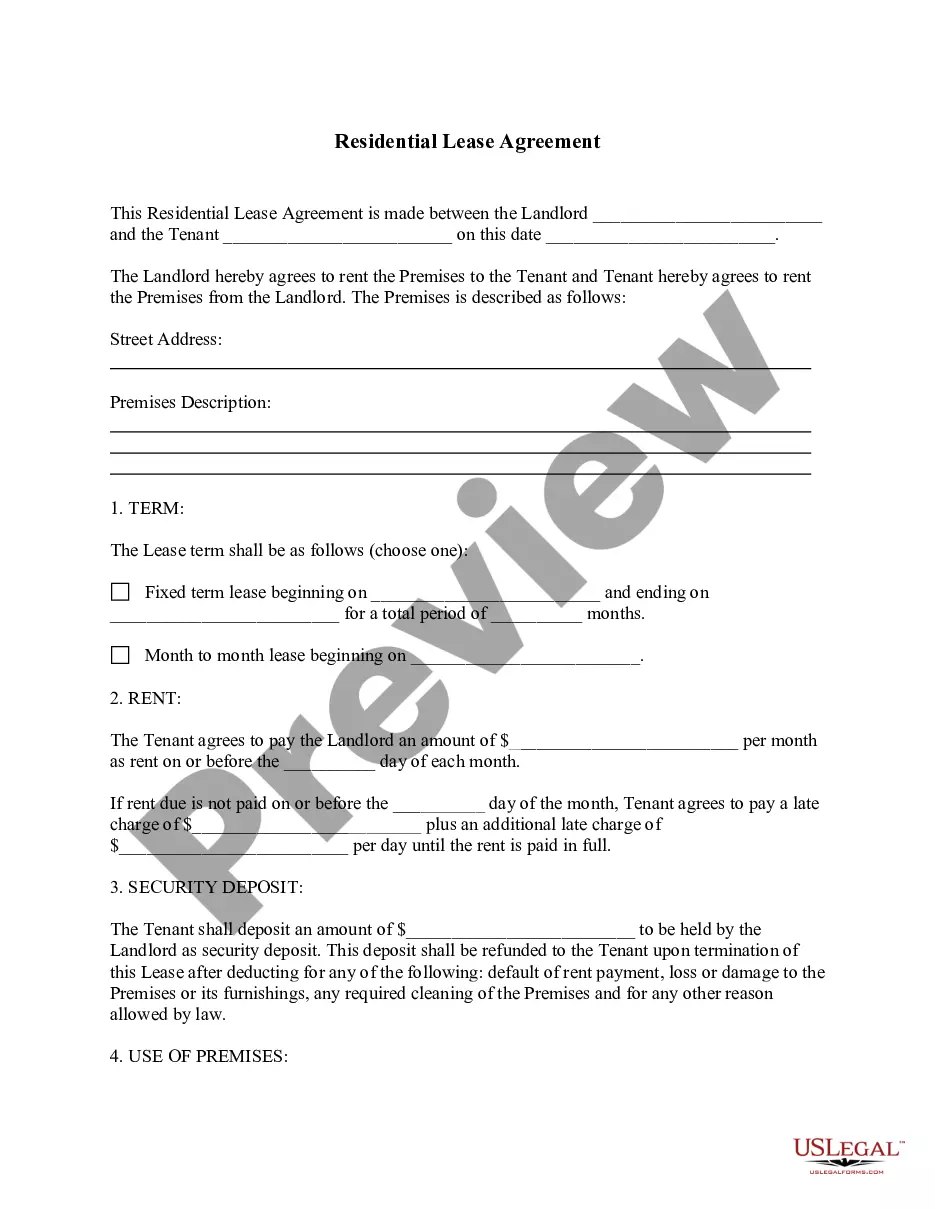
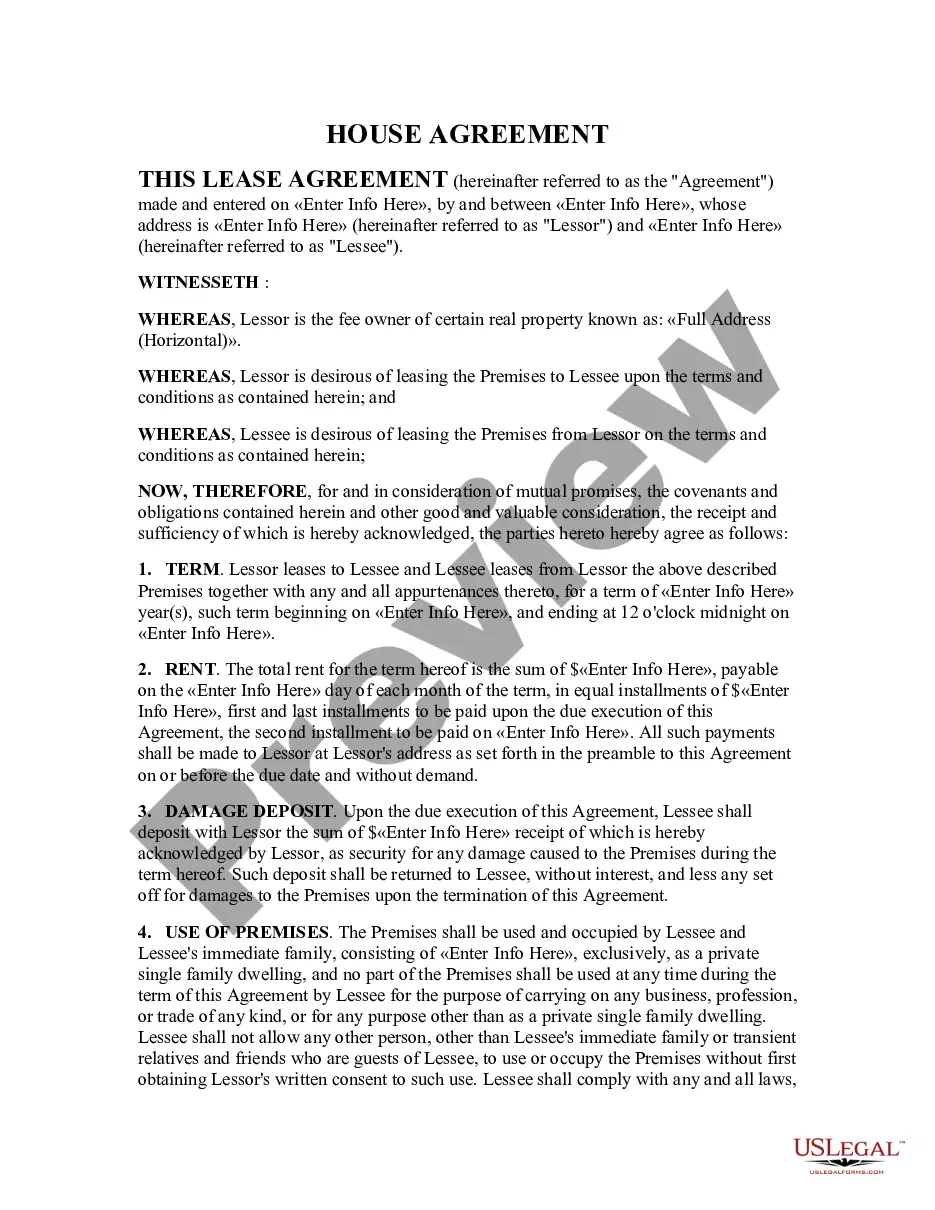
Residential Rental Lease Agreement
Act, how cited.
Sections 76-1401 to 76-1449 shall be known and may be cited
as the Uniform Residential Landlord and Tenant Act. §76-1401
Purposes; rules of construction.
(1) Sections 25-21,219 and 76-1401 to 76-1449 shall be liberally
construed and applied to promote their underlying purposes and policies.
(2) Underlying purposes and policies of sections 25-21,219
and 76-1401 to 76-1449 are:
(a) To simplify, clarify, modernize and revise the law governing
the rental of dwelling units and the rights and obligations of landlord
and tenant;
Supplementary principles of law applicable.
Unless displaced by the provisions of sections 25-21,219 and 76-1401
to 76-1449, the principles of law and equity, including the law relating
to capacity to contract, mutuality of obligations, principal and agent,
real property, public health, safety and fire prevention, estoppel,
fraud, misrepresentation, duress, coercion, mistake, bankruptcy,
or other validating or invalidating cause supplement its provisions.
§76-1403
Construction against implicit repeal.
Sections 25-21,219 and 76-1401 to 76-1449 being a general
act intended as a unified coverage of its subject matter, no part of it
is to be construed as impliedly repealed by subsequent legislation if that
construction can reasonably be avoided. §76-1404
Remedies; administration and enforcement; duty to mitigate damages.
(1) The remedies provided by sections 25-21,219 and
76-1401 to 76-1449 shall be so administered that the aggrieved
party may recover appropriate damages. The aggrieved party has a
duty to mitigate damages.
(2) Any right or obligation declared by sections
25-21,219 and 76-1401 to 76-1449 is enforceable by action unless
the provision declaring it specifies a different
and limited effect. §76-1405
Settlement; authorized.
A claim or right arising under sections
25-21,219 and 76-1401 to 76-1449 or on a rental agreement may be
settled by agreement. §76-1406
Jurisdiction; territorial application.
Sections 25-21,219 and 76-1401 to 76-1449 apply
to, regulate, and determine rights, obligations and remedies
under a rental agreement, wherever made, for a dwelling unit located within
this state. §76-1407
Exclusions from application of sections.
Unless created to avoid the application of sections
25-21,219 and 76-1401 to 76-1449, the following
arrangements are not governed by sections 25-21,219 and 76-1401 to 76-1449:
(1) Residence at an institution, public or private, if incidental
to detention or the provision of medical, geriatric, educational, counseling,
religious, or similar service.
(2) Occupancy under a contract of sale of a dwelling unit or the
property of which it is a part, if the occupant is the purchaser or a person
who succeeds to his interest.
(3) Occupancy by a member of a fraternal or social organization
in the portion of a structure operated for the benefit
of the organization.
(5) Occupancy by an employee of a landlord whose right to occupancy
is conditional upon employment in and about the premises.
(6) Occupancy by an owner of a condominium unit or a holder of a
proprietary lease in a cooperative.
(7) Occupancy under a rental agreement covering premises
used by the occupant primarily for agricultural purposes.
Courts; jurisdiction.
The district or county court of this state may exercise jurisdiction
over any landlord or tenant with respect
to any conduct in this state governed
by sections 25-21,219 and 76-1401 to 76-1449 or with respect
to any claim arising from a transaction
subject to sections 25-21,219 and 76-1401 to 76-1449 for
a dwelling unit located within its jurisdictional boundaries.
§76-1409
Terms, defined.
Subject to additional definitions contained in the Uniform Residential
Landlord and Tenant Act and unless the context otherwise requires:
(1) Action includes recoupment, counterclaim, setoff,
suit in equity, and any other proceeding
in which rights are determined, including an action for possession.
(2) Building and housing codes include any law, ordinance,
or governmental regulation concerning fitness for habitation,
or the construction, maintenance, operation, occupancy, use, or appearance
of any premises, or dwelling unit. Minimum housing code shall be
limited to those laws, resolutions, or ordinances or regulations, or portions
thereof, dealing specifically with health and minimum standards of fitness
for habitation.
(3) Dwelling unit means a structure or the part of a structure that
is used as a home, residence, or sleeping place by one person who maintains
a household or by two or more persons who maintain a common household.
(5) Landlord means the owner, lessor, or sublessor of
the dwelling unit or the building of which it is a part, and it also
means a manager of the premises who fails to disclose
as required by section 76-1417.
(6) Organization includes a corporation, government, governmental
subdivision or agency, business trust, estate,
trust, partnership, limited liability company, or association,
two or more persons having a joint or common interest,
and any other legal or commercial entity.
(7) Owner means one or more
persons, jointly or severally, in whom is vested
(a) all or part of the legal title to property, or (b) all or part of the
beneficial ownership and a right to present use and enjoyment of the premises;
and the term includes a mortgagee in possession.
(8) Person includes an individual, limited liability
company, or organization.
(9) Premises means a dwelling unit and the structure of which it
is a part and facilities and appurtenances therein and grounds,
areas, and facilities held out for the use of tenants generally
or whose use is promised to the tenant.
(11) Rental agreement means all agreements, written or oral,
between a landlord and tenant, and
valid rules and regulations adopted under section 76-1422 embodying
the terms and conditions concerning the use and occupancy of a
dwelling unit and premises.
(12) Roomer means a person occupying a dwelling
unit that lacks a major bathroom or kitchen facility, in a
structure where one or more major facilities
are used in common by occupants of the dwelling units.
Major facility in the case of a bathroom means toilet, or either a bath
or shower, and in the case of a kitchen means refrigerator, stove,
or sink.
(13) Single-family residence means a structure maintained
and used as a single dwelling unit. Notwithstanding that a dwelling
unit shares one or more walls with another dwelling unit, it is a single-family
residence if it has direct access to a street or thoroughfare and
shares neither heating facilities, hot water equipment, nor any other essential
facility or service with any other dwelling unit.
(14) Tenant means a person entitled under a rental agreement to
occupy a dwelling unit to the exclusion of others. §76-1410
Obligation of good faith.
Every duty under sections 25-21,219 and
76-1401 to 76-1449 and every act which must be performed
as a condition precedent to the exercise of a right
or remedy under sections 25-21,219 and 76-1401 to 76-1449 imposes
an obligation of good faith in its performance or enforcement.
§76-1411
Unconscionability.
(1) If the court, as a matter of law, finds that a rental agreement
or any provision thereof was unconscionable when made, the court may refuse
to enforce the agreement, enforce the remainder of the agreement without
the unconscionable provision, or limit the application of any unconscionable
provision to avoid an unconscionable result.
(2) If unconscionability is put into issue by a party or by the
court upon its own motion the parties shall be afforded a reasonable opportunity
to present evidence as to the setting, purpose, and effect of the rental
agreement or settlement to aid the court in making the determination.
§76-1412
Notice.
(1) A person has notice of a fact if (a) he has actual knowledge
of it, (b) he has received a notice or notification
of it, or (c) from all facts and circumstances known to him at the time
in question he has reason to know that it exists. A person knows
or has knowledge of a fact if he has actual knowledge of it.
(2) A person notifies or gives a notice or notification to
another by taking steps reasonably calculated to inform the
other in ordinary course whether or not the other actually comes
to know of it. A person receives a notice or notification
when
(a) it comes to his attention,
(b) in the case of the landlord, it is delivered at the place of
business of the landlord through which the rental agreement was made or
at any place held out by him as the place for receipt
of the communication, or
(c) in the case of the tenant, it is delivered in hand to
the tenant or mailed to him at the place
held out by him as the place for receipt of the communication, or in the
absence of such designation, to his last-known place of residence.
(3) Notice, knowledge or a notice or notification received
by an organization is effective for a particular transaction from
the time it is brought to the attention of the individual conducting that
transaction, and in any event from the time it would have been brought
to his attention if the organization had exercised reasonable diligence.
§76-1413
Terms and conditions of rental agreement.
(1) The landlord and tenant may include in a rental agreement terms
and conditions not prohibited by sections 25-21,219 and
76-1401 to 76-1449 or other rule of law including rent, term of the agreement,
and other provisions governing the rights and obligations of the
parties.
(2) In absence of agreement, the tenant shall pay as rent
the fair rental value for the use and occupancy of the
dwelling unit.
(3) Rent shall be payable without demand or notice at
the time and place agreed upon by the parties. Unless otherwise
agreed, rent is payable at the dwelling unit and periodic rent is payable
at the beginning of any term of one month or less and
otherwise in equal monthly installments at the beginning of each month.
Unless otherwise agreed, rent shall be uniformly apportionable
from day to day.
(4) Unless the rental agreement fixes a definite term, the tenancy
shall be week to week in case of a roomer who pays weekly rent, and in
all other cases month to month. §76-1414
Prohibited provisions in rental agreements.
(1) No rental agreement may provide that the tenant:
(a) Agrees to waive or to forego rights or remedies
under sections 25-21,219 and 76-1401 to 76-1449;
(d) Agrees to the exculpation or limitation
of any liability of the landlord arising due to active and actionable
negligence of the landlord or to indemnify the landlord for that liability
arising due to active and actionable negligence or the costs connected
therewith.
(2) A provision prohibited by subsection (1) included in a rental
agreement is unenforceable. If a landlord deliberately uses
a rental agreement containing provisions known by him to
be prohibited, the tenant may recover actual damages sustained by him and
reasonable attorney's fees. §76-1415
Security deposits; prepaid rent.
(1) A landlord may not demand or receive security, however
denominated, in an amount or value in excess of one month's periodic rent,
except that a pet deposit not in excess of one-fourth of one month's periodic
rent may be demanded or received when appropriate, but this subsection
shall not be applicable to housing agencies organized or existing
under the Nebraska Housing Agency Act.
(2) Upon termination of the tenancy, property or money held
by the landlord as prepaid rent and security may be applied to
the payment of rent and the amount
of damages which the landlord has suffered by reason of the
tenant's noncompliance with the rental agreement
or section 76-1421. The balance, if any, and a written itemization
shall be delivered or mailed to the tenant
within fourteen days after demand and designation of the location where
payment may be made or mailed.
(3) If the landlord fails to comply with subsection (2) of this
section, the tenant may recover the property and money
due him or her and reasonable attorney's fees.
(4) This section does not preclude
the landlord or tenant from recovering other damages to which he or
she may be entitled under the Uniform Residential
Landlord and Tenant Act and section 25-21,219.
(5) The holder of the landlord's interest
in the premises at the time of the termination of the tenancy is bound
by this section. §76-1416
Disclosure.
(1) The landlord or any person authorized to enter into a rental
agreement on his behalf shall disclose to the tenant in writing at or before
the commencement of the tenancy the name and address
of:
(b) An owner of the premises or a person authorized to act
for and on behalf of the owner for the purpose of service of process and
for the purpose of receiving and receipting for notices and demands.
(2) The information required to be furnished by this section shall
be kept current and this section extends to and is enforceable against
any successor landlord, owner, or manager.
(3) A person who fails to comply with subsection
(1) becomes an agent of each person who is a landlord for the purpose of:
(b) Performing the obligations of the landlord
under sections 25-21,219 and 76-1401 to 76-1449 and under the rental agreement
and expending or making available for the purpose all rent collected from
the premises. §76-1417
Landlord to supply possession of dwelling unit.
At the commencement of the term the landlord shall deliver
possession of the premises to the tenant in compliance
with the rental agreement and section 76-1419. The landlord may bring an
action for possession against any person wrongfully in possession
and may recover the damages provided in subsection (3) of section
76-1437. If the landlord makes reasonable efforts to obtain possession
of the premises, he shall not be liable for an action under this section.
§76-1418
Landlord to maintain fit premises.
(1) The landlord shall:
(a) Substantially comply, after written
or actual notice, with the requirements of the applicable minimum
housing codes materially affecting health and safety;
(b) Make all repairs and do whatever
is necessary, after written or actual notice, to put and keep the premises
in a fit and habitable condition;
(d) Maintain in good and safe working order and condition all electrical,
plumbing, sanitary, heating, ventilating, air conditioning, and
other facilities and appliances, including elevators, supplied or required
to be supplied by him;
(e) Provide and maintain appropriate receptacles and conveniences
for the removal of ashes, garbage, rubbish, and other waste incidental
to the occupancy of the dwelling unit and arrange for their removal from
the appropriate receptacle; and
(f) Supply running water and reasonable amounts of hot water
at all times and reasonable heat except where the building that includes
the dwelling unit is not required by law to be equipped for that
purpose, or the dwelling unit is so constructed that heat or hot water
is generated by an installation within the exclusive control
of the tenant and supplied by a direct public utility connection.
If there exists a minimum housing code applicable to
the premises, the landlord's maximum duty under this section
shall be determined by subdivision (1)(a) of this section. The obligations
imposed by this section are not intended to change existing
tort law in the state.
(2) The landlord and tenant of a single-family residence
may agree that the tenant perform the landlord's duties specified
in subdivisions (e) and (f) of subsection (1) and also specified
repairs, maintenance tasks, alterations, and remodeling, but
only if the transaction is in writing, for good consideration, entered
into in good faith and not for the purpose of evading the obligations of
the landlord.
(3) The landlord and tenant of a dwelling unit other than a single-family
residence may agree that the tenant is to perform specified repairs,
maintenance tasks, alterations, or remodeling only if:
(a) The agreement of the parties is entered
into in good faith and not for the purpose of evading the obligations
of the landlord and is set forth in a separate writing signed by the parties
and supported by adequate consideration; and
(b) The agreement does not diminish
or affect the obligation of the landlord to other tenants in the premises.
(4) Notwithstanding any provision of sections 25-21,219 and 76-1401
to 76-1449, a landlord may employ a tenant to perform the obligations of
the landlord. §76-1419
Limitation of liability.
(1) Unless otherwise agreed, a landlord, who conveys premises that
include a dwelling unit subject to a rental agreement in a good faith sale
to a bona fide purchaser, is relieved of liability under
the rental agreement and sections 25-21,219 and 76-1401
to 76-1449 as to events occurring subsequent
to written notice to the tenant of the conveyance, but he remains
liable to the tenant for any property and money to which the
tenant is entitled under section 76-1416, except that assignment
of any security deposits or prepaid rents to a bona fide purchaser
with written notice to the tenant shall serve to relieve
the conveying landlord of any further liability under
section 76-1416.
(2) Unless otherwise agreed, a manager of premises that include
a dwelling unit is relieved of liability under the rental agreement and
sections 25-21,219 and 76-1401 to 76-1449 as to
events occurring after written notice to
the tenant of the termination of his management. §76-1420
Tenant to maintain dwelling unit.
The tenant shall:
(1) Comply with all obligations primarily imposed upon tenants
by applicable minimum standards of building and housing codes
materially affecting health or safety;
(2) Keep that part of the premises that he occupies and uses
as clean and safe as the condition of the premises permit, and upon
termination of the tenancy place the dwelling unit in as clean condition,
excepting ordinary wear and tear, as when the tenancy commenced;
(3) Dispose from his dwelling unit all ashes, rubbish, garbage,
and other waste in a clean and safe manner;
(4) Keep all plumbing fixtures in the dwelling unit or used
by the tenant as clean as their condition permits;
(5) Use in a reasonable manner all electrical, plumbing, sanitary,
heating, ventilating, air conditioning and other facilities
and appliances including elevators in the
premises;
(6) Not deliberately or negligently destroy, deface,
damage, impair or remove any part of the premises or
knowingly permit any person to do so;
(7) Conduct himself and require other persons on
the premises with his consent to conduct themselves in a manner that
will not disturb his neighbors' peaceful
enjoyment of the premises; and
(8) Abide by all bylaws, covenants, rules or regulations of any
applicable condominium regime, cooperative housing agreement,
or neighborhood association not inconsistent with the landlord's rights or
duties. §76-1421
Rules and regulations.
A landlord, from time to time, may adopt rules or regulations,
however described, concerning the tenant's use and occupancy of the premises.
It is enforceable as provided in section 76-1431 against the tenant only
if:
(1) Its purpose is to promote the appearance, convenience, safety,
or welfare of the tenants in the premises, preserve the landlord's
property from abusive use, or make a fair distribution of services
and facilities held out for the tenants generally;
(4) It is sufficiently explicit in its prohibition, direction, or
limitation of the tenant's conduct to fairly inform him of what he must
or must not do to comply;
(6) The tenant has notice of it at the time he enters into
the rental agreement. A rule or regulation adopted after the tenant enters
into the rental agreement is enforceable against the
tenant if reasonable notice of its adoption is given to the tenant and
it does not work a substantial modification of his bargain. §76-1422
Access.
(1) The tenant shall not unreasonably
withhold consent to the landlord to enter into the dwelling unit
in order to inspect the premises, make
necessary or agreed repairs, decorations, alterations,
or improvements, supply necessary or
agreed services, or exhibit the dwelling unit to prospective
or actual purchasers, mortgagees, tenants, workmen, or contractors.
(2) The landlord may enter the dwelling unit without consent
of the tenant in case of emergency.
(3) The landlord shall not abuse the right of access or use it to
harass the tenant. Except in case of emergency or if
it is impracticable to do so, the landlord shall give the tenant
at least one day's notice of his intent to enter and enter
only at reasonable times.
(4) The landlord has no other right of access except by court order,
and as permitted by subsection (2) of section 76-1432, or if
the tenant has abandoned or surrendered the premises. §76-1423
Tenant to use and occupy.
Unless otherwise agreed, the tenant shall occupy his dwelling unit
only as a dwelling unit. The rental agreement may require that
the tenant notify the landlord of any anticipated extended absence from
the premises in excess of seven days no later than the first day of the
extended absence. §76-1424
Noncompliance by landlord.
(1) Except as provided in sections 25-21,219 and 76-1401 to 76-1449,
if there is a material noncompliance by the landlord
with the rental agreement or a noncompliance with section 76-1419
materially affecting health and safety, the
tenant may deliver a written notice to the landlord specifying
the acts and omissions constituting the breach
and that the rental agreement will terminate upon a date
not less than thirty days after receipt of the notice if the breach is
not remedied in fourteen days, and the rental agreement
shall terminate as provided in the notice subject
to the following. If the breach is remediable by repairs or the payment
of damages or otherwise and the landlord adequately remedies
the breach prior to the date specified in the notice, the rental agreement
will not terminate. If substantially the same act
or omission which constituted a prior noncompliance of which notice was
given recurs within six months, the tenant
may terminate the rental agreement upon at least fourteen days' written
notice specifying the breach and the date of termination of the rental
agreement. The tenant may not terminate for a condition
caused by the deliberate or negligent act or omission of the tenant, a
member of his family, or other person on the premises with his consent.
(2) Except as provided in sections
25-21,219 and 76-1401 to 76-1449, the tenant may recover
damages and obtain injunctive relief for any noncompliance
by the landlord with the rental agreement or section
76-1419. If the landlord's noncompliance is willful the
tenant may recover reasonable attorney's fees. If the landlord's
noncompliance is caused by conditions or circumstances beyond his
control, the tenant may not recover consequential damages, but retains
remedies provided in section 76-1427.
(3) The remedy provided in subsection
(2) is in addition to any right of the tenant arising under subsection
(1) of section 76-1425.
(4) If the rental agreement is terminated, the landlord shall
return all prepaid rent and security recoverable by the tenant
under section 76-1416. §76-1425
Failure to deliver possession.
If the landlord fails to deliver possession of the dwelling
unit to the tenant as provided in
section 76-1418, rent abates until possession is delivered and the tenant
shall:
(1) Upon at least five days' written
notice to the landlord terminate the rental agreement and upon termination
the landlord shall return all prepaid rent and security; or
(2) Demand performance of the rental agreement by the
landlord and, if the tenant elects, maintain an action
for possession of the dwelling unit against any person wrongfully
in possession or wrongfully withholding possession and recover the damages
sustained by him. If a person's failure to deliver possession is
willful and not in good faith, an aggrieved person may recover from
that person an amount not more than three months'
periodic rent or threefold the actual damages sustained
by him, whichever is greater, and reasonable attorney's
fees. §76-1426
Wrongful failure to supply heat, water, hot water,
or essential services.
(1) If contrary to the rental agreement or section
76-1419 the landlord deliberately or negligently fails to supply
running water, hot water, or heat, or essential services, the tenant may
give written notice to the landlord specifying the breach and may:
(a) Procure reasonable amounts of hot water,
running water, heat and essential services
during the period of the landlord's noncompliance and deduct their
actual and reasonable cost from the rent;
(c) Procure reasonable substitute housing during the period
of the landlord's noncompliance, in which case the tenant is excused from
paying rent for the period of the landlord's noncompliance. In addition
to the remedy provided in subdivisions (a) and (c), if the failure to supply
is deliberate, the tenant may recover the actual and reasonable
cost or fair and reasonable value of the substitute housing not in excess
of an amount equal to the periodic rent, and in any case under this
subsection reasonable attorney's fees.
(2) If the tenant proceeds under this section, he may
not proceed under section 76-1425 as to that breach.
(3) The rights under this section do not arise
until the tenant has given written notice to the landlord or
if the condition was caused by the deliberate or negligent act or
omission of the tenant, a member of his family, or other person on the
premises with his consent. This section is not intended to cover circumstances
beyond the landlord's control. §76-1427
Landlord's noncompliance as defense to action for possession.
(1) In an action for possession based upon nonpayment of
the rent or in an action for rent where the tenant is in possession, the
tenant may counterclaim for any amount which he may recover under
the rental agreement or sections 25-21,219 and
76-1401 to 76-1449. In that event the court from time to time may
order the tenant to pay into court all or part of the
rent accrued and thereafter accruing, and shall determine the amount due
to each party. The party to whom a net amount is owed
shall be paid first from the money paid into court, and the balance by
the other party. If no rent remains due after application of
this section, judgment shall be entered for the tenant in the action
for possession. If the defense or counterclaim by the tenant
is without merit and is not raised in good faith the landlord may recover
reasonable attorney's fees.
(2) In an action for rent where the tenant is not in possession,
the tenant may counterclaim as provided in subsection (1) but the tenant
is not required to pay any rent into court. §76-1428
Fire or casualty damage.
(1) If the dwelling unit or premises are damaged
or destroyed by fire or casualty to an
extent that enjoyment of the dwelling unit
is substantially impaired, the tenant may:
(a) Immediately vacate the premises and notify the landlord
in writing within fourteen days thereafter of his intention to terminate
the rental agreement, in which case the rental agreement terminates
as of the date of vacating; or
(b) If continued occupancy is lawful, vacate any part
of the dwelling unit rendered unusable by the fire or casualty, in
which case the tenant's liability for rent is reduced in proportion to
the diminution in the fair rental value of the dwelling unit.
(2) If the rental agreement is terminated the landlord shall
return all prepaid rent and security recoverable under section 76-1416.
Accounting for rent in the event of termination or apportionment is to
occur as of the date of the casualty. Notwithstanding the provisions of
this section, the tenant is responsible for damage caused by his
negligence. §76-1429
Tenant's remedies for landlord's unlawful ouster,
exclusion, or diminution of service.
If the landlord unlawfully removes or excludes the tenant from
the premises or willfully and wrongfully diminishes services to the tenant
by interrupting or causing the interruption of electric, gas, water or
other essential service to the tenant, the tenant may recover possession
or terminate the rental agreement and, in either case, recover an amount
equal to three months' periodic rent as liquidated
damages, and a reasonable attorney's fee. If the rental agreement
is terminated the landlord shall return all prepaid rent and security recoverable
under section 76-1416. §76-1430
Noncompliance; failure to pay rent; effect.
(1) Except as provided in sections 25-21,219 and 76-1401 to 76-1449,
if there is a noncompliance with section 76-1421 materially
affecting health and safety or a material noncompliance by the tenant with
the rental agreement or any separate agreement, the landlord may deliver
a written notice to the tenant specifying the acts and omissions constituting
the breach and that the rental agreement will terminate upon a date not
less than thirty days after receipt of the notice if the breach is not
remedied in fourteen days, and the rental agreement shall terminate as
provided in the notice subject to the following. If the breach is
remediable by repairs or the payment of damages or otherwise and the tenant
adequately remedies the breach prior to the date specified in the notice,
the rental agreement will not terminate. If substantially the same
act or omission which constituted a prior noncompliance of which notice
was given recurs within six months, the landlord may terminate
the rental agreement upon at least fourteen days' written notice specifying
the breach and the date of termination of the rental agreement.
(2) If rent is unpaid when due and the tenant fails to pay
rent within three days after written notice by the landlord
of nonpayment and his intention to terminate the rental agreement if
the rent is not paid within that period of time, the landlord may terminate
the rental agreement.
(3) Except as provided in sections §25-21,219 and
76-1401 to 76-1449, the landlord may recover damages and obtain
injunctive relief for any noncompliance by the tenant with the rental
agreement or section 76-1421. If the tenant's noncompliance
is willful the landlord may recover reasonable attorney's fees. §76-1431
Remedies for absence, nonuse, and abandonment.
(1) If the rental agreement requires the tenant
to give notice to the landlord of an anticipated extended absence
in excess of seven days as required in section 76-1424 and
the tenant willfully fails to do so, the landlord may recover actual damages
from the tenant.
(2) During any absence of the tenant in excess of seven days, the
landlord may enter the dwelling unit at times reasonably necessary.
(3) If the tenant abandons the dwelling unit, the landlord shall
take immediate possession and shall make reasonable efforts to rent
it at a fair rental. If the landlord rents the dwelling unit for
a term beginning prior to the expiration of the rental agreement,
it is deemed to be terminated as of the date the new tenancy begins.
Total absence from the premises without notice to landlord for one full
rental period or thirty days, whichever is less, shall constitute abandonment.
§76-1432
Waiver of landlord's right to terminate.
Acceptance of rent with knowledge of a default by tenant or acceptance
of performance by the tenant that varies from the terms of
the rental agreement or rules or regulations
subsequently adopted by the landlord constitutes a waiver of his
right to terminate the rental agreement for that breach,
unless otherwise agreed after the breach has occurred. §76-1433
Landlord liens; distraint of property; prohibited.
(1) A lien or security interest on behalf of the landlord in the
tenant's household goods is not enforceable.
(2) Distraint for rent is abolished. §76-1434
Remedy for termination.
If the rental agreement is terminated, the landlord is entitled
to possession and may have a claim for rent and a separate claim
for actual damages for breach of the rental agreement and reasonable attorney's
fees as provided in subsection (3) of section 76-1431. §76-1435
Recovery of possession limited.
A landlord may not recover or take possession of the
dwelling unit by action or otherwise, including willful diminution
of services to the tenant by interrupting or causing the
interruption of electric, gas, water or other essential service
to the tenant, except in case of abandonment, surrender, or as permitted
in sections 25-21,219 and 76-1401 to 76-1449. §76-1436
Periodic tenancy; holdover remedies.
(1) The landlord or the tenant may terminate a week-to-week tenancy
by a written notice given to the other at least seven
days prior to the termination date specified in the notice.
(2) The landlord or the tenant may terminate a month-to-month
tenancy by a written notice given to the other at least thirty days prior
to the periodic rental date specified in the notice.
(3) If the tenant remains in possession without the landlord's
consent after expiration of the term of the rental agreement or
its termination, the landlord may bring an action for possession
and if the tenant's holdover is willful and not in good faith the landlord,
in addition, may recover an amount not more than three
months' periodic rent or threefold the actual damages sustained by
him, whichever is greater, and reasonable attorney's
fees. If the landlord consents to the tenant's continued occupancy, subsection
(4) of section 76-1414 applies. §76-1437
Landlord and tenant remedies for abuse of access or entry.
(1) If the tenant refuses to allow lawful access, the landlord
may obtain injunctive relief to compel access,
or terminate the rental agreement. In either case, the landlord may
recover actual damages and reasonable attorney's fees.
(2) If the landlord makes an unlawful entry or a lawful entry
in an unreasonable manner or makes repeated demands for
entry otherwise lawful but which have the effect of unreasonably
harassing the tenant, the tenant may obtain injunctive relief to
prevent the recurrence of the conduct, or terminate the
rental agreement. In either case, the tenant may recover actual damages
not less than an amount equal to one month's rent and reasonable attorney's
fees. §76-1438
Retaliatory conduct prohibited.
(1) Except as provided in this section, a landlord
may not retaliate by increasing rent or
decreasing services or by bringing or threatening
to bring an action for possession after:
(a) The tenant has complained to a government agency charged with
responsibility for enforcement of a minimum building or housing code of
a violation applicable to the premises materially affecting
health and safety; or
(2) If the landlord acts in violation of subsection (1), the tenant
is entitled to the remedies provided in section 76-1430 and has a defense
in action against him for possession. Nothing in this section shall be
construed as prohibiting reasonable rent increases or changes in
services notwithstanding the occurrence of acts specified in subsection
(1).
(3) Notwithstanding subsections (1) and (2), a landlord may bring
an action for possession if:
(a) The violation of the applicable minimum building or housing
code was caused primarily by lack of reasonable care by the tenant or other
person in his household or upon the premises with his consent;
(c) Compliance with the applicable minimum building or housing code
requires alteration, remodeling, or demolition which would effectively
deprive the tenant of use of the dwelling unit. The maintenance of
the action does not release the landlord from liability under subsection
(2) of section 76-1425. §76-1439
Action for possession.
An action for possession of any premises subject to the Uniform
Residential Landlord and Tenant Act shall be commenced in the manner described
by sections 76-1440 to 76-1447. §76-1440
Petition for restitution; filing; contents.
The person seeking possession shall file a petition for restitution
with the clerk of the district or county court. The petition shall contain
(a) the facts, with particularity, on which he or she seeks to recover;
(b) a reasonably accurate description of the premises; and (c) the
requisite compliance with the notice provisions of the
Uniform Residential Landlord and Tenant Act. The petition may notify
the tenant that personal property remains on the premises and that it
may be disposed of pursuant to section 69-2308. The petition
may also contain other causes of action relating to the tenancy,
but such causes of action shall be answered and tried separately, if requested
by either party in writing. §76-1441
Summons; contents; issuance; service; when; affidavit of service.
The summons shall be issued and directed, with a copy of the petition
attached thereto, and shall state the cause of the complaint, the time
and place of trial of the action for possession, answer day for other causes
of action, and notice that if the defendant fails to appear judgment shall
be entered against him or her. The summons may be served and returned
as in other cases or by any person, except that the summons shall be served
within three days, excluding Saturdays, Sundays, and holidays,
from the date of issuance and shall be returnable within five days, excluding
Saturdays, Sundays, and holidays, from the date of issuance. The person
making the service shall file with the court an affidavit stating with
particularity the manner in which he or she made the service.
If diligent efforts have been made to serve the summons in the manner provided
in sections 25-505.01 to 25-516.01 but such efforts
were unsuccessful, the summons may be served in the manner provided in
section 76-1442.01. §76-1442
Summons; alternative method of service; affidavit; contents.
When authorized by section 76-1442, service of a summons issued
under such section may be made by leaving a copy
of the summons at the defendant's last-known address and mailing a copy
by first-class mail to such address. The plaintiff shall file an
affidavit with the court showing that an attempt was made to
serve the summons in the manner provided in sections 25-505.01 to 25-516.01,
the reasons why such service was unsuccessful, and
that service was made by posting the summons at
the last-known address of the defendant and mailing a copy by first-class
mail to the defendant. §76-1442.01
Continuance; when.
No continuance shall be granted unless extraordinary cause be shown
to the court, and then not unless the defendant applying therefor
shall deposit with the clerk of the court payment of any rents that
have accrued, or give an undertaking with sufficient
surety therefor, and, in addition, deposit with the clerk such rental payments
as accrue during the pendency of the suit. §76-1443
Default of defendant.
If the defendant shall not appear in response to the summons, and
it shall have been properly served, the court shall try the cause as though
he were present. §76-1444
Defendant may appear and answer.
On or before the day fixed for his appearance, the defendant may
appear and answer and assert any legal or equitable defense, setoff,
or counterclaim. §76-1445
Trial; judgment; limitation; writ of restitution; issuance.
Trial of the action for possession shall be held not less than
ten nor more than fourteen days after the issuance of
the summons. The action shall be tried by the court without a jury.
If the plaintiff serves the summons in the manner provided
in section 76-1442.01, the action shall proceed as other actions for possession
except that a money judgment shall not be
granted for the plaintiff. If judgment is rendered against the defendant
for the restitution of the premises, the court
shall declare the forfeiture of the rental agreement, and shall,
at the request of the plaintiff or his or her attorney,
issue a writ of restitution, directing the constable or sheriff
to restore possession of the premises to the plaintiff
on a specified date not more than ten days after issuance of
the writ of restitution. The plaintiff shall comply with the
Disposition of Personal Property Landlord and Tenant
Act in the removal of personal property remaining on
the premises at the time possession of the premises is restored.
§76-1446
Appeal; effect.
If either party feels aggrieved by the judgment, he may appeal
as in other civil actions. An appeal by the defendant shall stay
the execution of any writ of restitution, so long as the defendant deposits
with the clerk of the district court the amount of judgment and costs,
or gives an appeal bond with surety therefor, and thereafter pays into
court, on a monthly basis, an amount equal to the monthly rent called for
by the rental agreement at the time the complaint was filed. §76-1447
Operative date; sections; applicability.
Sections 25-21,219 and 76-1401 to 76-1449 shall become
operative on July 1, 1975. They apply to rental agreements
entered into or extended or renewed after that date. §76-1448
Transactions entered into before effective date; effect.
Transactions entered into before July 12, 1974, and not extended
or renewed after that date, and the rights, duties, and
interests flowing from them remain valid and may be terminated,
completed, consummated, or enforced as required or permitted prior to July
12, 1974. §76-1449