Montana General Power of Attorney for Care and Custody of Child or Children

Understanding this form
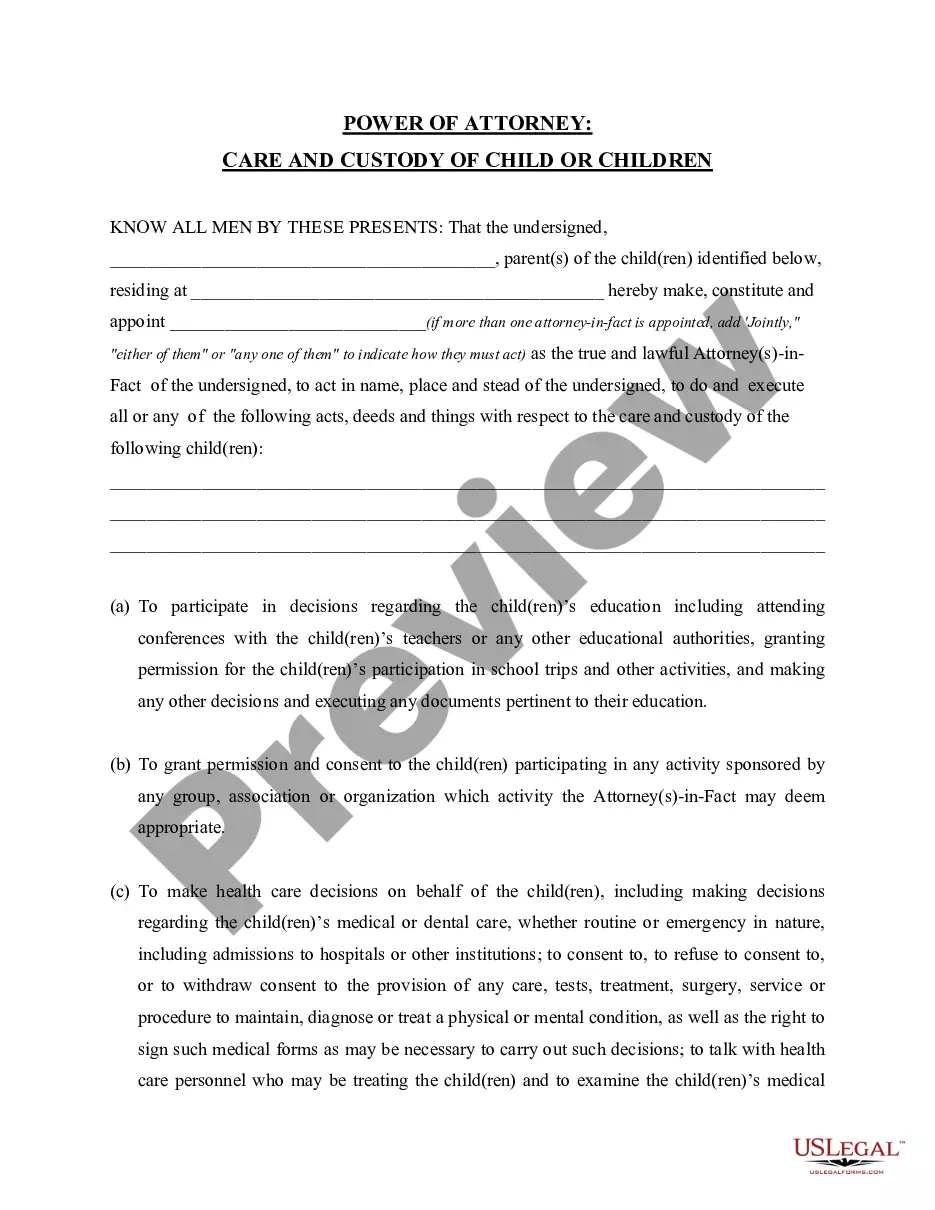
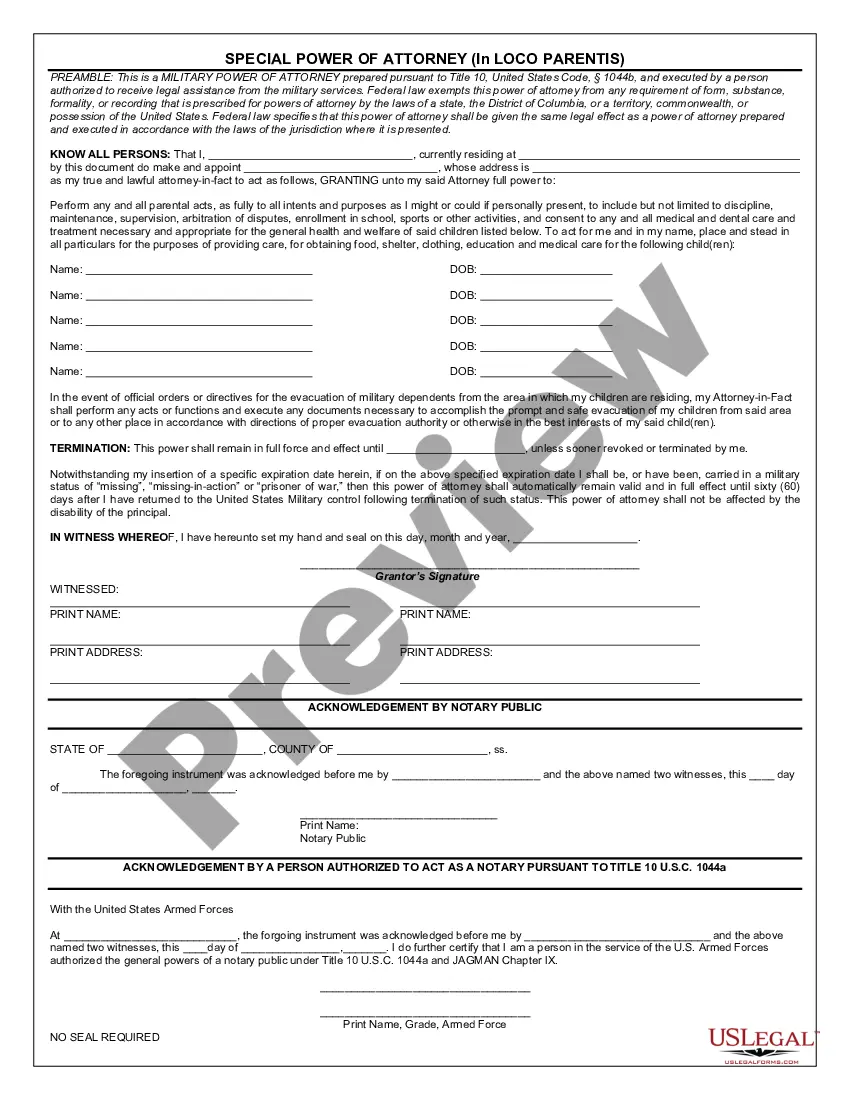
The General Power of Attorney for Care and Custody of Child or Children is a legal document that allows a parent or guardian to appoint an attorney-in-fact to make decisions regarding the care, custody, and education of their minor child or children. This power of attorney includes health care decision-making authority, which distinguishes it from other types of powers of attorney focused solely on financial matters or real estate. It provides peace of mind and ensures that designated individuals can act on behalf of the parent or guardian when needed.
Key parts of this document
- Identification of the parent(s) granting authority and the child(ren) involved.
- Appointment of one or more attorneys-in-fact with specific powers and responsibilities.
- Authority concerning education, including attending school meetings and giving permissions for activities.
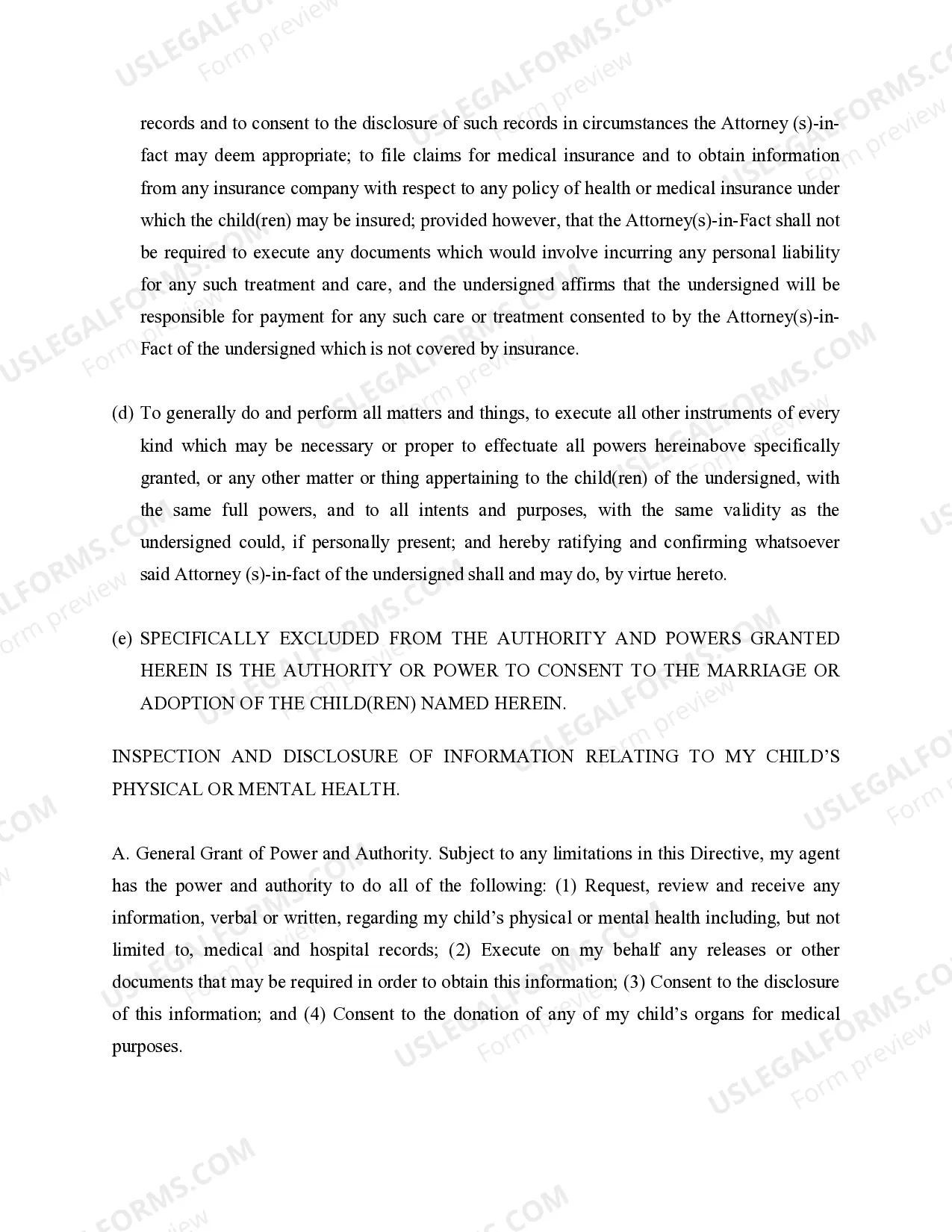
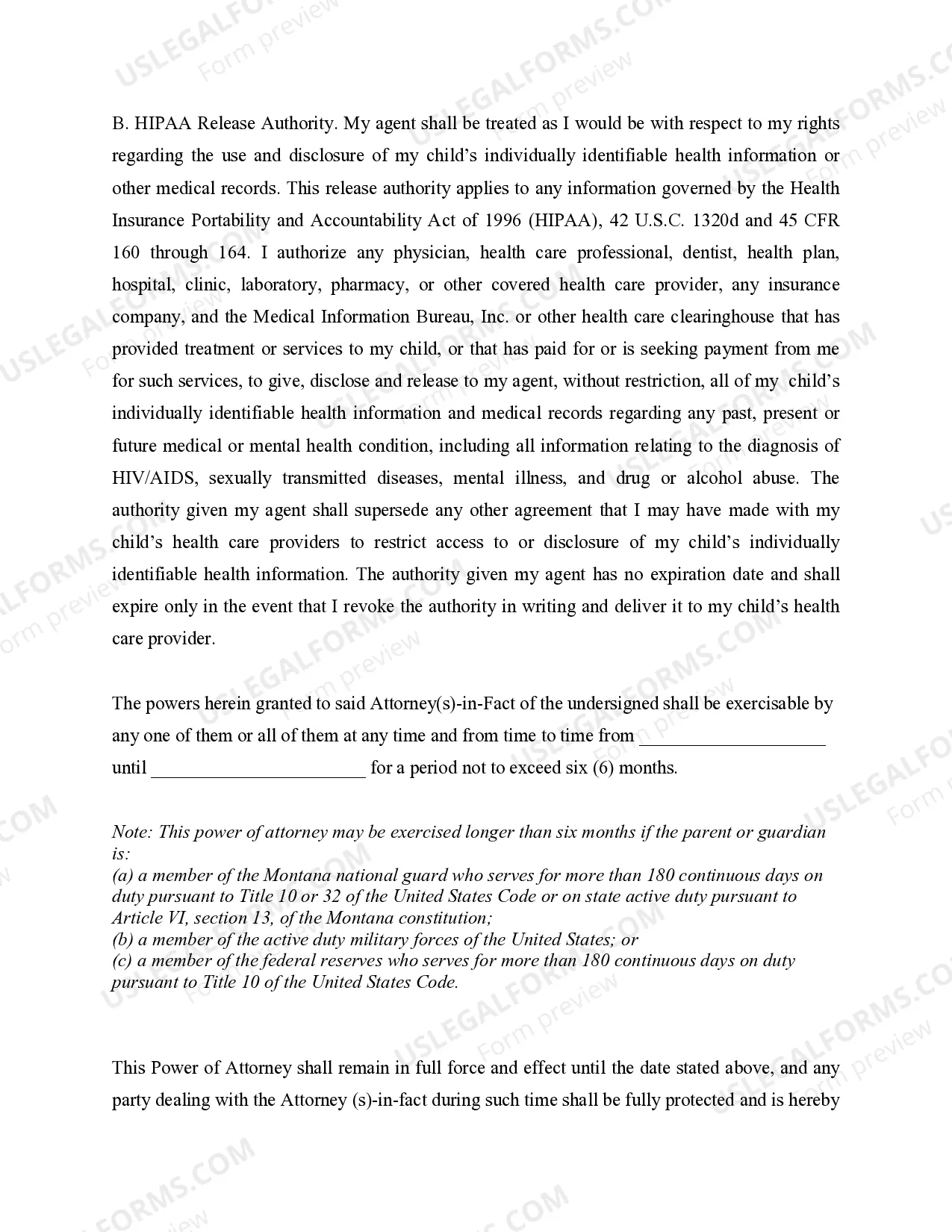
- Healthcare decision-making powers, including managing medical records and consent for treatments.
- Exclusions of powers, particularly concerning marriage or adoption of the child(ren).
- Notarization requirement for the document to enhance its legality.

Situations where this form applies
This form is useful in various situations where a parent or guardian may be unable to care for their child or children or make decisions on their behalf. Common scenarios include temporary absences due to work, travel, military deployment, or medical emergencies. It can also be used when a parent wants to delegate decision-making responsibilities to a trusted family member or friend for an extended period.
Intended users of this form
- Parents or legal guardians who need to appoint someone to make decisions for their children.
- Individuals preparing for military service who may not be available to care for their children.
- Parents planning travel who want to ensure someone can manage their childâs needs in their absence.
- Anyone seeking to give temporary custody and care responsibilities to a trusted person.
How to complete this form
- Identify the parent(s) providing the power of attorney and the child(ren) involved.
- Clearly appoint the attorney-in-fact, specifying if multiple attorneys are chosen.
- Detail the powers granted, including educational and health care decisions.
- Specify any exclusions of authority, particularly concerning marriage or adoption.
- Sign and date the document in the presence of a notary public to ensure validity.
Does this document require notarization?
Yes, this form must be notarized to be legally valid. This ensures that the identity of the signer is confirmed, and can protect against challenges to the power of attorney. US Legal Forms offers integrated online notarization, making it easy to complete the notarization process securely via video call and without needing to travel.
Get your form ready online
Our built-in tools help you complete, sign, share, and store your documents in one place.
Make edits, fill in missing information, and update formatting in US Legal Forms—just like you would in MS Word.
Download a copy, print it, send it by email, or mail it via USPS—whatever works best for your next step.
Sign and collect signatures with our SignNow integration. Send to multiple recipients, set reminders, and more. Go Premium to unlock E-Sign.
If this form requires notarization, complete it online through a secure video call—no need to meet a notary in person or wait for an appointment.
We protect your documents and personal data by following strict security and privacy standards.

Make edits, fill in missing information, and update formatting in US Legal Forms—just like you would in MS Word.

Download a copy, print it, send it by email, or mail it via USPS—whatever works best for your next step.

Sign and collect signatures with our SignNow integration. Send to multiple recipients, set reminders, and more. Go Premium to unlock E-Sign.

If this form requires notarization, complete it online through a secure video call—no need to meet a notary in person or wait for an appointment.

We protect your documents and personal data by following strict security and privacy standards.
Common mistakes
- Failing to specify all children involved, leading to potential confusion.
- Not providing detailed responsibilities, which can cause misunderstandings.
- Overlooking the notarization requirement, making the document unenforceable.
- Not communicating with the appointed attorney-in-fact about their role and responsibilities.
- Failing to update the form if circumstances change or after expiration.
Advantages of online completion
- Convenience of completing the form from home without needing legal appointments.
- Editability allows users to customize the document to their specific needs.
- Access to attorney-drafted templates, ensuring legal accuracy and compliance.
- Quick download and printing options for immediate use.
Key takeaways
- The General Power of Attorney for Care and Custody is vital for temporary delegations of parental authority.
- Understand who qualifies as an attorney-in-fact and the extent of their authority.
- Ensure the form is properly executed, including notarization, for it to be effective.
Looking for another form?
Form popularity
FAQ
Broadly speaking, you get power of attorney for a parent by having him or her name you as the agent in a POA document that he or she has signed while sound of mind. However, the process is rarely as simple as it seems, especially when it comes to ensuring that your power of attorney will be recognized by third parties.
Power of attorney gives someone other than a legal parent or guardian the right to make decisions about a child's welfare, but it does not establish legal custody. You can only modify legal custody through court proceedings.
A power of attorney over a child is a document signed and notarized by a parent giving a non- parent authority to make decisions for a minor child.It can be used to authorize the person to obtain medical treatment for a child or sign up a child for an activity or for other significant decisions.
They do not act for their own benefit under a power of attorney or make decisions that involve their own assets and finances.In other words, the attorney-in-fact does not become responsible for repaying the lender from the attorney-in-fact's personal funds if the principal runs out of money.
A Power of Attorney might be used to allow another person to sign a contract for the Principal. It can be used to give another person the authority to make health care decisions, do financial transactions, or sign legal documents that the Principal cannot do for one reason or another.
A power of attorney and a guardianship are tools that help someone act in your stead if you become incapacitated. With a power of attorney, you choose who you want to act for you. In a guardianship proceeding, the court chooses who will act as guardian.
A Durable Power of Attorney for Health Care allows you to appoint a person or persons to make health care decisions if you cannot act for yourself.A Durable Power of Attorney for Health Care is broader because it can apply to any condition you may have or treatment you may need.
A power of attorney is a legal document in which one person nominates and gives legal authority to another to act on affairs on their behalfi. In effect, a power of attorney allows you delegate the management of your affairs to someone you trustii.
An agent under a durable POA does not have any power until the principal is incapacitated. Once that happens, however, the designated individual must make health care decisions for the principal.