Missouri Letter from Tenant to Landlord containing Notice that premises leaks during rain and demand for repair
Understanding this form
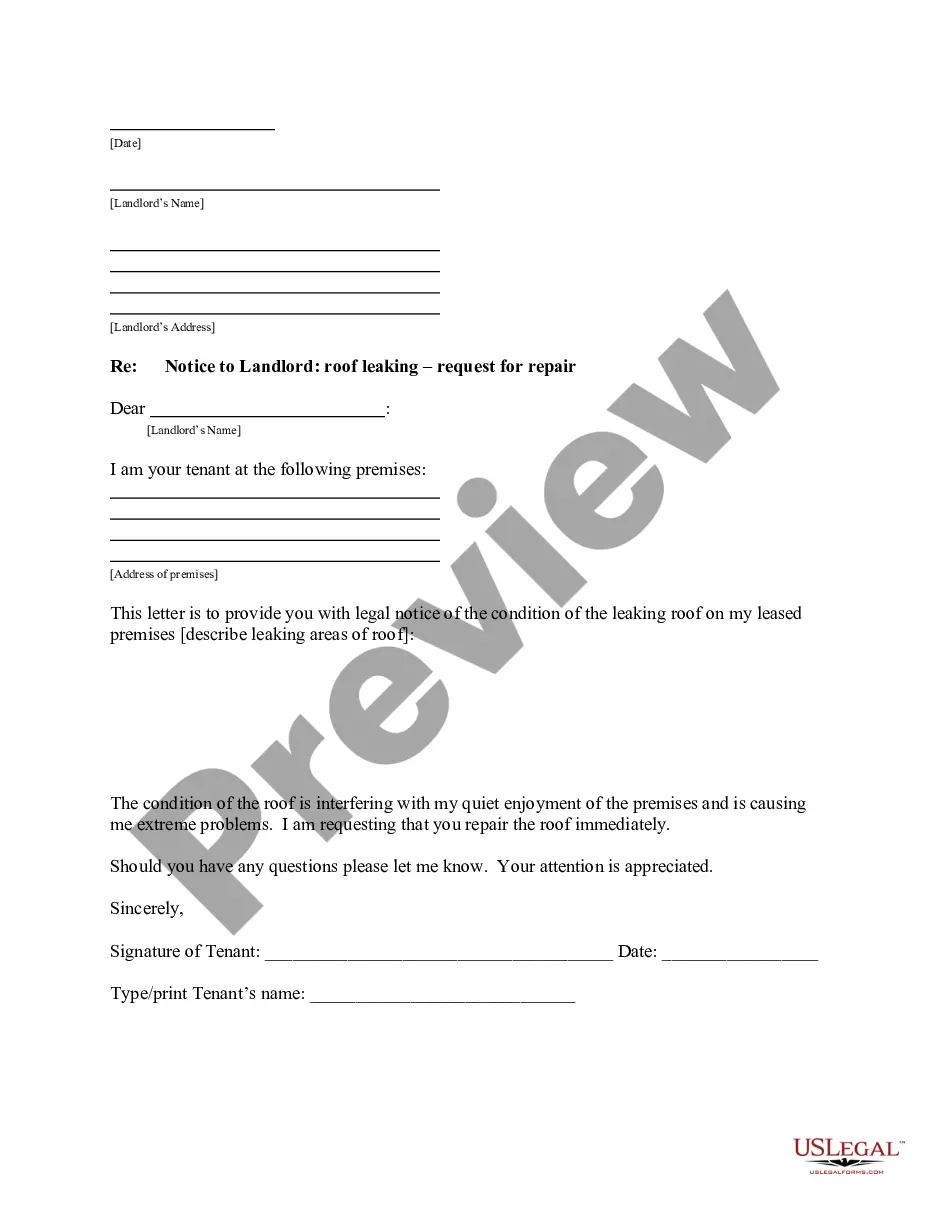
This letter from tenant to landlord serves as a formal notification regarding a leak in the premises during rain. It is designed to make a demand for repair as stipulated in the lease agreement. This form is essential for tenants to document issues and requests for maintenance, setting it apart from other forms which may cover different types of tenant-landlord communications.
Key parts of this document
- Identification of the tenant and landlord.
- Detailed description of the leak issue.
- Request for timely repairs as per the lease terms.
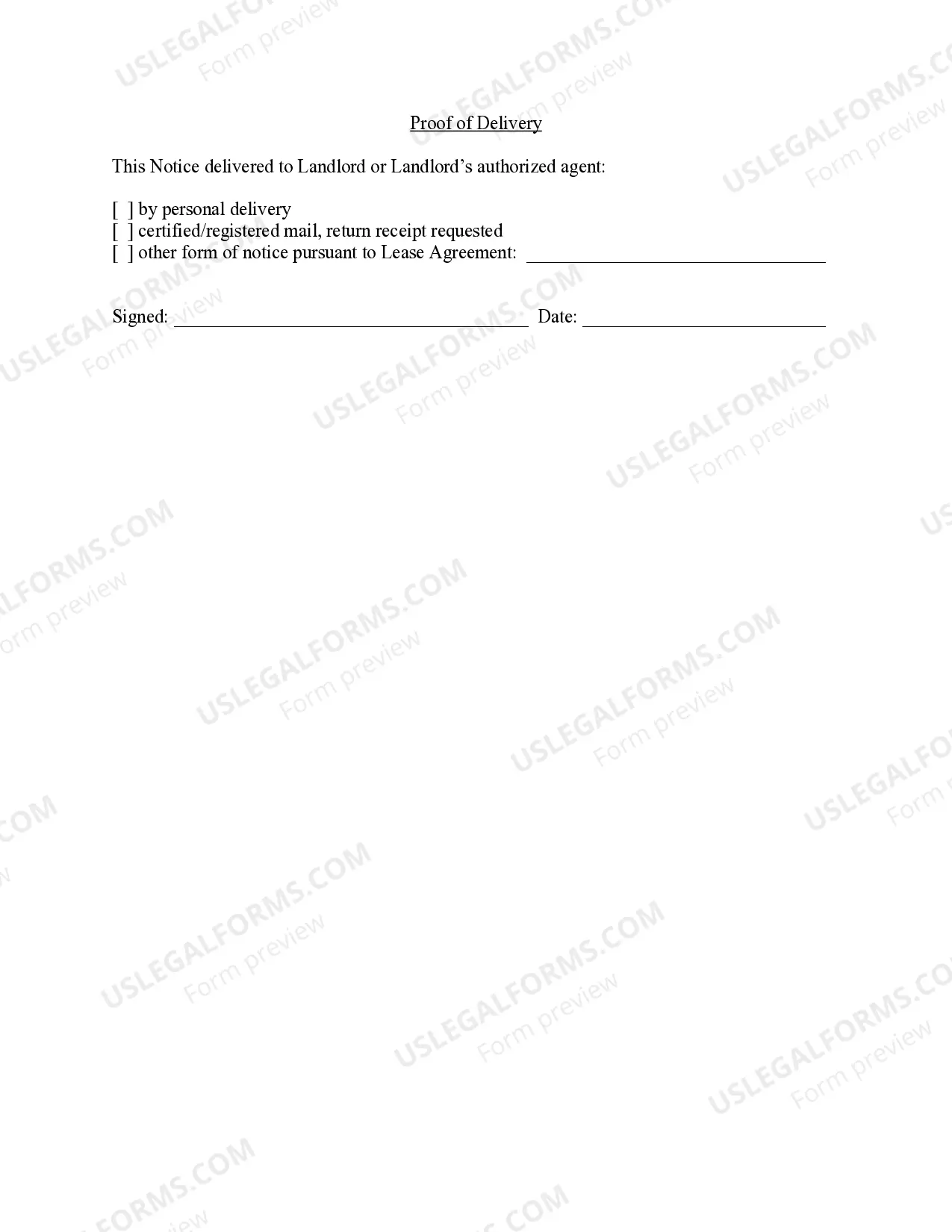
- Proof of delivery options for submitting the notice.
- Signature and date for tenant acknowledgement.

Common use cases
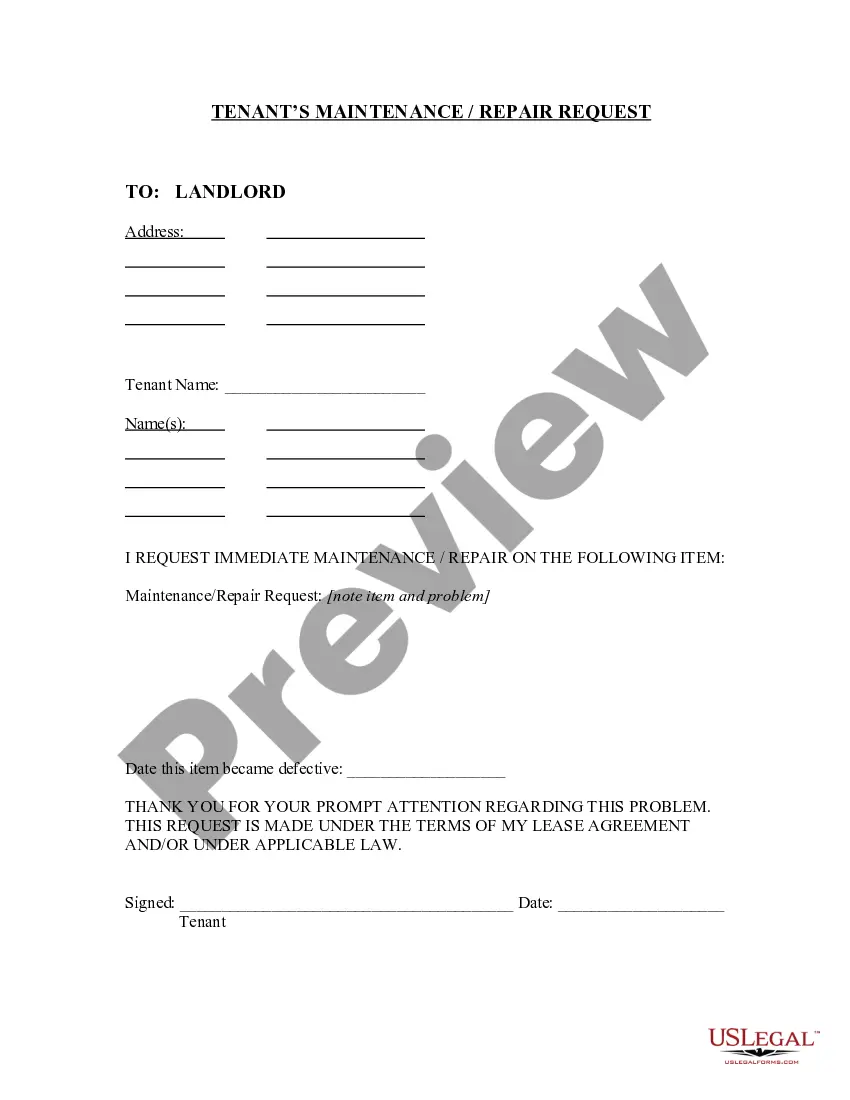
You should use this form when you, as a tenant, notice a leak in the roof or another part of the property that affects living conditions, especially during rain. This formal notice is vital for notifying your landlord about the issue and ensuring that repairs are demanded in a timely manner as required by your lease agreement.
Who needs this form
- Residential tenants who are experiencing leaks in their rental property.
- Tenants who have a lease that requires landlords to maintain the property.
- Individuals who wish to document their request for repairs formally.
How to complete this form
- Identify and enter the names of both the tenant and the landlord.
- Clearly describe the leak issue and its effects on the living conditions.
- Specify the date the notice is created and include the tenant's signature.
- Select the method of delivery for the notice and provide the required details.
- Ensure a copy of this notice is retained for your records.
Does this document require notarization?
This form does not typically require notarization to be legally valid. However, some jurisdictions or document types may still require it. US Legal Forms provides secure online notarization powered by Notarize, available 24/7 for added convenience.
Get your form ready online
Our built-in tools help you complete, sign, share, and store your documents in one place.
Make edits, fill in missing information, and update formatting in US Legal Forms—just like you would in MS Word.
Download a copy, print it, send it by email, or mail it via USPS—whatever works best for your next step.
Sign and collect signatures with our SignNow integration. Send to multiple recipients, set reminders, and more. Go Premium to unlock E-Sign.
If this form requires notarization, complete it online through a secure video call—no need to meet a notary in person or wait for an appointment.
We protect your documents and personal data by following strict security and privacy standards.

Make edits, fill in missing information, and update formatting in US Legal Forms—just like you would in MS Word.

Download a copy, print it, send it by email, or mail it via USPS—whatever works best for your next step.

Sign and collect signatures with our SignNow integration. Send to multiple recipients, set reminders, and more. Go Premium to unlock E-Sign.

If this form requires notarization, complete it online through a secure video call—no need to meet a notary in person or wait for an appointment.

We protect your documents and personal data by following strict security and privacy standards.
Common mistakes
- Failing to provide a detailed description of the leak.
- Not including the correct information for proof of delivery.
- Neglecting to sign and date the letter.
- Not following up with the landlord after sending the notice.
Benefits of using this form online
- Convenient access to downloadable legal forms that can be customized as needed.
- Time-saving options to fill out and save forms digitally.
- Increased reliability by using attorney-drafted templates.
Legal use & context
This letter serves to document a tenant's request for repairs and can be used as evidence if disputes arise regarding maintenance issues. It is important to use this form properly to ensure legal enforceability.
What to keep in mind
- Use this form to formally notify your landlord about a leaking problem.
- Document your requests, as it helps establish a record of communication.
- Follow local laws to ensure compliance and address issues promptly.
Looking for another form?



Form popularity
FAQ
A 14/30 notice in Missouri refers to the timeframe a landlord has to address significant issues after being notified. If a tenant submits a notice about necessary repairs, like leaks during rain, the landlord must respond within 14 days for urgent repairs. For less urgent issues, the timeframe extends to 30 days. Understanding this process can help you effectively communicate using a Missouri Letter from Tenant to Landlord containing Notice that premises leaks during rain and demand for repair.
To write a letter requesting repairs, begin with your contact information and that of your landlord. Clearly describe the problem, like leaks during rain, and outline when the issue began. Include any previous communication regarding the repairs and request a timeline for resolution. This approach aligns with a Missouri Letter from Tenant to Landlord containing Notice that premises leaks during rain and demand for repair.
In Missouri, uninhabitable living situations include severe water leaks, lack of heat, or plumbing issues that pose health risks. If your home has mold due to leaks or presents safety hazards, it may be deemed uninhabitable. As a tenant, you have the right to safe living conditions. If you encounter such issues, consider using a Missouri Letter from Tenant to Landlord containing Notice that premises leaks during rain and demand for repair to address the situation.
To write a demand letter to your landlord for repairs, start by clearly stating the issue, such as the leaks during rain. Include the date you first reported the problem and any previous communications. Use a formal tone, and specify your expectations for repair timelines. Finally, mention that this letter serves as a Missouri Letter from Tenant to Landlord containing Notice that premises leaks during rain and demand for repair.
State who you are and why you need a rental. Mention where you found their ad and how you can afford the rental. Offer to provide references (work/volunteer/housing office) Include some highlighting feature from the original ad so that when you receive a response you can remember which rental you are talking about (ex.
Today's Date. Landlord's Name. Property Address and Unit Number. State Your Desire to Move Out of the Apartment. Include Desired Move-Out Date. That You Expect the Return of Your Security Deposit Under State Law. A Forwarding Address Where Your Security Deposit Can Be Sent.
When a crime occurs at a rental property, the tenant is responsible for insuring his or her possessions, while the landlord is responsible for the premises and any damage incurred. The only exception would be in the highly unlikely event that the landlord could prove that you were somehow responsible for the damage.
Addresses. Date. Tenant names. Status and date of the lease. Why the eviction notice is served (clear and concise explanation) Date tenant must vacate the property. Proof of service or delivery of notice.
You can send your letter by email if your tenancy agreement says you can. You should say something like: I am giving 1 month's notice to end my tenancy, as required by law. I will be leaving the property on (date xxxxx).
Dear (Name of landlord or manager), This letter constitutes my written (number of days' notice that you need to give based on your lease agreement)-day notice that I will be moving out of my apartment on (date), the end of my current lease. I am leaving because (new job, rent increase, etc.)