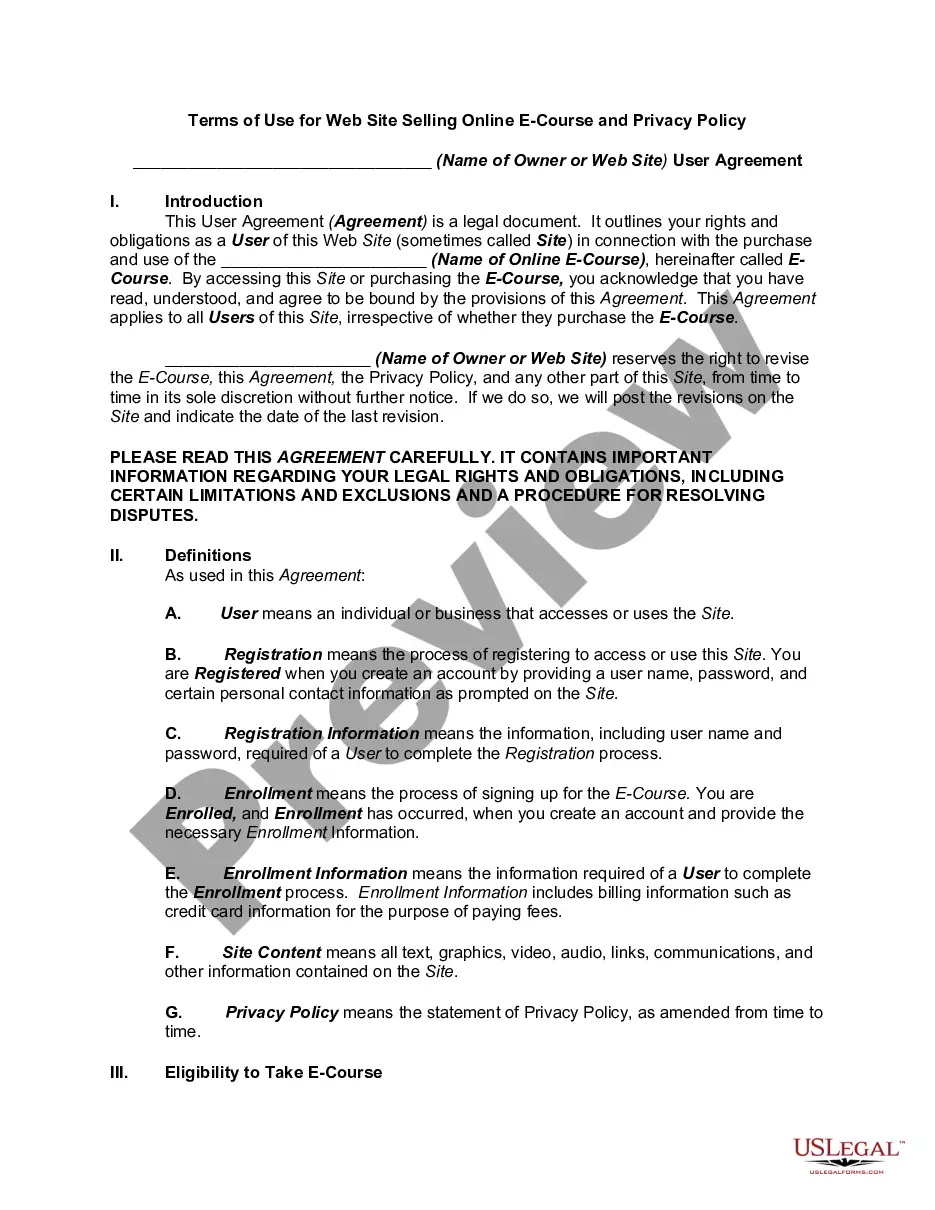
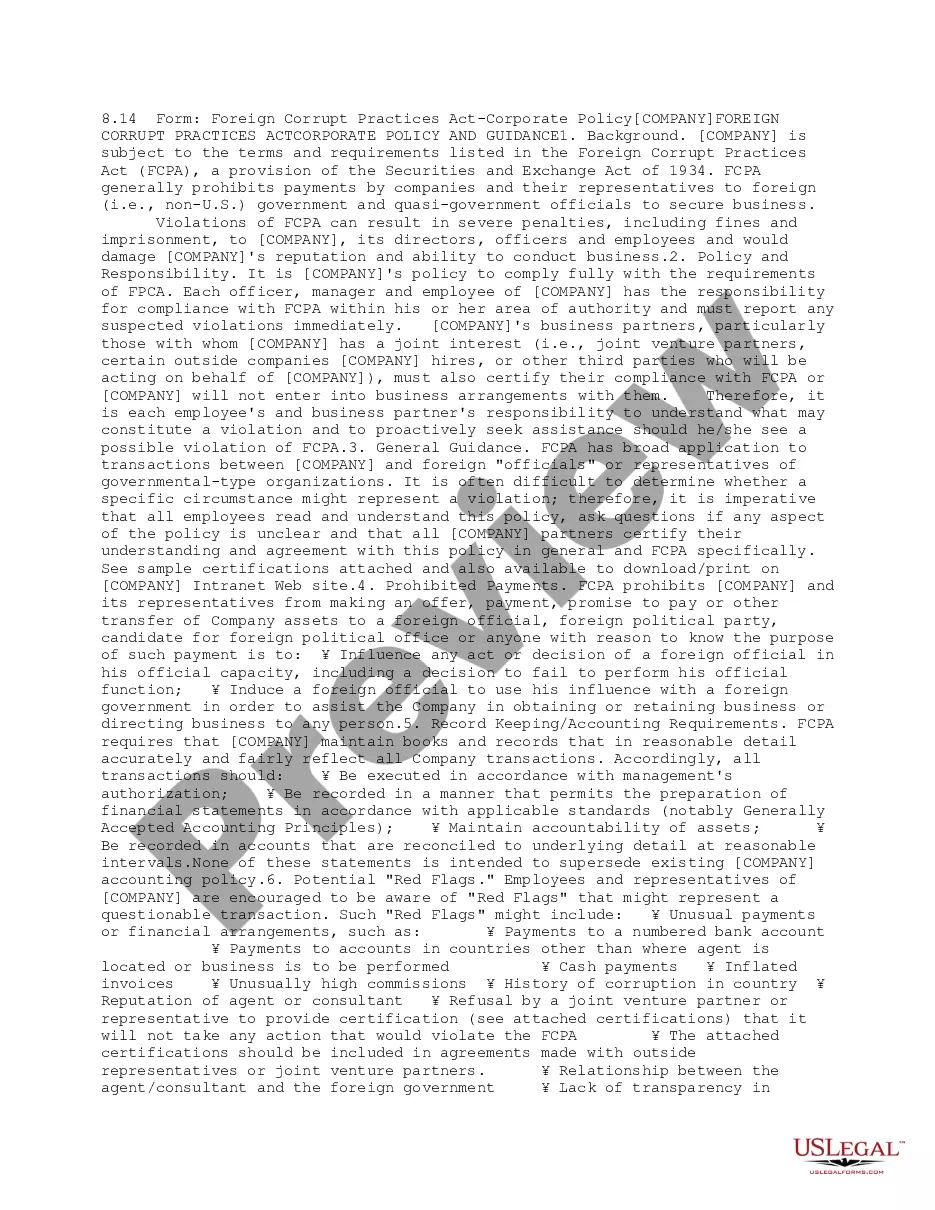
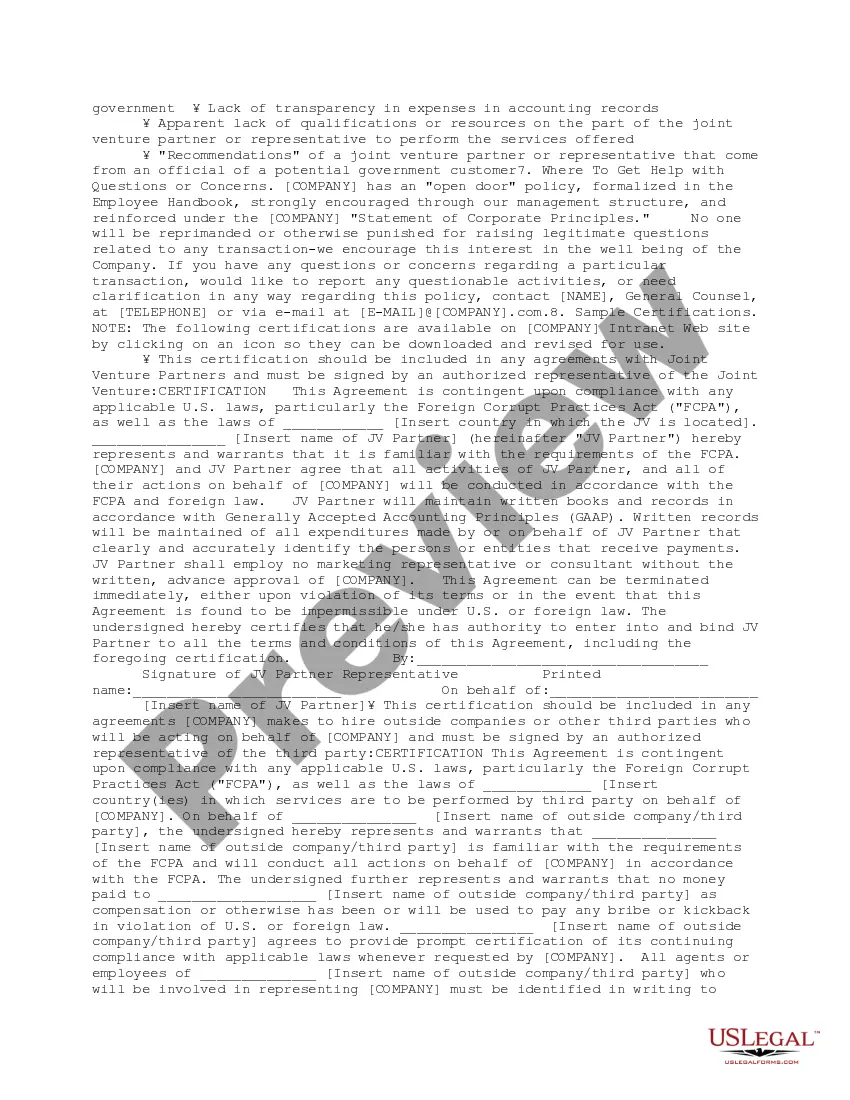
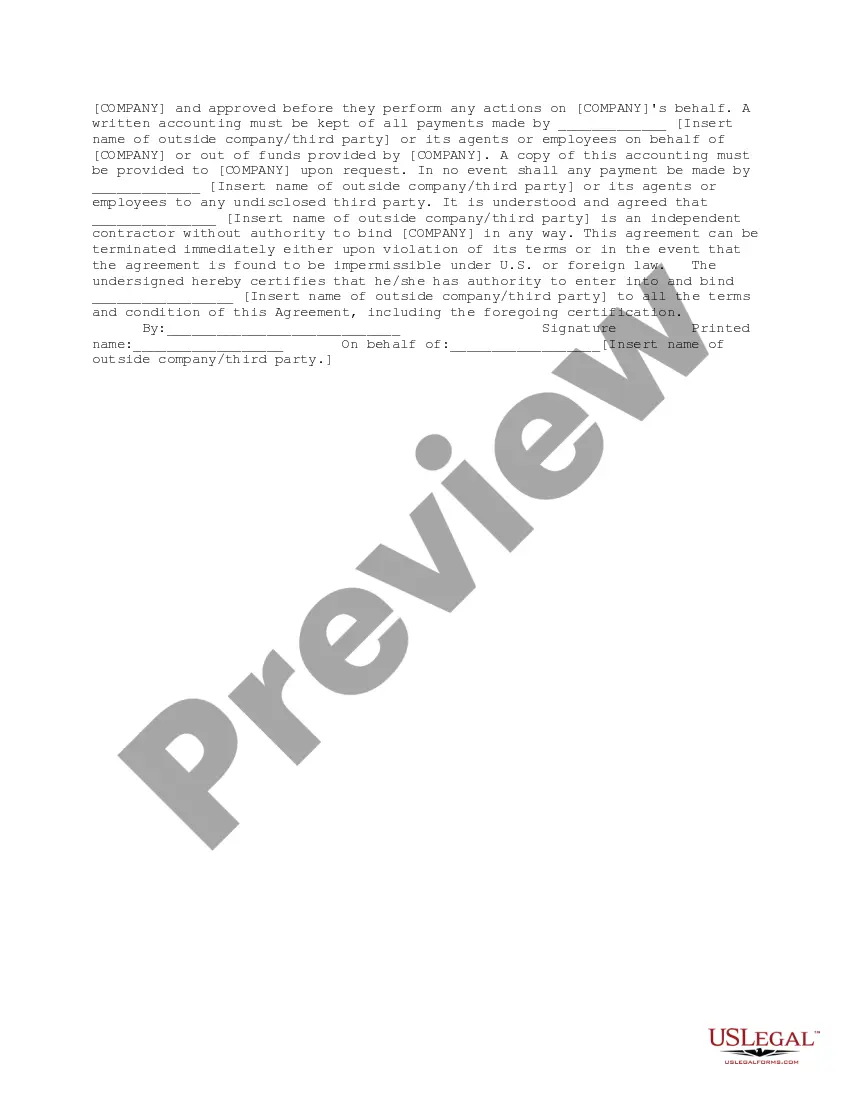
This is a corporate policy document designed to meet the standards of the Foreign Corrupt Practices Act, a provision of the Securities and Exchange Act of 1934. FCPA generally prohibits payments by companies and their representatives to foreign (i.e., non-U.S.) government and quasi-government officials to secure business.
Wayne Michigan Foreign Corrupt Practices Act - Corporate Policy
Category:
State:
Multi-State
County:
Wayne
Control #:
US-TC0814
Format:
Word;
PDF;
Rich Text
Instant download
Description
Free preview

How to fill out Foreign Corrupt Practices Act - Corporate Policy?
Creating documents, such as the Wayne Foreign Corrupt Practices Act - Corporate Policy, to manage your legal affairs is a challenging and time-intensive endeavor.
Numerous scenarios necessitate an attorney's involvement, which further adds to the expense of this undertaking.
Nevertheless, you can take control of your legal issues and oversee them independently.
The process of onboarding new users is quite uncomplicated! Here’s what you need to do prior to downloading the Wayne Foreign Corrupt Practices Act - Corporate Policy.
- US Legal Forms is here to assist you.
- Our platform offers over 85,000 legal templates tailored for various circumstances and life events.
- We guarantee that each document complies with the laws of each state, so you need not worry about potential compliance issues.
- If you are already familiar with our offerings and possess a subscription with US, you recognize how simple it is to access the Wayne Foreign Corrupt Practices Act - Corporate Policy form.
- Feel free to Log In to your account, download the template, and customize it to suit your requirements.
- Lost your document? No problem. You can retrieve it in the My documents section in your account - accessible on both desktop and mobile.
Form popularity
FAQ
Who Is Covered by the FCPA? The FCPA applies to two broad categories of persons: those with formal ties to the United States and those who take action in furtherance of a violation while in the United States. U.S. "issuers" and "domestic concerns" must obey the FCPA, even when acting outside the country.
The Foreign Corrupt Practices Act of 1977, as amended, 15 U.S.C. §§ 78dd-1, et seq. ("FCPA"), was enacted for the purpose of making it unlawful for certain classes of persons and entities to make payments to foreign government officials to assist in obtaining or retaining business.
A federal law prohibiting US citizens and permanent residents, both public and private US companies and certain non-US individuals and entities from bribing foreign government officials to obtain a business advantage (15 U.S.C. §§ 78dd-1 to 78qq).
The Foreign Corrupt Practices Act (FCPA), enacted in 1977, generally prohibits the payment of bribes to foreign officials to assist in obtaining or retaining business.
Anti-corruption laws like the FCPA promote ethical conduct. Companies that have comprehensive policies against bribery and corruption send a strong message to other companies and foreign officials that they are committed to aiding in the federal government's fight against corruption.
The Foreign Corrupt Practices Act (FCPA, the Act) is a United States law that prohibits U.S. firms and individuals from paying bribes to foreign officials to further business deals. The FCPA contains two main articles: The anti-bribery provisions.
Examples of FCPA accounting violations include failing to implement internal controls, to keep accurate books and records, to conduct appropriate audits of payments, and to implement sufficient anti-bribery compliance policies.
FCPA has two components, anti-bribery provisions and maintaining accurate books, records, and internal controls so bribes cannot be hidden.
FCPA Representation Ralph Lauren, Oracle, Eli Lilly, Pfizer, and Tyco, are but a few of the companies who have been charged with FCPA violations and paid millions of dollars in settlements. Investigations into violations of the act are conducted by specialized agents with the SEC's FCPA fraud unit.
U.S. "issuers" and "domestic concerns" must obey the FCPA, even when acting outside the country. An "issuer" is any company that has securities registered in the United States or is otherwise required to file periodic reports with the SEC.