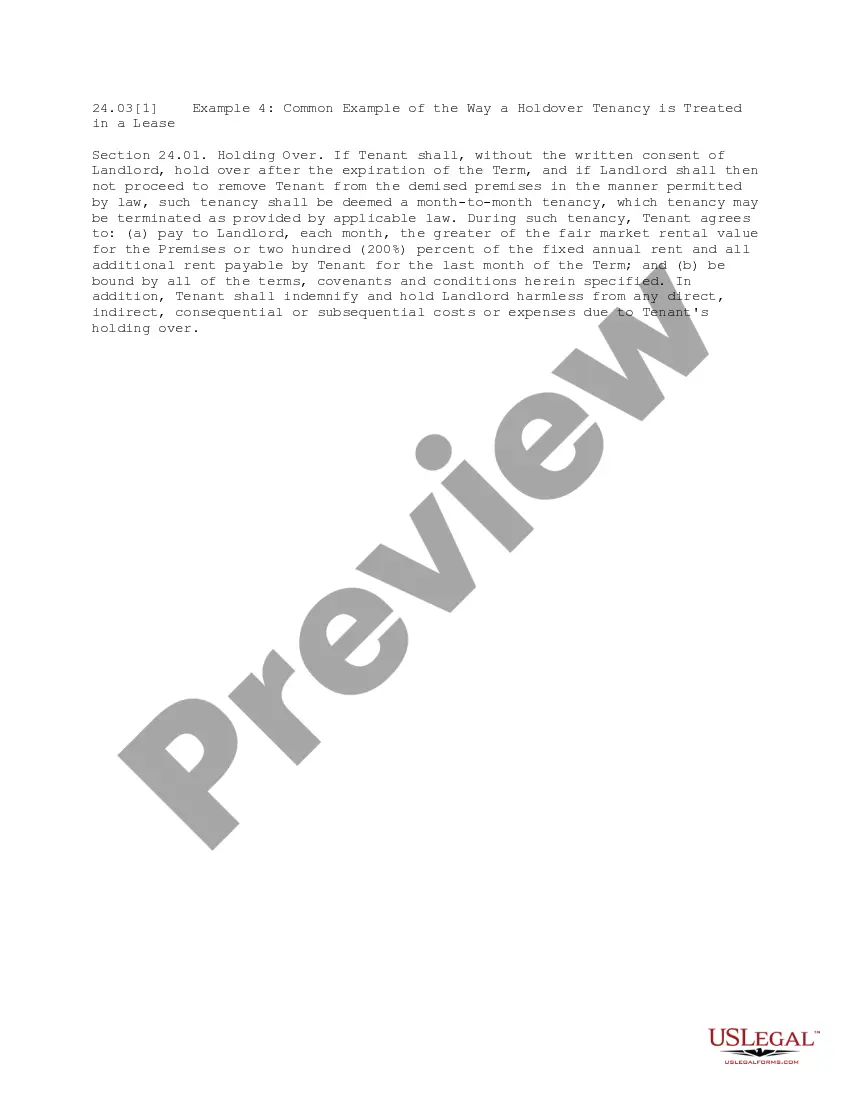
This office lease form states that if the tenant, without the written consent of Landlord, holds over after the expiration of the term of the lease, and if the landlord does not proceed to remove the tenant from the demised premises in the manner permitted by law, the tenancy will be deemed a month-to-month tenancy.
Sacramento California Addressing Holdover Tenancy in a Lease
State:
Multi-State
Category:
County:
Sacramento
Control #:
US-OL24031
Format:
Word;
PDF
67 downloads
Description
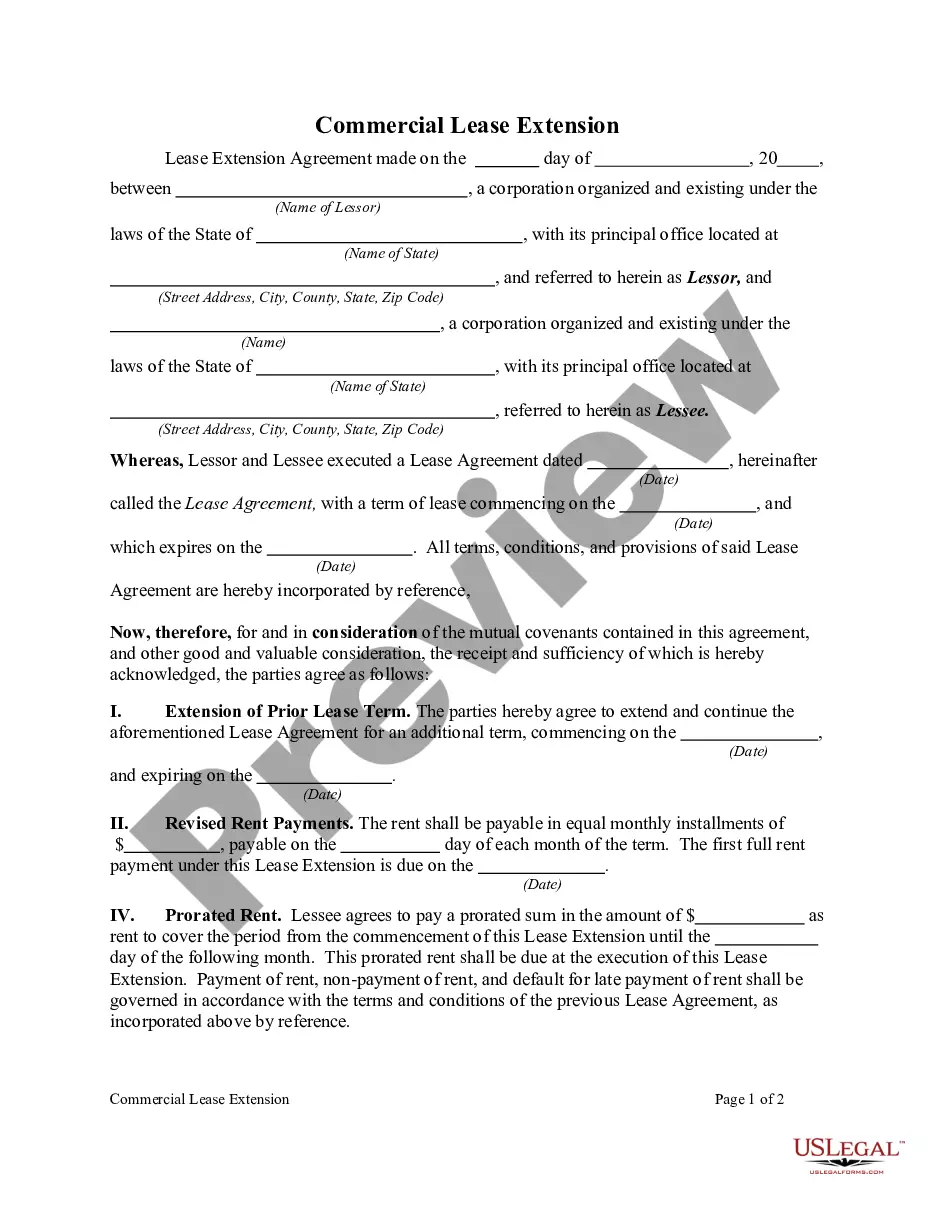
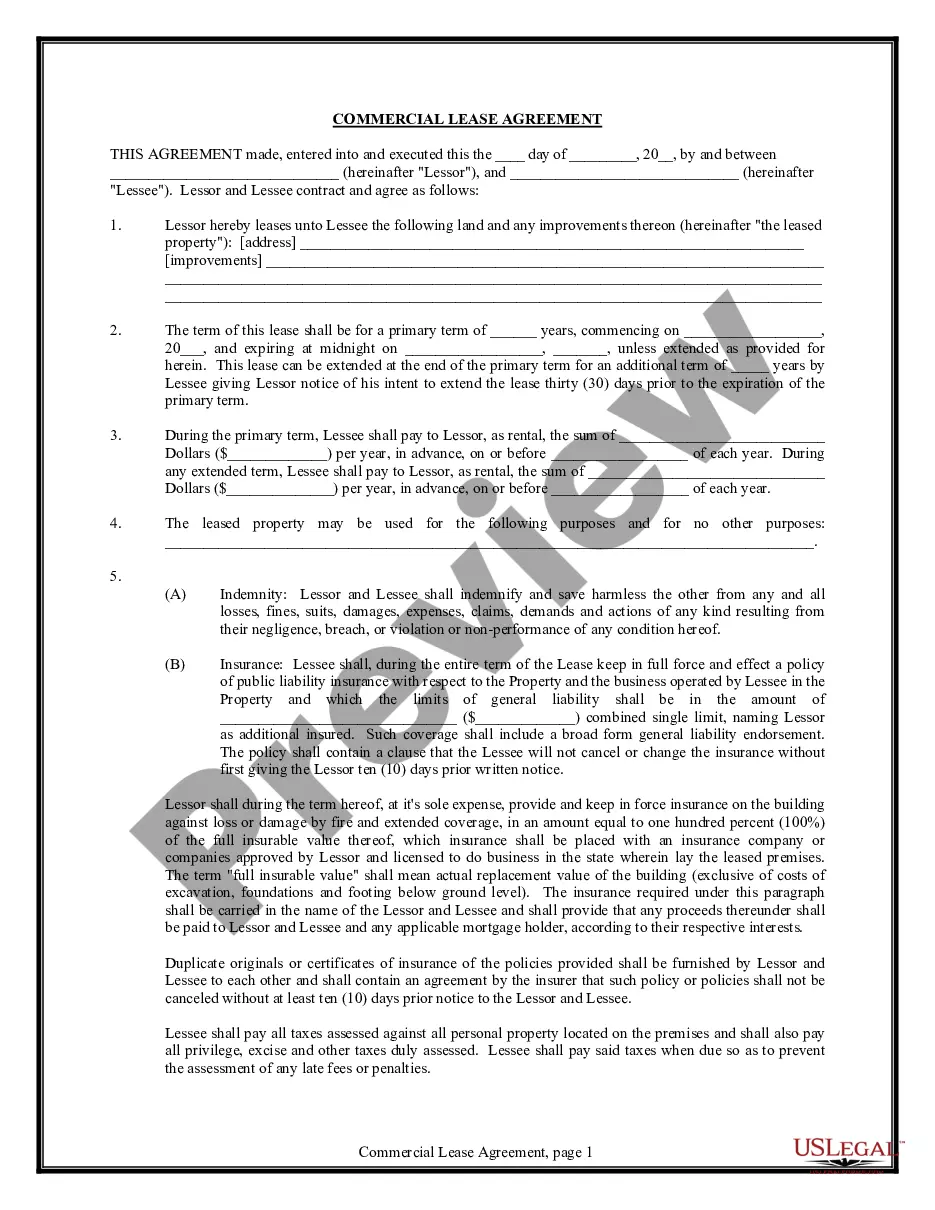
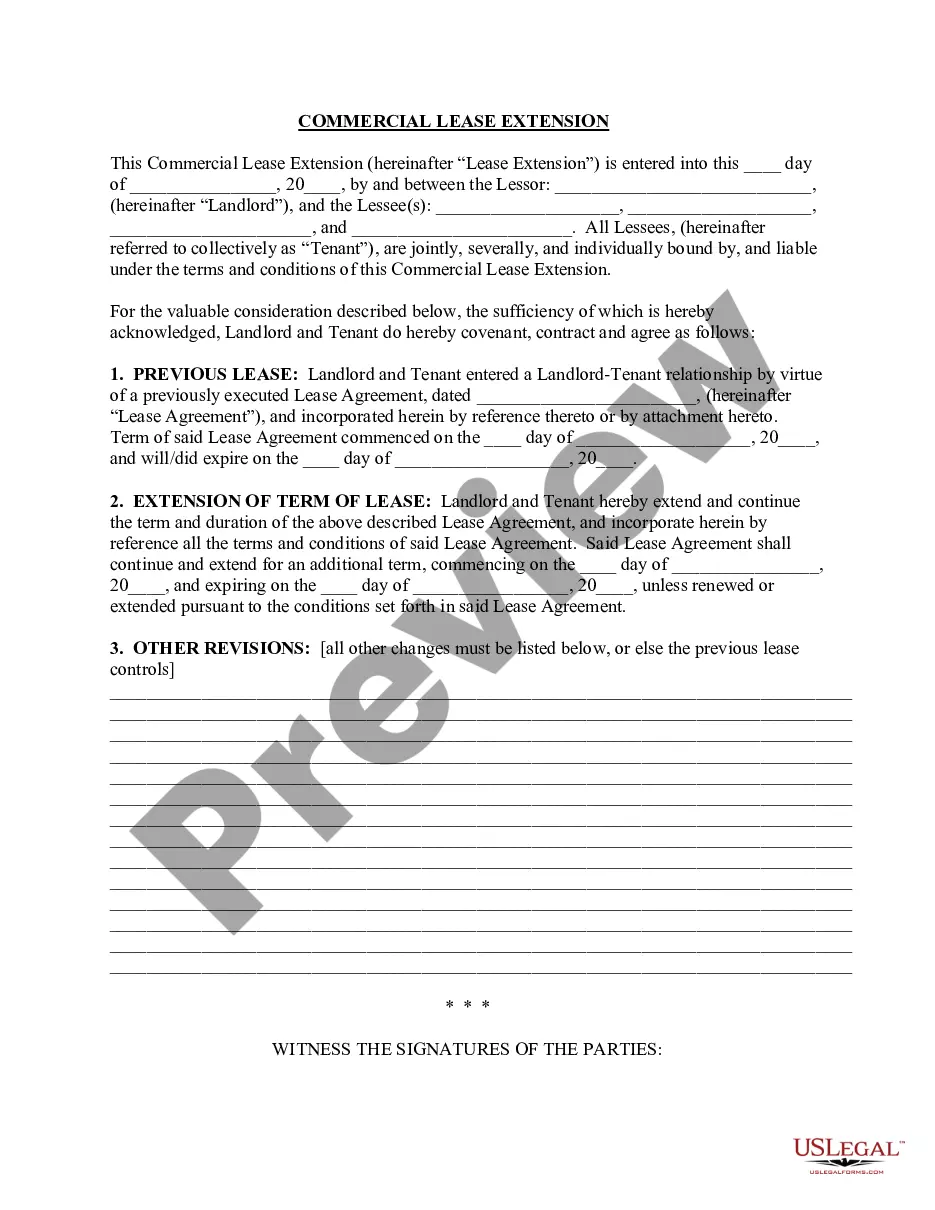
Get your form ready online
Our built-in tools help you complete, sign, share, and store your documents in one place.
Built-in online Word editor
Make edits, fill in missing information, and update formatting in US Legal Forms—just like you would in MS Word.
Export easily
Download a copy, print it, send it by email, or mail it via USPS—whatever works best for your next step.
E-sign your document
Sign and collect signatures with our SignNow integration. Send to multiple recipients, set reminders, and more. Go Premium to unlock E-Sign.
Notarize online 24/7
If this form requires notarization, complete it online through a secure video call—no need to meet a notary in person or wait for an appointment.
Store your document securely
We protect your documents and personal data by following strict security and privacy standards.

Make edits, fill in missing information, and update formatting in US Legal Forms—just like you would in MS Word.

Download a copy, print it, send it by email, or mail it via USPS—whatever works best for your next step.

Sign and collect signatures with our SignNow integration. Send to multiple recipients, set reminders, and more. Go Premium to unlock E-Sign.

If this form requires notarization, complete it online through a secure video call—no need to meet a notary in person or wait for an appointment.

We protect your documents and personal data by following strict security and privacy standards.
Looking for another form?
How to fill out Addressing Holdover Tenancy In A Lease?
Whether you intend to establish your business, engage in a transaction, request your identification modification, or address family-related legal matters, you must assemble specific documentation in compliance with your local statutes and regulations.
Locating the appropriate documents may require significant time and effort unless you utilize the US Legal Forms library.
The platform offers users access to over 85,000 professionally drafted and verified legal templates for any personal or business scenario. All documents are organized by state and area of use, making it quick and straightforward to select a copy such as Sacramento Addressing Holdover Tenancy in a Lease.
The forms provided by our library are reusable. With an active subscription, you can access all of your previously obtained documents at any time in the My documents tab of your account. Stop wasting time on an endless quest for current formal documentation. Join the US Legal Forms platform and maintain your paperwork in order with the most comprehensive online form library!
- Ensure the sample aligns with your personal requirements and state legal regulations.
- Review the form description and check the Preview if one is available on the page.
- Utilize the search feature specifying your state above to find another template.
- Click Buy Now to acquire the sample once you identify the correct one.
- Choose the subscription plan that best fits your needs to continue.
- Log in to your account and pay the service with a credit card or PayPal.
- Download the Sacramento Addressing Holdover Tenancy in a Lease in the desired file format.
- Print the copy or complete it and sign it electronically through an online editor to save time.
Form popularity
FAQ
over clause in a commercial lease typically provides that if a tenant remains in possession of the leased premises after the expiration of the stated lease term, the tenant must pay rent to the landlord in an amount substantially in excess of the rental rate at the end of the term often as high as 150 percent
If your lease expires, the landlord has to provide you with a 30-day, 60-day, or 90-day notice to leave, depending on how long you've been renting and if you're in subsidized housing. If you've been renting for less than a year, the landlord only needs to give you 30 days' notice.
Tenancy at Sufferance Failure to do so enables a tenant to stay in the property for 60 days after the lease ends under the same terms and conditions as the previous lease.
A landlord can evict a tenant after a lease is up if the lease is a fixed-term lease, or a lease for a specific period of time. The landlord does not have to give notice in this scenario. The landlord may file an unlawful detainer (eviction) case without giving notice first.
A tenancy at will can be terminated simply by either party letting the other know that they wish to end the tenancy, including by the tenant giving up possession or the landlord demanding it.
A holdover occurs when a tenant continues to occupy and use the premises after the term of the lease ends. If the landowner continues to accept rent payments, the holdover tenant can continue to legally occupy the premises.
You don't need to give a reason for your decision to not renew. Similarly, the landlord must give you a 30-day written notice if you've lived there less than one year, or a 60-day notice if you've lived there more than one year.
It doesn't matter if your lease has expired In California, residential rental agreements automatically convert to month-to-month tenancies at the end of your lease term.
On the other hand, you can choose to treat the holdover tenant as a trespasser. To do this, you must initially, and at all times, treat the tenant as a wrongful possessor of the property. And, to remove a holdover tenant from the rental property, you must then go through the eviction process.
Valid Reasons for Terminating a Lease and Evicting a Tenant In general, most states allow a landlord to terminate a lease or rental agreement if the tenant: Fails to pay rent; Violates a clause in the lease or rental agreement; Violates a responsibility imposed by law.