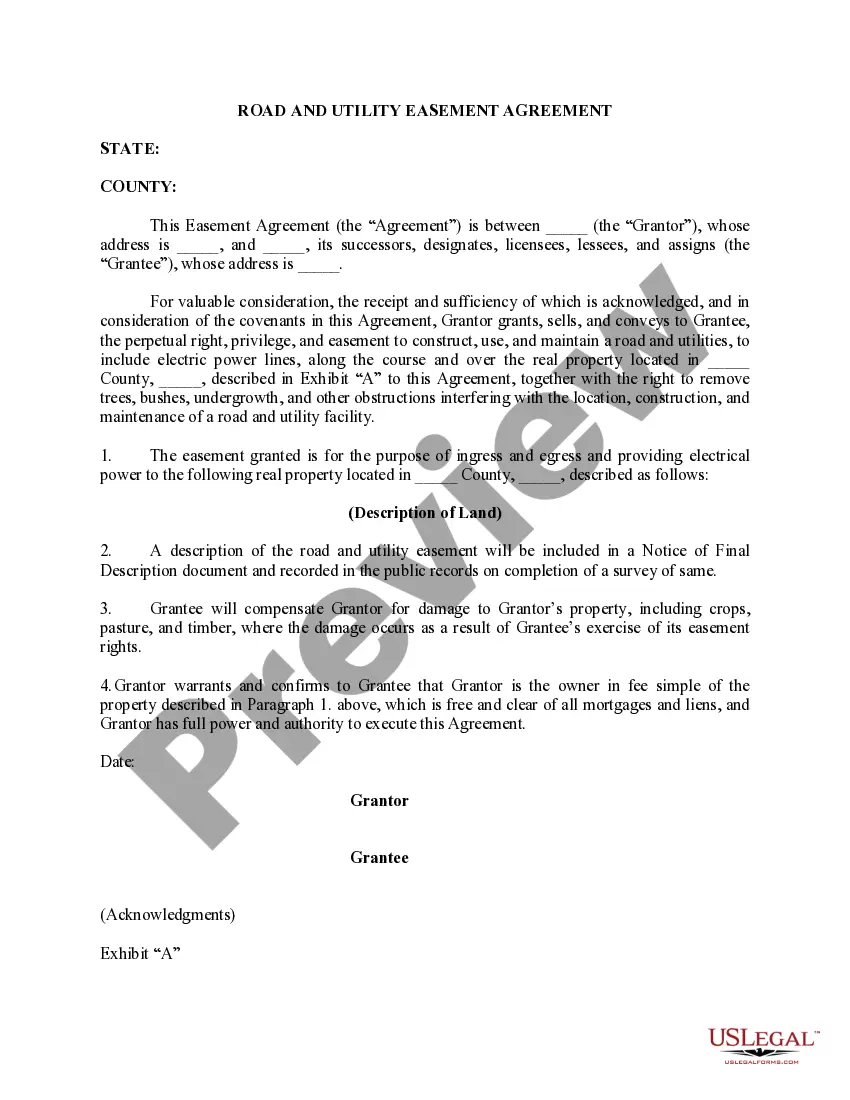
Hillsborough Florida Road and Utility Easement Agreement
Description
Get your form ready online
Our built-in tools help you complete, sign, share, and store your documents in one place.
Make edits, fill in missing information, and update formatting in US Legal Forms—just like you would in MS Word.
Download a copy, print it, send it by email, or mail it via USPS—whatever works best for your next step.
Sign and collect signatures with our SignNow integration. Send to multiple recipients, set reminders, and more. Go Premium to unlock E-Sign.
If this form requires notarization, complete it online through a secure video call—no need to meet a notary in person or wait for an appointment.
We protect your documents and personal data by following strict security and privacy standards.

Make edits, fill in missing information, and update formatting in US Legal Forms—just like you would in MS Word.

Download a copy, print it, send it by email, or mail it via USPS—whatever works best for your next step.

Sign and collect signatures with our SignNow integration. Send to multiple recipients, set reminders, and more. Go Premium to unlock E-Sign.

If this form requires notarization, complete it online through a secure video call—no need to meet a notary in person or wait for an appointment.

We protect your documents and personal data by following strict security and privacy standards.
Looking for another form?


How to fill out Road And Utility Easement Agreement?
Legislation and codes in every domain differ from jurisdiction to jurisdiction.
If you are not a lawyer, it can be challenging to navigate through numerous standards involved in creating legal documentation.
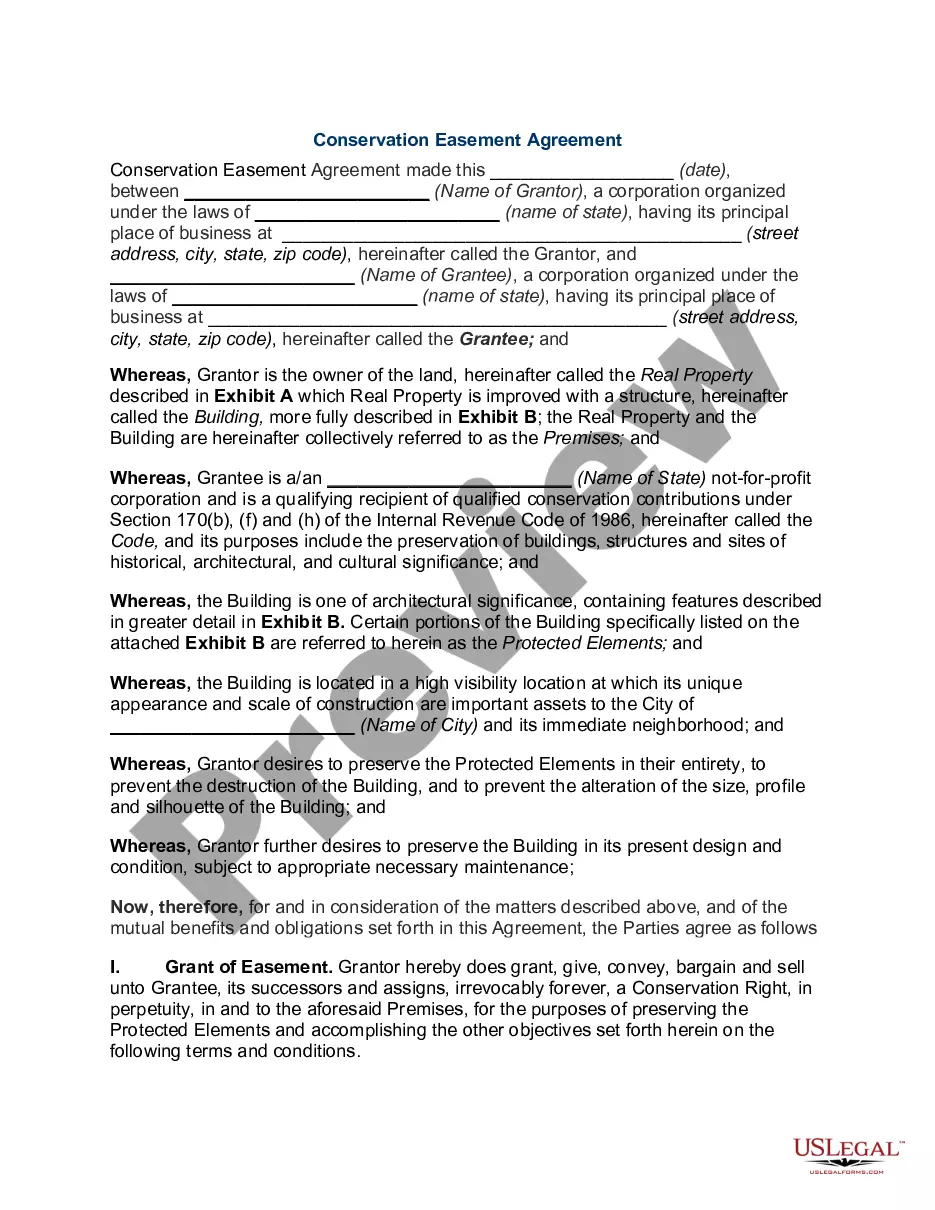
To prevent costly legal fees when drafting the Hillsborough Road and Utility Easement Agreement, you need a verified template valid for your county.
This is the easiest and most economical way to obtain current templates for any legal needs. Find them all in just a few clicks and maintain your paperwork organized with the US Legal Forms!
- Review the page content to confirm you have located the correct template.
- Make use of the Preview option or check the form description if available.
- Search for another document if there are discrepancies with any of your needs.
- Press the Buy Now button to acquire the document once you ascertain it is the correct one.
- Choose one of the subscription options and Log In or set up an account.
- Select how you wish to pay for your subscription (via credit card or PayPal).
- Pick the format in which you want to save the file and click Download.
- Complete and sign the document on paper after printing it or execute it all electronically.
Form popularity
FAQ
The land that has the easement on it is called the servient estate while the land that benefits from the easement is known as the dominant estate. These easements are attached to the land itself and pass from one person's ownership to another automatically.
There are several types of easements, including: utility easements. private easements. easements by necessity, and. prescriptive easements (acquired by someone's use of property).
Right-of-Way Width - The minimum right-of-way widths in all manufactured home rental communities shall not be less than sixty (60) feet for local roads, seventy (70) feet for collector roads, or eighty (80) feet for arterial roads.
Building Fences on Easements Fences regularly get built along or across easements. Homeowners who do this must expect the chance that their fence might be pulled down by a dominant estate (utility company, for example). A few utility companies state that, as a courtesy, they will do their best to reconstruct the fence.
Who is responsible for maintaining an easement? Usually, the owner of the easement is responsible for maintenance (20 Florida Jurisprudence 2d Easements section 49 2014). The parties to an express easement may alter their responsibilities by agreement.
Some widths may be less than 20 feet. Other Utilities: Power, cable, telephone, etc., require a minimum of a 10-foot easement, but may need more depending on the location of the easement.
Utility Easements and Homeowners Every utility company, such as Florida Power & Light, are given legal easements on the land over or under which their lines run. They are only allowed to use the property to gain access to their equipment, such as powerlines or electrical poles or towers.
Utility easements and cable easements are types of easements that attach to a property and are often 15 to 20 feet wide and allow the utility companies to use your property for a particular use.