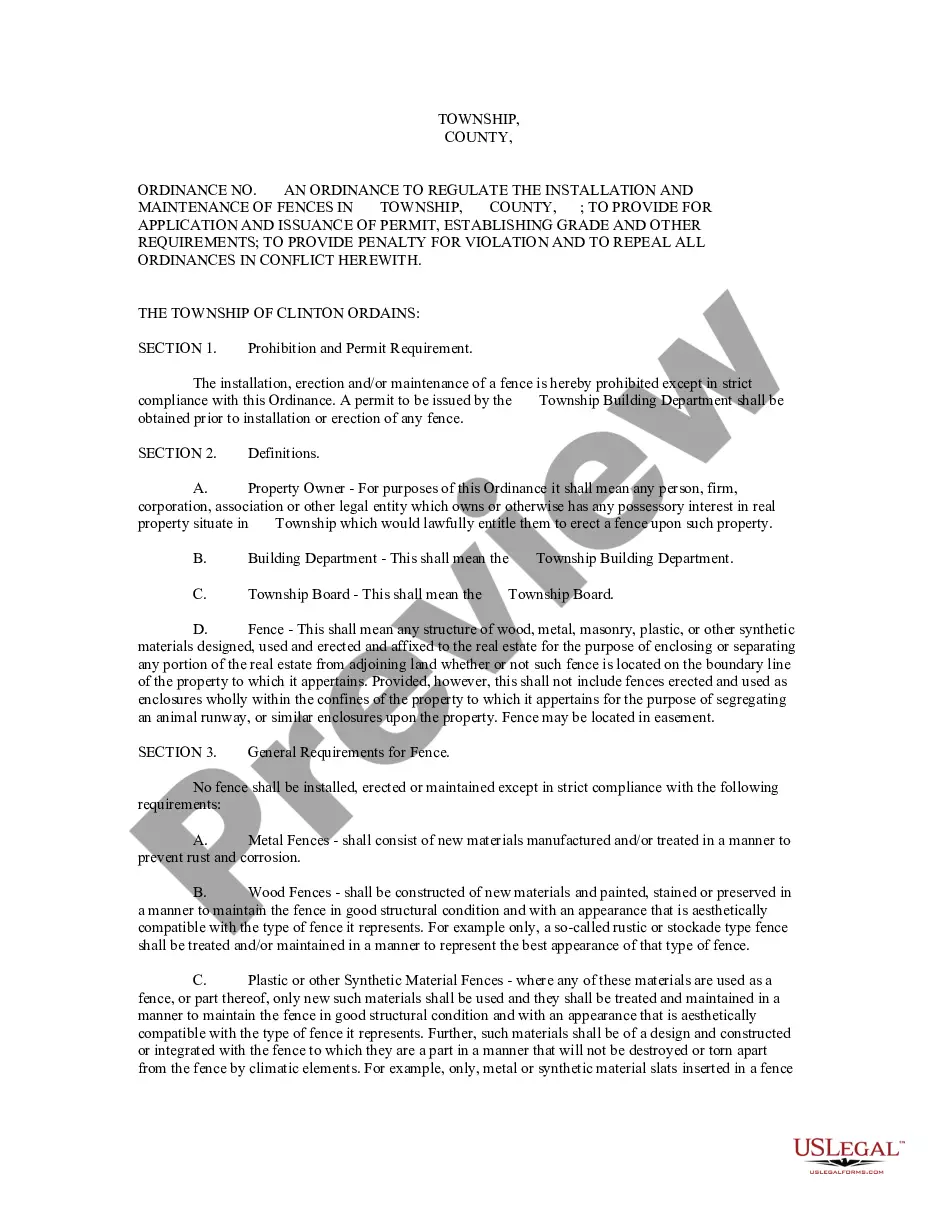
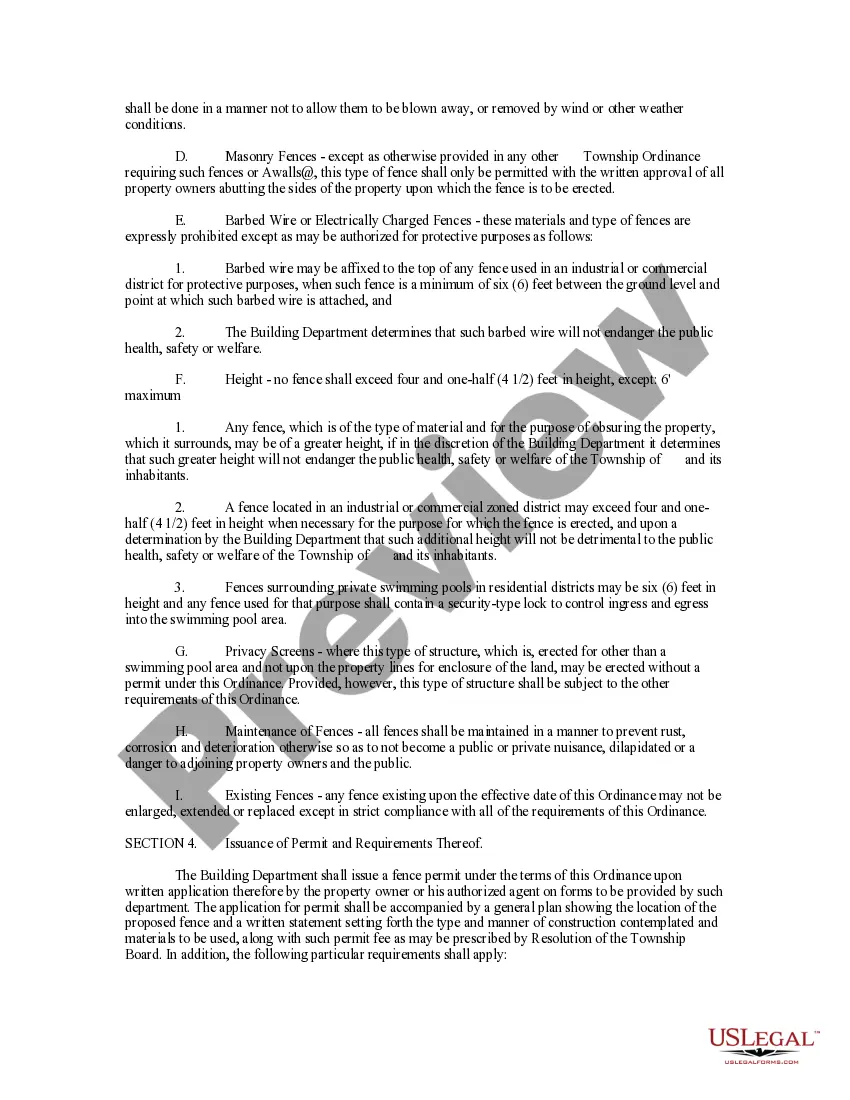
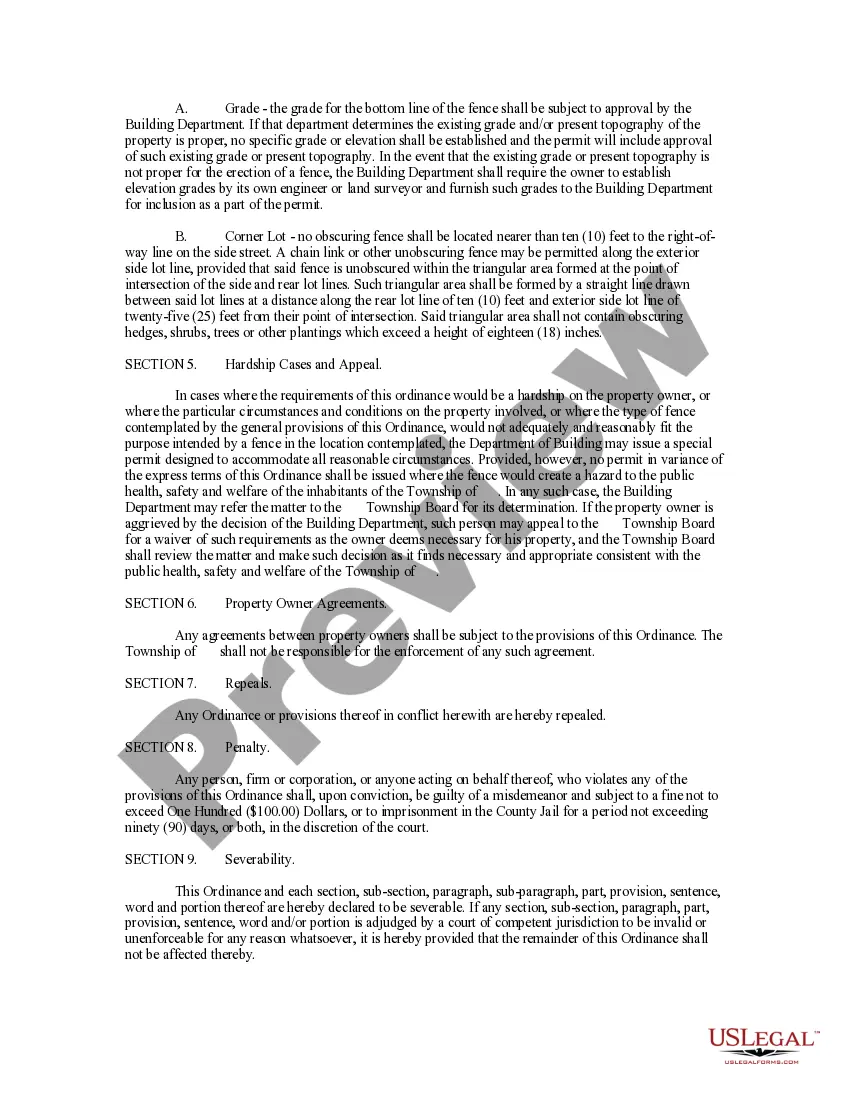
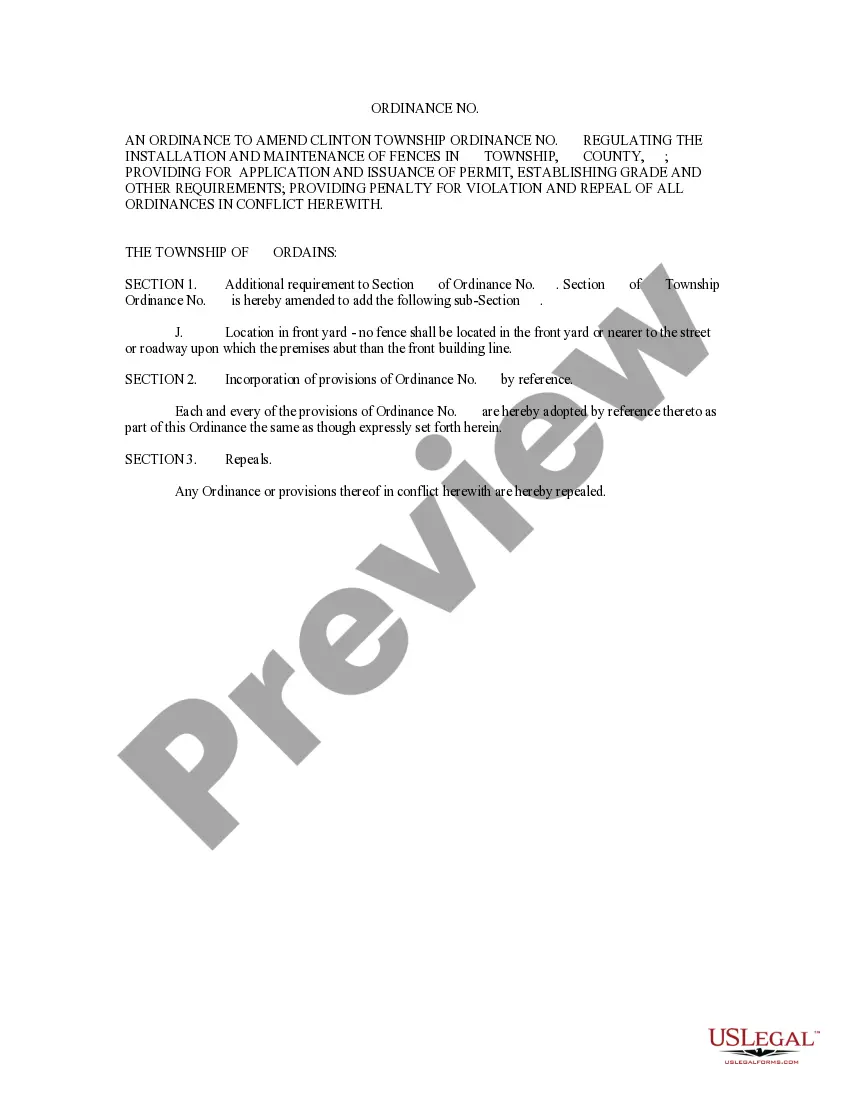
Collin Texas Fence Ordinance
Description
Get your form ready online
Our built-in tools help you complete, sign, share, and store your documents in one place.
Make edits, fill in missing information, and update formatting in US Legal Forms—just like you would in MS Word.
Download a copy, print it, send it by email, or mail it via USPS—whatever works best for your next step.
Sign and collect signatures with our SignNow integration. Send to multiple recipients, set reminders, and more. Go Premium to unlock E-Sign.
If this form requires notarization, complete it online through a secure video call—no need to meet a notary in person or wait for an appointment.
We protect your documents and personal data by following strict security and privacy standards.

Make edits, fill in missing information, and update formatting in US Legal Forms—just like you would in MS Word.

Download a copy, print it, send it by email, or mail it via USPS—whatever works best for your next step.

Sign and collect signatures with our SignNow integration. Send to multiple recipients, set reminders, and more. Go Premium to unlock E-Sign.

If this form requires notarization, complete it online through a secure video call—no need to meet a notary in person or wait for an appointment.

We protect your documents and personal data by following strict security and privacy standards.
Looking for another form?


How to fill out Fence Ordinance?
Are you aiming to swiftly generate a legally-binding Collin Fence Ordinance or perhaps another document for your personal or corporate needs? You have two choices: engage a legal professional to create a legitimate document for you or completely draft it by yourself.
The positive news is there’s an alternative - US Legal Forms. It will assist you in obtaining well-written legal documents without incurring exorbitant costs for legal services.
Start the search again if the form isn’t what you expected by using the search box in the header.
Select the plan that suits your requirements best and proceed to payment. Choose the file format for your document and download it. Print it out, fill it in, and sign where indicated. If you already have an account, you can seamlessly Log In, locate the Collin Fence Ordinance template, and download it. To re-obtain the file, just head to the My documents section. Finding and downloading legal forms is simple with our catalog. Additionally, the documents we provide are maintained and updated by industry specialists, boosting your confidence in handling legal matters. Try US Legal Forms today and experience it firsthand!
- US Legal Forms has an extensive collection of over 85,000 state-compliant form templates, which includes the Collin Fence Ordinance and form bundles.
- We supply documents for various purposes: from divorce filings to real estate contracts.
- With over 25 years in the industry, we've established a strong reputation among our clientele.
- Here’s how you can join them and acquire the needed template with minimal fuss.
- First and foremost, verify that the Collin Fence Ordinance aligns with your state or county regulations.
- If the document includes a description, ensure you understand its purpose.
Form popularity
FAQ
The building distance limit depends on the structure you intend on building. It usually ranges between five to 15 feet. It is important to communicate property boundaries with your neighbor before beginning any permanent or semi-permanent projects, due to the risk of township or county penalties.
Front-yard fences are now required to be at least 50 percent open. They cannot be over four feet in height. The fence must be constructed out of wood, brick, wrought iron, stone or masonry materials.
Customers having new fencing installed often ask us exactly where they should position their new fence. Getting it right avoids (potentially costly) disputes over encroachment in the future. As a rule of thumb, the outer face of the fence should be placed along the boundary. The posts should stand on your land.
In most cases, you can build a fence on an easement that runs through your property. However, the dominant estate (for example, the utility company) may need to take down the portion of the fence that runs over the easement for a certain activity, such as repairing the sewer main.
Yes. Yes, you can build next to your neighbour's fence. As long as you're inside your property line you're fine. One consideration: your posts might have to be staggered relative to the fence posts of the existing fence.
Without a neighbour's agreement, there is no right to build a wall over the boundary line.
Check Rules and Regulations Typically, fences are installed anywhere from 2 to 8 inches from a property line in most areas. Some areas might allow to go right up to a property line, especially if you live in an urban row house where every inch makes a difference!
Even where you will be installing the fence within your own property makes a difference. A privacy fence in your backyard will often not require a permit unless it is to be over 6 feet tall, depending on where you live, while the cut-off for the same type of fence in your front yard may be just 3.5 feet.
In most cases, if you add an outdoor structure such as a fence, you need a permit. However, it specifically depends on the codes, zoning and regulations of where you live. In some cases, you may not need a permit but you must adhere to the local regulations regarding height limits and specific fence materials.
You cannot build a "solid" fence over 8 feet high. A fence considered "ornamental" may be built higher than 8 feet.