Dallas Texas Musical Compositions Co-Publishing Agreement
Description

Get your form ready online
Our built-in tools help you complete, sign, share, and store your documents in one place.
Make edits, fill in missing information, and update formatting in US Legal Forms—just like you would in MS Word.
Download a copy, print it, send it by email, or mail it via USPS—whatever works best for your next step.
Sign and collect signatures with our SignNow integration. Send to multiple recipients, set reminders, and more. Go Premium to unlock E-Sign.
If this form requires notarization, complete it online through a secure video call—no need to meet a notary in person or wait for an appointment.
We protect your documents and personal data by following strict security and privacy standards.

Make edits, fill in missing information, and update formatting in US Legal Forms—just like you would in MS Word.

Download a copy, print it, send it by email, or mail it via USPS—whatever works best for your next step.

Sign and collect signatures with our SignNow integration. Send to multiple recipients, set reminders, and more. Go Premium to unlock E-Sign.

If this form requires notarization, complete it online through a secure video call—no need to meet a notary in person or wait for an appointment.

We protect your documents and personal data by following strict security and privacy standards.
Looking for another form?
How to fill out Musical Compositions Co-Publishing Agreement?
Preparing legal documents can be challenging.
Furthermore, if you opt to hire a legal expert to draft a business contract, ownership transfer documents, pre-nuptial agreement, divorce documents, or the Dallas Musical Compositions Co-Publishing Agreement, it could be quite expensive.
Browse through the page and confirm there is a sample for your area.
- What is the most sensible approach to conserve resources and create valid forms in full adherence to your state and local laws.
- US Legal Forms offers an excellent solution, whether you require templates for personal or commercial purposes.
- US Legal Forms boasts the largest online repository of state-specific legal documents, delivering users with the latest and professionally certified templates for every scenario compiled all in one location.
- Thus, if you are in need of the latest version of the Dallas Musical Compositions Co-Publishing Agreement, you can swiftly find it on our platform.
- Acquiring the documents requires minimal time.
- Those with existing accounts should verify their subscription is current, Log In, and choose the sample using the Download button.
- If you are not subscribed yet, here's how you can obtain the Dallas Musical Compositions Co-Publishing Agreement.
Form popularity
FAQ
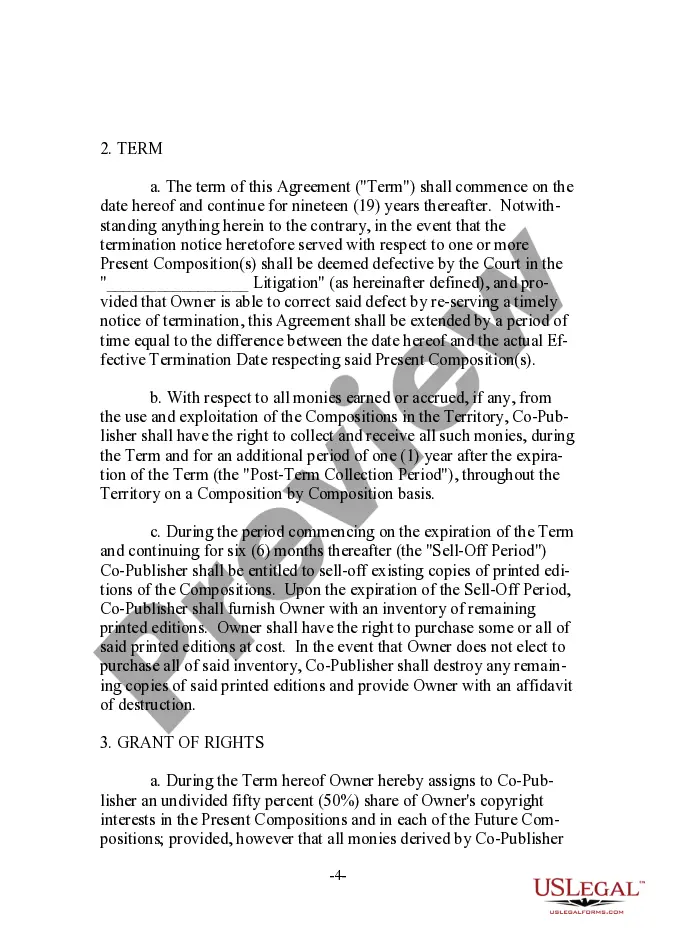
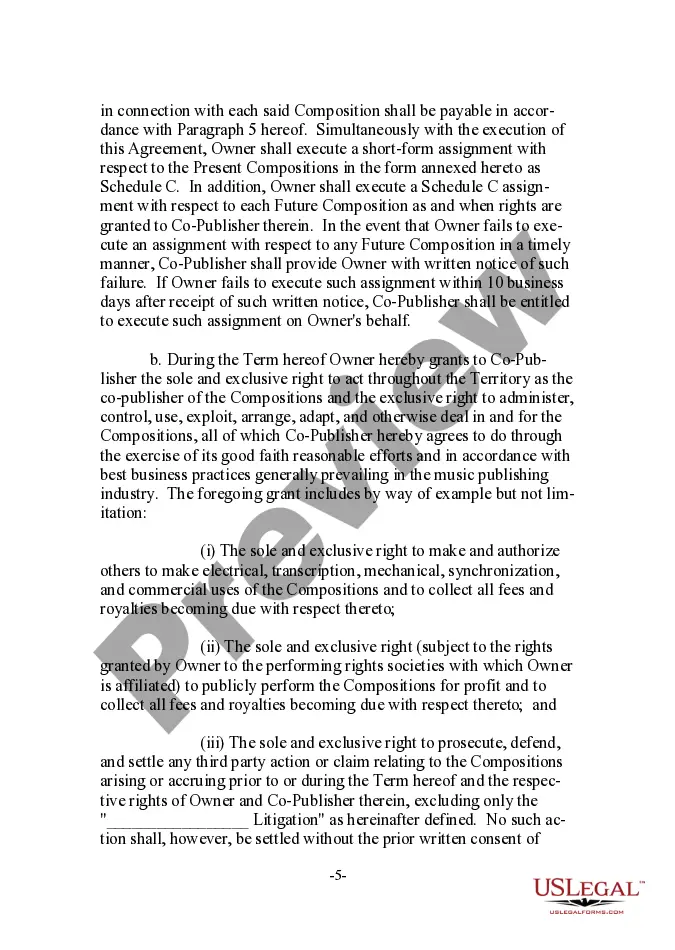
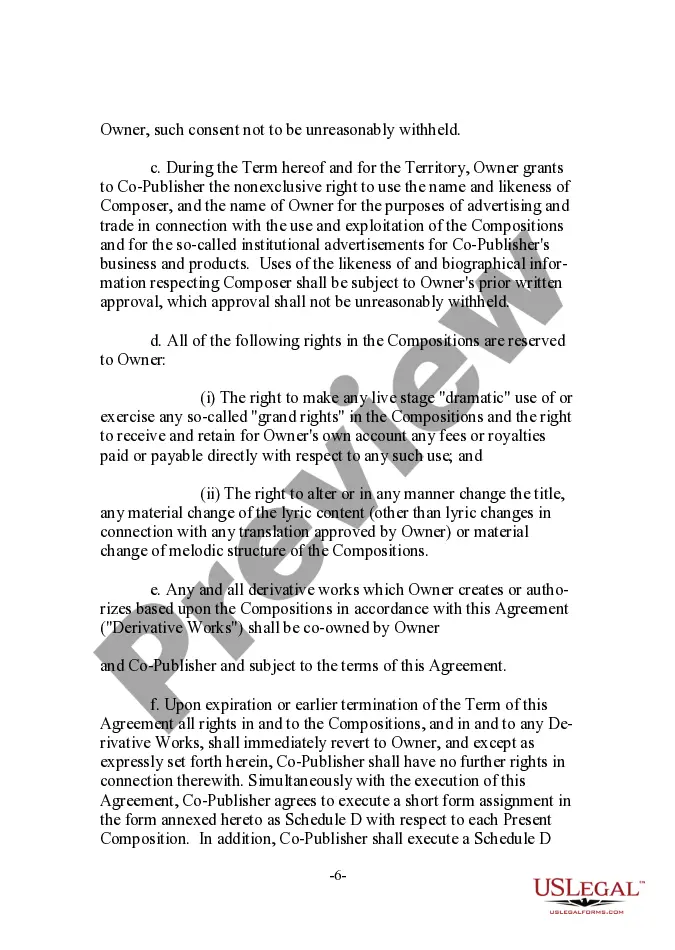
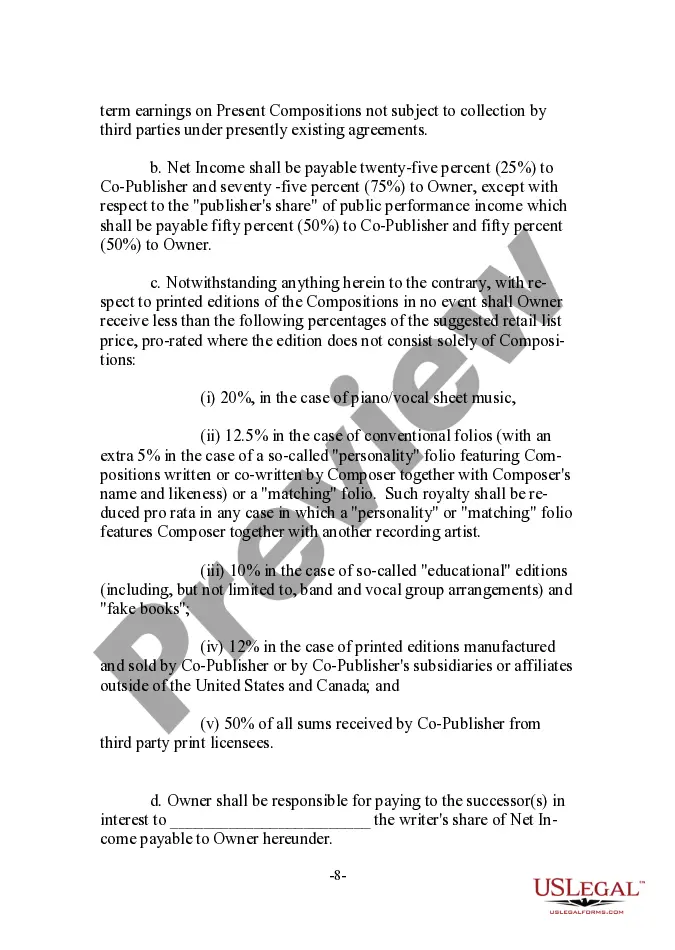
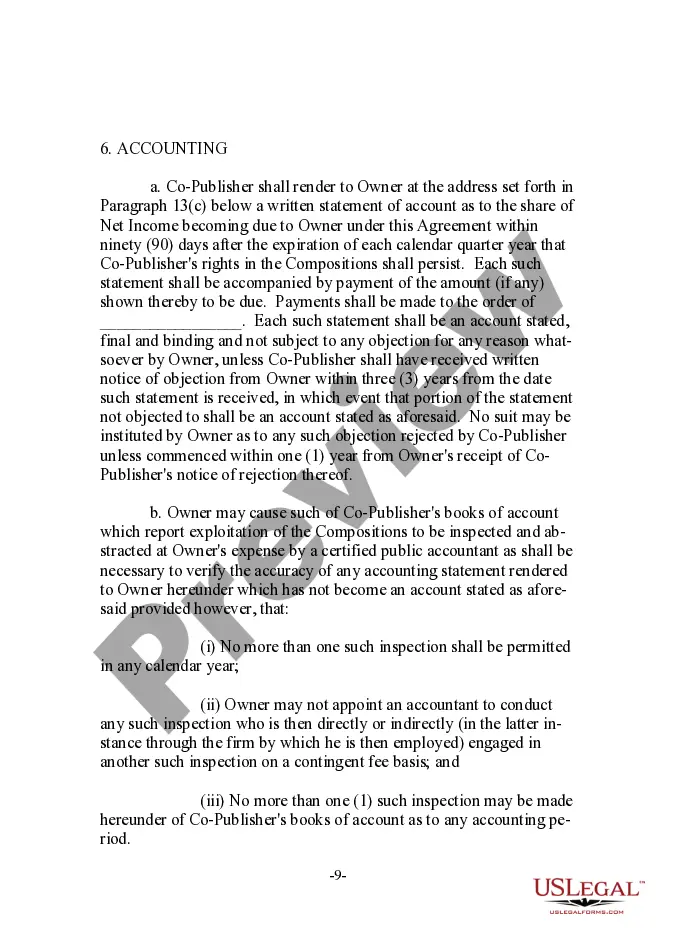
To secure a co-publishing deal, start by building relationships within the music industry to find potential partners. Prepare your best work and present it to publishers who are open to co-publishing arrangements. Knowledge of the Dallas Texas Musical Compositions Co-Publishing Agreement can also help you understand what to expect in terms of rights and royalties.
A traditional publishing deal typically assigns all rights to the publisher, while a co-publishing deal allows the songwriter to retain a portion of the rights. In a co-publishing agreement, both parties share revenues and responsibilities, making it a collaborative arrangement. Understanding the specifics of the Dallas Texas Musical Compositions Co-Publishing Agreement can help you better navigate these options.
CO-PUBLISHING DEALS A co-publishing deal is what its name implies you share the publishing with someone else (whether an individual or a company). You as the songwriter typically assign 50% of your publishing share over to this other entity in exchange (usually) for money.
In a typical publishing deal, the Music Publisher is usually paid 50% (the Publisher's share) of all mechanical and residual income, which is income from mechanical and synchronization royalties. For your performance income, since those monies are collected by PROs, the Music Publisher usually gets only 25%.
A: The standard composer deal is that you agree to sell the copyright to your music to the studio or production company in exchange for the ability to collect 100% of the writer's share of performance royalties (backend royalties), which you can collect through ASCAP, BMI, SESAC or GMR.
As stated above, the songwriter receives 50% of the performance and mechanical royalties. The other 50% is the publisher's share. Now, this doesn't mean that the publisher keeps 50% of the royalties it just means that it's the publisher's duty to collect this share.
Royalty Splits All music publishing income is split 50/50 between the songwriter and the publisher. This is typically referred to as the writer share and publisher share of income. No matter how many writers and publishers, the publishing royalties are split in this way.
Publishers are responsible for representing composers, songwriters, and lyricists the authors of the musical works making sure that they get compensated for the commercial use of their intellectual property.
What is a Publishing Deal? In general terms, a typical publishing deal involves the assignment of some part of the ownership of your songs to a publishing company in exchange for a share of the royalties received by the publisher for exploitation of the songs.
Music Publishing Deals Explained Whenever the song is created, there are two equal shares of royalties attached to it. So, even if there's just a single writer working on a song, the composition will be split into two parts: the writer's share and the publisher's share, each worth 50% of the composition.