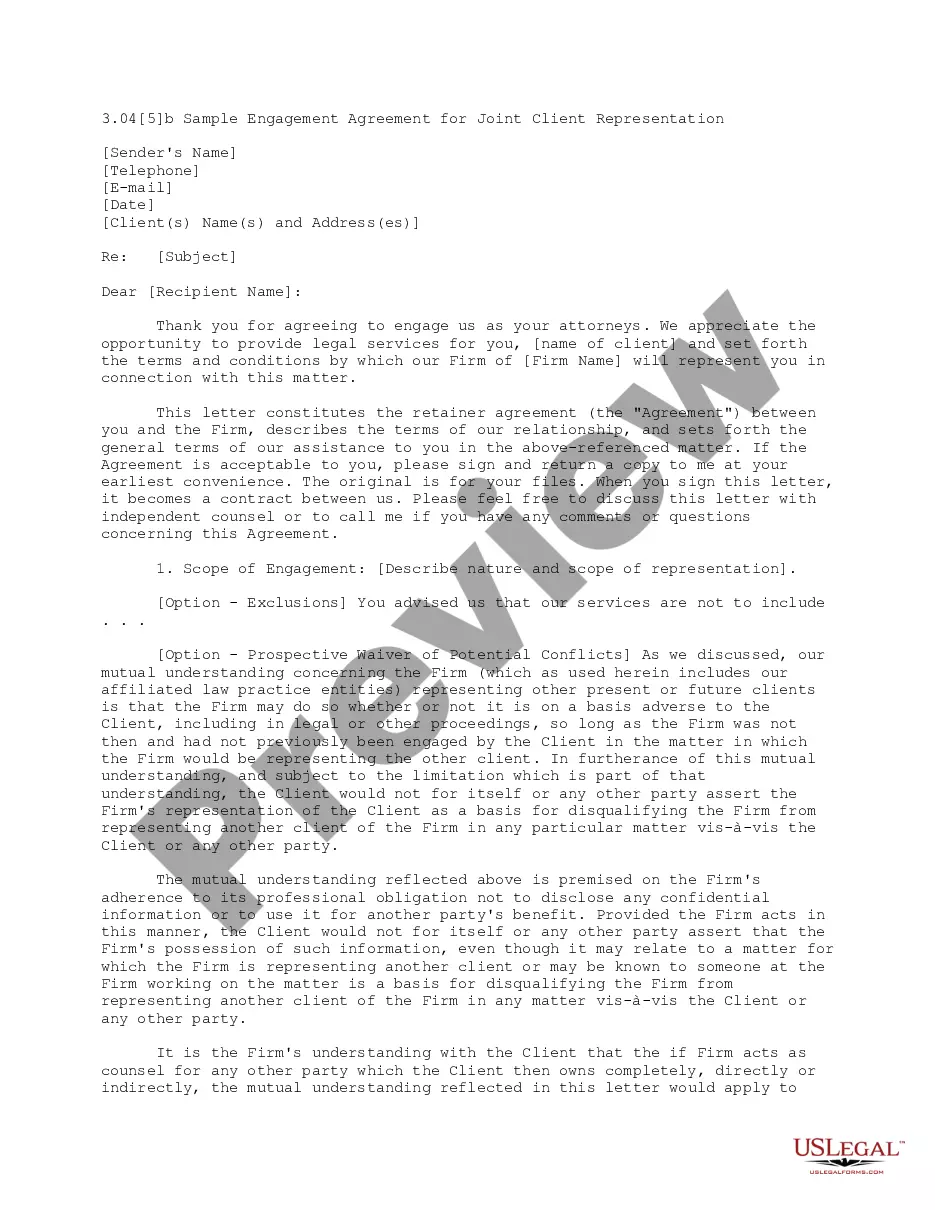
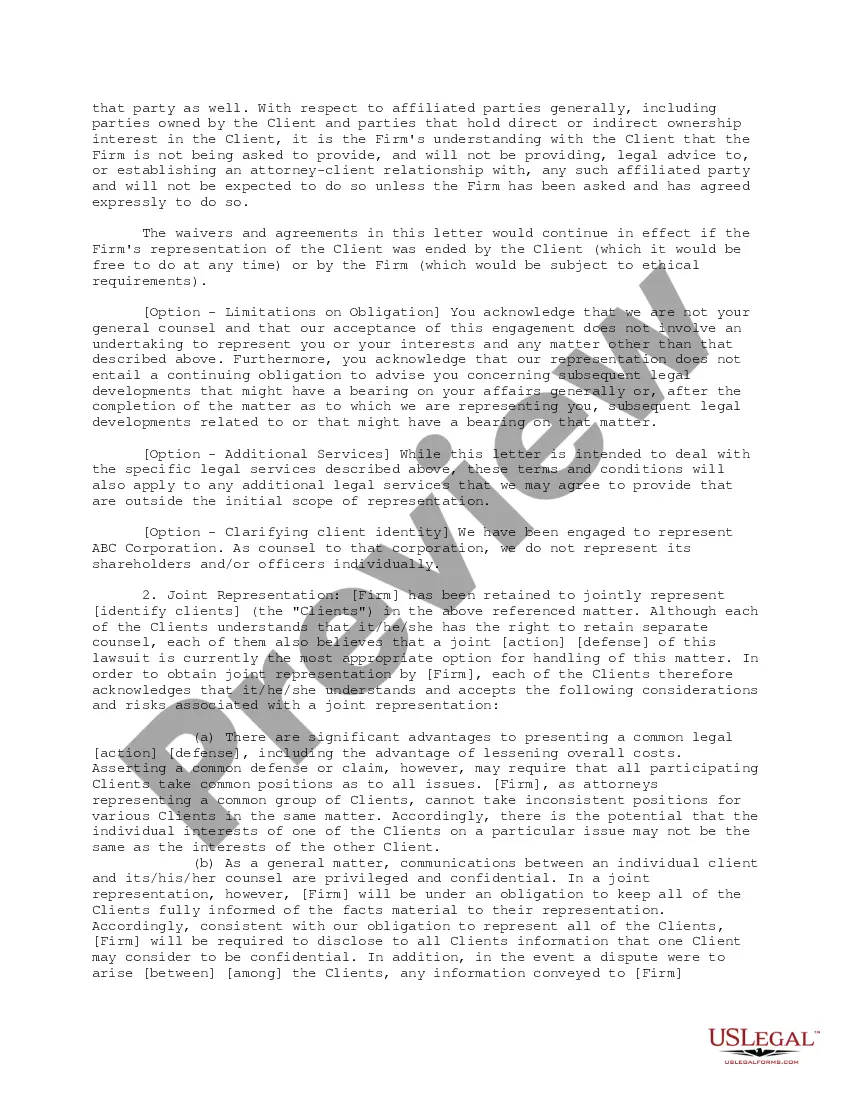
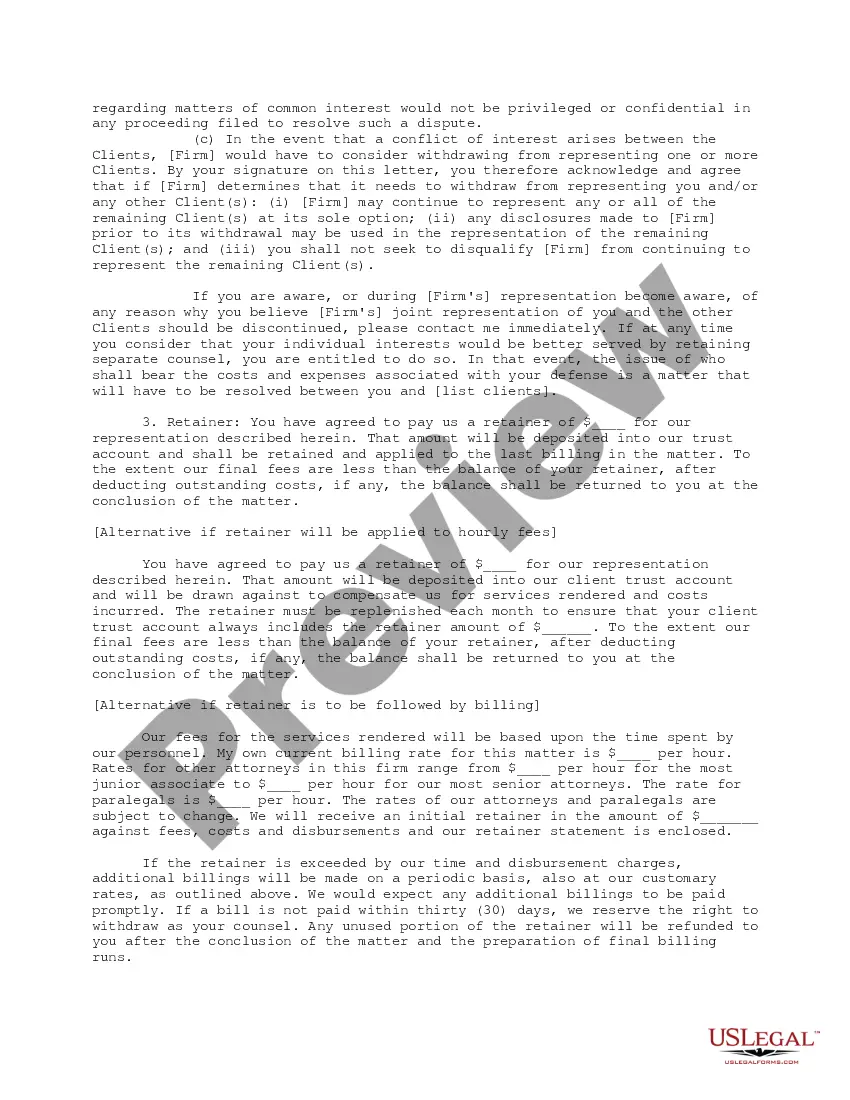
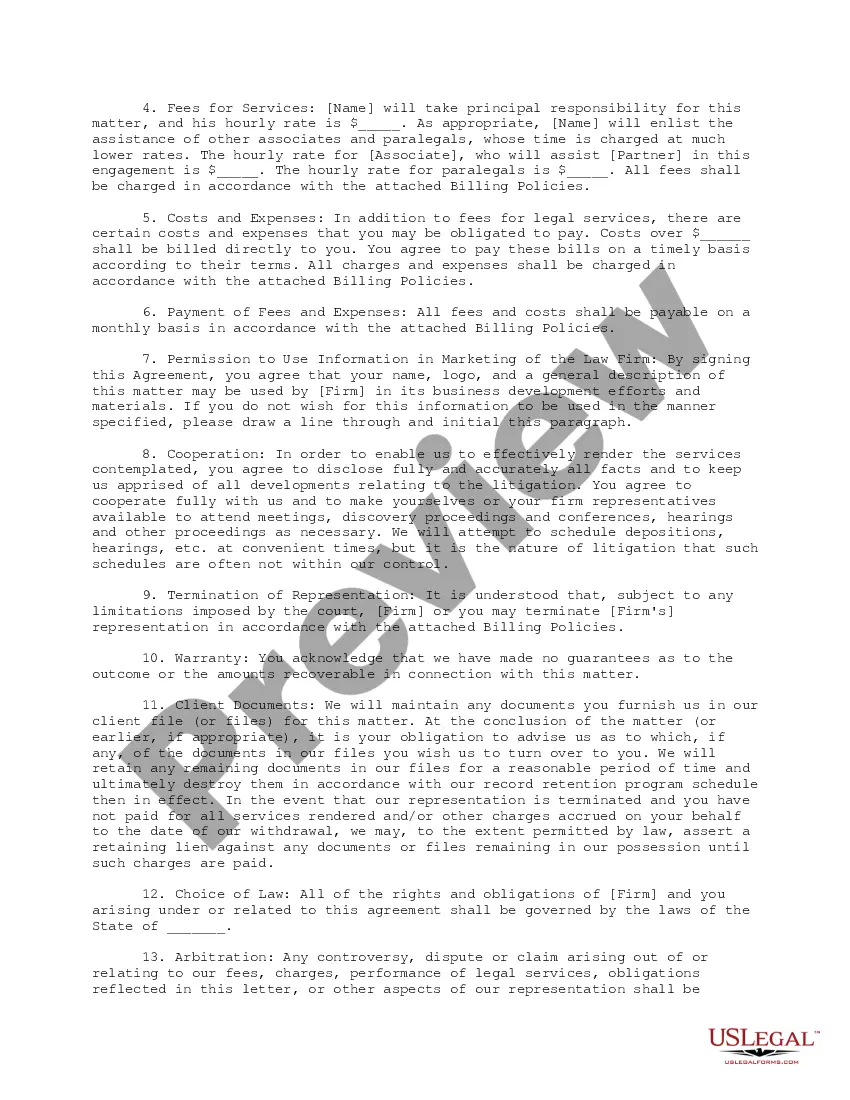
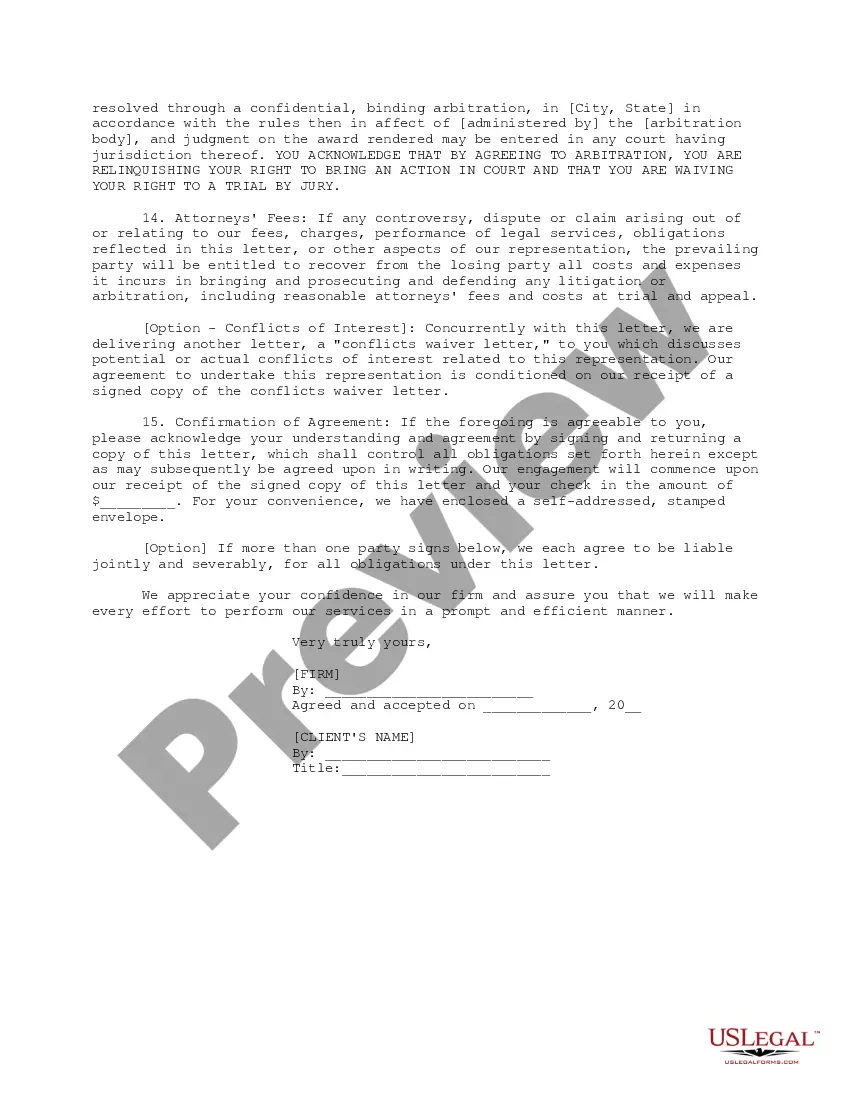
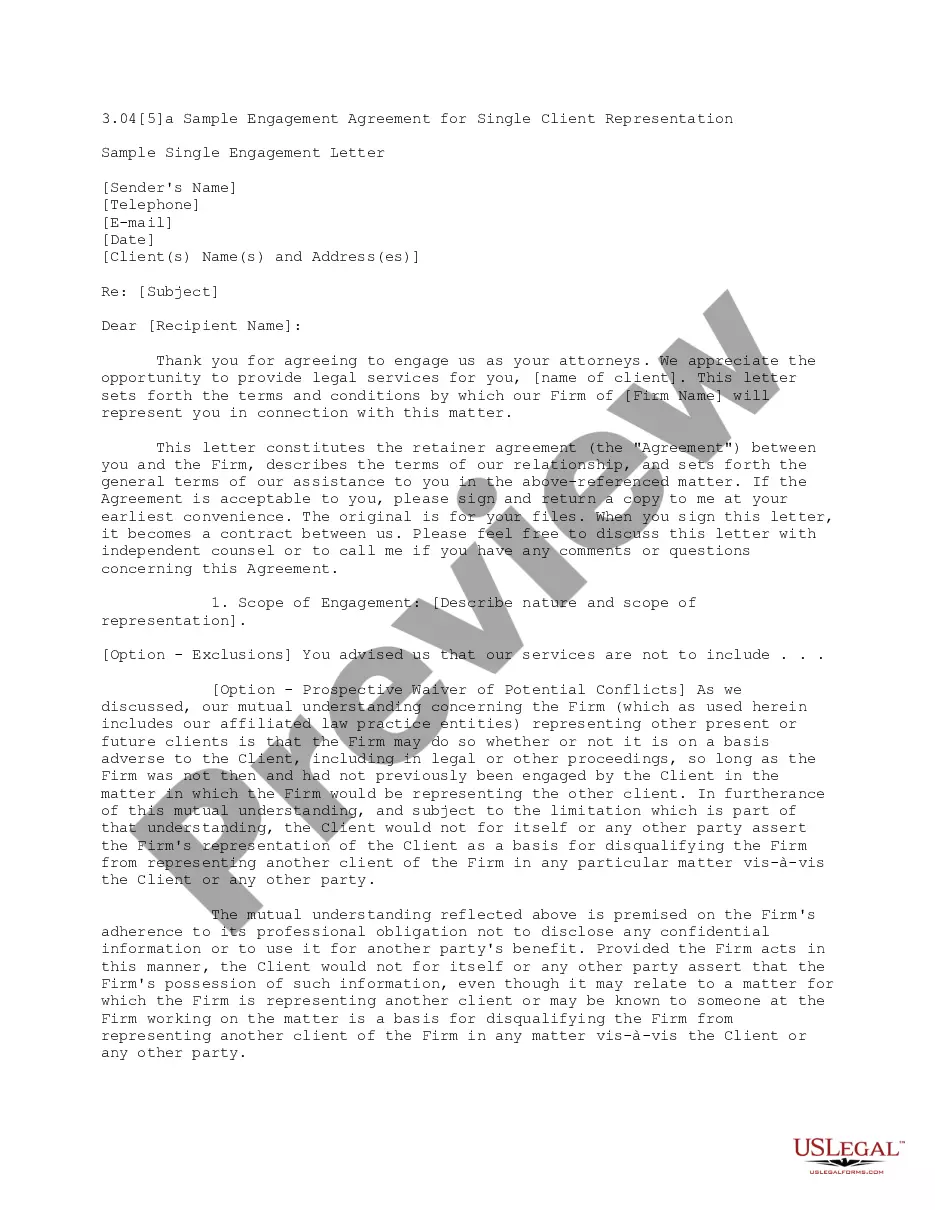
This is an engagement letter for joint client representation. It covers the nature and scope of the representation, any exclusions, potential conflicts of interest, retainer, fees, costs and expenses, arbitration, and other issues.
Los Angeles California Engagement Agreement for Joint Client Representation
State:
Multi-State
Category:
County:
Los Angeles
Control #:
US-L03045B
Format:
Word;
PDF;
Rich Text
81 downloads
Description
Free preview
Get your form ready online
Our built-in tools help you complete, sign, share, and store your documents in one place.
Built-in online Word editor
Make edits, fill in missing information, and update formatting in US Legal Forms—just like you would in MS Word.
Export easily
Download a copy, print it, send it by email, or mail it via USPS—whatever works best for your next step.
E-sign your document
Sign and collect signatures with our SignNow integration. Send to multiple recipients, set reminders, and more. Go Premium to unlock E-Sign.
Notarize online 24/7
If this form requires notarization, complete it online through a secure video call—no need to meet a notary in person or wait for an appointment.
Store your document securely
We protect your documents and personal data by following strict security and privacy standards.

Make edits, fill in missing information, and update formatting in US Legal Forms—just like you would in MS Word.

Download a copy, print it, send it by email, or mail it via USPS—whatever works best for your next step.

Sign and collect signatures with our SignNow integration. Send to multiple recipients, set reminders, and more. Go Premium to unlock E-Sign.

If this form requires notarization, complete it online through a secure video call—no need to meet a notary in person or wait for an appointment.

We protect your documents and personal data by following strict security and privacy standards.
Looking for another form?
How to fill out Engagement Agreement For Joint Client Representation?
Preparing documents for business or personal needs is consistently a significant obligation.
When formulating an agreement, a public service application, or a power of attorney, it’s essential to take into account all federal and state statutes and regulations relevant to the particular area.
However, smaller counties and even towns also have legislative processes that you must consider.
To find the one that meets your needs, use the search tab in the page header.
- All these factors make it stressful and laborious to draft a Los Angeles Engagement Agreement for Joint Client Representation without expert assistance.
- It is feasible to prevent spending on attorneys for drafting your paperwork and create a legally binding Los Angeles Engagement Agreement for Joint Client Representation independently, utilizing the US Legal Forms online database.
- It is the largest online directory of state-specific legal documents that are expertly verified, so you can be assured of their legitimacy when selecting a template for your county.
- Former subscribers only need to Log In to their accounts to retrieve the necessary document.
- If you still lack a subscription, adhere to the step-by-step instructions below to acquire the Los Angeles Engagement Agreement for Joint Client Representation.
- Browse the page you have accessed and check if it contains the document you need.
- To do this, utilize the form description and preview if these options are available.
Form popularity
FAQ
A joint representation waiver is a crucial document in the context of the Los Angeles California Engagement Agreement for Joint Client Representation. It allows two or more clients to agree to share the same legal representation while acknowledging potential conflicts of interest. By signing this waiver, clients understand the implications of joint representation, ensuring that their interests are still protected. It is essential to consider this waiver carefully, as it outlines how the attorney will manage any conflicts that may arise during the representation.
Rule 3.10 addresses the importance of maintaining independence and avoiding conflicts of interest when representing clients. This rule serves to ensure that attorneys prioritize their clients' interests above all else. In the context of a Los Angeles California Engagement Agreement for Joint Client Representation, this rule underscores the responsibility of attorneys to protect the interests of each client effectively.
Rule 3 300 in the California Rules of Professional Conduct deals with the responsibilities of attorneys regarding informed consent from clients. It mandates that attorneys must obtain explicit consent before proceeding with joint representation, ensuring that all clients understand the implications. A well-crafted Los Angeles California Engagement Agreement for Joint Client Representation should include provisions about obtaining this informed consent.
The rule of Professional Conduct 3 310 is designed to protect clients by ensuring that attorneys disclose any potential conflicts when representing joint clients. This rule plays a crucial role in safeguarding the integrity of legal practices in California. When drafting a Los Angeles California Engagement Agreement for Joint Client Representation, adhering to this rule helps build trust and clarity among all parties involved.
Rule 3 310 of the California Rules of Professional Conduct focuses on the requirements for an attorney to inform clients about potential conflicts of interest when representing multiple clients. This rule is essential for maintaining transparency in the attorney-client relationship. In the context of a Los Angeles California Engagement Agreement for Joint Client Representation, it emphasizes the necessity of clear communication regarding any conflicts that might arise.
A conflict of interest in joint representation arises when a lawyer's ability to represent one client is compromised by their obligations to another client. This situation can lead to divided loyalties, which is why the Los Angeles California Engagement Agreement for Joint Client Representation includes provisions to address and mitigate these conflicts. Understanding this dynamic is crucial for ensuring fair representation for all parties involved.
The rule 4.1 emphasizes that lawyers must provide truthful information when communicating with others, particularly in negotiations and legal discussions. This requirement fosters trust among clients and opposing parties alike. The Los Angeles California Engagement Agreement for Joint Client Representation incorporates this principle, ensuring that all representations made by attorneys are accurate and dependable.
Rule 4.1 of the California Rule of Professional Conduct is dedicated to ensuring honesty and fairness in legal dealings. It instructs lawyers to refrain from making false statements or omitting relevant information. When using the Los Angeles California Engagement Agreement for Joint Client Representation, this rule serves as a guiding principle for attorneys to uphold their professional integrity.
The 4.1 rule underscores the obligation of lawyers to be truthful in their statements to others and to avoid misleading conduct. This rule is essential when entering into agreements, such as the Los Angeles California Engagement Agreement for Joint Client Representation, as it protects the interests of all parties involved. Lawyers must be clear and factual in their communications to maintain ethical standards.
The new rule of professional conduct in California aims to enhance the ethical standards lawyers must follow while representing clients. Specifically, it addresses the responsibilities involved in joint client representation, emphasizing the need for transparency and informed consent. The Los Angeles California Engagement Agreement for Joint Client Representation ensures that all parties understand their rights and obligations under this rule.